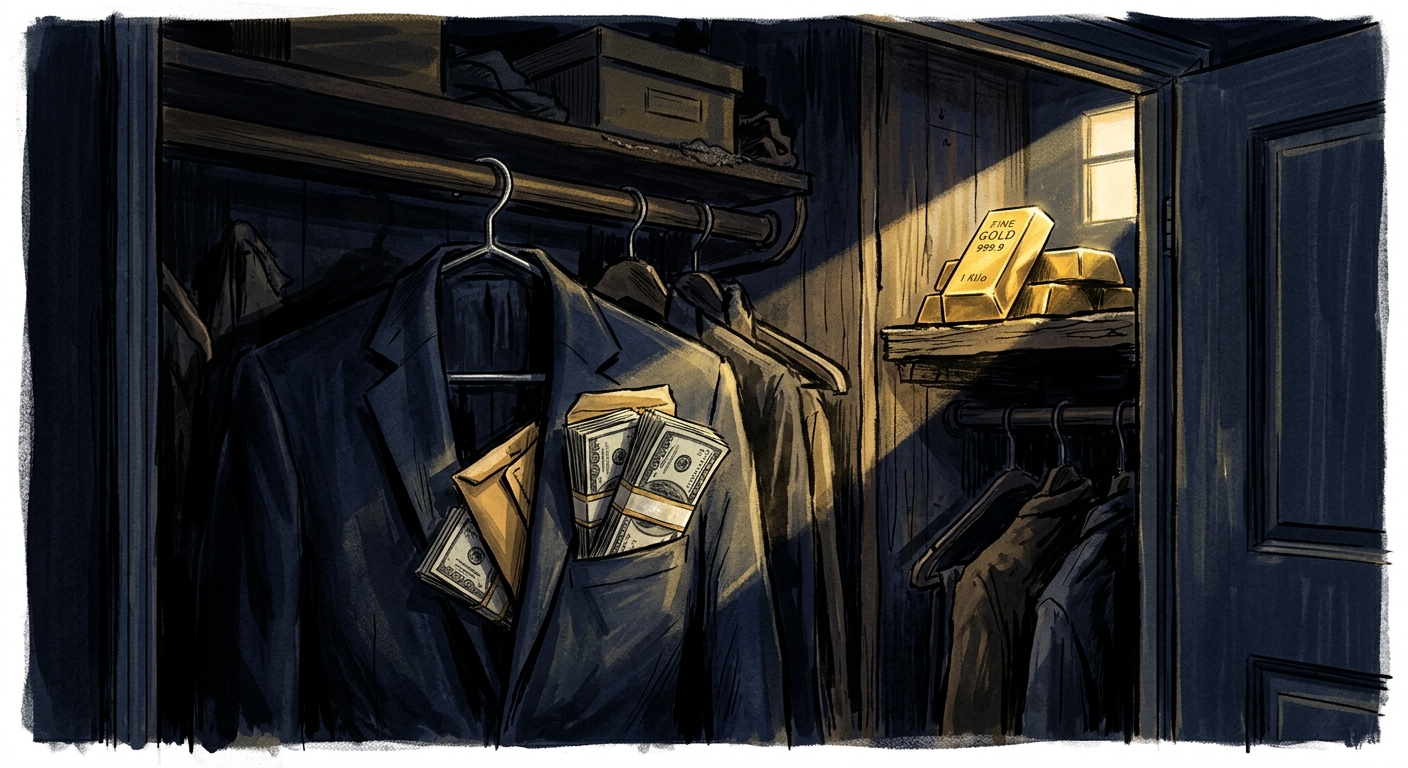
The search warrant was executed on June 16, 2022, at a house in Englewood Cliffs, New Jersey, and what the agents found there belongs less to the literature of modern campaign-finance corruption — the dark-money PACs, the consulting fees, the deniable intermediaries — than to some older, blunter century. Cash, nearly $480,000 of it, in envelopes and closets and the pockets of jackets, including jackets with the senator’s name embroidered on them. Thirteen kilogram and one-ounce bars of gold, worth more than $100,000, some stamped with serial numbers that traced to a New Jersey real-estate developer. In the garage, a Mercedes-Benz C-300 convertible. The house belonged to Robert Menendez, senior United States senator from New Jersey and chairman of the Senate Foreign Relations Committee — a man who, by virtue of that chairmanship, held sway over billions of dollars in American military aid and stood inside the smallest circle of official secrets the country keeps.
Two years later, a Manhattan jury convicted him on every count: bribery, honest-services fraud, extortion under color of official right, obstruction, conspiracy — and, for the first time in the history of the United States Senate, a violation of the Foreign Agents Registration Act by a sitting senator. The gold in the closet had come, the jury found, from men who were buying the foreign policy of the United States at retail. What distinguishes the Menendez case from the long gray ledger of congressional corruption is not the tawdriness of the loot, though the loot was tawdry. It is that the thing sold was not an earmark or a contract. It was the Senate’s constitutional share of American power in the world.
The Senator From Hudson County
Menendez’s biography was the kind the country likes to tell about itself. Born in New York to Cuban immigrants, raised in a Union City tenement, he entered politics as a reformer — famously, as a young man, he testified in a corruption case against his own political mentor, the Union City mayor William Musto, and wore a bulletproof vest to do it. He climbed through the Hudson County machine he had defied: school board, mayor, state legislature, Congress in 1992, the Senate in 2006. By 2013 he chaired Foreign Relations. And by 2015 he was under indictment, accused of trading official favors for private-jet flights and vacations from a Florida eye doctor named Salomon Melgen. That case ended in a hung jury in 2017; the Justice Department dropped it in 2018, and the Senate Ethics Committee issued a public letter of admonition that severely criticized his conduct. New Jersey re-elected him anyway. The lesson a different man might have taken — that he had used up a lifetime of luck — was not, evidently, the lesson taken. The conduct charged in the second indictment began within months of the first case’s collapse.
The First Time
The Melgen affair deserves its paragraph, because it establishes that everything that followed happened in broad daylight, after warning. Salomon Melgen was a Palm Beach ophthalmologist and Democratic donor whose friendship with Menendez included flights on his private jet, a Paris hotel suite, and Dominican villa vacations — hospitality the senator did not disclose — while Menendez intervened with federal health officials over a Medicare billing dispute worth millions to Melgen and with other agencies over the doctor’s port-security contract in the Dominican Republic and visas for his foreign girlfriends. The 2015 indictment out of New Jersey ended in a 2017 mistrial after jurors deadlocked, the trial judge acquitted Menendez on several counts, and the Justice Department — its bribery arsenal freshly narrowed by the Supreme Court’s McDonnell decision, which required a formal “official act” rather than mere advocacy — abandoned the rest. Melgen was less fortunate in his separate case: convicted of a Medicare fraud that prosecutors valued at up to $73 million, he was sentenced to seventeen years, and served until January 2021, when President Trump commuted his sentence in his final hours in office — an act for which Menendez had personally lobbied. The Senate Ethics Committee’s 2018 admonition ordered Menendez to repay the undisclosed gifts. Five years later, FBI agents were cataloguing gold bars in his closet. Whatever deterrence is supposed to feel like from the inside, this was its opposite: he had watched the machinery jam once, and drawn the rational conclusion.
Halal
The scheme, as laid out in the Southern District of New York’s September 2023 indictment and proved at trial, ran through the senator’s wife. Nadine Arslanian, whom Menendez began dating in 2018 and married in 2020, was a friend of Wael Hana, an Egyptian-American businessman with connections to Egyptian military and intelligence officials. In 2019, Egypt granted Hana’s company, IS EG Halal — a firm with no experience in the field — a monopoly over the certification of all halal meat exported from the United States to Egypt, a bottleneck position worth millions. When the U.S. Department of Agriculture objected that the monopoly was raising costs for American exporters, Menendez personally called a senior USDA official and pressed him to stop interfering. The monopoly stayed. Money from IS EG Halal flowed to Nadine, including payments described as salary for a low-show job and help with her mortgage.
For Egypt, the jury found, Menendez did more. He passed non-public information — including details about personnel at the U.S. Embassy in Cairo — through Nadine and Hana to Egyptian officials. He secretly ghost-wrote a letter, for Egypt’s use, lobbying his own Senate colleagues to release a hold on hundreds of millions of dollars in military aid. He assured Cairo’s contacts of his sign-off on weapons sales that his chairmanship allowed him to block. Prosecutors did not have to argue that this compromised national security; they merely displayed the org chart — the chairman of Foreign Relations, functioning in secret as Egypt’s advocate inside the institution designed to check exactly that.
The domestic favors were more traditional. For Jose Uribe, an insurance broker anxious about a New Jersey criminal investigation touching his associates, Menendez attempted to influence the state attorney general’s office; Uribe paid for Nadine’s Mercedes, and later pleaded guilty and testified about it. For Fred Daibes, a politically wired Edgewater developer facing federal bank-fraud charges, Menendez recommended a candidate for United States Attorney for New Jersey whom he believed he could influence to go easy — and Daibes, the government showed, supplied gold bars and cash. Agents found Daibes’s fingerprints and DNA on cash envelopes in the senator’s house, and Daibes’s driver’s returned prints on others. The senator’s own search history supplied the case’s signature detail: in the days after receiving gold, Menendez had Googled the price of a kilogram of gold.
The Trial of the Gold Bars
The nine weeks of trial gave the public record a density that indictments never achieve. Jurors saw photographs of the cash in the senator’s monogrammed jackets and handled the evidence of the gold itself; they read text messages in which Nadine brokered meetings between her husband and Egyptian intelligence and military figures, and heard how, hours after one such dinner, the senator texted his approval of a pending arms package. Jose Uribe, the only bribe-payer to flip, walked the jury through the purchase of the Mercedes in language of almost liturgical clarity — he had bought the car, he said, to buy the senator’s intervention. The defense answered with family: the senator’s sister testified to a Cuban-exile household habit of hoarding cash born of confiscation trauma, an explanation the government met with the withdrawal records showing no withdrawals remotely matching the hoard, and with the fact that some of the bills bore Daibes’s prints and post-2018 series dates. The foreign-agent count drew its own constitutional battle: Menendez’s lawyers invoked the Speech or Debate Clause, arguing that a senator’s legislative acts could not be criminal evidence, and lost the essential rulings — issues that form the spine of his pending appeal.
Menendez fought with the tenacity of a man who had beaten the government before. He refused to resign; he relinquished the Foreign Relations gavel under caucus rules but kept his seat and his security clearance eligibility, to the vocal discomfort of colleagues. His defense at the nine-week trial in 2024 was a New Jersey opera: the cash hoarding was a psychological inheritance from his family’s flight from Cuba, a distrust of banks; the gold belonged to Nadine; the favors were constituent services and ordinary diplomacy; whatever crossed lines had been crossed by his wife, whose trial was severed while she underwent treatment for breast cancer. The jury deliberated briefly by the standards of such cases and, on July 16, 2024, convicted on all sixteen counts. Weeks later, facing an expulsion vote he could not survive, Menendez resigned from the Senate, effective August 20, 2024 — thirty-one years after arriving in Congress.
The verdict’s completeness startled even the prosecutors: sixteen counts, sixteen convictions, no compromise acquittals of the kind juries often distribute in complex corruption cases as rough equity. Jurors interviewed afterward pointed to the physicality of the evidence — the gold could be held, the jackets bore his name, the search history was his own hand asking the internet what his bribes were worth.
At sentencing on January 29, 2025, Judge Sidney Stein gave him eleven years — among the longest terms ever imposed on a former member of Congress — and told him, in a line that compressed the whole biography, that somewhere along the way working for the public good had become working for his own good. Hana and Daibes drew multi-year sentences of their own. On the courthouse steps, Menendez reached for the era’s available vocabulary, declaring that the process was political and corrupted to the core, and appealed openly to a president fluent in that idiom. No rescue came. He reported to the Federal Correctional Institution at Schuylkill, Pennsylvania, on June 17, 2025. Nadine Menendez, convicted at her own trial in April 2025 on every count, was sentenced that September to four and a half years. The appeals continue; the gold, the cash, and the convertible do not.
The political death was slower than the legal one, and stranger. After the indictment, more than half the Senate’s Democrats — beginning, within hours, with the freshman John Fetterman, who made the senator’s removal a personal crusade — called on Menendez to resign; New Jersey’s governor and virtually its entire congressional delegation joined. He refused, skipped the Democratic primary, and in June 2024, mid-trial, filed to seek re-election as an independent, gathering signatures for a candidacy that existed mainly as leverage and epilogue. The conviction ended it. His son, Representative Rob Menendez, kept his House seat through it all, a dynastic footnote to a career that had begun as an insurgency against exactly this kind of entrenchment. And in the season of his sentencing, Menendez’s public rhetoric completed its final rotation: the prosecutor’s son who had testified against his own corrupt mentor in a bulletproof vest now denounced prosecutors as the corruption, in language indistinguishable from that of the president whose pardon he was visibly courting.
What the Body Couldn’t Do
It is worth pausing on the institutional record, because it is nearly bare. The conduct spanned 2018 to 2023. In all that time, the machinery the Senate maintains for policing itself produced nothing: no Ethics Committee action beyond the leftover admonition from the Melgen affair, no referral, no restriction on a chairman whose colleagues had watched him stand trial for bribery once already. The disclosure system Congress designed after Watergate — annual financial reports, meant to make exactly this kind of enrichment visible — was defeated by the oldest technology there is: physical gold and paper currency, hidden in a closet, omitted from the forms. Detection came from the FBI and the Southern District, which is to say from the executive branch policing the legislature, with all the constitutional friction that entails. The Senate’s own contribution was to await the verdict and then discuss expulsion until resignation made it moot.
The foreign-agent conviction, in particular, will outlive the tabloid details, because it names a category the law had politely declined to imagine. The Foreign Agents Registration Act was written in 1938 against Nazi propagandists and applied, for most of its life, to publicists and lobbyists; Congress exempted federal officials from its registration regime on the sensible theory that a sitting senator could not, by definition, be a foreign power’s agent — the conflict rules and the Constitution were assumed to make the status impossible. The related statute under which Menendez fell, barring public officials from acting as agents of foreign principals, had never been used against a senator because no prosecutor had ever been able to prove the unthinkable. The Southern District proved it with dinner reservations, text messages, and bullion. Whatever the appeals do with the Speech or Debate questions, the precedent now exists: the chairmanship of the Foreign Relations Committee has been, at least once in American history, an asset under foreign management, and the constitutional order noticed only when the FBI opened a closet.
History offers one close precedent, and the comparison flatters no one. In 1981, another New Jersey senator, Harrison Williams, was convicted in the Abscam sting of taking bribes from FBI agents costumed as Arab sheikhs; he resigned in 1982 on the eve of certain expulsion, and the Senate of that era treated the case as a constitutional trauma requiring formal machinery — hearings, a committee report, a floor debate. The Menendez Senate, four decades on, produced statements. The difference is partly procedural — resignation mooted expulsion both times — but mostly cultural: the modern chamber has lost confidence in its own disciplinary function, outsourcing it entirely to the Southern District of New York and the voters, neither of which owes the institution anything. A body that cannot punish its members can only be embarrassed by them, and embarrassment, as the gold bars demonstrated, is survivable for years at a time.
Menendez became the first senator convicted as a foreign agent, but his deeper distinction is arithmetical: indicted twice for bribery in eight years, by two different U.S. Attorneys’ offices, under two different theories, surviving the first on a hung jury and a Supreme Court that had narrowed the bribery laws. The system’s eventual success is routinely cited as proof that it works. The better reading is narrower and colder. The system works when a defendant takes payment in forms that hold fingerprints. The gold bars convicted him — their serial numbers, their traceability, their sheer courtroom presence on an evidence cart — where flights and vacations had not. Every future buyer of a senator has absorbed the lesson, which is not to refrain, but to dematerialize. The closet in Englewood Cliffs was a museum of corruption’s past. Its successors will not photograph as well.
Sources: United States v. Menendez et al., No. 23-cr-490 (S.D.N.Y.), indictment Sept. 22, 2023, superseding indictments, trial record, verdict July 16, 2024, and sentencing Jan. 29, 2025; DOJ, U.S. Attorney’s Office for the Southern District of New York, press releases 2023–2025; Senate Ethics Committee letter of admonition, April 2018; United States v. Menendez & Melgen (D.N.J. 2015–2018); contemporaneous coverage by Reuters, the New York Times, NBC News, CNN, and the New Jersey Monitor, including sentencing coverage of Nadine Menendez, Sept. 11, 2025.