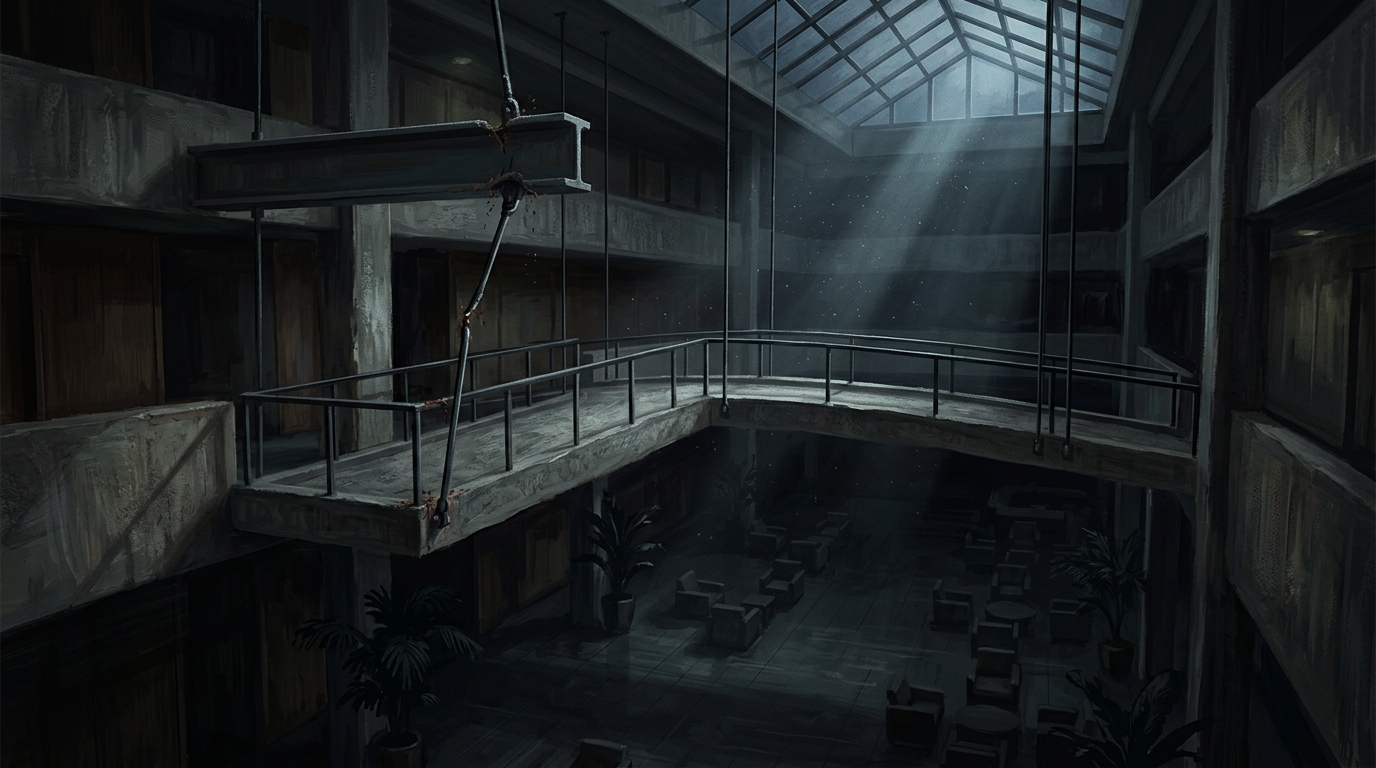
The Hyatt Regency Kansas City was one year and one week old on the evening of July 17, 1981, and its atrium was the reason people came. Forty stories of hotel tower stood beside a vast glass-roofed lobby, and through the lobby’s air, like something drawn rather than built, ran three suspended walkways — steel-and-concrete bridges at the second, third, and fourth floor levels, hung from the roof structure on slender rods so that they seemed to float. That Friday the hotel held its weekly tea dance, a Depression-era revival that had become the most popular standing event in town. Some fifteen hundred people filled the lobby; a band played big-band standards; couples danced on the floor and spectators lined the walkways above. At 7:05 p.m., with a sound witnesses compared to a thunderclap, the fourth-floor walkway’s connections gave way. It fell onto the second-floor walkway hanging directly beneath it, and both — more than sixty tons of steel, concrete, and glass — came down onto the crowded floor.
One hundred and fourteen people died. More than two hundred were injured, many catastrophically — crushed limbs, spinal injuries, lives divided permanently into before and after an evening at a hotel dance. Rescue crews worked through the night with jackhammers and cranes, cutting through slabs while a broken sprinkler main flooded the wreckage; the last survivor came out well after dawn. Until September 11, 2001, it stood as the deadliest structural collapse in American history — and it remains the deadliest ever caused by structural engineering failure alone: no earthquake, no bomb, no fire. The load that brought the walkways down was people standing on them, at a dance, in a building open one year.
The night itself entered the city’s permanent memory. The lobby’s survivors described a dance floor transformed in a second into a landscape of slab and rebar, dust so thick the atrium’s lights vanished, and then the sounds — the injured, and water: a ruptured main from the building’s systems flooding the debris field while people lay pinned beneath it. Off-duty physicians who had come to dance became the first triage officers; construction companies across the city sent cranes and compressors without being asked; emergency crews performed field amputations to free the trapped, and a bulldozer was eventually driven through the lobby’s glass front to lift slabs no jack could move. The last living victim was not freed until the following morning, more than nine hours after the collapse. Kansas City’s emergency services would be studied for years afterward — the response became a foundational case in modern mass-casualty and disaster-medicine planning, and the psychological toll on rescuers helped push critical-incident stress debriefing into standard emergency practice.
One Connection
The walkways were the signature of the building’s grandest gesture. The architects had organized the hotel around its atrium — the era’s defining hospitality form — and rather than interrupt the volume with columns, the design hung the crossing bridges from the roof structure above, so that guests moving between the tower and the function block would travel through the open air of the lobby itself. Suspension made the drama; suspension also meant that every walkway’s weight, and the weight of everyone on it, traveled up slender rods into a handful of connections that no guest would ever see and no redundancy would ever back up.
What makes the Hyatt collapse the founding case study of modern engineering ethics is the terrible simplicity of its cause. The National Bureau of Standards, whose investigators spent ten months on the wreckage and the calculations, traced the failure to a single detail: the connection where the hanger rods met the fourth-floor walkway’s box beams — transverse beams formed by welding two steel channels toe-to-toe. In the original design, each hanger rod was to run continuously from the atrium roof down through the fourth-floor box beams to the second-floor walkway below. Under that scheme, each fourth-floor connection carried the weight of one walkway.
During fabrication, in early 1979, the steel fabricator, Havens Steel Company, proposed a change. A continuous rod threaded along its length was awkward to make and install; Havens suggested two rods instead — one set hanging the fourth-floor walkway from the roof, a second set hanging the second-floor walkway from the fourth. The revision looked, on a shop drawing, like a trivial substitution. It was not. In the changed arrangement, the fourth-floor box beams no longer carried one walkway’s load; they carried both — their own and the entire weight of the walkway below, transferred through the new lower rods. The change doubled the demand on the connection. And the connection had no margin to give, because — as the NBS found — even the original single-rod design fell far short: it would have resisted only about 60 percent of the load required by the Kansas City building code. As built, the doubled connection could carry barely a third of the code-required capacity. On the night of the dance, with people ranked along the railings, a box-beam connection deformed, the rod’s washer and nut pulled through the welded seam, and the load raced from one failing connection to the next.
Nor was the walkway detail the project’s first structural warning. In October 1979, while the hotel was still under construction, some 2,700 square feet of the atrium’s roof collapsed onto the floor below when a connection failed — at night, with no one beneath it. The owner commissioned reviews, repairs were made, and the engineers assured the project team that the atrium’s structure had been checked. The walkway connections — the detail that would kill 114 people twenty-one months later — passed through that season of heightened attention unrecalculated. Investigators and the licensing tribunal would later treat the roof collapse as the fact that stripped the case of any remaining charity: the building had already announced, in the language structures use, that its connections deserved suspicion, and the announcement had been processed as a construction incident rather than an engineering alarm.
The revised shop drawings had not gone unexamined. They had been sent, in the ordinary course, from the fabricator to the structural engineer of record for review, and they had come back stamped with the seal of the engineering firm — Jack D. Gillum & Associates, later G.C.E. International, the structural engineers for the project. Jack Gillum, the principal, had affixed his seal; Daniel Duncan was the project engineer through whose hands the walkway design and the change passed. Both would testify that the connection was never actually recalculated — that the change was treated as the fabricator’s detail, reviewed for conformance rather than re-analyzed, in a process where each party assumed another had done the arithmetic. Havens maintained it had been told by phone that the change was acceptable. The engineers disputed aspects of the account. What no one disputed was the stamp. The drawings bearing the fatal detail carried the seal of the engineer of record, and under the law of the profession, the seal is not a formality. It is the signature on the calculation, whether or not the calculation was ever performed.
The Newspaper and the Bureau
The city learned the cause with unusual speed, and not from officials. The Kansas City Star and Times put a team on the collapse within hours and hired a structural engineer, Wayne Lischka, to examine the public record; within days the papers had discovered and published the discrepancy between the original design drawings and the walkways as built — one rod on paper, two in the wreckage. The coverage, which won the 1982 Pulitzer Prize for local news reporting, set the investigative agenda that the federal engineers then confirmed: the NBS report of 1982 established the doubled load, the deficient original design, and the absence of any calculation that would have caught either. The findings left no refuge in complexity. First-year engineering students, professors would say for decades afterward, could perform the analysis that was never done; the free-body diagram of the fourth-floor box beam became, and remains, the most widely taught sketch in engineering ethics courses.
Accountability then divided into its American channels. A county grand jury investigated and returned no criminal charges — negligence, however gross, is not readily a crime in the absence of intent, and responsibility was diffused across a design-and-construction process seemingly built for diffusion. The civil litigation was enormous: thousands of claimants, consolidated proceedings in federal and state court, and settlements and judgments ultimately estimated at well over $140 million, paid largely by the hotel’s owner-developer interests and the professionals’ insurers. Money moved; no one went to jail. Which left the third channel — the one that gave the case its permanent place in professional ethics.
The License
In 1984, the Missouri Board for Architects, Professional Engineers and Land Surveyors filed a formal complaint against Gillum, Duncan, and their firm. The proceeding that followed before the state’s Administrative Hearing Commission was, in effect, the trial the criminal system never held: months of testimony, thousands of exhibits, the entire chain of the shop-drawing change reconstructed under oath. In November 1985, Judge James B. Deutsch delivered a 442-page decision finding both engineers guilty of gross negligence, misconduct, and unprofessional conduct in the practice of engineering. The opinion’s force lay in its refusal of the diffusion defense. The engineer of record who seals a structural drawing, it held, is responsible for the structural adequacy of what the seal covers; the review of shop drawings is not a clerical act; and the walkway connections — novel, non-redundant, and carrying an atrium full of human beings — were precisely the details a structural engineer exists to verify. In 1986 the board revoked Gillum’s and Duncan’s Missouri engineering licenses and the firm’s certificate of authority. The American Society of Civil Engineers, adopting the findings, disciplined the men as well, and adopted policy language — the structural engineer of record owns the structure’s integrity, undivided — that traces straight to the case.
The revocations were, in dollar terms, the smallest sanction the disaster produced, and in professional terms the largest. Licensure is the profession’s constitution: the state grants engineers a monopoly over structural design because the public cannot audit the calculations it lives inside, and the license certifies that someone answerable has done the work. The Missouri decision made the Hyatt the defining precedent for what the seal means — that “I assumed the fabricator checked it” and “the phone call approved it” and “everyone does shop drawings this way” are not defenses but confessions. It is the reason the case appears in the first weeks of engineering-ethics syllabi from ABET-accredited programs everywhere: not because the engineers were monsters — no one has ever claimed they were — but because they were ordinary, busy, respected professionals inside an ordinary process, and 114 people died of the assumptions.
What the Profession Did With It
The civil aftermath produced its own drama. A federal class action before Judge Scott O. Wright sought punitive damages against the Hallmark-affiliated ownership interests on theories that the tea dance’s crowds had been invited onto a structure no one had verified; it collided with a wave of individual state-court settlements as defendants moved to resolve claims before a punitive verdict could set a benchmark. In the end the money was large and the adjudication thin: the overwhelming majority of claims settled, the settlements exceeded $140 million, and no court ever rendered a final merits judgment assigning the disaster’s full responsibility. That task fell, by default, to the federal investigators and the licensing board — which is a large part of why the licensing case matters as much as it does.
The reforms were concrete. Connection design and shop-drawing review procedures were rewritten across the industry; the fatal ambiguity — fabricator proposes, engineer “reviews,” no one calculates — was addressed in standards and contracts that now require the engineer of record to verify structural connections or explicitly delegate their design to a qualified engineer who takes documented responsibility. Kansas City and other jurisdictions tightened requirements for independent design review and inspection on major public-assembly structures. The disaster became a standing argument for redundancy in structural systems — the walkways had none; each connection was a single point of total failure — and for the principle, now textbook, that details are structures: the collapse involved no exotic physics, only a nut, a washer, and a welded seam asked to carry twice what anyone had calculated, which was itself twice what the calculation would have allowed.
The case also entered the profession’s literature as its great parable of ethical duty. Henry Petroski made the collapse a centerpiece of “To Engineer Is Human,” his study of the role of failure in design; every major engineering-ethics text since has built a chapter around it; and instructors pair the free-body diagram with the first canon of the engineering codes — hold paramount the safety, health, and welfare of the public — to make a point no abstraction can: the canon is not aspirational language but a description of where the load path ends. The hotel itself was repaired and reopened within months, its remaining walkway removed, its lobby rebuilt with structure rising from the ground; it trades today under another flag at Crown Center, and most guests who cross its atrium have no idea. The profession has never been permitted to forget, which was, in the end, the licensing board’s entire theory of the sanction.
Jack Gillum spent much of his later career doing something the disgraced rarely do: talking about it. At engineering conferences and university classrooms, he retold the sequence — the delegated detail, the unperformed check, the seal — as a warning delivered in the first person, telling audiences that the failure haunted him daily and that every young engineer should understand how responsibility can evaporate between offices until it condenses, all at once, on a single stamp. Duncan largely vanished from public professional life. In Kansas City, the dead were finally named in bronze in 2015, when the Skywalk Memorial in a park overlooking the hospital district was dedicated to the victims and to the rescuers of that night — thirty-four years after the collapse, and long after the case had already become what it remains: the profession’s central parable, the one that begins with a dance and ends with the proposition that an engineer’s seal is a promise made to strangers, every one of whom is standing on it.
Sources: National Bureau of Standards, “Investigation of the Kansas City Hyatt Regency Walkways Collapse” (NBSIR 82-2465, May 1982); Missouri Administrative Hearing Commission, Missouri Board for Architects, Professional Engineers & Land Surveyors v. Duncan, Gillum, and G.C.E. International, decision of Nov. 15, 1985, and subsequent 1986 license revocations; Kansas City Star and Kansas City Times collapse coverage (1981-82, Pulitzer Prize for local news reporting, 1982); ASCE professional-conduct proceedings and subsequent policy statements on the structural engineer of record; grand jury and consolidated civil-litigation records reported contemporaneously; retrospective accounts and lectures by Jack D. Gillum, including his published reflections in ASCE forums; Skywalk Memorial Foundation records (memorial dedicated 2015).