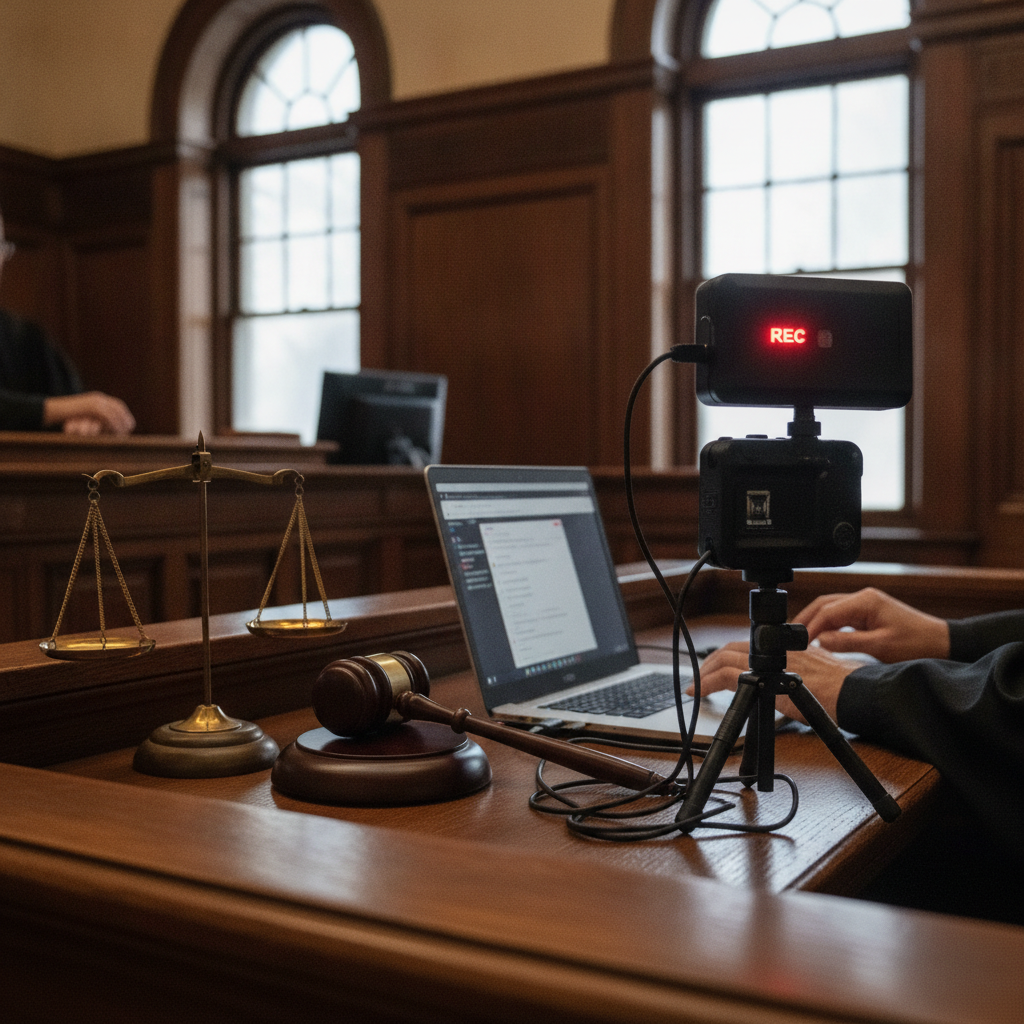
The courtroom has always had an audience. Long before Zoom hearings and court TV, the common law tradition treated public proceedings as a feature rather than a flaw — a check on judicial power, a guarantee that justice would not disappear into a private room. That tradition served an important purpose, and it still does. But a courthouse audience and a YouTube channel are not the same thing, and the Texas State Commission on Judicial Conduct has now formalized the distinction in its public warning to Judge Stephanie Boyd, judge of the 187th Criminal District Court in San Antonio.
Boyd had been livestreaming her court's proceedings on YouTube — a practice not inherently improper, and one that the commission did not condemn in its entirety. What the commission did find improper, in its June 3 public warning, was a series of specific incidents in which the camera appeared to change the nature of what happened in the courtroom: a judge who found herself hosting a book club with viewers, making comments that could foreshadow her rulings, and — in the incident that will likely define her disciplinary record — telling a defendant on a live public feed that he would be "passed around for cigarettes or dessert" in prison. "Because you're young. And they will think you are attractive at the prison."
The Henson Incident: Off the Record, But Still On Camera
The most striking incident in the commission's findings occurred in October 2024, during a hearing involving defendant Thomas Henson. After concluding that he wanted to proceed to trial rather than accept a plea, Boyd directed the court reporter to go "off the record." This is a standard mechanism in judicial proceedings — a way to step outside the formal transcript for informal discussion. What Boyd apparently did not consider, or did not care about, is that going off the record for the court reporter is not the same as going off camera for the YouTube audience. The livestream continued while the court reporter's pen stopped.
What Boyd then said to Henson, with however many viewers watching in real time: "So it appears that you want to go to prison to be passed around for cigarettes or dessert. Because that's what's going to happen to you. Because you're young. And they will think you are attractive at the prison." The commission found that this statement demonstrated bias and prejudice toward Henson, that it was neither patient, dignified, nor courteous — the minimum standard that every defendant, regardless of what they are charged with, is entitled to expect from the judge presiding over their case.
It is worth dwelling on what that statement actually is. It is a judge telling a defendant, in graphic terms, that she believes he will be sexually assaulted in prison — and deploying that belief as a form of pressure or punishment for exercising his right to trial. The right to trial is not a privilege. It is a constitutional guarantee. A defendant who elects to proceed to trial rather than accept a plea is doing exactly what the Constitution says he may do. A judge who responds to that election by describing, in lurid terms, the sexual violence she anticipates awaiting him is not merely being "harsh." She is using the power and presence of the bench — and, in this case, the reach of a public YouTube channel — to threaten and humiliate someone for exercising a constitutional right.
Telling a defendant he would be "passed around for cigarettes" on a livestreamed YouTube channel is not judicial candor. It is the judge using public reach to humiliate a person for exercising his constitutional right to trial.
The Villamil Case: Injecting Herself Into the Plea
The commission's findings were not limited to the Henson incident. A separate episode from July 2023 involved defendant Willberth Villamil. According to the commission, Boyd had rejected a plea agreement submitted by the parties — an unusual but not unheard-of step for a judge — and was then informed that Villamil was withdrawing his plea entirely. At that point, rather than allowing the matter to proceed as a contested case, Boyd asked Villamil whether he "was willing to accept the 20 years in prison offered by the court" and characterized the case against him as "a 'life-sentence worthy case.'"
This is a form of judicial involvement in plea negotiations that the ethical rules governing judges are designed to prevent. The commission found that Boyd had "improperly injected herself into the plea bargaining process." That finding reflects a principle at the core of American criminal procedure: judges are referees, not parties. The negotiation between a defendant and the state over the terms of a plea is conducted between those two parties, with the court providing a neutral backdrop. When a judge enters that negotiation — by characterizing a case as "life-sentence worthy," by suggesting that an offer of twenty years should be accepted — the judge has become an interested party. She has used the authority of the bench to influence the outcome of a negotiation in which her role is supposed to be passive.
The harm is not merely procedural. A defendant in a criminal case is already at an extraordinary power disadvantage relative to the state. The judge is supposed to be the one institution in the room that is not trying to maximize the defendant's punishment. When the judge joins the state in applying pressure toward a particular outcome, the defendant's already-limited bargaining position becomes something close to untenable. To make that pressure public, on a YouTube channel, amplifies it further: the defendant is now being told, in front of a public audience, what a "life-sentence worthy case" looks like, by the person who will preside over any trial.
The YouTube Problem: Engagement Versus Impartiality
The commission's warning also addressed Boyd's broader conduct on the court's YouTube channel, which went beyond the two specific incidents. The commission found that Boyd had "engaged in extrajudicial activities with viewers," including hosting a book club and "allowing comments about current court proceedings and participants." She was faulted for making channel comments that "could suggest how she might decide a case."
This dimension of the case is worth examining separately from the in-court incidents, because it reflects a tension that the proliferation of judicial social media has made newly acute. Transparency in the courts is a value — it is, in fact, one of the foundational principles of the common law. Livestreaming proceedings serves that value in obvious ways, making the justice system accessible to people who cannot attend in person, demystifying the process for a public that often has no direct experience of how courts work. Boyd, in her responses to the commission, emphasized that she had never viewed or responded to viewer comments and that all her decisions were based solely on the evidence and the law.
The commission's concern, however, was not whether Boyd actually made decisions based on viewer feedback. It was whether her conduct on and around the channel created the reasonable appearance that she might. A judge who hosts a book club through her court's YouTube presence, who makes comments in that forum about pending cases and their participants, is doing something that the Canons of Judicial Conduct are specifically designed to prevent: creating the impression that her judicial conduct is shaped by something other than the record in front of her. Impartiality is not merely an internal state. It is, and must be, a public appearance. When the line between a courtroom and a content channel blurs, the appearance of impartiality is the first casualty.
'Willful and Persistent Conduct' — and a Platform That Amplified It
The commission's concluding language in the Boyd warning deployed words that carry significant weight in judicial discipline: "willful and persistent conduct that is clearly inconsistent with the proper performance of her judicial duties." The word "willful" distinguishes the findings from error or inadvertence. The word "persistent" distinguishes them from a single bad moment. Together they describe a pattern — a judge who, across multiple proceedings and in her extracurricular engagement with her YouTube audience, repeatedly made choices inconsistent with the basic obligations of the bench.
Boyd received a public warning rather than removal or suspension, reflecting a judgment about proportionality. A public warning is the least severe formal sanction in the Texas commission's toolkit; it is a rebuke on the record, not a punishment that interrupts the judge's service. Whether that calibration is correct is a question reasonable people can debate. The public warning creates a documented record of misconduct — one that will follow Boyd and that the commission can point to if future complaints require more serious action.
What the case illustrates, regardless of whether the sanction was correctly weighted, is something that the judiciary is only beginning to reckon with as social media becomes an ordinary feature of public life: the courtroom and the content platform have different logics, and a judge who does not keep them rigorously separate will eventually let one corrupt the other. The camera does not change what justice requires. But it changes, in ways that are easy to underestimate, what a judge might be tempted to do — and who, in the most viral moments, they might feel themselves to be performing for.