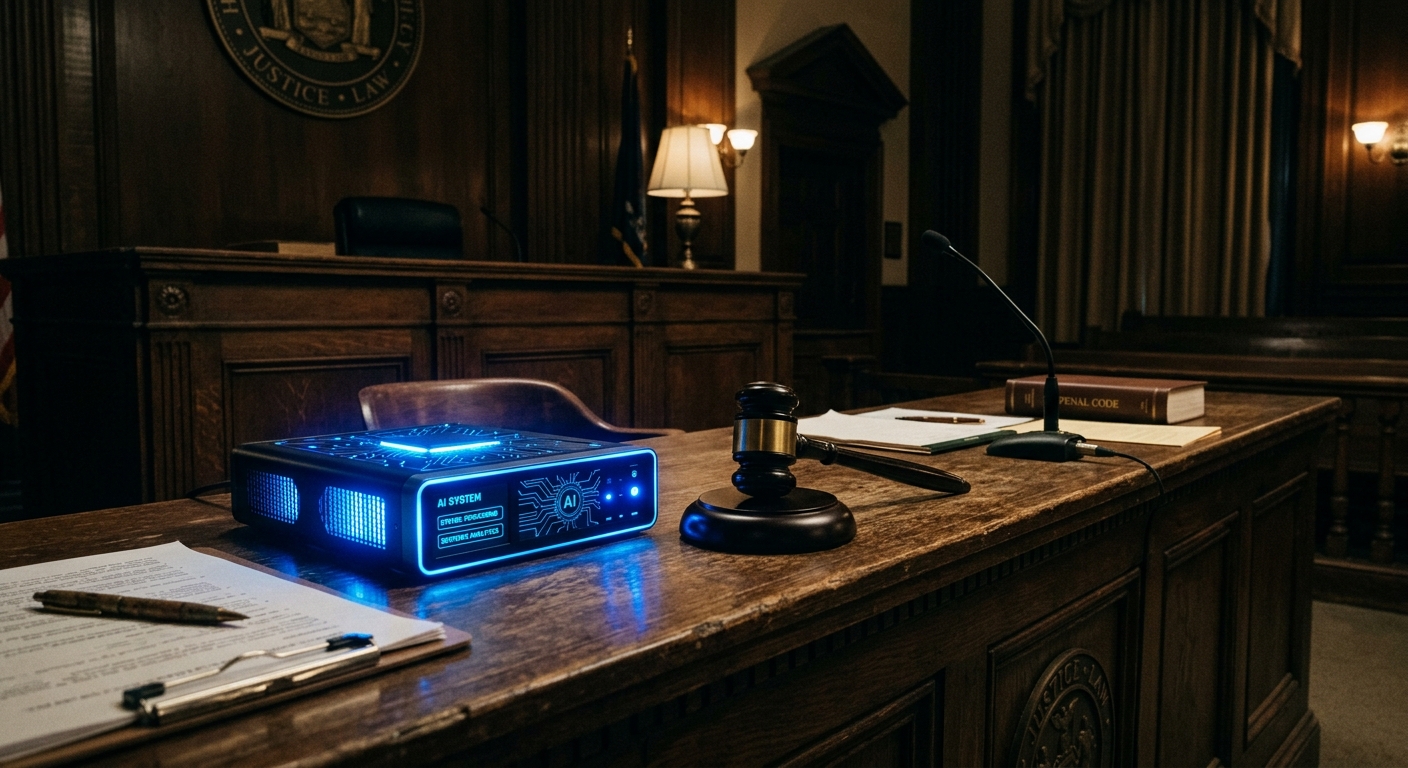
The precise figure of the penalty is what gives the game away. On a Tuesday in late April, U.S. Magistrate Judge Peter H. Kang of the Northern District of California handed down a sanction against an attorney named Webb. The fine was for exactly $1,001. That extra dollar is not a clerical error; it is a calculated mechanism of professional humiliation, deliberately pushing the sum across the threshold that often triggers mandatory reporting to state bar associations and malpractice carriers. Webb was not fined for lying to the court. He was not fined for embezzling client funds, breaching attorney-client privilege, or missing a catastrophic statute of limitations. He was fined, in the court’s own meticulously parsed language, for "failing to supervise" a subordinate attorney who had relied too heavily on an artificial intelligence tool.
The order did not stop at the monetary penalty, which was nominal for a partner at a functioning law firm. The true punishment was the accompanying pageantry of contrition. Webb was forced to circulate the reprimand to every attorney and paralegal in his firm, a digital scarlet letter distributed via the company intranet to ensure that the indignity was witnessed by the very people he was tasked with managing. He was further ordered to complete four hours of continuing legal education, specifically including two hours on the supervision of junior staff and two hours on the "ethical and professional use" of artificial intelligence in legal practice. Across the country, in the less glamorous but equally unforgiving venues of New Jersey, a nearly identical scene was playing out almost simultaneously. A panel of three judges in Cherry Hill formally reprimanded another attorney for filing a brief that included "seven citations riddled with factual and legal inaccuracies," the hallmark hallucinations of a generative language model pushed beyond its training. The panel did not simply strike the brief, which would have been the traditional remedy for poor legal research. They made a public, searing example of the lawyer who filed it.
These are not isolated instances of judicial housecleaning. They are not merely the growing pains of a profession adjusting to a new digital tool, like the transition from carbon paper to word processors or from physical law libraries to Westlaw. They are the opening salvos in a quiet, desperate war of attrition. Across the United States, courts and bar associations have recognized a profound existential threat in generative artificial intelligence. But because the legal profession is fundamentally conservative, it cannot simply ban the machine outright. To do so would be to admit a Luddite panic, exposing the profession's vulnerability to the public and to the corporate clients who pay their exorbitant fees. Instead, the establishment has chosen a more insidious, more effective method of gatekeeping: it is weaponizing the ethical duty of supervision.
By making the personal and professional risks to senior partners so astronomically high—by threatening them with $1,001 fines, mandatory firm-wide humiliations, and bar investigations for the algorithmic missteps of their juniors—the profession is effectively freezing the adoption of technology that threatens its economic monopoly. It is a brilliant, terrifying strategy, cloaking raw economic protectionism in the unimpeachable language of legal ethics.
The Architecture of the Guild
To understand the panic underlying Judge Kang’s order, one must first understand the fragile, increasingly absurd economic architecture of the modern American law firm. The business of law is not, as television dramas suggest, a business of grand oratory and sudden courtroom epiphanies. It is an industrial pyramid scheme built on the foundation of the billable hour. At the top of the pyramid sit the equity partners, the rainmakers who leverage their country club relationships, their alumni networks, and their sheer force of personality to secure clients willing to pay upwards of a thousand dollars an hour. But the partner does not, for the most part, do the thousand-dollar-an-hour work. They delegate it down the pyramid to a sprawling base of first- and second-year associates, document review contractors, and paralegals.
For decades, this base of the pyramid has been tasked with the profession’s most soul-crushing, mind-numbing labor. They sift through millions of pages of corporate emails in antitrust discovery, looking for the single stray comment that might indicate price-fixing. They draft the endless, boilerplate interrogatories that serve as the opening skirmishes of civil litigation. They cross-reference jurisdictional statutes to ensure compliance in fifty-state regulatory surveys. This is the grist mill of the law. It requires high intelligence, zero creativity, and an infinite capacity for suffering. And it is incredibly lucrative. A firm can bill a junior associate’s time at four hundred dollars an hour, pay the associate a fraction of that, and funnel the massive surplus upward to finance the partner’s draw.
Artificial intelligence does not threaten the partner's relationships. It threatens the grist mill. An advanced large language model can ingest a terabyte of discovery documents, isolate the legally relevant communications, and generate a chronological summary in the time it takes a human associate to log into the firm's virtual private network. It can draft a flawless motion to dismiss based on fifty years of circuit precedent without taking a bathroom break, without complaining about work-life balance, and without demanding a year-end bonus. The technology, even in its current, imperfect, occasionally hallucinating state, has the capacity to vaporize the billable hours that form the financial bedrock of the legal industry.
The profession cannot say this out loud. It cannot lobby state legislatures to ban AI on the grounds that it will hurt partner profit margins or reduce the number of summer associate slots available to the children of affluent donors. Such an argument would be laughed out of the public square. And so, the profession has retreated to the only defensible high ground it has left: the language of ethics, competence, and public protection. They have dressed their economic terror in the robes of moral outrage.
When a judge sanctions an attorney for an AI-generated hallucination, the rhetoric is always cloaked in the absolute sanctity of the judicial process. The court speaks of the sacred duty of candor to the tribunal. It speaks of the danger of polluting the jurisprudential stream with fictitious case law, warning that the very fabric of stare decisis is at risk. These are, on their face, valid concerns. An attorney who submits a brief citing a case that does not exist has, undeniably, failed in their duty to the court. But the ferocity of the response—the eagerness to publicly flog the offending lawyer, to demand continuing education, to force firm-wide confessions—betrays a much deeper anxiety.
The Cherry Hill attorney who submitted seven fake citations was not attempting to defraud the court in a traditional sense. He was not constructing an elaborate fiction to cover up a crime. He was, most likely, overworked, desperate, and careless. He used a tool he did not fully understand, treating a predictive text engine as a search engine, and he failed to verify its output. In any other context, a careless error in a brief—a misstated holding, a transposed citation, a failure to Shepardize a reversed case—might result in a stern lecture from the bench or an order to resubmit the filing. But because the error was generated by a machine, it triggered the full, wrathful machinery of the ethical establishment. The punishment was designed not merely to correct the error, but to terrify anyone else who might consider outsourcing their legal reasoning to silicon.
The Weaponization of Supervision
The true genius of the legal establishment’s counterattack lies in its specific target. By sanctioning Webb for "failing to supervise" his subordinate, Judge Kang struck at the very mechanism by which law firms adopt new practices. In a law firm, technology is rarely adopted from the top down. Senior partners, comfortably ensconced in their corner offices, accustomed to dictating memos to secretaries and having junior associates print out their emails, are not the ones experimenting with generative AI. It is the junior associates, the digital natives drowning in document review, who are quietly utilizing these tools to survive their eighty-hour workweeks.
Under the Model Rules of Professional Conduct, specifically Rule 5.1, a partner in a law firm must make reasonable efforts to ensure that the firm has in effect measures giving reasonable assurance that all lawyers in the firm conform to the Rules. A supervising lawyer is responsible for another lawyer's violation if they order it, ratify it, or fail to take remedial action at a time when its consequences can be avoided or mitigated. Historically, this rule has been invoked in cases of gross negligence—a partner turning a blind eye to an associate systematically stealing from a client trust account, or an associate routinely blowing statutes of limitations due to substance abuse issues.
Now, Rule 5.1 is being weaponized as an anti-technology perimeter. By holding the supervising partner strictly liable for the algorithmic missteps of their juniors, the courts are creating an environment of paralyzing risk aversion. If a senior partner knows that a junior associate’s failure to catch an AI hallucination could result in personal fines, mandatory CLEs, and the humiliation of a circulated order, the rational response is not to train the associate to use the tool better. The rational response is to ban the tool entirely.
This is precisely what is happening inside the mahogany-paneled conference rooms of America's largest law firms. Information Technology departments are quietly blocking access to generative AI platforms on company networks. Memos are being circulated threatening immediate termination for any attorney caught using unauthorized language models to draft client communications or conduct legal research. The firms frame these policies as necessary measures to protect client confidentiality—citing the risk of feeding proprietary data into public models—and to ensure the unimpeachable accuracy of legal work. In reality, they are desperate, heavy-handed attempts to protect the partners from the expanding blast radius of judicial sanctions.
The hypocrisy of this gatekeeping becomes glaringly apparent when one considers the baseline reality of human legal practice. Courts routinely accept, and largely ignore, staggering levels of human incompetence. Every day, across the country, exhausted public defenders represent indigent clients while carrying caseloads double or triple the recommended maximum. They miss objections. They fail to file critical suppression motions. They provide representation that meets only the most cynical, minimalist definition of the Sixth Amendment. The courts process these cases with factory-like efficiency, rarely pausing to sanction the system that necessitates such corner-cutting, because the system relies on that very efficiency to keep the dockets moving.
Similarly, the civil dockets are choked with poorly drafted, boilerplate pleadings generated by exhausted associates pulling all-nighters fueled by anxiety and cold coffee. Judges roll their eyes in chambers, opposing counsel files tedious motions to strike, and the system grinds on. There are no mandatory firm-wide apologies for submitting a human-drafted brief that fundamentally misreads a key statute. There are no $1,001 fines designed to trigger malpractice reporting when a tired paralegal attaches the wrong exhibit to a summary judgment motion. Human error is priced into the system. It is expected. It is managed with a weary tolerance, because to demand perfection of human lawyers would bring the entire apparatus of justice to a grinding halt.
But machine error is treated as a contagion. When the machine hallucinates, it is not treated as a mistake; it is treated as a desecration of the temple. The profession demands absolute perfection from the algorithm, holding it to a standard that no human lawyer has ever met, specifically to ensure that the algorithm can never be cleared for practice. It is a rigged game, designed to preserve the status quo by setting the bar for technological entry impossibly high.
The Ghost in the Law Library
There is a historical echo in this current panic. In the late 1970s and early 1980s, when LexisNexis and Westlaw first began replacing physical law libraries with digital terminals, the older generation of lawyers reacted with similar dismay. They argued that keyword searching would destroy the serendipitous discovery of reading case reporters. They warned that young lawyers would lose the ability to synthesize the law if they could simply type a query into a machine. They feared that the democratization of legal research would erode the intellectual rigor of the profession.
They were, of course, entirely wrong. Digital research did not destroy the profession; it supercharged it. It allowed lawyers to find on-point precedent in seconds rather than days. But it also profoundly altered the economics of legal research, largely eliminating the role of the "library associate" who spent weeks compiling physical binders of case law. The current panic over generative AI is not a repeat of the Westlaw transition, because AI does not merely retrieve information; it synthesizes it. It does not just find the case; it drafts the argument.
This is why the reaction from the bench and the bar is so much more visceral today. The fear is not that the young lawyers will lose their research skills; the fear is that the young lawyers will lose their jobs, and that the partners will lose the leverage that those young lawyers provide. The ghost in the machine is not just an algorithm; it is the specter of obsolescence.
When Judge Kang ordered Webb to take a continuing legal education course on the "ethical and professional use" of AI, he was participating in a familiar ritual of professional self-regulation. The CLE requirement is the legal profession's equivalent of penance. It assumes that the problem is a lack of education, a deficit of awareness that can be cured by a PowerPoint presentation in a Marriott conference room. But the problem is not that lawyers do not understand how AI works. The problem is that they understand exactly how it works, and they are terrified of what it means for their bottom line.
The "ethical" use of AI, as defined by the current regime of sanctions and reprimands, is effectively a non-use. It is an insistence that every output be double-checked, triple-checked, and independently verified to the point where the efficiency gains of the technology are entirely negated. If a lawyer must spend four hours verifying the citations in an AI-generated brief that took four seconds to write, the economic incentive to use the AI disappears. And that, of course, is the point. The ethical rules are being used to artificially inflate the cost of utilizing technology, preserving the economic viability of the human associate.
The Collateral Damage of Purity
The tragedy of this gatekeeping is not that it protects the profit margins of wealthy equity partners at massive corporate firms. The tragedy is what it costs the public. The American legal system is currently in the grip of a profound, devastating access-to-justice crisis. According to the Legal Services Corporation, low-income Americans do not receive any or enough legal help for 92% of their substantial civil legal problems. In family courts, housing courts, and consumer debt dockets across the country, the vast majority of litigants appear pro se—without a lawyer—navigating a labyrinthine, hostile system that was designed by lawyers, for lawyers.
Artificial intelligence represents the first genuine opportunity in a century to bridge this gap. An accessible, highly trained legal language model could empower a tenant facing eviction to draft a competent answer to a landlord’s complaint, raising affirmative defenses that they would never have known existed. It could help a victim of domestic violence navigate the procedural complexities of securing a protective order without having to retell their trauma to a series of overworked intake clerks. It could automate the creation of simple wills, trusts, and uncontested divorce filings, reducing the cost of basic, life-altering legal services to near zero.
But the same ethical rules being weaponized against junior associates are simultaneously being deployed to prevent the unauthorized practice of law by machines. State bar associations view any attempt to provide algorithmic legal assistance directly to the public as a criminal intrusion into their monopoly. They send cease-and-desist letters to legal tech startups that offer automated document assembly. They argue that because an AI cannot be licensed, cannot hold a trust account, cannot pass a character and fitness evaluation, and cannot be disbarred, it cannot be permitted to offer legal advice.
They insist, with a straight face, that the public is better served by having no legal representation at all than by having representation that lacks a pulse. This is the ultimate collateral damage of the profession's obsession with ethical purity. In their zeal to protect the public from the hypothetical harm of an AI hallucination—a harm that is entirely theoretical for a person who currently has zero access to legal help—the courts and bar associations are ensuring that the very real, ongoing harm of unrepresented litigation continues unabated.
The sanctions handed down in California and New Jersey are not just disciplinary actions; they are boundary markers. They signal to the profession that the cost of innovation will be measured in personal reputation, professional standing, and public humiliation. The $1,001 fine is a toll that few partners are willing to pay. And so, the law firms will continue to bill by the hour, the junior associates will continue to suffer in the document review dungeons, and the unrepresented public will continue to face the machinery of the state alone.
The legal profession has successfully constructed a fortress of ethics to keep the future out. They have built the walls high, using the mortar of professional responsibility and the bricks of Rule 5.1. But as the world outside the fortress continues to accelerate, driven by technological forces that do not care about the Model Rules or the partnership track, the law risks protecting its monopoly right into irrelevance. They are guarding a temple that the rest of society is slowly, inevitably bypassing, clutching their $1,001 fines and their mandatory CLE certificates as the foundation crumbles beneath their feet.