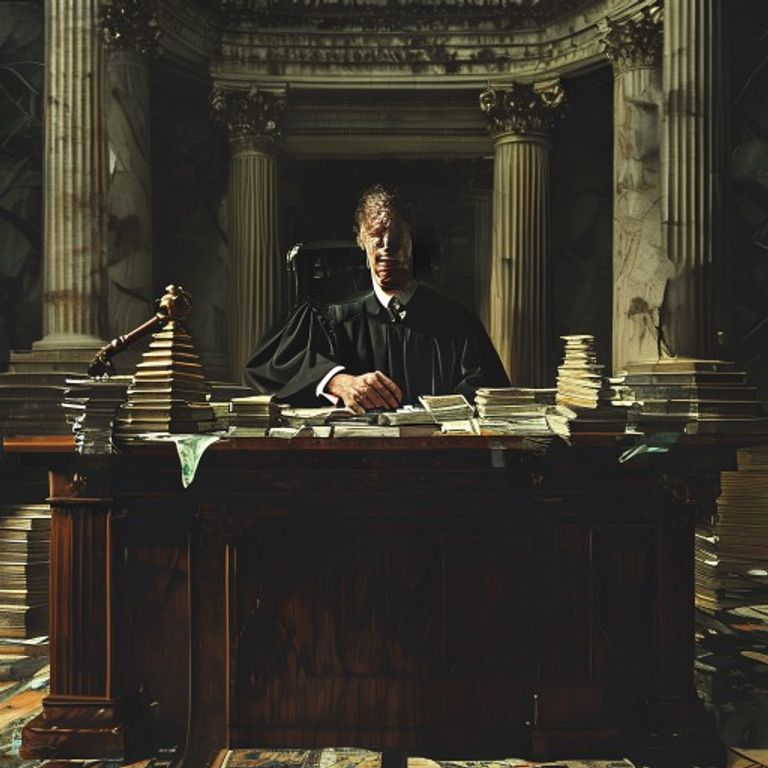
The Supreme Court of the United States relies upon a carefully cultivated mythology to maintain its authority. The public is conditioned to view the nine justices not as political actors or ambitious lawyers, but as ascetic monks of the law. They are presented as men and women who, upon donning the black robe, strip away their mortal desires for wealth and influence, dedicating themselves entirely to the pure, unadulterated interpretation of the Constitution. This mythology is essential because the Court possesses no army and no police force; its power rests entirely on the public's belief in its inherent integrity.
In 1969, Associate Justice Abe Fortas shattered that mythology. He revealed the highest court in the land to be just another marketplace for the American oligarchy.
Fortas became the first and only Supreme Court Justice in American history to resign under the explicit threat of impeachment. He did not step down over a principled ideological dispute or a contested legal philosophy. He was forced off the bench because he had established a side-hustle. While sitting on the Supreme Court, Fortas accepted a lifetime retainer of $20,000 a year (equivalent to roughly $170,000 today) from the family foundation of Louis Wolfson, a notorious Wall Street financier who was actively under federal investigation for securities fraud.
Wolfson was not paying Fortas for his brilliant legal mind. He was paying for a bagman. He was purchasing a direct, unchecked conduit to the President of the United States, Lyndon B. Johnson, whom Fortas had served as a lifelong political "fixer."
The Abe Fortas scandal is rarely discussed with the severity it deserves by the modern legal establishment, which prefers to treat it as a historical footnote rather than a structural indictment. But the Fortas affair is the ultimate proof that the American judicial system is fundamentally defunct. It demonstrates that the Founders' greatest fears regarding an unaccountable, self-regulating elite were absolutely justified, and that the "privilege of the corps" extends all the way to the marble temple in Washington.
- The Justice: Abe Fortas, appointed to the U.S. Supreme Court by President Lyndon B. Johnson in 1965.
- The Financier: Louis Wolfson, a Wall Street corporate raider under investigation by the SEC for securities fraud.
- The Deal: In 1966, while on the bench, Fortas signed a contract with the Wolfson Family Foundation for a $20,000 annual retainer for the rest of his life (and his wife's life).
- The Expectation: Wolfson expected Fortas to use his profound influence with President LBJ to secure a pardon or intervene in the criminal investigation.
- The Exposure: In 1969, LIFE Magazine published a bombshell exposé detailing the financial arrangement.
- The Consequence: Facing certain impeachment and criminal investigation by the Nixon Justice Department, Fortas resigned in May 1969.
- The Privilege of the Corps: Fortas was never criminally charged. He returned to lucrative private practice in Washington D.C., keeping his wealth, his status, and his freedom.
The President's Fixer on the High Bench
To understand the audacity of Abe Fortas's corruption, one must understand how he arrived at the Supreme Court. Fortas was not a cloistered academic or an appellate judge who had spent his life removed from the dirt of politics. He was a founding partner of Arnold, Fortas & Porter (now Arnold & Porter), one of the most powerful corporate law firms in Washington. More importantly, he was Lyndon Johnson's personal fixer.
When LBJ's 1948 Senate election was contested over allegations of massive voter fraud (the infamous "Box 13" scandal), it was Abe Fortas who outmaneuvered the opposition in federal court to secure Johnson's path to the Senate, and ultimately, the presidency. From that moment on, Fortas was Johnson's closest confidant. Even after Johnson appointed him to the Supreme Court in 1965, Fortas continued to act as a shadow political advisor, attending White House strategy meetings on the Vietnam War and helping draft presidential speeches. He viewed the separation of powers as a suggestion for lesser men.
This was the environment that produced the Wolfson contract. Louis Wolfson was an aggressive corporate raider who had run afoul of the Securities and Exchange Commission (SEC). Facing indictment, Wolfson needed the one thing money could usually buy in Washington: political intervention. He approached Fortas, who had done legal work for his foundation before joining the Court.
In January 1966, Associate Justice Abe Fortas accepted a check for $20,000 from the Wolfson Family Foundation. The agreement stipulated that Fortas would receive this amount every year for the rest of his life, and upon his death, the payments would continue to his wife. In exchange, Fortas was ostensibly supposed to advise the foundation on its charitable giving. It was a transparent, farcical cover story. Wolfson wanted a presidential pardon, and he was paying the President's best friend to get it.
The Delusion of Federalist 78
The Fortas scandal entirely demolishes the theoretical foundation upon which the American judiciary was built. When Alexander Hamilton drafted Federalist No. 78 to defend the concept of lifetime judicial tenure, he recognized that granting unelected men absolute power to interpret the law was a dangerous proposition. To soothe the anxieties of the public, Hamilton argued that the judiciary would be the "least dangerous" branch because it possessed "neither force nor will, but merely judgment."
Hamilton's entire thesis rested on the assumption that the men selected for the bench would be paragons of virtue. "The qualifications in the judges, which are essential to the impartial administration of the laws, are of such a nature as to demand long and laborious study," Hamilton wrote. He believed that the sheer intellectual rigor required to master the law would filter out the corrupt, attracting only men of "integrity and moderation."
Abe Fortas possessed a brilliant legal mind; he had certainly engaged in "long and laborious study." But his intellect did not guarantee his integrity. Hamilton failed to account for the reality that placing a man in a position of supreme, unassailable power does not strip him of his greed; it merely raises his asking price.
Fortas believed that the prestige of the Supreme Court effectively immunized him from scrutiny. He was an Article III judge, appointed for life. He assumed he could operate a lucrative side business with a convicted felon because the system he belonged to simply did not question its own elites. Hamilton promised the public a court of impartial judgment; Fortas delivered a court of transactional leverage.
Jefferson's Nightmare and the Privilege of the Corps
Unlike Hamilton, Thomas Jefferson viewed the federal judiciary with profound, unyielding suspicion. He recognized that lawyers, when concentrated into a self-regulating institution, would inevitably form an oligarchy that elevated its own interests above the Constitution. Jefferson did not believe in the mythology of the robes.
In a prophetic 1820 letter to William Jarvis, Jefferson diagnosed the exact pathology that drove Abe Fortas:
"Our judges are as honest as other men, and not more so. They have, with others, the same passions for party, for power, and the privilege of their corps."
The "privilege of their corps" is the defining sickness of the American legal system. It is the unwritten rule that the legal elite must be protected from the consequences that are brutally inflicted upon the working class. When a poor citizen steals a hundred dollars from a cash register, they are crushed by the state. When a Supreme Court Justice accepts twenty thousand dollars from a corporate fraudster, the establishment searches for an exit ramp.
When the LIFE Magazine story broke in May 1969, the political class panicked. Attorney General John Mitchell, operating under the Nixon administration, wanted Fortas gone. But the establishment did not want the spectacle and the institutional damage of a criminal trial for a sitting Supreme Court Justice. Mitchell essentially offered Fortas a deal: resign, and the criminal investigation into obstruction of justice and bribery would disappear.
Fortas resigned. He wrote a deeply arrogant resignation letter to Chief Justice Earl Warren, claiming he was stepping down merely to spare the Court from distraction, while refusing to admit any genuine wrongdoing. The Department of Justice promptly dropped the investigation. Fortas was never indicted. He was never disbarred. He simply returned to the lucrative world of private corporate law in Washington D.C., driving a Rolls-Royce and living in a Georgetown mansion until his death.
He was afforded the ultimate privilege of the corps: the ability to walk away from a monumental corruption scandal with his wealth and freedom completely intact.
The Failure of Madison's Safeguards
James Madison, the chief architect of the Constitution, structured the American government on the premise that power inherently corrupts. In Federalist No. 51, Madison declared that "ambition must be made to counteract ambition." Because men are not angels, no institution could be trusted to police itself. Every branch of government required an external check.
But the Supreme Court has successfully exempted itself from Madison's rule. For two centuries, the Court has claimed that the separation of powers requires it to be entirely self-regulating. It is the only court in the United States that does not possess a binding code of ethics enforced by an external body.
When Fortas took Wolfson's money, there was no independent inspector general to investigate him. There was no judicial conduct board with the authority to subpoena his bank records. The only mechanism for accountability was the nuclear option of congressional impeachment, which is a slow, hyper-political process that the legislature is loath to use. Because the Court policed itself, Fortas felt completely comfortable hiding the arrangement. He only returned the $20,000 (after keeping it for nearly a year) because Wolfson had been indicted and Fortas feared the payment would be discovered by federal prosecutors rummaging through Wolfson's files.
The Fortas scandal proved that the Supreme Court cannot be trusted to self-regulate. Yet, over fifty years later, the Court continues to operate under the exact same structural deficiency. Recent revelations regarding modern Supreme Court justices accepting undisclosed luxury travel, private jet flights, and real estate purchases from billionaires demonstrate that the lesson of Abe Fortas was entirely ignored. The system did not reform; it simply learned to be more discreet about its patrons.
The Brutus Prophecy
During the ratification debates of the Constitution, the Anti-Federalist writer known as "Brutus" (believed to be Robert Yates) warned that the federal judiciary described in Article III was a recipe for tyranny. Brutus argued that by granting judges lifetime tenure and insulating them from the people, the Constitution would create an unaccountable aristocracy.
"They are independent of the people, of the legislature, and of every power under heaven. Men placed in this situation will generally soon feel themselves independent of heaven itself."
Fortas felt independent of heaven itself. He sat on the highest court in the republic, drafting opinions that altered the lives of millions of Americans, while simultaneously offering his services as a high-priced consultant to a criminal. He embodies the terrifying reality that Brutus warned against: a man who views the law not as a sacred trust, but as a mechanism for personal leverage.
When a system allows a man like Fortas to ascend to its highest pinnacle, and then allows him to escape accountability simply by handing in his resignation, that system is not merely flawed. It is completely defunct. It is an insult to the foundational premise of equal justice under law.
A Call for Systemic Reconstruction
The establishment views the resignation of Abe Fortas as a successful deployment of the system's immune response. They argue that the pressure worked, the corrupt justice was removed, and the integrity of the Court was preserved. This is a profound delusion. Allowing a corrupt official to resign to avoid criminal prosecution is not justice; it is a protection racket.
We cannot reform a system that inherently prioritizes the protection of its elite over the administration of justice. We require immediate, systemic reconstruction of the Supreme Court to align it with the founding principles of this republic.
1. Abolish Lifetime Tenure
The "good behavior" clause of Article III has been disastrously interpreted as a guarantee of lifetime employment. This must end. The Supreme Court must be restructured with mandatory 18-year term limits. A rotating bench ensures that no justice can establish a lifelong, untouchable fiefdom, and regular turnover dilutes the immense concentration of power that attracts corrupt benefactors like Louis Wolfson.
2. Independent, Civilian-Led Ethics Enforcement
The Supreme Court cannot be permitted to police itself. Congress must establish an independent Office of the Inspector General for the Federal Judiciary, governed by a civilian board with absolute subpoena power over the financial records of all federal judges, including Supreme Court justices. If a justice accepts undisclosed funds, the investigation must be conducted by outsiders, not by their colleagues.
3. Mandatory Criminal Prosecution for Judicial Bribery
The era of the "quiet resignation" must end. If a federal judge or Supreme Court justice is found to have accepted undisclosed funds, gifts, or retainers from individuals with interests before the federal government, the law must mandate an immediate criminal referral to an independent prosecutor. Resignation cannot function as a get-out-of-jail-free card. The elite must face the exact same prosecutorial ruthlessness that is applied to the poor.
4. Total Financial Transparency
The finances of a Supreme Court justice should be an open book. All tax returns, investment portfolios, and spousal income must be subject to rigorous, unannounced public audits. A public servant who objects to financial transparency has no business sitting in judgment of others.
Conclusion: Tearing Down the Temple
Abe Fortas treated the Supreme Court of the United States like a country club where he could network with billionaires and sell his influence. He made a mockery of the Constitution. But the true tragedy is that the legal establishment let him do it, and when he was caught, they let him walk away.
The Founders warned us that any institution permitted to police itself will inevitably descend into tyranny and corruption. The Abe Fortas scandal proved that the Supreme Court is not immune to this law of human nature; in fact, its immense power makes it the ultimate target for corruption. Until we tear down the mythology of the robes, strip the Court of its self-policing monopoly, and reconstruct the system on a foundation of absolute democratic accountability, the highest court in the land will remain nothing more than a marketplace for those who can afford the asking price.
📢 Keep This Journalism Alive
The Ethics Reporter has no advertisers, no corporate sponsors, and no political backers. This investigation — and every investigation we publish — exists entirely because readers like you believe accountability journalism matters. If this reporting moved you, please consider supporting us.
Donate to The Ethics ReporterEven $1 helps. No amount is too small. Thank you for standing with us.