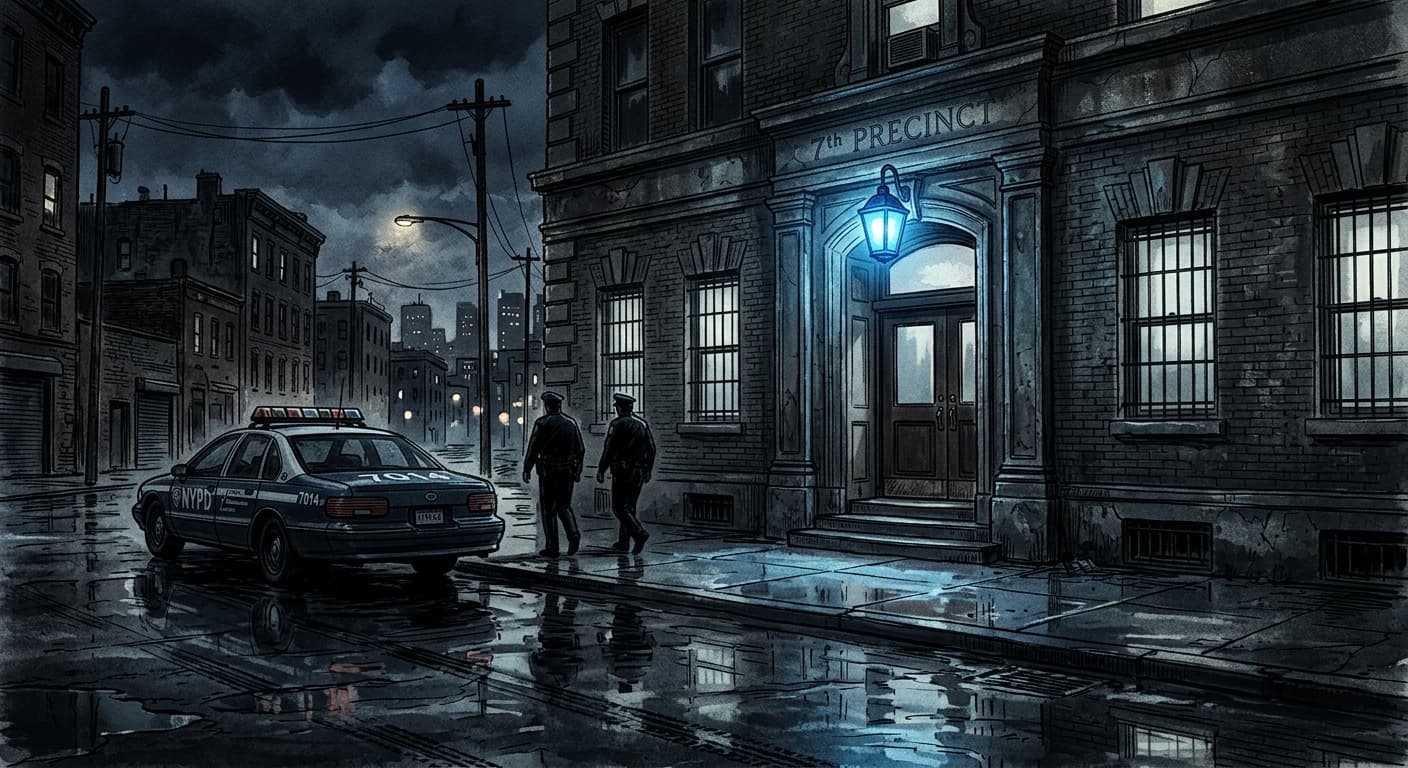
At approximately four o’clock in the morning on August 9, 1997, a thirty-year-old Haitian immigrant named Abner Louima stood in the bathroom of New York City’s 70th Precinct station house in Brooklyn, handcuffed, his pants and underwear pulled down to his ankles. Behind him stood Officer Justin Volpe. What happened next in that bathroom — what Volpe did to Louima with a wooden stick, first in the bathroom and then on the floor of the adjoining room — was an act of such grotesque violence that when Louima arrived at the hospital hours later, the emergency-room physicians initially could not determine how he had been injured and concluded, despite the attempts of precinct officers to pass the case off as the result of rough consensual sex, that the man handcuffed to the gurney had been brutally, deliberately tortured by police officers while in custody. The assault ruptured Louima’s bladder. It tore his colon. It broke four of his teeth, some knocked out at the root. It required three surgeries and two months of hospitalization to repair. The officers who delivered Louima to the hospital told staff he had been injured during an arrest outside a nightclub. They did not mention the bathroom. They did not mention the stick. They did not mention the words Volpe spoke afterward, holding the broken handle of a plunger in his hand and parading it around the squad room, announcing, according to Louima’s testimony: “I broke a man down tonight.” And then: “If you tell anybody about this, I’ll find you and kill you.”
The Abner Louima case cracked the blue wall of silence in New York more completely than any case before or since. It produced a thirty-year federal prison sentence for the torturer, one of the longest sentences ever imposed on an American police officer for a crime committed under color of law. It produced federal civil rights convictions against multiple officers — some of which stood and some of which were reversed on appeal, in an instructive demonstration of how the American legal system protects itself even in the act of appearing to punish its own. It produced a mayoral task force, a federal consent decree for the New York City Police Department, and reforms that outlasted neither the decade nor the newspaper headlines. And it produced, at its center, a Haitian security guard whose testimony was so credible it survived cross-examination, internal-affairs corruption, perjured police witnesses, and a judicial system designed at every joint to discredit victims like him.
It is tempting to read the Louima case as an accountability success story — the rare instance in which a brutal officer was actually punished, and punished severely. It is more accurate to read it as an accountability demonstration: a case in which the evidence was so overwhelming, the physical trauma so unanswerable, and the victim’s credibility so unshakeable that the system’s ordinary protective machinery could not function. Even then, the system exonerated most of the men involved, reversed several of the convictions it handed down, and produced structural reforms that were largely rolled back or ignored within a decade. The question the Louima case poses to the American legal order is not whether it can ever punish a brutal officer. It is whether the punishment of one officer — in a case where the officer literally paraded the instrument of torture in front of his colleagues — changes anything about the institution that makes the brutality routine. The answer, a quarter-century later, is no.
The Night at Club Rendez-Vous and the Arrest That Should Never Have Happened
On the night of August 8, 1997 — the evening before the assault — Abner Louima was at Club Rendez-Vous, a Haitian nightclub on Flatbush Avenue in Brooklyn, with friends and family. Louima was an immigrant who had come to the United States from Thomazeau, Haiti, six years earlier. He had a job as a security guard. He had a wife, Micheline, and a young son. He had no criminal record. At closing time, a fight broke out between two women outside the club. Police arrived. In the confusion of dispersing the crowd, someone — according to later testimony likely another bystander — punched Officer Volpe in the head. Volpe did not see who threw the punch. The officers began making arrests. Louima, who had been standing near the fight and trying to help separate the combatants, was arrested. He was not the man who punched Volpe. No witness ever identified him as the man who punched Volpe. Volpe himself later conceded that Louima was almost certainly not the man. Louima’s arrest was, at its legal root, exactly the kind of indiscriminate group seizure the Fourth Amendment was written to prevent: the state sweeping up proximate Black men because a blow had been struck somewhere in the crowd.
On the drive to the precinct — with other officers participating and present, in a police car in which other officers did nothing to intervene — the officers beat Louima. By Louima’s account and later-established evidence, they struck him in the face and the head and the groin. At the station house, in a bathroom at the back of the 70th Precinct, the torture continued. Officer Charles Schwarz held Louima down. Volpe sodomized him with the wooden handle of a plunger, driving it into his rectum, tearing his colon and rupturing his bladder, then shoving the dirtied handle into his face and mouth and breaking his teeth. Volpe then paraded the broken handle around the squad room. Louima was placed in a holding cell. He spent the next hours bleeding internally. Officers told desk personnel he was drunk and disorderly. When paramedics were finally called — hours later — the officers told them, and then told emergency-room staff at Coney Island Hospital, that Louima’s injuries had happened during an altercation outside the nightclub or perhaps as the result of, in the words of one officer’s account, “an abnormal homosexual act.” The hospital staff, confronted with injuries that could not be reconciled with that story — a ruptured bladder in a handcuffed man — contacted the NYPD’s Internal Affairs Bureau themselves.
The Hospital, Internal Affairs, and the Failure of the First Story
The doctors and nurses at Coney Island Hospital who received Abner Louima in the early hours of August 9, 1997, behaved like constitutional actors. Recognizing the injuries could not have occurred as the accompanying officers claimed — and that police handcuffs on a torture victim suggested something closer to what was investigated as a war crime than to ordinary arrest trauma — they alerted the hospital administration, who contacted the NYPD Internal Affairs Bureau, who began an investigation. Nurse Magalie Laurent, herself Haitian-American, found Louima on the gurney in the emergency room, heard his initial, halting account, and became one of the first people inside an institution to treat him as a victim rather than as a problem to be managed. The hospital staff’s conduct is a kind of constitutional baseline: the minimum the country should expect from state employees confronted with evidence of state violence. In most American police-torture cases, that minimum is not met. The reason the Louima case exists in the historical record as a case prosecuted to conviction rather than as another sealed internal file is that emergency-room physicians refused to accept the police story in their own hospital.
The NYPD’s Internal Affairs Bureau, to its credit and under enormous political pressure, moved quickly. Within days, Volpe and Schwarz were arrested. Within weeks, Officer Thomas Wiese and Officer Thomas Bruder were implicated in the precinct-house assault or the subsequent cover-up. Officer Michael Bellomo was arrested for lying to federal investigators to protect Volpe and Schwarz, and Sergeant Kenneth Wernick was later charged with obstruction. By the end of the first month, the department had arrested or disciplined more officers than in any brutality case in its modern history. The speed was itself an admission: the NYPD understood, within days, that what had happened in the 70th Precinct bathroom was so far outside even the system’s tolerated violence that the ordinary machinery of delay, denial, and discredit-the-victim was not going to function. The internal investigation, rather than protecting the officers, peeled the precinct open. This was, and remains, exceptional. The default setting of internal-affairs machinery in American policing had been documented for decades, by the Knapp Commission in the 1970s and the Mollen Commission in the 1990s, as the protection of officers from outside accountability. In the Louima case, for once, it did something else.
The Trial: When the Evidence Is a Ruptured Colon
Federal prosecutors — the United States Attorney for the Eastern District of New York — brought the case under 18 U.S.C. § 242, deprivation of rights under color of law, and related statutes. Volpe’s defense, in the first phase, was essentially the official story: that Louima had been injured before arriving at the precinct, possibly by consensual sexual activity. As the physical evidence accumulated — the nature of the tearing, the presence of fecal matter in Volpe’s locker, the implausibility of the consensual-sex account when measured against the internal damage — that defense became progressively less tenable. The turning point was the testimony of Officer Eric Turetzky, a young officer at the 70th Precinct who told Internal Affairs, against the explicit instruction and implicit threat of the Patrolmen’s Benevolent Association, that he had seen Officer Schwarz lead Louima toward the bathroom, and that Schwarz had been the man holding Louima down. Turetzky’s decision to break the blue wall was one of the bravest acts by a police officer in modern NYPD history. He was shunned by colleagues, received threats, and eventually left the city.
In May 1999, midway through his federal trial, after the prosecution’s case had established the physical evidence and Schwarz’s involvement, Volpe changed his plea. He admitted to sodomizing Louima with the plunger handle. He admitted to threatening to kill Louima if he told anyone. In December 1999, Judge Eugene Nickerson sentenced Volpe to thirty years in federal prison — a sentence widely described as the longest ever imposed on a New York police officer for brutality, and one the judge justified explicitly by reference to the depravity of the act and the deliberate humiliation with which it was inflicted. Volpe’s plea and sentence were understood, correctly, as the federal system’s judgment that this case could not be tolerated even by a system with an enormous tolerance for police violence. What was not equally emphasized was the converse: that the severity of the sentence was itself evidence of how rarely the system punishes at all. A thirty-year sentence for an officer who tortured a man in a precinct bathroom, with witnesses, with physical evidence, with colleagues parading the instrument — in any other context, an easy conviction. The fact that it was treated as the accountability event of a generation is the actual measure of American police accountability.
The other convictions told a different story. Officer Schwarz was convicted by the same jury of violating Louima’s civil rights by holding him down during the assault, and, in a later trial, of perjury and conspiracy to obstruct justice for lying about his role. His 2000 civil rights conviction was reversed by the Second Circuit in 2002, which held that the evidence was insufficient to place him in the bathroom. His perjury convictions were also later vacated, reinstated, then vacated in part again through a legal odyssey lasting years. Schwarz ultimately served approximately five years. The officers convicted in the cover-up phase — Bruder, Wiese, and Sergeant Bellomo — had their federal convictions overturned by the Second Circuit in 2003 on grounds that the prosecution had not proved the defendants knew their false statements would be made to federal rather than state investigators. The pattern is precise and deliberate-looking: the torture conviction stood; the accountability for everyone around the torture was litigated into reversal. The system protected itself at the margins, even in its showcase prosecution.
The Blue Wall, the PBA, and the Cost of Testifying
Any honest account of the Louima case must reckon with the Patrolmen’s Benevolent Association — the NYPD rank-and-file union — and the institution historians call the blue wall of silence. The blue wall is not an allegation. Its existence has been documented by every serious commission ever to examine the NYPD: the Knapp Commission (1972), which distinguished “meat eaters” from “grass eaters” but identified the code of silence as the enabling condition of both; the Mollen Commission (1994), which concluded that the “code of silence” was “the most serious corruption problem facing the Department” and that officers who cooperated with investigations faced ostracism, threats, and abandonment in dangerous situations; and the federal consent-decree monitors who have periodically audited the department ever since. The wall functions through a simple mechanism: the officer who testifies against another officer is marked. In a profession in which your physical safety depends on other officers’ willingness to come when you call for backup, being marked is potentially fatal. The code makes the silence rational at the individual level and criminal at the institutional level. It is, in structure and effect, the same kind of organized oath-bound obstruction the Founders understood as the hallmark of a standing army unaccountable to civilian authority.
Officer Turetzky’s experience after testifying is the documented case study. Within weeks, he was moved to a different assignment. His locker was vandalized. He received threatening phone calls. Other officers refused to work with him. The PBA, while publicly calling Volpe’s actions aberrant, did nothing to protect the officer whose testimony made the prosecution possible. Turetzky eventually left Brooklyn for a different life, having discovered that the institution valued the wall more than the truth. If there is a single fact about the Louima case that predicts its institutional aftermath, it is this: the officer who tortured went to federal prison, and the officer who testified against him had to leave the city. The system punished the violence and punished the witness against the violence. Both punishments were structural. Neither was accidental.
What the Reforms Changed and What They Did Not
The immediate political response to the Louima case was substantial. Mayor Rudolph Giuliani, whose relationship with the PBA had been overtly hostile, established the Task Force on Police/Community Relations, chaired by Geraldine Ferraro and Milton Mollen — the same Mollen who had chaired the 1994 corruption commission. The task force’s recommendations — an independent civilian complaint process with real power, residency requirements for officers, mandatory integrity training, a reformed Internal Affairs Bureau with authority to compel testimony — were partially implemented. The Civilian Complaint Review Board was given expanded authority. The city agreed to a form of federal oversight regarding certain police practices. The Justice Department opened a pattern-or-practice investigation into the NYPD under 42 U.S.C. § 14141. Internal Affairs was reorganized. The precinct where the torture occurred was cleaned out and its commanding officers disciplined.
The longer-term record is less flattering. The pattern-or-practice investigation, opened in 1997, produced a memorandum of agreement in 2000 focused primarily on street-stop practices — the domain that would eventually produce the Floyd v. City of New York stop-and-frisk litigation a decade later, a case demonstrating that the underlying constitutional violations continued at industrial scale. The CCRB’s expanded authority did not include the power to impose discipline, which remained with the police commissioner — a structural limitation that has persisted. The PBA fought every meaningful reform through collective bargaining, litigation, and political pressure. The 48-hour rule — a contractual provision allowing officers to delay cooperation with investigators — survived. The internal-affairs reforms were gradually diluted. Within a decade, the Louima case had receded into department lore: the nightmare case, the exception, the proof that the system works. The structural conditions that had made it possible — a culture of tolerated routine violence, a disciplinary system captured by the union contract, a civilian oversight body with no enforcement power, and a rank-and-file code of silence enforced professionally — remained in place.
Consider the trajectory: Louima, 1997; the killing of Amadou Diallo, an unarmed West African immigrant shot at forty-one times by four NYPD officers in the Bronx, 1999 — acquitted at trial; the killing of Sean Bell, an unarmed groom-to-be shot fifty times by NYPD officers on the morning of his wedding in Queens, 2006 — three acquittals in 2008; the killing of Eric Garner, an unarmed man choked to death on video on a Staten Island sidewalk in 2014 while saying “I can’t breathe” eleven times — no indictment. Each case produced the same cycle: outrage, task force, reform announcement, partial implementation, dilution, return to baseline. The institution has been studied, prosecuted, reformed, and consent-decreed for half a century and continues to generate the same cases because the structural machine underneath — shielded officers, protected disciplinary processes, a captive civil-oversight mechanism, and a code of silence enforced through dependence on mutual protection — has never been dismantled.
The Fourth, Fifth, and Fourteenth Amendments Against the Torture Chamber
What happened to Abner Louima in the 70th Precinct bathroom was not merely a crime. It was a violation of the specific protections the Founders placed highest in the Constitution’s ordering of restraints on state violence. The Fourth Amendment’s guarantee against unreasonable seizure was violated at the moment of his arrest: an indiscriminate group detention conducted because a blow had been struck somewhere in a crowd. The Fifth Amendment’s due-process guarantee — the right not to be deprived of liberty or bodily integrity without the process of law — was violated the moment officers took a handcuffed man into a bathroom to inflict pain. The Fourteenth Amendment’s extension of those guarantees against the states — the amendment whose enforcement statute, 42 U.S.C. § 1983, was enacted during Reconstruction specifically to make state officers answerable in federal court for violence against Black citizens and immigrants — was the entire ground of the federal prosecution. The Eighth Amendment’s prohibition on cruel and unusual punishment is implicated most starkly of all: the deliberate infliction of pain by the state upon a person in its custody is the Eighth Amendment’s paradigm case, the thing the amendment exists to forbid before it exists to forbid anything else.
The Founders wrote these provisions against specific historical memories. The general warrants and writs of assistance against which James Otis argued, and from which the Fourth Amendment directly descends, authorized crown officers to break into homes on suspicion and seize persons without particularized cause. Pretrial torture to extract confessions — the practice the English had nominally abandoned by the eighteenth century but which the colonists had seen in the Tower and heard of in every European court — was the direct target of the Fifth Amendment’s privilege against self-incrimination and the Eighth’s cruelty bar. Blackstone, whose Commentaries the Framers read as the legal bible of their generation, identified the state’s use of pain against the accused as the hallmark of tyranny: “By this means the accused is punished, before he is found guilty of any offence.” The torture of Abner Louima was not a deviation from policing the Founders could not have anticipated. It was the precise thing they wrote the Fourth, Fifth, and Eighth Amendments to prevent. The amendments were available. The amendments did not protect him. The institution had, through a century of judicial dilution and internal protective structure, rendered them inoperative inside a station house bathroom at four in the morning.
The Officer’s Sentence and the Institution’s Absolution
Justin Volpe’s thirty-year sentence, imposed in December 1999, remains one of the most severe ever handed down against an American police officer for an on-duty or custody-related crime. It is instructive to read Judge Nickerson’s sentencing rationale against the system’s ordinary operations. The judge emphasized the deliberateness of the act, its humiliating intent, the threat to kill the victim if he reported, and the use of the station house itself — the place of law — as the torture chamber. The sentence was meant, in the judge’s framing, as a statement that the law could reach an officer even inside his own precinct. And it could: under federal civil-rights law, in the most overwhelming case, with the most unshakeable victim, with physical evidence including a ruptured colon, with an internal-affairs investigation that for once did its job, with federal prosecutors willing to try the case, and with a judge prepared to sentence at the high end of the range — under all those concurrent conditions, an American police officer could be made to answer for torturing a handcuffed man. Everything about the case that made the sentence possible was exceptional. The ordinary case, the ordinary victim, the ordinary injury, the ordinary disciplinary process, produced nothing.
The institution’s subsequent absorption of the sentence into its own narrative — the system works, the bad apple was punished, the reforms addressed the underlying issues — is the more durable legacy. The PBA’s official response treated Volpe as an aberration, not a product. The task force’s recommendations were implemented only in their least intrusive forms. The federal oversight agreement focused on data collection and reporting, not on the structural conditions that permit brutality. When the same institution produced the Diallo shooting two years later, the Bell shooting nine years later, and the Garner choking seventeen years later, the Louima-era reforms were invoked each time as evidence the institution was addressing its problems. The invocation was false. The institution had learned to absorb even the most extreme cases without structural change. Volpe served his thirty years in a federal prison. The machine that manufactured the conditions in which he operated ran on, unchanged.
What the Case Proved
The Louima case proved, definitively and for all time, that the American legal system can punish an officer for torture committed in a station house — under conditions of overwhelming evidence, an extraordinarily credible victim, a functioning internal-affairs investigation for once, federal prosecutors willing to use § 242, and a judge willing to sentence severely. It proved the ceiling of possible accountability. It also proved the floor: that in the same case, the officers who assisted the torturer, helped hold down the victim, walked the plunger handle around the squad room, lied to investigators, and covered the case up were largely able to negotiate the appellate system into reduced accountability or reversal. It proved that the officer who broke the blue wall to tell the truth about what he saw would be driven from the department. It proved that a task force could be appointed, findings issued, reforms announced within months — and that a decade later the same department would be killing unarmed men on video with the same impunity it had displayed before the bathroom at the 70th Precinct.
What the case proved, in the Founders’ vocabulary, is that parchment barriers without structural enforcement are parchment only. Madison wrote in Federalist No. 48 that “a mere demarcation on parchment of the constitutional limits of the several departments, is not a sufficient guard against those encroachments which lead to a tyrannical concentration of all the powers of government in the same hands.” The Fourth and Fifth and Eighth Amendments are parchment. The blue wall is structure. The disciplinary contract is structure. The pattern of appellate protection of police perjury is structure. The code of silence enforced by mutual dependence is structure. Against that structure, parchment loses every time it is encountered at four in the morning in a precinct bathroom. The remedy the Founders proposed — and the remedy any serious reconstruction of American criminal justice must attempt — is structural: civilian oversight with real power, criminal liability for police perjury enforced as ordinary perjury, an end to qualified immunity, an end to the disciplinary system’s capture by union contract, and a revival of the jury as the community’s check on state violence in the community where the violence occurred. The Louima case, with its singular thirty-year sentence, is proof that the structure can in the rarest case be made to produce one conviction. It is also proof that one conviction is not accountability, and that without structural change the structure will absorb the conviction and produce the next bathroom.
Even $1 helps. No amount is too small. Thank you for standing with us.