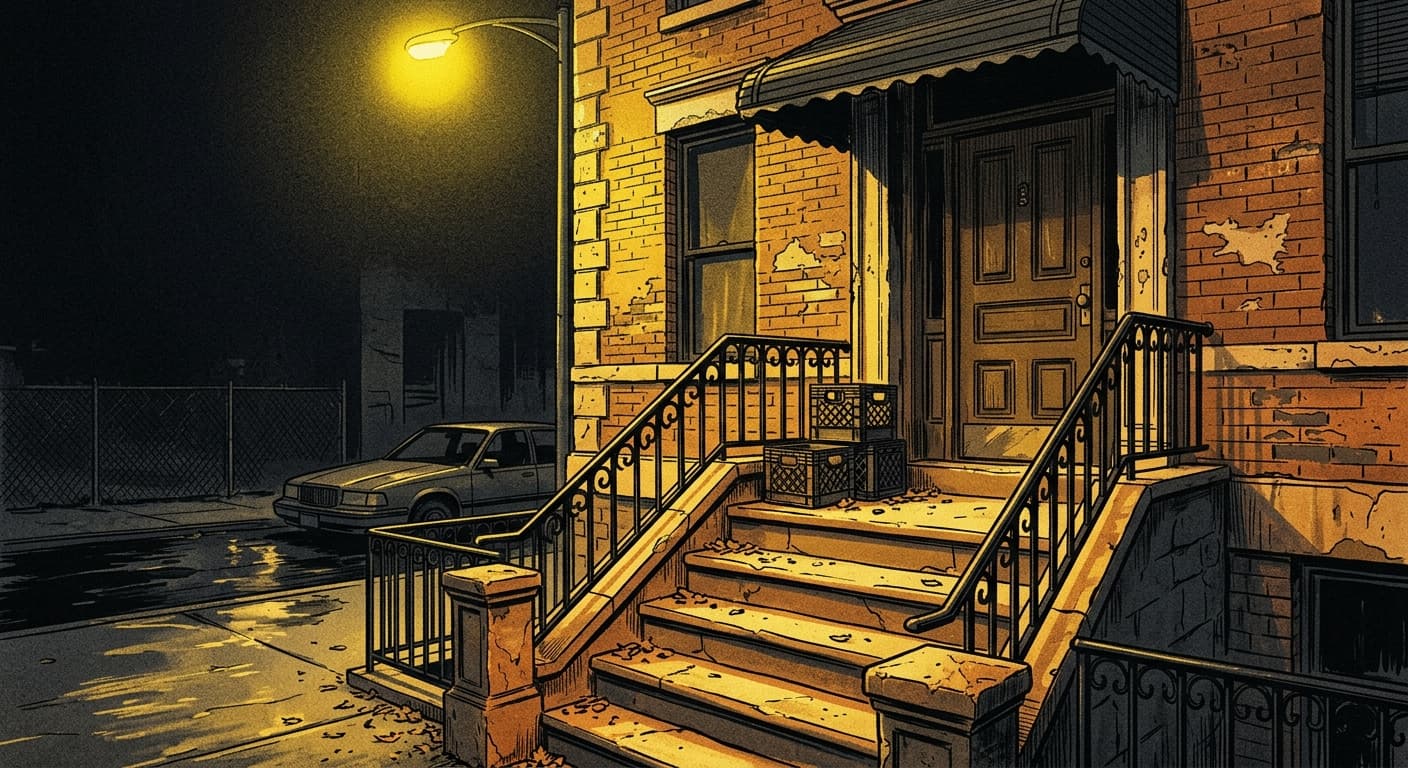
In the first seconds of February 4, 1999, a twenty-two-year-old street vendor from Guinea named Amadou Diallo stood in the vestibule of his own apartment building at 1157 Wheeler Avenue in the Soundview section of the Bronx. He had spent the evening the way he spent most evenings, working long hours selling videotapes, gloves, and socks to save money for the computer science education he hoped to pursue. He was five feet six inches tall and weighed perhaps one hundred and fifty pounds. He carried no weapon. He had no criminal record. In his pocket was a black wallet. When four white plainclothes officers of the New York City Police Department's elite Street Crime Unit confronted him on that doorstep, he reached for the wallet — possibly to show identification, possibly simply because he was frightened and did not understand what was happening. In the next several seconds, the four officers fired forty-one bullets at him. Nineteen struck his body. He died in the doorway of his own home, his wallet still in his hand.
The four officers — Sean Carroll, Edward McMellon, Kenneth Boss, and Richard Murphy — would later testify that they believed Diallo was reaching for a gun. They would describe a man who matched, they said, the description of a serial rapist who had been operating in the neighborhood, a man who was never apprehended and who bore no meaningful physical resemblance to Diallo beyond skin color. They would describe fear, split-second decisions, the chaos of a dark doorway. A jury of their peers, empaneled not in the Bronx where the killing occurred but in Albany, two hundred and fifty miles to the north, after an appellate court ruled that pretrial publicity made a fair trial in the Bronx impossible, heard all of this and acquitted them of every charge — murder, manslaughter, criminally negligent homicide, reckless endangerment. Not one count. Not one conviction. Not one day of prison for a fusillade so intense that bullets struck Diallo while he was already falling, while he was already on the ground.
The killing of Amadou Diallo was not the first time the New York City Police Department had been accused of treating Black and brown New Yorkers as presumptive threats to be neutralized rather than citizens to be protected. It would not be the last. But it became, in the winter of 1999, the case that forced the city — and, for a time, the nation — to look directly at what happens when a government arms its agents, instructs them to treat an entire demographic as suspect, and then shields them from consequence when the inevitable tragedy occurs. It is a case that goes to the heart of the Fourth Amendment's promise, its demand that the people be secure in their persons against unreasonable seizure, its insistence that the state may not simply gun down the innocent on their own doorsteps and call the result lawful.
This is the story of what happened on Wheeler Avenue, of the unit that created the conditions for it, of the trial that absolved the men who did it, and of the legal architecture that ensures it will keep happening.
The Fourth Amendment Was Written for Doorsteps Like This One
When the Founders drafted the Fourth Amendment, they were thinking about doorsteps. They were thinking about the general warrants and writs of assistance that British officers had used to invade colonial homes at will, to ransack, to seize, to intimidate. James Madison's proposal, ratified in 1791, declared that the right of the people to be secure in their persons, houses, papers, and effects against unreasonable searches and seizures shall not be violated. The amendment's logic is a logic of presumption: the citizen is presumed free, and the state's intrusion upon that freedom must be justified, particularized, and reasonable. A man standing in the vestibule of his own apartment building at midnight, having committed no crime, matching no meaningful description, holding no weapon — such a man sits at the very center of the amendment's protection. If the Fourth Amendment means anything, it means that Amadou Diallo had a right to stand on his own doorstep and not be shot to death by the state.
The tragedy of Wheeler Avenue is that the modern machinery of American policing had, by 1999, engineered a set of doctrines and practices that hollowed out that protection almost entirely. The Street Crime Unit did not patrol for calls. It hunted. Its officers worked in plainclothes, in unmarked cars, trawling high-crime neighborhoods for people who looked like they might be up to something. Its unofficial motto, according to reporting at the time, was We Own the Night. Its methods were aggressive pretext stops, on-the-spot judgments about who was suspicious, and a willingness to draw weapons quickly. These were the tactics of an occupying force, not of a police department serving a free people. And they were tactics that the Supreme Court's own Fourth Amendment jurisprudence — from Terry v. Ohio onward — had made almost impossible to challenge in any meaningful way.
The Street Crime Unit: A Machine Built for Tragedy
The NYPD's Street Crime Unit had been expanded dramatically under Mayor Rudolph Giuliani and Police Commissioner Howard Safir as part of the city's much-celebrated war on crime. By early 1999, the unit had grown to roughly four hundred officers, deployed across the city's precincts with a mandate to get guns off the street. The unit's approach was saturation stops. Its officers were trained — in the words the department itself would later use in its own internal reviews — to be proactive, to initiate contacts rather than respond to complaints, to treat certain neighborhoods and certain kinds of people as presumptively likely to be armed.
The numbers told the story before the bullets did. Reporting in the aftermath of the Diallo killing, including figures cited by the New York State Attorney General's office and the city's own data, revealed that the Street Crime Unit was stopping and searching Black and Hispanic New Yorkers at staggering rates. An analysis by the New York Daily News, and later work by the New York Civil Liberties Union examining stop-and-frisk patterns, confirmed what residents of Soundview already knew: the unit stopped tens of thousands of New Yorkers, the overwhelming majority of them Black or Latino, and the overwhelming majority of those stopped were found to have done nothing wrong at all. In some stretches of 1997 and 1998, the unit made tens of thousands of stops producing only a few thousand arrests — meaning tens of thousands of innocent people had been confronted, frisked, and humiliated by armed strangers for the crime of existing in their own neighborhoods while Black or brown.
This was not policing in the constitutional sense. It was the construction of a standing presumption of guilt, applied by race and geography — precisely the inversion of the Fourth Amendment's logic that the Founders had fought a revolution to reject. Where the amendment demands particularized suspicion, the Street Crime Unit operated on generalized profiling. Where the amendment demands that the state justify its intrusions, the unit demanded that the innocent justify their presence. Amadou Diallo was the human cost of that inversion, rendered in nineteen bullets.
Carroll, McMellon, Boss, and Murphy were products of this machine. They were young officers — all in their twenties or early thirties — assigned to a unit whose institutional culture valorized aggression. On the night of February 3 into February 4, they were operating in the Bronx in an unmarked Ford Taurus, looking, by their own later accounts, for the serial rapist whose pattern of attacks had terrorized the neighborhood. What the record would establish is that the description they carried was so vague — a Black man — as to encompass effectively every Black man in the borough, and that Diallo, slight, soft-spoken, with no record and no weapon, matched it in no way that a functioning constitutional system should have recognized.
Twelve Twenty-Four in the Morning
The events of that night, as reconstructed through trial testimony, forensic evidence, and contemporaneous reporting, unfolded with terrible speed. Shortly after midnight, at approximately 12:24 a.m., the unmarked Taurus carrying the four officers rolled up in front of 1157 Wheeler Avenue. Diallo was standing in or near the vestibule of the building. The officers would testify that his behavior caught their attention — that he appeared to duck back into the doorway as the car approached, that he seemed to be avoiding them, that he matched the rapist's description. Carroll and McMellon exited the vehicle first. Carroll testified that he identified himself as police. Whether Diallo heard or understood those words — whether the officers, in plainclothes, in the dark, shouting, presented themselves in a way a Guinean immigrant with imperfect English could have processed as police rather than as the very street robbers such neighborhoods often produced — remains one of the case's enduring and unresolvable questions.
What happened next took seconds. Diallo, according to the officers' testimony, did not respond to commands. He moved toward the vestibule. He reached into his pocket. He began to withdraw a black object — his wallet. McMellon and Carroll perceived, they said, a gun. McMellon opened fire. He fell backward off the steps as he did so, and Carroll would later testify that he believed McMellon had been shot. Boss and Murphy, emerging from the car into what they understood to be a firefight already in progress, began firing as well. The shooting became self-perpetuating: each officer interpreted the others' gunfire as confirmation that Diallo was armed and shooting back. Bullets ricocheted in the enclosed vestibule. The officers fired and fired and fired — forty-one rounds in total, in a span of perhaps four or five seconds, at a man holding a wallet.
The forensic evidence assembled by the Bronx District Attorney's office and presented at trial painted a devastating picture. Bullets struck Diallo in the torso, the legs, the groin, the spine. The trajectories suggested that several rounds hit him while he was falling or already down — that the shooting continued past the point where any conceivable threat, real or imagined, could have persisted. He was hit nineteen times. When the firing stopped, and the officers approached the body, they found no gun. They found a wallet, a pager, and a set of keys. Boss, by his own account at trial, wept when he realized the man they had killed was unarmed.
The Rev. Al Sharpton, the Diallo family, and a coalition of civil rights leaders and activists would soon transform the case into a national referendum on police violence. But in the immediate hours, the machinery of official explanation was already turning. The officers, through their attorneys and the Patrolmen's Benevolent Association, began constructing the narrative that would carry them to acquittal: a dark night, a suspicious man, a furtive movement, a tragic mistake, reasonable fear. It is a narrative that has been deployed in American courtrooms a thousand times before and since, and it works, because American law has been built to make it work.
The Doctrinal Trap: Reasonableness as Blank Check
Here it is necessary to step back from Wheeler Avenue and examine the legal architecture into which the Diallo case would be fed, because the acquittal of the four officers was not primarily a failure of that jury. It was the predictable output of a doctrinal system engineered to acquit.
The controlling federal standard for police use of force flows from the Supreme Court's 1989 decision in Graham v. Connor, which holds that claims of excessive force must be judged under the Fourth Amendment's reasonableness standard, assessed from the perspective of a reasonable officer on the scene, in tense, uncertain, and rapidly evolving circumstances, without regard to the officer's underlying intent or motivation, and — crucially — without the clarity of hindsight. On its face, this is not an absurd standard. Split-second decisions are real. Officers do face genuine danger. But in application, Graham and its companion cases have been transformed into something approaching absolute deference. The question is never really whether the shooting was reasonable in the way a citizen might understand the word. The question is whether a court, reconstructing events entirely through the officer's own recounted perception, can be persuaded that some hypothetical reasonable officer might have felt afraid. Because fear is unfalsifiable — because the officer is the sole surviving narrator of his own inner state — the standard collapses into tautology: the shooting was reasonable because the shooter says he was reasonably afraid.
Add to this the framework of Tennessee v. Garner, which held that deadly force against fleeing suspects is constitutional only when the officer has probable cause to believe the suspect poses a significant threat, and Terry v. Ohio, which permits stops and frisks on reasonable suspicion short of probable cause, and you have assembled a doctrinal lattice that permits an armed state agent to initiate contact with an innocent man on the flimsiest of suspicions, escalate that contact through his own perception of threat, and then be judged only by the reasonableness of his own frightened perception at the final moment. The Diallo officers' defense rested on precisely this architecture. Their attorneys did not have to prove Diallo was dangerous. They only had to plant the seed that the officers' fear was plausible. Once planted, the law did the rest.
The Founders would not have recognized this as law under the Fourth Amendment. The amendment's reasonableness clause was a restraint on the state — a check the citizen could invoke against the government. Graham v. Connor inverted it into a shield for the state — a standard the government invokes against the citizen's claim. That inversion, more than any verdict in Albany, is the deep scandal of the Diallo case.
Making the Case Move: The Bronx to Albany
On March 31, 1999, a Bronx grand jury indicted all four officers on charges of second-degree murder, depraved-indifference murder, manslaughter, criminally negligent homicide, and reckless endangerment. Bronx District Attorney Robert Johnson assembled what he believed was a strong case, built on the forensic evidence of nineteen hits on an unarmed man, on the trajectory analysis, on the sheer and horrific imbalance between forty-one bullets and a wallet.
Then the case left the Bronx. The officers' attorneys moved for a change of venue, arguing that the torrent of publicity — the daily protests, the civil disobedience campaign at One Police Plaza that saw hundreds arrested, including former Mayor David Dinkins, the Rev. Jesse Jackson, and members of Congress — had made a fair trial in the Bronx impossible. In December 1999, the state's Appellate Division agreed, in a ruling whose logic would be debated for years. The court ordered the trial moved to Albany County — a jurisdiction demographically and culturally remote from the South Bronx, with a far smaller Black population and, as critics immediately noted, a jury pool far more likely to be sympathetic to police officers and far less likely to have lived experience of the Street Crime Unit's methods.
It is one of the bitter ironies of American criminal procedure that the change-of-venue doctrine — designed by the Founders' generation as a protection for defendants facing mob prejudgment — has been so routinely deployed to move police defendants out of the communities they policed, to more comfortable venues, while Black criminal defendants on trial for their lives have almost never enjoyed the same solicitude. The Sixth Amendment speaks of a jury of the district wherein the crime shall have been committed. Amadou Diallo was killed in the Bronx. The men who killed him were tried in Albany. That displacement, lawful as it was, severed the case from the community that bore its consequences and that the Constitution's own jury-of-the-vicinage principle was written to honor — a principle the Founders had specifically embedded in the revolutionary charters to prevent exactly this kind of venue manipulation by the Crown.
The Trial and the Verdict
The trial opened in Albany in January 2000 before Justice Joseph Teresi and a jury of seven men and five women — four of them Black, eight of them white — drawn from Albany County. The prosecution's theory was moral arithmetic: forty-one shots at an unarmed man on his own doorstep is not a mistake, it is a crime. Lead prosecutor Eric Warner presented the forensic evidence, the bullet trajectories showing rounds striking Diallo as he fell, the absence of any weapon, the absence of any meaningful match between Diallo and the rapist description. The prosecution called witnesses, including a neighbor, Schrrie Elliott, who testified to hearing the gunfire, and whose account — though shaken on cross-examination — suggested contradictions in the officers' timeline.
The defense's strategy was more elemental. The four officers took the stand in their own defense — a gamble that carries risk but that in police shooting trials is nearly always the decisive move, because it converts the officers from case files into human beings, and because it allows the jury to experience the encounter as the officers narrate having experienced it. Edward McMellon wept on the stand. He testified that when he saw Diallo pull the black object, he believed his life was over. Sean Carroll described the moment McMellon fell backward, and his certainty that his partner had been shot. Kenneth Boss — who, the jury would later learn in a revelation the court had initially kept from them, had shot and killed another man, an armed robbery suspect, in Brooklyn in 1997 in an incident the department had ruled justified — described tunnel vision, a perceived muzzle, fear. Each officer described the seconds as an eternity of mortal danger.
Justice Teresi's jury instructions on the law of justification — New York's codification of the police use-of-force defense, incorporating the reasonable-belief standard — laid the trap that the doctrine always lays. A person in the officers' position, the jury was told in substance without argument, may use deadly physical force if he reasonably believes another is using or about to use deadly physical force against him or another. Reasonableness is judged by what the officer perceived at the time. If the jurors found the officers' belief reasonable, they must acquit. The jury deliberated for roughly three days over two days of sessions and returned on February 25, 2000, with verdicts of not guilty on every count, for every officer.
The courtroom reaction, and then the city's, was seismic. Diallo's mother, Kadiatou Diallo, who had sat through every day of the trial, was overcome. In the Bronx, crowds gathered on Wheeler Avenue. The verdict was denounced by civil rights leaders across the country. And yet, from a doctrinal standpoint, the verdict was not an aberration. It was the system working precisely as it had been built to work. When the standard is the officer's own fear, and the officer testifies compellingly to fear, and the law instructs the jury that reasonable fear is a complete defense — acquittal is not a bug. It is the feature.
What the Dollar Could Not Buy
The criminal case was over. The civil case was not. Kadiatou Diallo and Amadou's father, Saikou Diallo, sued the City of New York in federal court, and in March 2004 the city agreed to pay a settlement of three million dollars to resolve the wrongful-death claims. No officer was criminally sanctioned. No officer was fired in the immediate aftermath. The city's checkbook absorbed what its conscience and its courts would not: the cost of a young man's life, calculated and paid, as municipalities across America have calculated and paid for police killings for decades. New York City Comptroller data in later years would show the city paying out hundreds of millions of dollars to settle claims of police misconduct — a quiet, budgeted indemnification of violence that functions, in practice, as the cost of doing unconstitutional business.
This settlement architecture deserves scrutiny of its own, because it, too, is a structural feature rather than an accident. When a city pays millions to the family of a man its officers killed while the officers themselves pay nothing, serve nothing, and lose nothing, money has been substituted for accountability. The taxpayers indemnify the badge. The individual officers, insulated by union contracts, indemnification statutes, and the qualified immunity doctrine that shields them personally from civil liability unless they violate clearly established law — a standard the Supreme Court under Harlow v. Fitzgerald and its successors made nearly impossible to satisfy — walk away. The city writes the check. Nothing, structurally, changes. The Founders designed a system in which the government's agents answered for their trespasses; the modern system designs ways for them not to.
The Department of Justice, in the Clinton administration's final year, declined to bring federal civil rights charges against the four officers, concluding that the evidence could not establish the specific intent required under the federal criminal civil rights statutes — 18 U.S.C. § 242, the Reconstruction-era law that had been designed to give the federal government a backstop precisely when local machinery failed. That backstop failed too. Every level of the American legal system that touched the death of Amadou Diallo — grand jury, criminal trial, federal civil rights review, civil settlement — processed the killing, and every level produced the same substantive outcome: nothing.
The Inquest the City Held Against Itself
To the city's credit — or, more precisely, to the credit of the public pressure that would not relent — the aftermath of the Diallo killing produced some of the most searching official self-examination of policing in American municipal history. In 2000, the New York State Attorney General's office under Eliot Spitzer released a comprehensive study of the NYPD's stop-and-frisk practices, analyzing hundreds of thousands of stop forms. The findings confirmed what Soundview already knew: Blacks and Hispanics were stopped at rates grossly disproportionate to their share of the population and to the rates at which stops of their members produced arrests. The NYPD itself, in a separate task force review, examined the Street Crime Unit's methods. And in 2002, the city formally disbanded the Street Crime Unit as a standalone entity, folding its functions into other commands.
But the disbanding of a unit is not the disbanding of a doctrine. The stop-and-frisk regime that produced Wheeler Avenue did not end in 2002; it metastasized. Under Mayor Michael Bloomberg and Commissioner Ray Kelly, stop-and-frisk expanded to a scale the Giuliani years never approached, peaking at nearly seven hundred thousand documented stops in a single year, the overwhelming majority of those stopped young Black and Latino men, the overwhelming majority innocent of any wrongdoing. It took until 2013, and a federal court ruling in Floyd v. City of New York by Judge Shira Scheindlin, for a court to declare officially what the Diallo case had shown in blood fourteen years earlier: that the city's stop-and-frisk regime, as practiced, violated the Fourth Amendment's prohibition on unreasonable seizures and the Fourteenth Amendment's guarantee of equal protection. Fourteen years. The constitutional injury was obvious in 1999. The law required a decade and a half, a class action, and thousands of pages of statistical evidence to say so.
This is the pattern that Take America Back exists to expose: constitutional violations of the most flagrant, deadly character are processed, accommodated, and normalized by the legal system, and only after years of struggle does the law grudgingly acknowledge what the victims' communities knew from the first siren. The Diallo family got three million dollars and no justice. The city got a consent-decree monitor fourteen years later. And the doctrine — Graham's deference, qualified immunity's shield, the venue system's displacement — stands today essentially unaltered.
A Death That Echoes Forward
Measure the legacy honestly. Amadou Diallo's name became, in the years after 1999, a shorthand invocation at every subsequent police killing of an unarmed Black man — Sean Bell in 2006, whose fifty-bullet killing on the morning of his wedding would be the subject of this series' next inquiry in three days' time; Oscar Grant; and onward through the terrible roll of names that would eventually produce the largest protest movement in American history in the summer of 2020. Bruce Springsteen recorded a song, American Skin (41 Shots), that the Patrolmen's Benevolent Association denounced — an episode that captured the nation's bifurcation perfectly: to one America, Diallo's death was an indictment; to another, the indictment itself was the outrage.
The deeper legacy is doctrinal, and it is bleak. The killing of Amadou Diallo demonstrated, to anyone willing to see it, that the Fourth Amendment's protection of the person had been nullified for a specific class of Americans by a combination of practice and precedent: practice, in the form of proactive aggressive units hunting in Black and brown neighborhoods; precedent, in the form of use-of-force doctrine that converts the officer's subjectively narrated fear into an objectively complete defense. A constitutional right that cannot be enforced against the government that violates it is not a right. It is a decoration. On Wheeler Avenue in February 1999, the decoration fell away, and what stood revealed was raw state power, unaccountable and deadly, occupying a free citizen's doorstep.
The Founders wrote the Fourth Amendment because they had lived under exactly such power, and they ordained that in America the citizen's body and home would be inviolable absent particularized, justified, reasonable state action reviewed by detached magistrates and accountable juries of the vicinage. Every element of that design failed Amadou Diallo. The suspicion was not particularized — it was racial and geographic. The action was not reviewed in advance by any magistrate — it was executed in seconds on a doorstep. The jury was not of the vicinage — it sat in Albany. And the accountability was not accountability — it was acquittal, declination, and a check.
Take America Back begins, on questions like this one, with a simple insistence: the Fourth Amendment must mean on Wheeler Avenue what it means on Park Avenue. A wallet is not a weapon. A Black man reaching for his identification on his own doorstep is not a threat. And a state that cannot train, direct, and discipline its armed agents well enough to avoid firing forty-one rounds at such a man — and cannot bring itself to hold a single one of those agents accountable afterward — is a state whose courts need reconstruction, not decoration. The Diallo case is not history. It is the operating manual of the present, written in 1999, still in force. Until the law changes, the doorsteps are not safe, and the amendment lies bleeding in the Bronx vestibule where Amadou Diallo fell, his black wallet still clutched in his hand.