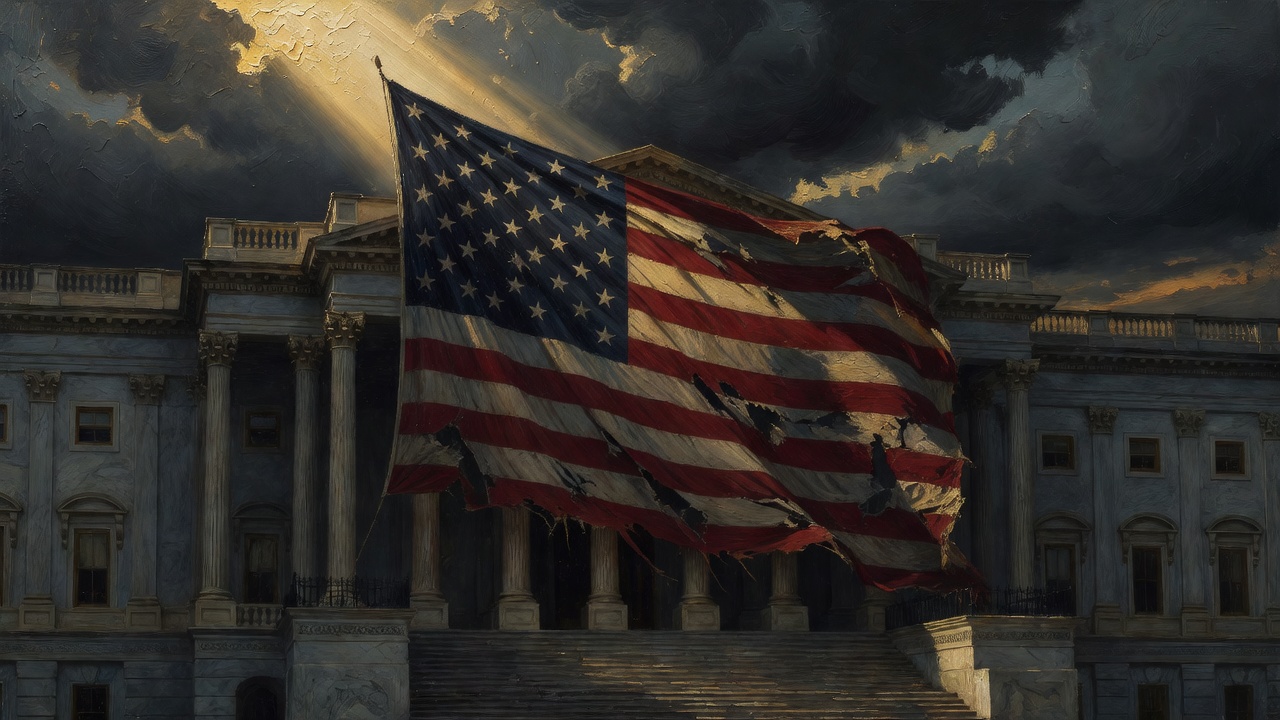
An indictment of a government against the people it was made to serve, written in the semiquincentennial year of the Republic, 1776–2026.
Introduction: An Accounting Long Overdue
These are the times that try men's souls. So wrote a corset-maker turned pamphleteer in the winter of 1776, when the cause of American liberty was a ragged army freezing on the banks of the Delaware and a set of ideas that most of the crowned heads of Europe considered a fever-dream. Thomas Paine did not write for scholars. He wrote for the farmer, the blacksmith, the sailor, the shopkeeper — the ordinary men and women whose consent alone could make a government legitimate. He wrote in language a plain man could read by candlelight and understand, and having understood, could act upon. That is the tradition this essay claims. Not the tradition of the seminar room, but the tradition of the pamphlet, the broadside, the fireside argument that ends with a decision.
We stand now in the two hundred and fiftieth year of the American experiment. The bunting will be hung. The fireworks will be launched over a hundred rivers. Politicians who have spent their careers strangling the thing they praise will stand before monuments and speak of freedom with the practiced solemnity of men reading a eulogy they do not believe. There will be parades. There will be speeches. There will be a great deal of noise about how far we have come.
This essay is an interruption of that noise. It is not a celebration. It is an accounting.
For two hundred and fifty years is long enough to test a proposition, and the proposition America put to the world was a simple and radical one: that a people could govern themselves; that government derives its just powers from the consent of the governed; that when it becomes destructive of the ends for which it was instituted, it is the right of the people to alter or abolish it. That was the wager of 1776. The men who made it knew it was a wager. They pledged their lives, their fortunes, and their sacred honor precisely because they understood they might lose all three.
The question before us in this anniversary year is whether they have already lost. Not on a battlefield — no foreign army occupies our capital — but by the slow, patient, bureaucratic conquest of the thing they built from within. The question is whether the government the founders designed as a servant of the people has become the master of the people; whether the citizen, sovereign in theory, has been reduced in fact to a subject, a taxpayer, a data-point, a source of revenue and a target of surveillance, whose consent is manufactured, whose money is taken, whose sons are sent to die in wars never declared, and whose objections are managed by a professional class that regards him as a problem to be handled rather than a master to be obeyed.
I intend to prove that this has happened. I intend to lay it out as an indictment — count by count, betrayal by betrayal — the way a prosecutor lays out a case, or the way a bookkeeper reconciles an account that has been quietly plundered for a very long time. I will name the betrayals. I will date them. I will show that they are not accidents but a pattern, and that the pattern has a direction: always away from the sovereignty of the citizen, always toward the sovereignty of the state and the interests that have captured it.
A word about scope. The founders had their sins, and they were grave — chattel slavery chief among them, a contradiction so total that it required a civil war and six hundred thousand dead to begin to resolve. This essay is not a hagiography of the founding generation. But it is not about them. The men who signed the Declaration are dead, and they answered for their compromises in their own time. This is an accounting of what was done after they died — of the betrayals committed by their heirs, by the government they left in trust, by the long line of officials who swore oaths to a Constitution they proceeded to dismantle. The founders lit a fire. This is the record of the men who let it go out, and the men who put it out on purpose.
And I will return, again and again, to the thing they cared about most and that we have forgotten most completely: money. Taxes. The power to take a man's earnings, to debase his currency, to bury his children under debts contracted without their consent. The American Revolution began as a tax revolt. It began over threepence on a pound of tea and a principle larger than any sum: no taxation without representation. The founders understood, as we have ceased to understand, that the power to tax is the power to destroy, and that a people who do not control the purse do not control anything at all. We will begin there, we will end there, and we will keep coming back to it, because it is the master key to everything else. A government that can take what it wants from you, that can print money to hide what it takes, that can indebt you without your vote — that government has already answered the question of who is sovereign. It has answered that it is, and you are not.
Let us begin the accounting.
I. The Revolution Was a Tax Revolt — And We Have Forgotten What It Was For
Begin at the beginning, because everything that follows is a betrayal of the beginning.
The American Revolution was, in its origin and its animating grievance, a revolt against taxation imposed without consent. This is not a footnote. It is the whole point. The colonists were not, on the whole, oppressed men. They were among the freest and most prosperous people on earth. They had no secret police, no gulags, no famine. What they had was a distant Parliament in which they had no seat, presuming to reach into their pockets and take their money — for stamps, for sugar, for tea — and a growing conviction that a man who cannot say no to a tax is not a free man but a tenant of the state, farmed for revenue at the pleasure of his rulers.
"No taxation without representation" was not a slogan about paperwork. It was a philosophy of sovereignty compressed into four words. It held that property is the fruit of a man's labor and therefore an extension of his person; that to take it without his consent is a species of theft dressed in the robes of law; and that consent, to be real, must be given by representatives the man himself has chosen and can remove. Take away the consent, and the tax becomes tribute. Take away the tribute's limit, and the citizen becomes a subject. This the founders understood in their bones.
Samuel Adams and the Sons of Liberty did not throw the tea into Boston Harbor because the tea tax was high. The Tea Act of 1773 actually lowered the price of tea. They threw it into the harbor because to pay even a cheap tax levied without their consent was to concede the principle that Parliament could tax them at all — and having conceded the principle, there would be no logical stopping point. They grasped what we have lost the ability to grasp: that the danger is not the size of any particular tax but the establishment of the principle that the government may take what it decides to take, and that your only role is to pay.
Now hold that founding conviction up against the America of 2026 and measure the distance we have fallen.
The colonial tax burden that provoked a revolution has been estimated by historians at something on the order of one to two percent of income — a trifle, a rounding error, a sum that would embarrass a modern accountant to mention. The total tax burden on the American citizen today — federal income tax, state income tax, payroll taxes for Social Security and Medicare, sales taxes, property taxes, excise taxes on fuel and alcohol and tobacco and tires and telephones, corporate taxes passed through in the price of every good, capital gains taxes, estate taxes, license fees, and the vast hidden tax of inflation — routinely consumes somewhere between a third and a half of everything an ordinary working American earns in his lifetime. The average American now labors from the first of January until sometime in April or May — "Tax Freedom Day," the statisticians call it — working for the government before he is permitted to work for himself and his family.
Let the enormity of that settle. Men pledged their lives over a burden of one or two percent. We surrender a third to a half and call it citizenship. We surrender it not to representatives we know and can hold accountable over a threepence duty, but to a permanent apparatus so vast that no single human being understands its whole. The tax code runs to thousands of pages, incomprehensible even to the experts paid to interpret it, changed constantly by a Congress whose members do not read the bills they pass. The colonist knew exactly what he was being taxed and by whom, and it drove him to revolution. The modern American cannot even calculate what he owes without hiring a professional or purchasing software, and he accepts it as the weather.
How did we get here? Not all at once. Betrayal is patient. It came in three great strokes, each of which we will examine in its turn, but which must be named here at the outset because they are the foundation on which every other betrayal is built: the creation of the Federal Reserve in 1913, which handed control of the nation's money to a banking cartel; the ratification of the Sixteenth Amendment in the same year, which gave the federal government a direct, unlimited claim on the income of every citizen; and the final abandonment of the gold standard in 1971, which severed the dollar from any objective anchor and turned the currency itself into an instrument of silent taxation. Nineteen thirteen and nineteen seventy-one. Remember those years. They are the years the American purse was picked, and the citizen with it.
But before we examine the mechanisms, understand the principle they violate, because the founders stated it with a clarity we can no longer match. Jefferson wrote that "the natural progress of things is for liberty to yield and government to gain ground." He was not speaking abstractly. He was describing exactly the process by which a modest revenue power becomes a total one, by which a tax to fund a war becomes a permanent claim, by which the servant becomes the master one appropriation at a time. He warned that if the American people ever permitted private banks to control the issue of their currency, "first by inflation and then by deflation, the banks and corporations that will grow up around them will deprive the people of all property until their children wake up homeless on the continent their fathers conquered." That specific quotation is disputed by scholars — you will not find it in his verified papers, and it is likely apocryphal or a later paraphrase — but the sentiment is entirely consistent with his documented and repeated warnings about banks, paper money, and public debt, which are not disputed at all. "I sincerely believe," he wrote to John Taylor in 1816, in words that are verified, "that banking establishments are more dangerous than standing armies." A standing army was, to the founding generation, the ultimate instrument of tyranny. Jefferson ranked the banks above it.
He ranked them above it because he understood that the man with the gun can only take your body, but the man with the printing press can take your labor, your savings, and your children's future, and can do it so quietly that you will thank him for the paper he leaves in your hand. That is the master betrayal, and it is a betrayal of money. Everything else in this indictment — the wars, the surveillance, the detentions, the two-tiered justice, the captured courts — is downstream of it, funded by it, made possible by the government's seizure of the power to take without limit and to print without restraint. Keep your eye on the money. It is the thread that runs through the entire tapestry of betrayal, and if you pull it, the whole thing unravels.
II. The Great Money Betrayal: 1913, 1971, and the Hidden Tax of Inflation
If you would understand how a free people was quietly enslaved, do not look first to the tanks and the prisons. Look to the mint and the bank. The oldest trick of every ruler who ever lived is to debase the coin — to shave the silver, to mix in the base metal, to make one dollar do the work of two on the ledger while doing half the work in the purse. The Roman emperors did it until the denarius was a coin of tin dipped in silver. The kings of Europe did it. And the American republic, founded by men who had watched the Continental currency inflate into worthlessness during the Revolution — "not worth a Continental" was a curse for a generation — wrote sound money into its very bones. The Constitution gives Congress the power to "coin Money" and to "regulate the Value thereof," and it forbids the states to make anything but gold and silver coin a tender in payment of debts. The founders wanted money that was a thing, not a promise; a weight of metal, not a decree of officials.
They wanted this because they understood inflation for what it is: a tax. The most insidious tax ever devised, because it is levied without a vote, collected without a collector, and blamed on everyone except the men who cause it. When the government or its central bank creates new money out of nothing, it does not create new wealth. It dilutes the value of every dollar already in existence. The new money is spent first by those who create it — the government, the banks, the connected — at the old prices, before the dilution has rippled through the economy. By the time the new money reaches the ordinary man in the form of higher wages, if it reaches him at all, the prices of everything he must buy have already risen to meet it. He is left holding a dollar worth less than the dollar he held yesterday, and no one ever asked his consent, and no line on any tax form records what was taken. This is the hidden tax. It is theft by definition, conducted in slow motion, and it is the primary means by which the modern state finances the wars and the welfare and the whole vast apparatus that the citizen would never willingly fund if he were asked directly.
The machinery for this theft was assembled in a single fateful year. In 1913 — mark it well, for it is the annus horribilis of American liberty — two things happened that together broke the founders' design.
The first was the Federal Reserve Act, signed just before Christmas, born of a secret meeting on Jekyll Island, Georgia, where a handful of the most powerful bankers in the country and their political allies drafted, in conditions of deliberate secrecy, the blueprint for a central bank. They did not call it a central bank, because the American people, remembering Andrew Jackson's war on the Second Bank and Jefferson's warnings, would never have accepted one under its true name. They dressed it in the language of stability and reform, called it a "Federal Reserve System" of regional banks, and passed it during the sleepy days before a holiday recess. What it did was transfer the power to create the nation's money — the very power the Constitution had vested in Congress — to a body that is neither fully public nor fully accountable, a hybrid whose regional banks are literally owned by the private member banks they were meant to regulate. The fox was not merely set to guard the henhouse. The fox was handed the deed to the henhouse and told to report to himself.
The second event of 1913 was the ratification of the Sixteenth Amendment, which we will treat at length in its own section, giving the federal government the power to tax incomes directly, without apportionment among the states. Together, these two innovations created the perfect engine of unlimited government. The income tax gave the state a direct and expanding claim on the earnings of every citizen. The Federal Reserve gave it a way to spend beyond even that vast revenue by creating money and monetizing debt. The one taxes you openly; the other taxes you secretly. Between them, there is no limit to what the state can extract. And it was all built in a single year, a century after the men who would have died to prevent it had gone to their graves.
But the founders' design was not yet fully dead. For all its power, the Federal Reserve was still, for a time, tethered to gold. The dollar remained, at least in principle and often in practice, redeemable in a fixed weight of the metal. This was the last chain on the beast, the last objective limit on how much money could be conjured into existence. A government cannot print gold. It can only dig it out of the earth by labor, which means the supply of real money grows slowly and honestly, and a currency backed by it cannot be inflated at will.
That last chain was struck off on August 15, 1971. On that Sunday evening, President Richard Nixon went on television and announced that the United States would "temporarily" suspend the convertibility of the dollar into gold. The suspension was never lifted. It was never meant to be. Foreign governments, watching the United States print dollars to fund the Vietnam War and the Great Society simultaneously — guns and butter, war abroad and welfare at home, all on credit — had begun to lose faith and to demand gold for their paper, as was their right under the Bretton Woods agreement. Rather than stop printing, the United States simply defaulted. It closed the gold window. It told the world, and its own citizens, that henceforth the dollar would be backed by nothing but the word of the government that issued it — a "fiat" currency, from the Latin for "let it be done," money that is money because the state says it is money and for no other reason.
Measure what this meant. In 1913, when the Federal Reserve was created, the dollar had held its value, more or less, for the entire history of the republic. A dollar in 1800 bought roughly what a dollar bought in 1900. There were panics and booms, but the long-run value of money was stable, anchored to metal. In the century since 1913, and especially in the half-century since 1971, the dollar has lost more than ninety-six percent of its purchasing power. What a dollar bought in 1913, it now takes more than thirty dollars to buy. This is not an act of God. It is not a law of nature. It is policy. It is the cumulative result of a government and a central bank creating money faster than the economy creates goods, decade after decade, and pocketing the difference — which is to say, taking it from you, from your wages, from your savings, from the fixed pension of every retiree who did everything right and watched the value of his life's careful saving melt away in his hands.
This is why a single income was once enough to buy a home, raise a family, and put children through college, and why today two incomes strain to do the same. It is not because Americans have grown lazy or foolish. It is because the money itself has been hollowed out. The wage rises in numbers while it falls in value. The house costs more not because the house is better but because the dollar is worse. The young are told they cannot afford what their grandparents afforded on half the education and a quarter of the effort, and they are told this as though it were their own failing, when it is in fact the predictable consequence of a monetary policy that transfers wealth silently and continuously from those who hold dollars to those who create them and spend them first.
Who are those who create them and spend them first? The government, which funds its wars and its patronage. The financial sector, which sits closest to the spigot and grows fat on the flow of cheap money before it loses its value. The asset-holding class, whose stocks and real estate are lifted by the tide of new money while the wage-earner drowns in the rising cost of living. This is the hidden mechanism of the great divergence between the very rich and everyone else that has widened relentlessly since 1971 — the year, not coincidentally, when wages and productivity, which had risen together since the war, split apart and never rejoined. Productivity kept climbing. Wages flatlined. The difference did not vanish. It was captured, and the printing press was the instrument of capture.
Jefferson saw it coming across two centuries. Andrew Jackson, who killed the Second Bank of the United States and considered it the great accomplishment of his presidency, saw it. "The bank," Jackson told his contemporaries, "is trying to kill me, but I will kill it." He won that battle, and the republic went without a central bank for the better part of a century — the very century of its most explosive growth and its rise to power. Then in 1913 the bank came back under a new name, and this time there was no Jackson to kill it, and it has never left, and it has done to the dollar exactly what Jefferson and Jackson feared it would do. This is the master betrayal, the one from which the state draws the resources for all the others. Hold it in your mind as we proceed, because we will return to it at the end. Every war we are about to indict, every act of surveillance, every prison, every unaccountable agency, is paid for with money taken from you — openly through taxation, secretly through inflation — by a government that long ago slipped the constitutional leash on its purse.
III. The Sixteenth Amendment and the Birth of the Servant-State's Master
Return now to the income tax, for it deserves its own full reckoning. It is the beating heart of the modern state, the instrument that converts the citizen from a sovereign into a source of revenue, and its history is a case study in how a free people is talked into forging its own chains and told the whole time that it is doing something noble.
For the first hundred and twenty-five years of the republic, there was no permanent federal income tax, and there was not supposed to be. The founders had deliberately made direct taxation difficult. The Constitution required that any "direct" tax be apportioned among the states according to population — a clumsy, deliberately clumsy, restraint designed to make it painful for the federal government to reach directly into the pockets of individuals. The government was meant to fund itself chiefly through tariffs and excises — taxes on trade and on specific goods, taxes a man could largely avoid by his own choices, taxes that did not require him to open his books and his life to a federal official every spring. For most of the nineteenth century this worked. The federal government was small because it was starved by design, and it was starved by design because the founders wanted it small.
There had been a brief income tax during the Civil War, an emergency measure, and it was allowed to expire, as emergency measures were once allowed to do. When Congress tried to impose a peacetime income tax in 1894, the Supreme Court struck it down in Pollock v. Farmers' Loan & Trust Co. (1895), correctly holding that a tax on income from property was a direct tax that had to be apportioned and was not. For a moment, the constitutional restraint held. The Court did its job. The purse remained, in principle, beyond the easy reach of the federal hand.
Then came the Sixteenth Amendment, ratified in 1913, which swept Pollock aside and declared that Congress "shall have power to lay and collect taxes on incomes, from whatever source derived, without apportionment among the several States, and without regard to any census or enumeration." Read those words again and feel their weight. Without apportionment. Without regard to any census. From whatever source derived. Every restraint the founders had built was demolished in a single sentence. The federal government was granted a direct, unlimited, individualized claim on the income of every American, forever.
And here is the part that ought to enrage every citizen who has ever filed a return: they sold it as a tax on the rich. The income tax of 1913 applied only to the wealthiest sliver of the population. The top rate was seven percent, and it fell only on incomes above half a million dollars — an enormous fortune in that era. The ordinary man was assured, solemnly, that this tax would never touch him. It was a tax on plutocrats, on robber barons, on the Rockefellers and the Morgans. Vote for it, the ordinary man was told, and you soak the rich and lift the burden from yourself.
He believed it, and he was robbed. Within four years, to fund the First World War, the top rate leapt from seven percent to seventy-seven percent, and the tax reached down the income ladder to grab the middle. By the Second World War it had become a mass tax, and the government, understanding that the citizen would revolt if he had to write a single enormous check each spring, invented the masterstroke of concealment: withholding. The tax would be taken from the worker's paycheck before he ever saw the money, a little at a time, so that he would never feel the full weight of it in his hand, never have to consciously part with it, never build up the sum in his account and grow attached to it and resent its seizure. He would be taxed as a fish is bled, slowly, so it does not thrash. The withholding scheme was sold, again, as a wartime emergency. It, too, never ended.
This is the pattern, and once you see it you cannot unsee it. A tax is introduced as a burden on the rich; it becomes a burden on everyone. It is introduced as temporary; it becomes permanent. It is introduced at a low rate; the rate rises. It is introduced with a clean, simple justification and metastasizes into a code of tens of thousands of pages riddled with exemptions for the connected and traps for the ordinary. Every one of these steps was taken after the founders were dead. Every one violated the letter or the spirit of what they built. And every one was accepted by a people who had been assured it would not affect them.
And standing behind the tax is the enforcer: the Internal Revenue Service, an agency with powers the founders would have recognized instantly as tyrannical. The IRS can seize your bank account. It can garnish your wages. It can place a lien on your home. It can, uniquely among American legal proceedings, presume you guilty and place upon you the burden of proving your innocence — in tax court, it is you who must prove the government wrong, not the government which must prove you owe. It has, within living memory, been caught targeting citizens for their political beliefs: in the scandal that broke in 2013, the IRS admitted to singling out conservative and Tea Party groups for special scrutiny and delay based on words like "patriot" and "constitution" in their names. Let the irony land. An agency of the federal government targeted citizens for organizing under the banner of the Constitution. The founders feared exactly this: the use of the taxing power not merely to raise revenue but to punish dissent, to intimidate, to bring the individual to heel before the state. "The power to tax involves the power to destroy," wrote Chief Justice John Marshall in 1819. He meant it as a warning. We have made it a description.
Consider what the income tax does to the relationship between the citizen and the state, quite apart from the money. To collect it, the government must know everything about you. It must know what you earn and from whom. It must know what you own, what you sold, what you gave away, what you spent on what. It must know your marriages and your children and your medical expenses and your charitable gifts and the mortgage on your home. The income tax made the surveillance state inevitable, because you cannot tax what you cannot see, and so the government gave itself the right to see everything. The colonist's proud boast that his home was his castle, that the king's men could not enter without a warrant, has become a quaint antique. Every April, on pain of prison, you open your entire financial life to inspection. You do it so routinely that you have forgotten it is remarkable. But it is the daily, annual, universal enactment of the citizen's subjection — the ritual acknowledgment that your earnings are not yours by right but are held at the sufferance of a government that permits you to keep what it does not choose to take.
The founders revolted over a tax of one or two percent, transparently levied, on specific goods a man could choose to buy or not. We submit to a tax of a third to a half of everything we earn, taken invisibly from every paycheck, enforced by an agency that can ruin us, administered under a code no human can fully comprehend, requiring us to bare our entire financial existence to the state each year. And we call the founders' revolt heroic and our submission normal. That inversion — that we have come to see the founders' non-negotiable principle as extremism and our own total submission as maturity — is itself among the deepest betrayals, because it is a betrayal that has colonized our own minds. We no longer even want what they wanted. We have been taught to fear it.
IV. Dallas, 1963: The Day the Official Story Stopped Being Enough
On the twenty-second of November, 1963, in the noon sun of Dealey Plaza, the President of the United States was shot to death in front of his wife, his Secret Service detail, the press, and hundreds of ordinary citizens who had come out to wave at their government as free people are entitled to do. Within hours a suspect was in custody. Within two days that suspect was himself shot to death, in the basement of a police station, on live television, by a nightclub owner with mob connections who walked into a secured facility surrounded by armed officers and put a bullet in the one man who could have stood trial and told what he knew. The accused assassin never faced a jury. The nation was handed a conclusion before the man could speak.
I do not intend to litigate here the endless forensic questions — the trajectory of the bullets, the timing of the shots, the wounds, the famous frame of film, the magic-bullet theory and its critics. That is a library of its own, and reasonable people have argued it for sixty years. What concerns this indictment is not the precise mechanics of who fired from where. What concerns this indictment is what the Kennedy assassination did to the relationship between the American people and their government, and what the government's conduct in the decades since has confirmed about that relationship.
Here is the plain fact that no honest person disputes: the government has not told the American people everything it knows about the murder of their president. That is not a theory. It is documented in the government's own conduct. The Warren Commission, convened to investigate the killing, produced a report that a substantial and enduring majority of Americans have never believed. A later official body, the House Select Committee on Assassinations, concluded in 1979 that the assassination was "probably" the result of a conspiracy — an official finding, by the Congress of the United States, that contradicted the lone-gunman conclusion the public had been handed. And most damning of all: the government sealed thousands upon thousands of records related to the assassination, and then, decade after decade, president after president, extended the seal. The JFK Records Act of 1992 promised full disclosure within twenty-five years. That deadline came in 2017. It was not honored. Documents were withheld, redacted, delayed again, by administrations of both parties, on the stated grounds of "national security" — sixty years after the fact, for the murder of a president in a public square.
Ask yourself the plain man's question: if the official story is the whole story, what is there to hide? Why should the murder of a president, more than half a century past, require the continued concealment of records from the very citizens whose president he was? The government's answer — national security, sources and methods, the protection of institutions — is precisely the answer that erodes the foundation on which the whole American theory of government rests. For that theory holds that the government is the servant, the people the master, and that the servant owes the master a full accounting. A servant who says to his master, "I have handled a matter of the gravest importance to you, and I will tell you what I choose to tell you, and the rest is sealed for reasons I will not fully explain, and you must simply trust me" — that is not a servant at all. That is a master who has inverted the relationship and expects gratitude for the inversion.
The deeper betrayal of Dallas, then, is not any particular theory of the crime. It is the establishment of a principle that has governed American life ever since: that there exists a category of official truth which the citizen is expected to accept on faith, which is administered by agencies he does not control and cannot inspect, and which he questions at the cost of being branded a crank. Before Dallas, the ordinary American’s default posture toward his government was trust. After Dallas — and after the revelations that followed in its wake, the exposure of the CIA's assassination plots and domestic spying, the lies of Vietnam laid bare in the Pentagon Papers, the criminality of Watergate — that default trust was gone, and it has never returned, because the government has never earned it back. It has, instead, spent sixty years confirming the suspicion by its secrecy.
And here the connoisseur of betrayal must note what the 1960s and 70s revealed beyond Dallas, because it is essential to understanding why distrust of the official narrative is not paranoia but prudence. We now know, from the government's own declassified admissions, that in this era American intelligence agencies plotted to assassinate foreign leaders; that the CIA conducted illegal experiments on unwitting American citizens under the program called MKUltra, dosing people with drugs without their knowledge or consent; that the FBI under J. Edgar Hoover ran COINTELPRO, a systematic campaign to surveil, infiltrate, discredit, and destroy domestic political movements and their leaders, including the surveillance and attempted blackmail of Martin Luther King Jr., to whom the Bureau sent an anonymous letter urging him toward suicide. These are not theories. These are established facts, dragged into the light by the Church Committee in 1975, admitted by the government, entered into the record. The men who ran these programs believed they were entitled to do these things to American citizens in secret, and they did them, and they were only stopped, partially and temporarily, because a handful of investigators forced the truth out.
So when the government says, "Trust us, we have told you all you need to know about the murder of your president," the informed citizen is not being paranoid to withhold his trust. He is being rational. He has the government's own record in front of him. He knows what these agencies were doing to Americans in exactly this period. He has watched the records stay sealed for sixty years. He has been given every reason to believe that the official narrative is not a truth handed down but a story managed, and that somewhere behind the redactions lies an accounting he is not permitted to see. Dallas is where the American people learned, in blood and in a basement shooting broadcast to the nation, that their government would decide what they were allowed to know. That is a betrayal of the founders' most basic premise, and its poison has spread into every institution since. Once a people cannot trust the official account of how their own president died, they cannot fully trust the official account of anything — and a self-governing people that cannot trust the facts it is given cannot truly govern itself at all.
IVb. Orem, 2025: The Newest Official Story, and the Men Who Do Not Believe It
If Dallas taught the American people to distrust the official account of a killing, the years since have given them little reason to relearn faith. And so we arrive at the most recent test of that trust, still unfolding as this is written: the assassination of Charlie Kirk, gunned down on the tenth of September, 2025, while he spoke to a crowd of students in the open air at Utah Valley University in Orem. A young activist who had built a movement out of arguing in public, killed in the middle of the very act that defined him — open debate before an open crowd. That much is not in dispute. What is in dispute is nearly everything after.
The government's story is straightforward in the way official stories always are, because a story that must be sold to the public is always sanded smooth of its splinters. A twenty-two-year-old named Tyler Robinson, the prosecution says, found Kirk's politics hateful, drove some two hundred and fifty miles with his grandfather's aging bolt-action rifle and a handful of cartridges theatrically etched with internet memes, climbed to a rooftop overlooking the crowd, and delivered a single fatal shot to the neck before vanishing and later turning himself in. It is a tidy narrative. It has a motive fit for a headline, a lone gunman fit for a quick resolution, and a defendant fit for a courtroom. It asks, as these stories always ask, that we not look too closely.
But people are looking closely, and they are not the sort of people the managerial class can easily wave away as cranks. Consider first the strangeness the ordinary citizen was expected to accept without a murmur. It is the year 2026, an age of ubiquitous cameras and instant records, and yet, as one broadcast host put it, the American people seem to "know more about Lee Harvey Oswald than we do about" Tyler Robinson — or, for that matter, about Thomas Matthew Crooks, the young man who months earlier had come within an inch of killing a former president on a rooftop in Pennsylvania. Two rooftops, two young men, two official stories, and in both cases a public left with grainy footage and the instruction to stop asking. And when a citizen does ask a simple question, he is "instantly labeled a conspiracy theorist" — the modern heresy charge, the word designed to end thought rather than answer it.
Rob O'Neill — the former Navy SEAL Team Six operator credited with firing the shots that killed Osama bin Laden, a man who has seen more of what rifle fire does to the human body than any panel of television anchors — went on Newsmax and said plainly that the official narrative does not add up. He knows ballistics as few living men do, and he walked through the physical impossibilities one by one. The weapon in the story is a .30-06 — a .30 caliber cartridge designed in 1906, he noted, to kill big game — and a round like that, striking a man in the neck or spine, "would do a lot more than that." The wound, he observed, ran left to right, not front to back, with what he described as a visible exit wound on Kirk's left side — not the signature of the shot the government describes. And then the tactical farce: that the accused could climb onto a roof, disassemble a rifle, reassemble it without a working screwdriver, wrap it, tuck it neatly into the trees, and stroll off texting — a sequence O'Neill found absurd on its face. "Why are we supposed to believe everything we see on TV? Shut up, believe it, that's the narrative," he said. "No, it's not. I'm a SEAL Team Six sniper from the sniper school in 1998. I'm telling you." And elsewhere, the line that captures the whole posture of the honest man against the official wall: "I'm asking a lot of questions, and nobody wants to answer them." When a man with O'Neill's résumé says the tapes do not make sense, the honest citizen does not dismiss him — he listens, because this is precisely the kind of expert witness the official story would most prefer to silence.
And O'Neill has not been alone. Seated beside him in that same segment was retired Air Force Brigadier General Blaine Holt — a flag officer and combat C-17 commander, a man who spent a career in the service of the country and its chain of command — pressed on the convenient theory floated to explain away the wrongness of the wound: that Kirk's own spine had somehow stopped the .30-06 round, accounting for the absence of the devastation such a round would ordinarily produce. Holt would not lend his name or his uniform's authority to a claim he did not believe. There was even, in the days after, the strange episode of George Zinn, the seventy-one-year-old man who leapt up in the immediate aftermath and announced that he had shot Charlie Kirk — promptly labeled a "wacko" and brushed from the record, another loose thread the tidy story required be snipped. Consider what it means when a retired general and a Tier One sniper sit together on national television and, in effect, refuse to sign the government's story. These are not basement theorists. These are men the republic trained, trusted, and decorated — and they are telling you the official account does not survive contact with what they know of rifles, rounds, and the bodies they leave behind.
Nor is the skepticism confined to the television studios. In the courtroom itself, at the preliminary hearing, the defense has already forced the FBI's own DNA analyst to defend her methods under cross-examination, casting doubt on the forensic chain the government offers as proof. The proceeding, observers noted, resembles a minitrial — and one is entitled to ask why, in a case the government insists is so open-and-shut, the evidence requires so much defending.
Let the honest reader be careful here, for this is where discipline matters most. This essay does not claim to know what happened on that rooftop, and it will not pretend to a certainty the facts do not yet support. It is entirely possible the government's account is true in its essentials. But that is not the point, and the founders would tell us so. The point is the pattern, and the pattern is now two centuries deep: a shocking public killing, an official story assembled with suspicious speed and suspicious tidiness, credentialed and serious men raising specific and unanswered questions, and a government whose instinct is not to open the record but to close it, not to invite scrutiny but to shame it. A free people does not owe its government the presumption that its every pronouncement is gospel. That presumption is the disposition of a subject, not a citizen. The founders built a system of trials precisely because they did not trust the state's unexamined word — the whole apparatus of public trial, cross-examination, and the confrontation of witnesses exists because "the government says so" was, to them, the very definition of tyranny's evidence. When military men who have killed with rifles say the rifle story is wrong, and the state's answer is to hurry the show along rather than to answer them, the citizen is not paranoid to notice. He is merely doing the job the founders assigned him: watching his government with suspicion, and refusing to be told what he is permitted to doubt.
V. September 2001 and the Machinery of Permanent Fear
Every expansion of government power in American history has arrived wearing the mask of an emergency, and every emergency, once its powers are granted, has a way of never quite ending. The income tax was a wartime measure. Withholding was a wartime measure. The abandonment of gold was a temporary suspension. And the surveillance state that now watches over the daily life of every American was the child of a single September morning.
On the eleventh of September, 2001, nineteen men hijacked four airplanes and murdered nearly three thousand people in New York, at the Pentagon, and in a field in Pennsylvania. It was an atrocity, a genuine one, and the grief of that day was real and the dead deserve to be honored. Nothing in this indictment diminishes that. But an honest people must be able to hold two truths at once: that the attack was a real crime committed by real enemies, and that the government's response to it constituted one of the largest and most permanent expansions of state power over the individual in the history of the republic — an expansion that has never been rolled back, that has been used against ordinary Americans who had nothing to do with terrorism, and that the founders would have regarded as the very tyranny they revolted against.
Consider the speed of it. Within forty-five days of the attack — forty-five days, in a nation that had just been traumatized and was in no condition to deliberate soberly — Congress passed the USA PATRIOT Act, a sprawling piece of legislation that most of the members who voted for it admitted they had not read. It could not have been read. It ran to hundreds of pages of dense amendments to existing law, and it was passed in the fog of fear and fury, precisely when a free people is least capable of guarding its liberties. This is not a coincidence. It is a method. The emergency creates the fear; the fear suspends the judgment; the suspended judgment grants the power; and the power, once granted, becomes the new normal, defended thereafter by the same officials who acquired it.
What did that power turn out to be? For years the government insisted, publicly and under oath, that it was not conducting mass surveillance of American citizens. In March of 2013, the Director of National Intelligence, James Clapper, was asked directly before the Senate whether the NSA collected data on millions of Americans. "No, sir," he answered. "Not wittingly." It was a lie, and it was a lie told under oath to the elected representatives of the people, and its author was never prosecuted. Three months later, in June of 2013, the documents disclosed by Edward Snowden proved it a lie beyond any dispute. The National Security Agency was, in fact, collecting the telephone records of virtually every American — who called whom, when, and for how long — in bulk, without individualized warrants, in a program of mass domestic surveillance whose scale the government had specifically and repeatedly denied. It was collecting internet communications through direct access to the servers of the largest technology companies in the country. It was building, in secret, the infrastructure of total surveillance, and it was doing so while its officials looked the American people in the eye and told them it was not.
Hold this against the Fourth Amendment, which the founders wrote in plain and unmistakable words: "The right of the people to be secure in their persons, houses, papers, and effects, against unreasonable searches and seizures, shall not be violated, and no Warrants shall issue, but upon probable cause." The founders wrote this because they had lived under the writs of assistance — general warrants that allowed the king's officers to search anywhere, anytime, for anything, without naming a specific target or a specific cause. James Otis argued against those general warrants in 1761, and John Adams, who watched him, later said that "then and there the child Independence was born." The general warrant, the fishing expedition, the search without probable cause aimed at a named target — this was among the specific grievances that made a revolution. And the modern surveillance state is nothing other than the general warrant resurrected at a scale the king's men could never have imagined. It searches everyone, all the time, storing the record of your entire digital existence against the day it might become interesting to someone in power.
The founders understood, as we struggle to understand, that the danger of such a power is not primarily that it will be used against the guilty. It is that it will exist at all, hanging over the innocent, changing the way free men behave. A people that knows it is watched does not speak as freely, does not associate as freely, does not dissent as freely. The surveillance need not even be used against you; its mere existence disciplines you, teaches you a low background caution, makes you your own censor. This is the chilling effect, and it is corrosive to the very self-government the republic was built to protect, because self-government requires citizens bold enough to criticize their rulers, and a watched citizen is a cautious one.
And notice, as always, the money and the machinery. The attacks of September birthed not only the surveillance apparatus but an entire new cabinet department, the Department of Homeland Security, and a vast constellation of agencies, contractors, and "fusion centers" — a permanent security bureaucracy employing hundreds of thousands and consuming hundreds of billions of dollars, all of it funded by the taxed and inflated dollars of the citizen it surveils. The security state, like every state apparatus, has an institutional interest in the perpetuation of the fear that justifies it. It does not wish the emergency to end, because the emergency is the source of its budget, its power, and its exemption from ordinary accountability. And so the emergency does not end. A quarter-century on, the "temporary" powers remain. The war on terror was declared against a tactic, and a war against a tactic can never be won and therefore need never end, which is precisely its utility to those whose power depends on its continuation.
This is the pattern the founders feared above all others: the manufacture and perpetuation of external danger as a pretext for the accumulation of domestic power. Madison stated it with a clarity that indicts our entire era: "Of all the enemies to public liberty, war is, perhaps, the most to be dreaded, because it comprises and develops the germ of every other. War is the parent of armies; from these proceed debts and taxes; and armies, and debts, and taxes are the known instruments for bringing the many under the domination of the few." Read it again with the surveillance state and the endless war on terror in view. Armies. Debts. Taxes. The many brought under the domination of the few. He was describing, two centuries in advance, exactly what September 2001 was used to build.
VI. The Undeclared Wars and the Death of the War Power
The men who wrote the Constitution had a horror of war, and a specific, well-founded horror of executive war — of the single ruler who could plunge his people into slaughter and debt on his own authority, for his own glory or his advisers' profit. They had studied the kings of Europe, forever at war, forever taxing their subjects to pay for it. And so they did something deliberate and radical: they took the power to make war out of the hands of the one man who would command it, and gave it to the many who would have to fund it and bleed for it. Article One, Section Eight of the Constitution vests in Congress — not the President — the power "to declare War." The President is Commander in Chief once war is declared; he directs the fighting. But the decision to go to war, the decision to spend the nation's treasure and its sons, was reserved to the people's representatives, deliberating openly, on the record, accountable at the next election.
This was not a technicality. It was, to the founders, among the most important structural safeguards in the entire document. "The Constitution supposes, what the History of all Governments demonstrates," wrote Madison, "that the Executive is the branch of power most interested in war, and most prone to it. It has accordingly with studied care vested the question of war in the Legislature." Studied care. They thought hard about this. They knew that if one man could make war, there would always be war, because war flatters the vanity of rulers and enriches those who supply it. So they built a wall: no war without the deliberate consent of the people's House.
That wall is now rubble. Consider the record. The last time Congress formally declared war under its Article One power was in 1942, against the Axis satellite states in the Second World War. Since 1945, the United States has fought in Korea, in Vietnam, in Grenada, in Panama, in the Persian Gulf, in Somalia, in the Balkans, in Afghanistan, in Iraq — twice — in Libya, in Syria, in Yemen, and in a shifting archipelago of drone campaigns and special-operations conflicts across the Middle East and Africa whose full extent the public has never been told. In none of these did Congress declare war as the Constitution requires. Not one. Korea was a "police action." Vietnam escalated from "advisers" under a Gulf of Tonkin Resolution premised on an attack that, we now know from declassified records, did not happen as reported. The modern wars have been fought under vague, open-ended "Authorizations for the Use of Military Force" — the 2001 AUMF passed after September's attacks, and the 2002 AUMF for Iraq — blank checks that presidents of both parties have stretched to justify military action in country after country the drafters never contemplated, years and decades after the fact.
The Iraq War of 2003 stands as the monument to this betrayal, because it combined the abdication of the war power with a second crime: the deliberate deception of the American people into a war of choice. The nation was told, gravely and repeatedly, by the highest officials of the government, that Iraq possessed weapons of mass destruction — chemical, biological, and a reconstituting nuclear program — that posed a grave and gathering threat. "We don't want the smoking gun to be a mushroom cloud," the National Security Advisor warned. The Secretary of State went before the United Nations and the world with vials and satellite photographs and confident assertions. The Vice President spoke of certainty. On the strength of these claims, Congress abdicated its constitutional duty, handed the President an authorization, and the nation went to war.
There were no weapons of mass destruction. The stockpiles did not exist. The nuclear program did not exist. The intelligence was wrong, and worse than wrong — it had been "fixed," in the word of the leaked British Downing Street memo, "around the policy." The decision to invade had been made, and the justification was assembled to fit it. A trillion dollars and more were spent. Hundreds of thousands of Iraqis died. Nearly forty-five hundred American service members were killed and tens of thousands maimed in body and mind. An entire region was destabilized, giving rise to the very extremism the war was supposed to combat. And no one — not one architect of that war, not one official who made the false claims — was ever held to account. They wrote memoirs. They collected speaking fees. They were treated as elder statesmen. The ordinary soldier came home to a hollow economy and a stingy veterans' bureaucracy; the men who sent him came home to honoraria.
This is the war power the founders feared, arrived in full. One branch decides; the people pay. The decision is made in secret or on false pretenses; the accountability never comes. And the cost — always return to the cost — is borne by the citizen twice over: once in the blood of his children, and once in the debt and the taxes and the inflation that fund the war, for these wars have not been paid for honestly, out of current taxation openly voted, as the founders assumed war must be. They have been paid for on credit, added to a national debt that has now passed thirty-six trillion dollars, and monetized by the printing press we examined earlier. The endless wars and the debased currency are the same betrayal seen from two angles: a government that makes war without the people's consent, and pays for it by taking the people's wealth without the people's knowledge.
And the drums keep beating. In our own moment the same machinery grinds toward confrontation with Iran, the same voices insisting on the same certainties, the same intelligence marshaled to the same predetermined ends, the same assumption that the President may strike where and when he pleases and Congress will, at most, be informed. The lesson of Iraq — that the security apparatus will lie a nation into war and never answer for it — has been learned by the citizenry and ignored by the class that governs it. This is what it means to lose the war power: not that America never goes to war, but that America is always, somewhere, at war, and the people who bear its cost are never the people who decide it.
Washington, in his Farewell Address, and Jefferson, in his first inaugural, both warned of exactly this in the context of foreign entanglement, and we will come to their warnings in full. For now, mark the count in the indictment: the founders took the war power from the executive and gave it to the people, deliberately, as a safeguard against tyranny and endless war. Their heirs handed it back. Every undeclared war since 1945 is a standing violation of the Constitution's plainest command, committed by both parties, ratified by a Congress too cowardly to reclaim its own authority, and paid for by a citizen who was never asked.
VII. The NDAA and the Quiet Repeal of Habeas Corpus
Of all the betrayals catalogued in this indictment, none is more chilling in its constitutional audacity than the one that arrived, with almost no public notice, on the last day of December in 2011, when the President signed into law the National Defense Authorization Act for fiscal year 2012 — and with it, in Sections 1021 and 1022, a claim of power that the founders would have recognized instantly as the mark of tyranny: the power of the government to seize a human being, including an American citizen, and hold him in military detention indefinitely, without charge, without trial, without a lawyer, without a day in court, on nothing more than the executive's assertion that he is associated with terrorism.
Understand what is at stake, because the language is technical and the technicality is the point. The great and ancient guarantee that stands between the individual and the arbitrary power of the state is the writ of habeas corpus — literally, "you shall have the body" — the command that the jailer produce the prisoner before a court and show lawful cause for holding him. It is older than the Constitution, older than the republic; it descends from Magna Carta and the long English struggle against kings who imprisoned their enemies at will. The founders considered it so fundamental that they wrote it into the body of the Constitution itself, before the Bill of Rights was even added: "The Privilege of the Writ of Habeas Corpus shall not be suspended, unless when in Cases of Rebellion or Invasion the public Safety may require it." Rebellion or invasion. Those are the only two conditions. Absent an actual armed rebellion or a foreign invasion of American soil, the government may not hold a person without producing him before a court and justifying the detention. This is the bedrock. Without it, every other right is a fiction, because a government that can simply disappear you into indefinite detention need not bother violating your other rights — it has swallowed them all at once.
The Fifth Amendment reinforces the guarantee: no person shall "be deprived of life, liberty, or property, without due process of law." The Sixth Amendment specifies what that process includes for the accused: "a speedy and public trial, by an impartial jury," to "be informed of the nature and cause of the accusation," to "be confronted with the witnesses against him," to have "the Assistance of Counsel." These are not luxuries. They are the whole difference between a nation of laws and a nation of dungeons. They are what the word freedom means in practice: that the state cannot take your liberty except by proving its case, openly, before an impartial jury of your peers, with you present and represented and able to answer.
The NDAA's detention provisions drove a stake through the heart of all of it. Section 1021 affirmed the executive's asserted authority to detain, under the law of war, persons deemed part of or substantially supporting al-Qaeda, the Taliban, or "associated forces" — an elastic phrase with no fixed boundary — and to hold them "without trial until the end of hostilities." And since the "hostilities" in question are the war on terror, which as we have seen can never end, "until the end of hostilities" means, in plain English, forever. The law's defenders pointed to ambiguous language purporting not to alter existing law regarding American citizens, but the ambiguity was itself the danger — it did not clearly and unequivocally exclude citizens, and a government that wishes to reserve a power does not write a clear prohibition against itself. When citizens and journalists sued, arguing that the vagueness chilled their protected activity and exposed them to the risk of military detention, the government would not disavow the power. Asked in open court whether the plaintiffs could be detained under the statute, the government's lawyers declined to say they could not. That refusal is the whole story. A government that will not promise its own citizens that it lacks the power to imprison them without trial has already told them what it believes it may do.
Think on the enormity. The founders fought a revolution in part over the transportation of colonists across the sea for trial, over the denial of trial by jury, over the quartering of soldiers and the use of military power against civilians. The Declaration of Independence itself lists among the grievances against the king that he had subjected the colonists "to a jurisdiction foreign to our constitution," deprived them "in many cases, of the benefits of Trial by Jury," and rendered "the Military independent of and superior to the Civil power." And here, two hundred and thirty-five years later, the government of the United States claimed for itself a power the mad King George never dared assert against his own subjects at home: to take a citizen, hand him not to a court but to the military, and hold him without charge or trial for the rest of his life.
This is not a hypothetical horror invented for rhetorical effect. The apparatus already existed to make it real. In the bay at Guantánamo, the United States had for a decade held men — some of them, it later emerged, entirely innocent, swept up and sold for bounties — for years without trial, in a legal limbo deliberately constructed offshore to place them beyond the reach of American courts. The government argued that these men had no habeas rights at all, that the territory was chosen precisely so that no court could reach them. The Supreme Court, to its credit, pushed back in Rasul and Boumediene, affirming that the reach of the Constitution could not be switched off by the mere choice of a location. But the impulse — the executive's determined effort to build a zone where human beings could be held indefinitely beyond the law's reach — was fully revealed, and the NDAA sought to give that impulse a statutory home and to leave the door open to applying it on American soil, to Americans.
And there is a second betrayal folded into the same annual bill, less discussed than indefinite detention but no less alien to the founders' design, and it concerns the destination of what the surveillance state collects. The National Defense Authorization Act is not a single law but a yearly ritual, and year after year its pages have been used to write into permanent statute an ever-deepening intelligence and security partnership with a foreign government — the state of Israel. Successive NDAAs have codified and expanded the sharing of intelligence, the pre-positioning of American munitions on foreign soil, joint operations, and a stream of data and matériel that no citizen ever voted to send abroad. Consider what this means in plain terms. The same apparatus that gathers the phone records, the emails, the location data, and the digital lives of ordinary Americans — the machinery justified to us as the price of our own safety — feeds a river of intelligence to a foreign capital, under obligations Congress renews each December in a bill most of its own members do not read. The citizen is surveilled at home, told it is for his protection, and then discovers that the fruits of that surveillance, and his tax dollars, and weapons drawn from stockpiles on his dime, are pledged by standing law to the interests of another nation's government. This is precisely the entanglement Washington warned against in his Farewell Address, when he cautioned that "a passionate attachment of one nation for another produces a variety of evils," that it "gives to ambitious, corrupted, or deluded citizens" the means "to betray or sacrifice the interests of their own country," and that the truly independent republic must "steer clear of permanent alliances with any portion of the foreign world." Jefferson said the same in a single line: "peace, commerce, and honest friendship with all nations, entangling alliances with none." A statute that binds the American intelligence apparatus, the American arsenal, and the American treasury to the permanent service of a foreign state — renewed automatically, insulated from debate, buried in a military-pay bill — is the entangling alliance made flesh, and it is the citizen's own surveilled data that has been quietly conscripted into it.
Here is the through-line that binds this to everything else in the indictment. The surveillance state gathers the information. The endless, undeclared war supplies the perpetual emergency and the elastic category of "the enemy." The foreign entanglement redirects the harvest of that surveillance, and the treasure of the nation, to ends the people never chose. And the NDAA supplies the final instrument: the power to seize and hold, without the inconvenience of proof or trial, anyone the executive designates. Watch everyone, war forever, detain at will. These are not three separate betrayals. They are three components of a single machine, assembled over a single generation, whose function is to place the individual at the mercy of the state and to strip from him the ancient protections that made him a free man rather than a subject. The founders spent their lives building a wall of law between the citizen and the raw power of government. The NDAA is the demolition of the load-bearing stone. That it was signed quietly, on a holiday, with the public's attention elsewhere, in a bill ostensibly about military pay and procurement, only proves that those who did it understood exactly what they were doing and preferred that you not notice.
VIII. Gaza: The Citizen's Dollar and the Financing of Slaughter
We come now to a betrayal that is happening in the present tense, before our eyes, funded by the money taken from our pockets, and it must be spoken of plainly even though — perhaps especially because — it is the thing we are most pressured not to speak of plainly.
Since October of 2023, the United States has provided the state of Israel with billions of dollars in military aid, weaponry, and diplomatic cover for a genocide in Gaza that has killed, by the counts of health authorities and international observers, tens of thousands of human beings — a great many of them women and children — in one of the most densely populated strips of land on earth. Whole families have been erased. Whole neighborhoods reduced to gray dust. Hospitals struck. Aid convoys hit. Journalists killed in numbers without precedent in modern conflict. Famine engineered by the restriction of food and water and medicine to a trapped civilian population that cannot flee, because the borders are sealed and the sea is blockaded and there is nowhere to go. This is genocide, and it must be named as such. The United Nations — through its Special Committee, its independent Commission of Inquiry, and its own genocide-prevention experts — has concluded that Israel's campaign in Gaza meets the definition of genocide. It is not a fringe charge. Even a sitting member of the United States Senate, Bernie Sanders, has said plainly that what is being carried out in Gaza is a genocide, and that the American government is complicit in it. The scale of the killing, the character of the victims, and the deliberate restriction of the means of life are not in dispute; they are visible to anyone with the courage to look, and the moral vocabulary that fits them is not softened by our discomfort in using it.
And it is being paid for, in significant part, with the taxed and borrowed dollars of the American citizen. This is the point that concerns this indictment, the point where a foreign tragedy becomes an American betrayal. Your money — taken from your paycheck before you saw it, borrowed against your children's future, printed into existence by the central bank we have already indicted — is being converted into the bombs and the shells and the guidance systems that fall on that trapped population. You were not asked. There was no national debate in which the American people, sovereign in theory, deliberated and chose to spend their treasure this way. There was no declaration, no referendum, no meaningful vote in which a citizen could register his refusal to have his labor transmuted into the machinery of another people's destruction. The money simply flowed, appropriated in bundles by a Congress that receives, as we shall see, enormous financial and political support from the very lobby that demands the flow, insulated from the ordinary citizen's ability to object.
Here is the founders' voice on this. Washington, in the Farewell Address we will examine at length, warned specifically against "a passionate attachment of one Nation for another," which "produces a variety of evils." "Sympathy for the favourite Nation," he wrote, "facilitating the illusion of an imaginary common interest, in cases where no real common interest exists, and infusing into one the enmities of the other, betrays the former into a participation in the quarrels and Wars of the latter, without adequate inducement or justification." Read that with Gaza in view. A passionate attachment that infuses into America the enmities of another, that betrays us into participation in wars where no real American interest exists, that makes us complicit in quarrels not our own — Washington described the mechanism precisely, and named it a betrayal, more than two centuries before we lived it out.
And Jefferson: "peace, commerce, and honest friendship with all nations, entangling alliances with none." All nations. Honest friendship. Not the client relationship, not the blank check, not the automatic veto cast at the United Nations to shield a campaign of mass death from even verbal censure, not the pretense that the interest of a foreign state is identical to the interest of the American people. Jefferson's formula was neither isolationism nor hostility. It was even-handedness — friendship with all, entanglement with none, the refusal to bind the fortunes and the conscience of the American people to the ambitions of any foreign power. What we practice today is the precise inversion: total entanglement with a particular state, to the point of financing and arming and diplomatically defending a campaign that has made the American name, in much of the world, a synonym for complicity in slaughter.
There is a further betrayal here, and it cuts close to the bone of the founders' deepest fears: the betrayal of conscience through the corruption of speech. To speak plainly about American funding of the killing in Gaza is to invite, in the present climate, the destruction of one's career, the loss of one's platform, the branding of one's character. Students have been expelled and deported for protest. Professors have lost their positions. Ordinary people have learned to lower their voices. The First Amendment was written precisely so that the citizen could speak against the policies of his own government without fear — and here is a policy, the expenditure of the citizen's own money on the machinery of mass death, that the citizen is pressured into silence about. When a free people cannot openly debate how its own treasure is spent and what is done in its name, it is no longer a free people. It is a managed one. Its money is taken without consent and spent on horrors, and its tongue is stilled when it tries to object.
Make no mistake about where this belongs in the indictment. It is not merely a foreign-policy dispute. It is the convergence of every betrayal we have named: the seizure of the citizen's wealth without his consent; the entanglement in foreign wars the founders explicitly warned against; the capture of the Congress by a lobby that overrides the ordinary citizen's will; and the suppression of the speech by which a free people governs itself. The blood falls on Gaza. The bill falls on you. And you were never asked.
IX. The Ukraine Proxy War and the Entanglements the Founders Forbade
Turn now from one entanglement to another, on the far side of the world, where the same betrayal wears a different face. Since 2022, the United States has poured well over a hundred billion dollars in military and economic aid into the war between Ukraine and Russia — weapons, ammunition, intelligence, training, money, and the open commitment of American prestige and power to the defeat of a nuclear-armed adversary in a conflict on its own border, in a region where no vital American interest of the kind the founders would have recognized is genuinely at stake.
Let me be careful and fair, for this is a matter on which honest citizens differ. Russia's invasion of Ukraine was an act of aggression, and there is nothing admirable in the ambitions of the man who ordered it. The suffering of the Ukrainian people is real, and sympathy for them is decent and human. This indictment does not defend the invasion nor romanticize the invader. But the question before the American citizen is not whether the Russian cause is just — it is not — but whether it is the proper business of the American people to fund, arm, and direct a proxy war against a nuclear power, at a cost of scores of billions of their own dollars, with the attendant risk of escalation to a wider and even catastrophic conflict, without any vital American interest engaged and without ever having been genuinely asked.
And here the founders speak with a unanimity and a force that leaves no room for doubt. This was, above all others, the danger they feared for the young republic: entanglement in the endless quarrels of foreign powers. Washington devoted the longest and most impassioned section of his Farewell Address to it, and his words deserve to be quoted at length, because they read as though written for this precise moment: "The great rule of conduct for us, in regard to foreign Nations, is in extending our commercial relations to have with them as little political connection as possible. Europe has a set of primary interests, which to us have none, or a very remote relation. Hence she must be engaged in frequent controversies, the causes of which are essentially foreign to our concerns. Hence therefore it must be unwise in us to implicate ourselves, by artificial ties, in the ordinary vicissitudes of her politics, or the ordinary combinations and collisions of her friendships or enmities."
The ordinary combinations and collisions of European friendships and enmities. The frequent controversies whose causes are foreign to American concerns. Washington is describing, with uncanny precision, exactly the European quarrel into which the American treasure now pours. "Why forego the advantages of so peculiar a situation?" he asked — the situation of a nation protected by two oceans, able to stand apart from the ancient feuds of the Old World. "Why quit our own to stand upon foreign ground? Why, by interweaving our destiny with that of any part of Europe, entangle our peace and prosperity in the toils of European Ambition, Rivalship, Interest, Humour or Caprice?"
Jefferson echoed him in the formula already quoted, which he made the keystone of his inaugural address: "peace, commerce, and honest friendship with all nations, entangling alliances with none." The founders had watched Europe tear itself apart for centuries in dynastic wars, balance-of-power wars, wars of religion and succession and ambition, and they wanted no part of that machinery. They understood that a republic drawn into the permanent rivalries of great powers would become, over time, a great power of the same kind — with a standing army, a swollen debt, a military establishment with interests of its own, and a citizenry taxed to fund adventures it neither chose nor understood. They wanted America to be the exception to the ancient rule that great states must forever war. And for a time, guarded by its oceans and its founders' wisdom, it was.
No longer. The United States today maintains some seven or eight hundred military installations in scores of countries around the globe. It is party to alliances that commit it, on paper, to war in defense of dozens of nations. It stations its forces on every continent. It has arrogated to itself the role of global arbiter, policeman, and paymaster, and it funds this role with the taxed and inflated dollars of a citizenry that has never been asked whether it wishes to bear the cost of empire — for empire is what it is, whatever we call it. The founders built a republic. Their heirs built an empire on its bones, and an empire, as every student of history from the Roman to the British knew, is ruinous to the liberty of its own people. It requires a permanent military establishment, which the founders feared as a standing army; a vast revenue, which requires the total taxation we have indicted; and a concentration of power in the executive who commands the legions abroad, which is the death of republican self-government at home.
The Ukraine war is not, in itself, the whole of this betrayal; it is the current instance of a betrayal a century in the making. But it is a clarifying instance, because in it every founding warning converges. Foreign entanglement, against Washington's explicit counsel. War-adjacent commitment without any declaration, against the Constitution's plain command. Scores of billions in expenditure, appropriated without the citizen's meaningful consent, added to the crushing debt, funded by the taxed and debased dollar. And the ever-present risk that a proxy war against a nuclear power could, through miscalculation, become the war that ends everything — a risk the founders never faced but whose logic they would have grasped at once: that a people entangled in the quarrels of great powers has surrendered control of its own fate to the caprice of foreign courts. They warned us. We were the one nation in history positioned to heed the warning. We chose empire instead, and we are paying for it — in treasure now, and perhaps, if the entanglements deepen, in something far worse.
X. The Treason of the Robes: A Catalog of the Court's Betrayals
The founders built three branches and set them against one another, that ambition might check ambition and no single power grow to tyranny. Of the three, they expected the judiciary to be, in Hamilton's phrase from Federalist 78, "the least dangerous" branch, because it commanded "neither the sword nor the purse" — no army to enforce its will, no treasury to buy compliance — but only judgment. The Supreme Court's authority was to rest entirely on the confidence of the people that it spoke not its own preferences but the law, and above all the Constitution, faithfully applied. It was to be the guardian of the citizen against the overreach of the political branches — the last wall of law.
That wall has been breached again and again, from within, by the very justices sworn to defend it. Let us hold court on the Court itself, and enter into the record the decisions in which it betrayed its trust — sometimes by inventing powers for the government the Constitution never granted, sometimes by stripping from the citizen protections the Constitution plainly gave. These are real cases, correctly named and dated, and each is a count in the indictment.
Dred Scott v. Sandford (1857). The most infamous decision in American history, and the one that reveals what a captured Court can do. The justices held that a Black man, whether free or enslaved, was not and could never be a citizen of the United States, that he had "no rights which the white man was bound to respect," and that Congress lacked the power to prohibit slavery in the territories. It was a monstrous ruling, and it was more than a moral crime — it was a usurpation, an attempt by the Court to settle by judicial decree a question the political process was wrestling with, and it helped bring on the Civil War. It stands forever as proof that the robe is no guarantee of justice, that nine men can clothe atrocity in the language of law, and that the citizen must never mistake a court's ruling for a moral truth.
Plessy v. Ferguson (1896). The Court blessed the fiction of "separate but equal," upholding racial segregation and giving constitutional cover to the entire apparatus of Jim Crow that would grind millions of Americans under an official caste system for the better part of another century. Justice Harlan alone dissented, writing that "our Constitution is color-blind, and neither knows nor tolerates classes among citizens." He was right, and he was outvoted eight to one, and the citizens paid for the Court's cowardice in blood and humiliation for generations.
Korematsu v. United States (1944). The Court upheld the internment of tens of thousands of American citizens of Japanese descent — citizens, native-born, guilty of nothing — in concentration camps, on the naked basis of their ancestry, during the Second World War. The government lied to the Court about the military necessity, and the Court, deferring to the executive in wartime as courts so fatally tend to do, ratified the mass imprisonment of its own citizens without charge or trial. Here is the direct ancestor of the NDAA's detention power: the principle that in an emergency, the executive may seize whole categories of citizens and cage them, and the courts will look away. Korematsu was never formally overturned for decades; the nation apologized and paid reparations only long after, and the precedent's poison lingered.
Wickard v. Filburn (1942). Here the betrayal is subtler and, for the argument of this essay, more important, because it is the case that unshackled the federal government's power to regulate — and therefore to control — nearly every activity in American life. Roscoe Filburn was an Ohio farmer who grew wheat on his own land to feed his own animals and his own family. He sold none of it. It never entered commerce at all, let alone interstate commerce. Yet the federal government fined him for growing more than his allotted quota, and the Court upheld the fine, reasoning that even wheat a man grows and consumes entirely on his own farm "affects" interstate commerce, because by feeding himself he does not buy on the market, and if everyone did the same the aggregate effect on the national market would be substantial. Read that reasoning and grasp its enormity. Under Wickard, there is nothing — nothing — the federal government cannot reach, because any activity, or even the refusal to engage in activity, can be said to "affect" commerce in the aggregate. The Commerce Clause, written to let Congress prevent the states from erecting trade barriers against one another, was transformed into a general grant of power over all human activity. This is the constitutional foundation of the modern regulatory state, the Leviathan of agencies and rules that governs the citizen in ten thousand ways the founders never imagined and would have died to prevent. Wickard is the legal machinery by which a government of enumerated and limited powers became a government of effectively unlimited power.
Kelo v. City of New London (2005). The Fifth Amendment permits the government to take private property only "for public use," and only with "just compensation." Public use — a road, a fort, a courthouse. In Kelo, the Court held that a city could seize the modest homes of ordinary citizens through eminent domain and hand the land over to a private developer, on the theory that the resulting development might generate more tax revenue and jobs — and that this counted as "public use." Susette Kelo's little pink house was condemned not for a road or a school but so that private interests could profit and the government could harvest more taxes. The homes were seized and demolished. And the development never happened; the land sat vacant, a weed-strewn monument to the betrayal. Here is the government's true priorities laid bare: the ordinary citizen's home, his castle, the founders' sacred property right, may be taken from him and given to the powerful, and the justification — mark it — is tax revenue. Always the revenue. The citizen's most basic right in his own home yields to the state's hunger for money.
NFIB v. Sebelius (2012). When the constitutionality of the individual mandate — the requirement that every American purchase health insurance or pay a penalty — came before the Court, the government defended it primarily under the Commerce Clause. A majority of the Court rejected that argument, recognizing that if the government could compel a citizen to buy a product simply because he exists, there would be no limit to its power. But then Chief Justice Roberts saved the mandate anyway by rewriting it: the penalty, he declared, was not a penalty at all but a tax, and under the taxing power the mandate was permissible. Consider the maneuver. The law's own authors had insisted, publicly and repeatedly, that the mandate was not a tax, because calling it a tax would have doomed it politically. The Court took a thing the government swore was not a tax and christened it a tax in order to uphold it — and in doing so, confirmed once more the theme of this entire essay: that the taxing power is the master key, the power without limit, the door through which the government reaches anything it wishes to reach. When all else fails, call it a tax, and the Constitution's limits dissolve.
Citizens United v. FEC (2010). Here the Court held that corporations and unions have a First Amendment right to spend unlimited sums on political communications, striking down decades of campaign-finance restrictions and opening the floodgates to the torrents of money — much of it dark, its sources hidden — that now drown American elections. Whatever one thinks of the free-speech reasoning, the practical result is undeniable and it is central to this indictment: the further capture of the government by concentrated wealth. Citizens United did not create the donor class's grip on Washington, but it removed a major restraint upon it, and it accelerated the transformation of American elections into auctions in which the citizen's vote is drowned out by the megaphone that money buys. It is the judicial ratification of government by donor — the very oligarchy the founders feared, blessed as a constitutional right.
Set these decisions side by side and a pattern emerges that is impossible to unsee. When the Court has erred, it has erred, overwhelmingly, in one direction: toward the power of the state and the powerful, against the liberty of the ordinary citizen. It ratified slavery and segregation and internment. It unshackled the federal government's power to regulate everything. It permitted the seizure of homes for private profit. It rescued unlimited taxation. It opened the door to government by money. The "least dangerous branch," the guardian wall of law, has repeatedly been the instrument of the citizen's subjection rather than his shield. Not always — there are honorable decisions, and honorable dissents like Harlan's that shame the majorities they opposed. But the trend is unmistakable and it is a betrayal, because the Court was given its independence and its life tenure for one purpose above all: to stand between the citizen and the overreaching state. Too often, it has stood on the wrong side of that line, and lent the prestige of law to the very concentrations of power the Constitution was written to prevent.
XI. The Self-Dealing Class: How the Servants Grew Rich
There is a tell, an unmistakable sign, by which you may know that a government has ceased to serve the people and begun to serve itself: the servants grow rich. Not merely comfortable — rich, spectacularly and inexplicably rich, on salaries that could never account for their fortunes, in a manner that would land any ordinary citizen in prison, and that is instead protected by laws the servants write for their own exemption.
Consider the plain arithmetic that no defender of the system can explain away. A member of Congress earns a salary of one hundred seventy-four thousand dollars a year — a good living, but not a fortune, and certainly not enough to build the wealth that so many of them accumulate. Yet it is a matter of public record that members of Congress, as a class, routinely achieve investment returns that would make the shrewdest professional money managers weep with envy. They buy and sell stocks in industries their committees regulate. They trade in defense contractors before votes on military spending, in pharmaceutical companies before votes on drug policy, in banks before votes on financial regulation. They dumped stocks in the early days of the coronavirus pandemic — after receiving classified briefings on the coming catastrophe, and before the public understood what was descending. Study after study has found that the stock portfolios of members of Congress, on average, beat the market by margins that cannot plausibly be explained by luck or ordinary skill.
How? The answer is not mysterious. It is called insider trading, and for any ordinary American it is a serious federal crime that has sent thousands to prison. To trade on material, non-public information — to buy or sell a stock because you know something the public does not — is a felony when a private citizen does it. A businessman who acts on a whispered tip about a corporate merger goes to prison. But the member of Congress who votes on the laws that determine the fate of entire industries, who receives classified briefings on impending crises, who knows before anyone what the government is about to do — that member trades on his privileged knowledge and calls it a portfolio.
For years there was not even a law clearly forbidding it, on the theory that members of Congress were somehow not "insiders." In 2012, amid public outrage after the practice was exposed on national television, Congress passed, with great fanfare, the STOCK Act — the Stop Trading on Congressional Knowledge Act — which was supposed to end the scandal by explicitly banning members from trading on non-public information and requiring them to disclose their trades promptly. Observe what happened next, for it is a masterclass in how the self-dealing class protects itself. First, within barely a year, Congress quietly gutted the very transparency provisions that were the heart of the law — the requirement that the financial disclosures be posted in an easily searchable online database was repealed, in a nearly empty chamber, by unanimous consent, with almost no public notice. They removed the sunlight and kept the shade. Second, the disclosure requirements that remained have been flouted with near-total impunity: members routinely file their required trade disclosures late, in violation of the law, and the penalty is a paltry fine of a couple hundred dollars — a parking ticket for the privilege of insider trading, waived as often as it is imposed. Third, and most tellingly, in the years since the STOCK Act, no serious prosecution has followed, and the congressional trading has, by every available measure, continued unabated. The law was theater. It changed the appearance and preserved the substance. The servants investigated themselves, found themselves innocent, and quietly restored the shade.
This is the betrayal in its purest form, because it is naked self-interest, unmixed with any pretense of public purpose. There is no national-security justification here, no emergency, no complicated policy trade-off. There is only a ruling class that has arranged the laws so that it may enrich itself on privileged information that would send any of us to prison, and that has exempted itself from the accountability it imposes on everyone else. The founders were not saints, but they held — at least in their stated creed — that public office was a public trust, a burden of service, not a vehicle for private gain. "When a man assumes a public trust," Jefferson said, "he should consider himself as public property." The modern officeholder considers the public his property, to be farmed for information, access, and enrichment, and to be discarded, at retirement, into the lucrative embrace of the lobbying industry — the revolving door through which the legislator who wrote the rules becomes the lobbyist who profits from them, monetizing his contacts and his knowledge in a second career that is often more lucrative than the first.
And it is not only the stock trades. It is the sprawling ecosystem of enrichment that surrounds the modern government: the speaking fees, the book deals with advances that bear no relation to any book's sales, the sweetheart mortgage terms, the sudden lucrative board seats, the spouses and children who find themselves employed by interests with business before the government, the foundations and the consulting firms that serve as respectable conduits for influence. None of it, individually, may quite meet the legal definition of a bribe. All of it, collectively, constitutes a system in which power is reliably convertible into wealth and wealth into power, in which the people's servants leave office richer than any honest salary could make them, and in which the ordinary citizen — taxed on every dollar, watched in every transaction, prosecuted for every infraction — correctly perceives that the rules that bind him do not bind them. That perception is corrosive to the republic, and it is not a false perception. It is simply true. The servants have grown rich on the mastery they were never supposed to have, and they have written the laws to keep it that way.
XII. Two Tiers of Justice: One Law for the Powerful, Another for the People
Inscribed above the entrance to the Supreme Court are the words "Equal Justice Under Law." It is the foundational promise of a republic — the thing that most sharply distinguishes a nation of free citizens from a nation of subjects ruled by an aristocracy. In a monarchy, the law bends for the powerful and breaks upon the weak; the nobleman escapes what would hang the peasant. The whole point of the American experiment was to abolish that arrangement — to establish, in John Adams's phrase, "a government of laws, and not of men," in which the same law applies to the highest official and the humblest citizen alike, and no man is above it.
That promise is broken, systematically and visibly, and its breaking is perhaps the most demoralizing betrayal of all, because it strikes at the citizen's basic sense that the system is fair. We now live plainly under two systems of justice: one for the connected, the wealthy, and the powerful, in which crimes are overlooked, charges are declined, sentences are suspended, and accountability is a rumor; and another for the ordinary citizen, in which the full weight of the state descends for far lesser offenses, and mercy is scarce. Let the record show the proof.
The financial crisis of 2008. The reckless and, in many documented instances, fraudulent conduct of the largest financial institutions in the country brought the global economy to the brink of collapse, destroyed the savings and homes and retirements of millions of ordinary Americans, and required a taxpayer bailout of hundreds of billions of dollars — the citizen's money, once again, taken to rescue the very institutions whose recklessness caused the disaster. Banks that had bundled and sold securities they knew to be garbage, that had forged and robo-signed foreclosure documents by the hundreds of thousands, that had committed frauds documented in exhaustive government reports — how many of their executives went to prison? Essentially none. Not one senior executive of a major Wall Street firm was criminally convicted and imprisoned for the conduct that caused the 2008 collapse. The institutions were deemed, in a phrase that should live in infamy, "too big to fail" — and their leaders, it turned out, too big to jail. The Attorney General himself admitted before Congress that the size and importance of these institutions made the Justice Department reluctant to prosecute them, for fear of the economic consequences. Read that again: the government admitted that some criminals are too powerful to punish. That is the definition of a two-tiered justice system, confessed from the mouth of the nation's chief law-enforcement officer.
Now set beside that the treatment of the ordinary American. In the same years that the bankers walked free, ordinary citizens were prosecuted and imprisoned in vast numbers for drug offenses, for petty theft, for crimes of poverty and addiction. The United States incarcerates a larger share of its population than any nation on earth — more than the authoritarian states we congratulate ourselves for being unlike. A poor man who passes a bad check, who sells drugs on a corner, who cannot pay a fine and is jailed for the inability, feels the full crushing weight of the law. He is offered a plea bargain under the threat of a decade in prison, and takes it whether guilty or not, because he cannot afford to gamble at trial. He emerges branded a felon, stripped of his vote, his job prospects, his standing. The machinery of justice grinds him fine. And he watches the banker who wrecked the economy retire to a mansion, and he draws the obvious and correct conclusion: that the law is a net designed to catch the small fish and let the great ones through.
Iran-Contra. In the 1980s, officials of the executive branch secretly sold weapons to Iran — a nation the government had officially designated a sponsor of terrorism, in defiance of an arms embargo — and diverted the proceeds to fund a rebel army in Nicaragua, in direct violation of an explicit act of Congress, the Boland Amendment, that forbade exactly such funding. This was a conspiracy by officials of the government to circumvent the law and the Constitution's assignment of the power of the purse to Congress. It was lawlessness at the highest level. And its architects? Some were convicted, and their convictions were overturned on technicalities or vacated; several were pardoned. The senior figures largely escaped meaningful consequence, and several went on to respectable careers in government and media. The lesson, once again: officials who conspire to break the law in the name of the state face little, while the citizen who breaks a far smaller law faces much.
The Epstein affair. Here is the two-tiered system in its most grotesque and revealing form. Jeffrey Epstein, a financier of immense wealth and connection to the powerful, was credibly accused of the sexual abuse and trafficking of underage girls on a scale that beggars description. When first prosecuted in Florida in 2008, he received — through an arrangement that a federal judge later found had violated the victims' rights — an astonishingly lenient deal: a guilty plea to minor state charges, a brief jail sentence served largely on work release, and a secret non-prosecution agreement that shielded not only him but unnamed "co-conspirators" from federal charges. An ordinary man accused of such crimes would have faced the full fury of the state and died in prison. Epstein, for years, moved freely among the powerful. When he was finally arrested again in 2019 on federal charges, he died in a federal jail cell under circumstances that — with the cameras malfunctioning and the guards asleep or absent — have left a majority of the public disbelieving the official account, in a grim echo of Dallas. Whatever the truth of his death, the affair laid bare a network of wealth and power that operated for years beyond the reach of a justice system that crushes the ordinary citizen without hesitation. The names in the associated records, the flight logs, the client lists — the persistent sense that the powerful were protected while the powerless were preyed upon — have become, rightly, a symbol of everything the citizen suspects about the two-tiered system, and the government's continued reluctance to fully disclose has only deepened the suspicion, as such reluctance always does.
Set it all together. The banker who wrecks the economy walks free while the poor man rots for a bad check. The official who breaks the law for the state is pardoned while the citizen who breaks a lesser law is caged. The wealthy predator receives a secret sweetheart deal while his victims are silenced and the ordinary offender is destroyed. This is not equal justice under law. It is the aristocratic justice the Revolution was fought to abolish, returned in a business suit. And a citizen who perceives, correctly, that the law does not bind the powerful, will in time cease to believe in the law at all — and when a people ceases to believe in the law, the republic has lost the one thing no army and no treasury can supply: the willing consent of the governed to be governed by rules they believe are fair. That consent is bleeding out of the American system, and the two-tiered justice we have built is the wound.
XIII. The Founders in Their Own Words — and What They Would Do Now
Throughout this indictment I have summoned the founders as witnesses. Let me now call them to the stand in full, each in turn, in his own documented words, and let us reason honestly about what each of these men — not the marble statues, but the living, arguing, contradictory human beings — would make of the America of 2026, and what he would do were he alive to see it. I will be fair to them, including where they disagreed with one another and where their own conduct fell short of their words. But their words are on the record, and the record is devastating.
Thomas Jefferson
Jefferson is the philosopher of American liberty, and no man's warnings ring more prophetically in our ears. He believed, above all, in the sovereignty of the living generation and the danger of accumulated power. "The natural progress of things," he wrote, "is for liberty to yield and government to gain ground." He watched it happen in his own time and feared its acceleration. He believed the tree of liberty required, from time to time, refreshment: "The tree of liberty must be refreshed from time to time with the blood of patriots and tyrants. It is its natural manure." He wrote, in the same vein, that "a little rebellion now and then is a good thing, and as necessary in the political world as storms in the physical."
On banks and money, his warnings were explicit and, as we have seen, prophetic: "I sincerely believe that banking establishments are more dangerous than standing armies." He fought Hamilton's national bank tooth and nail, precisely because he foresaw that a marriage of government power and concentrated financial interest would end in the subjection of the ordinary citizen — the farmer, the free man on his own land, whom Jefferson idealized as the backbone of the republic. On debt, he was adamant that one generation had no right to bind the next: "the earth belongs in usufruct to the living," he wrote to Madison, and no generation may contract debts greater than it can pay in its own time, for to do so is to tax the unborn without their consent — the very tyranny of the thirty-six-trillion-dollar debt we have hung around the necks of children not yet born.
On foreign affairs: "peace, commerce, and honest friendship with all nations, entangling alliances with none." On vigilance: though the precise phrasing "eternal vigilance is the price of liberty" is often attributed to him and is not found verbatim in his writings, the sentiment saturates them — he believed liberty survives only where the people watch their government with unrelenting suspicion. On government's proper size: "a wise and frugal government, which shall restrain men from injuring one another, shall leave them otherwise free to regulate their own pursuits of industry and improvement, and shall not take from the mouth of labor the bread it has earned."
Shall not take from the mouth of labor the bread it has earned. Set that line against the withholding taken from every paycheck before the worker sees it, against a tax burden of a third to a half, against the hidden tax of inflation, and Jefferson's verdict writes itself.
What would Jefferson do in 2026? He would not need to be told. The man who wrote that a little rebellion is a good thing, who cheered even the misguided Shays' Rebellion because it kept rulers honest, who declared that when government becomes destructive of the rights it was made to protect it is the right of the people to alter or abolish it — that man would look at the surveillance state, the endless wars, the central bank, the total taxation, the indefinite-detention statute, and the two-tiered justice, and he would call, without hesitation, for the abolition and reconstitution of the whole apparatus. He would take the Declaration he wrote, which holds that governments derive their just powers from the consent of the governed and may be altered when they betray that trust, and he would read it aloud in the public square as an indictment of the present government, exactly as it was an indictment of the last one. Jefferson would be, by the definitions of our security state, a dangerous radical. He would wear the label with pride.
George Washington
Washington was no philosopher; he was something rarer and, for a republic, more precious — a man who held supreme power and gave it back. Twice he surrendered command when he could have kept it: first his military commission at the end of the Revolution, astonishing a watching world that expected him to make himself king, and again the presidency after two terms, establishing by his own restraint the precedent that no man should cling to power. His enemies in Britain could not believe it; King George III reportedly said that if Washington gave up power he would be "the greatest man in the world." He did, and he was.
His Farewell Address is his testament, and it reads as a catalog of the very betrayals we have indicted. On foreign entanglement, we have quoted him at length: avoid permanent alliances, have with foreign nations "as little political connection as possible," do not entangle American peace and prosperity in the ambitions and quarrels of others. On the spirit of party and faction, he warned that it "agitates the Community with ill-founded jealousies and false alarms, kindles the animosity of one part against another, foments occasionally riot and insurrection" and "opens the door to foreign influence and corruption" — a description of our poisoned, tribal, foreign-money-soaked politics so exact it might have been written yesterday. And on debt, he counseled: "cherish public credit," but use it sparingly, "avoiding likewise the accumulation of debt, not only by shunning occasions of expense, but by vigorous exertions in time of peace to discharge the debts which unavoidable wars may have occasioned, not ungenerously throwing upon posterity the burthen which we ourselves ought to bear."
Not ungenerously throwing upon posterity the burden which we ourselves ought to bear. Thirty-six trillion dollars. Washington's verdict, again, writes itself.
What would Washington do in 2026? He would be, first, heartbroken — for he warned against precisely the diseases that now consume the body he served: the foreign entanglements, the ruinous debt thrown upon posterity, the factional hatred that has turned citizen against citizen and opened every door to foreign and moneyed corruption. Washington was not a revolutionary by temperament; he was a builder, a man of order and institutions. He would not lightly counsel their overthrow. But the man who took up arms against a government that taxed without consent and maintained standing forces among a free people — the man who then voluntarily relinquished power to prove that in America the servant does not become the master — would recognize in the permanent, self-enriching, war-making, unaccountable managerial state the return of everything he fought against, and worse. He would demand, at the least, a return to the Constitution's plain limits: no war without a declaration, no debt thrown recklessly on the unborn, no entanglement in the endless quarrels of foreign powers, and the peaceful surrender of power by those who have accumulated too much of it. And he would be ignored by a political class incapable of the one virtue he embodied above all others: the willingness to let power go.
Benjamin Franklin
Franklin was the shrewdest of them, the printer and scientist and diplomat, a man of the people who never lost the common touch. Emerging from the Constitutional Convention, he was asked by a woman what kind of government the delegates had given the country. "A republic," he answered, "if you can keep it." If you can keep it. The entire burden of this essay is contained in that conditional. He knew a republic was not a possession but a task, not a gift but a trust that each generation must actively defend or forfeit. He suspected — he said as much — that the American government would be "well administered for a course of years, and can only end in Despotism, as other forms have done before it, when the people shall become so corrupted as to need despotic Government, being incapable of any other."
On the eternal trade the security state offers us, Franklin's judgment is famous and unambiguous: "Those who would give up essential Liberty, to purchase a little temporary Safety, deserve neither Liberty nor Safety." It is quoted so often that its edge has dulled; sharpen it again against the surveillance state, the PATRIOT Act, the NDAA, the whole apparatus built by trading liberty for the promise of safety after September 2001. Franklin told us the price of that bargain in advance: you lose the liberty and you do not even gain the safety. And on resistance to tyranny, the motto he proposed — "Rebellion to tyrants is obedience to God" — leaves no doubt where he stood when the two came into conflict.
What would Franklin do in 2026? He would recognize the moment instantly, because he named it: the point at which a people, corrupted and comfortable and afraid, becomes "incapable of any other" form than the despotic. And he would set to work, as he always did, on the practical business of waking them up. Franklin was the master of the press — the pamphlet, the almanac, the newspaper, the widely circulated argument in plain language. In 2026 he would be a publisher, a pamphleteer of the new media, flooding the channels of communication with the case for liberty in language the ordinary citizen could grasp, precisely the work this essay attempts. He would remind Americans, with that dry wit, that they had a republic once, if only they had kept it — and he would dare them, still, to keep it, because Franklin never quite gave up on the ordinary people's capacity to govern themselves if only someone would tell them the truth plainly enough.
John Adams
Adams was the lawyer, the constitutionalist, the prickly and honest defender of the rule of law. It was Adams who defended the British soldiers of the Boston Massacre in court — defended the men who had fired on his own townspeople — because he believed so fiercely that even the hated enemy deserved a fair trial and a competent defense, and that a nation which denied it had abandoned the law. "Facts are stubborn things," he argued to that jury, "and whatever may be our wishes, our inclinations, or the dictates of our passions, they cannot alter the state of facts and evidence." It was Adams who insisted the American experiment must be "a government of laws, and not of men" — the phrase he wrote into the Massachusetts Constitution, the oldest functioning written constitution in the world, and the phrase that stands as the exact opposite of the two-tiered justice we have indicted.
Adams knew the fragility of what they had built. "Liberty, once lost, is lost forever," he wrote to his beloved Abigail. And he issued a warning that has proven grimly exact: "Remember, democracy never lasts long. It soon wastes, exhausts, and murders itself. There never was a democracy yet that did not commit suicide." Adams was under no illusion that the republic was guaranteed to endure. He feared, specifically, the corruption of the people and the concentration of power, and he built his political thought around the desperate hope that a structure of laws and balanced powers might restrain the human appetite for domination long enough to matter.
Here honesty compels a note against Adams, for he is the one founder whose own hands were not clean of the very disease we indict. It was under Adams that the Alien and Sedition Acts of 1798 were passed — laws that criminalized criticism of the government, that jailed newspaper editors and even a congressman for the crime of political speech against the administration. It was the young republic's first great betrayal of the First Amendment, committed within a decade of the Bill of Rights' ratification, and Adams signed it. The lesson is instructive and this essay does not hide from it: even the founders, even the honest constitutionalist, could be seduced by the logic of security and the flattery of power into betraying the principles they had risked their lives to establish. The Sedition Act was an early proof of the very thesis of this essay — that the natural progress of things is for liberty to yield and government to gain ground, and that no man and no generation is immune. But the republic, then still vigorous, rebelled: the acts provoked the Kentucky and Virginia Resolutions, drove Adams from office, and were allowed to expire in disgrace. That is what a healthy republic does with a law that criminalizes dissent. Compare our own supine acceptance of surveillance and detention, and measure how far the people's vigor has declined.
What would Adams do in 2026? He would prosecute. He would litigate. He would stand before the courts, as he stood before that Boston jury, and insist that the facts are stubborn things — that the surveillance is real, the detention power is real, the two-tiered justice is real, and no amount of official euphemism can alter the state of facts and evidence. He would thunder that a government of laws has become a government of men, that liberty is being lost and, once lost, is lost forever. And having himself been humbled by his own Sedition Act, he would perhaps be the most credible of all the founders in warning that the betrayal is not the work of villains alone but the natural drift of power, resisted only by eternal, exhausting, unglamorous vigilance — the vigilance a comfortable people has ceased to practice.
Alexander Hamilton
And now, in fairness, the federalist — the one founder who wanted a strong central government, a national bank, a funded debt, an energetic executive. If any founder might be expected to approve of the modern American state, it is Hamilton, and so his hypothetical verdict carries a special weight: if even Hamilton would recoil, the case is closed.
Let us be fair and precise about what Hamilton actually believed, for he is too often caricatured. He argued, in the Federalist Papers and in his conduct as Treasury Secretary, for a vigorous national government capable of the tasks the feeble Confederation could not perform. He championed the assumption of state debts and the establishment of the First Bank of the United States. He wrote that "a national debt, if it is not excessive, will be to us a national blessing" — a line often quoted against him, but note the crucial qualifier, if it is not excessive, and note that in the same breath he insisted such debt must be accompanied by "the means of extinguishment," a firm plan to pay it down. Hamilton wanted credit, not perpetual and limitless debt; he wanted a bank to serve commerce and the government's legitimate needs, not a central bank to inflate the currency into worthlessness. He was a man of sound money in the hard-currency sense of his age; the notion of a pure fiat dollar, backed by nothing, inflated at the discretion of officials, would have struck him as fraud, not finance.
Hamilton wanted energy in the executive, yes — but energy within the law, bounded by the Constitution he had fought to ratify. In Federalist 78 he called the judiciary the "least dangerous branch" and reposed in it the duty to void acts of government that exceeded the Constitution's grants. He believed in a strong state, but a limited one — limited by the enumerated powers, by the separation of the branches, by the rule of law. The whole Federalist project was an argument that a strong government and a free people were compatible precisely because the government's strength would be channeled and constrained by a written constitution.
What would Hamilton do in 2026? Here is the devastating thing: even Hamilton would recoil. He wanted a bank; he would be appalled by a central bank that has destroyed ninety-six percent of the currency's value and funds the government's excesses by the hidden tax of inflation — that is not sound credit, it is the debasement he would have prosecuted. He wanted a funded debt with a plan for its extinguishment; he would be horrified by thirty-six trillion dollars of debt with no plan and no intention of repayment, thrown recklessly on posterity. He wanted an energetic executive; he would be alarmed by an executive that makes war without Congress, claims the power to detain citizens without trial, and presides over a surveillance apparatus that watches every citizen — for Hamilton's energy was always to be within the Constitution, and these things burst its bounds entirely. He wanted a strong government to make the nation prosperous and secure and free; he would grieve to find that strength turned against the citizen's liberty and the citizen's purse. Even the great advocate of federal power drew his lines at the Constitution's limits, at sound money, at debt with a plan to pay it, at energy under law. We have crossed every one of those lines. If even Hamilton would stand aghast, then no founder — not one, from the most radical Jeffersonian to the most centralizing Federalist — would recognize or endorse the government that now rules in their name. The verdict is unanimous across the whole spectrum of the founding mind. That is the point. They disagreed about almost everything. They would agree about this.
Patrick Henry and Thomas Paine
Two more voices, the firebrands, to close the roll. Patrick Henry, the great anti-federalist, opposed the Constitution itself because he feared exactly what it has become — a consolidated national power that would swallow the states and the liberties of the people. "I smell a rat," he said of the Constitutional Convention, and he refused to attend. He demanded the Bill of Rights as the price of his acquiescence, and we owe those first ten amendments in significant part to his suspicious vigilance. His cry — "Give me liberty, or give me death!" — was not rhetoric to him; it was a genuine ranking of values, liberty above life itself. What would Henry do in 2026? He would say he told us so. He warned that the new government would grow into a tyranny, that its powers were too great and its checks too weak, and he would point to the surveillance state and the detention statute and the endless taxation as the vindication of every fear that made him smell the rat. And he would demand liberty or death, and mean it, as few now living would dare to mean it.
And Thomas Paine, whose voice this essay borrows — Paine, who wrote Common Sense and lit the fuse of revolution with a pamphlet; Paine, who wrote in the darkest hour, "These are the times that try men's souls. The summer soldier and the sunshine patriot will, in this crisis, shrink from the service of their country; but he that stands it now, deserves the love and thanks of man and woman." Paine believed that government is at best a necessary evil, that "society in every state is a blessing, but government, even in its best state, is but a necessary evil; in its worst state an intolerable one." What would Paine do in 2026? He would do exactly what he did in 1776: he would write. He would put the case to the common people in language they could not misunderstand, and he would call them to a reckoning. He would tell them that these are again the times that try men's souls, that the summer soldiers and sunshine patriots who mouth the words of freedom while strangling its substance deserve no thanks, and that the crisis demands of every citizen a choice. He would remind them that the same tyranny they threw off can grow again from native soil, that a government is not made sacred by being one's own, and that the right of revolution — the right to alter or abolish a government that has betrayed its trust — does not expire. It is the birthright of every generation. He would call them to claim it.
XIV. The Transfer of Sovereignty: Who Actually Rules
Let us now assemble the counts of the indictment into a single charge, for the individual betrayals, damning as each is, are symptoms of one underlying disease, and it must be named precisely. The disease is this: sovereignty has been transferred. It has been moved, quietly and without a single moment of formal decision, from the citizen — where the founders placed it, where the entire theory of the American republic locates it — to a fusion of powers the founders never contemplated and would not have permitted.
Where did the sovereignty go? Trace it through the betrayals we have catalogued. Part of it went to the central bank, which controls the money — and he who controls the money controls the conditions of every life, silently taxing the citizen through inflation, funding the government's excesses beyond anything the taxpayer would openly approve, picking winners and losers with the turn of an interest-rate dial, accountable to no vote. Part of it went to the permanent bureaucracy — the vast administrative state of unelected agencies that now writes the great bulk of the rules Americans actually live under, rules that carry the force of law though no elected representative ever voted on them, enforced by agencies that legislate, adjudicate, and execute all at once, in violation of the separation of powers that was the founders' central structural safeguard. Part of it went to the national-security and intelligence apparatus — the surveillance agencies, the standing military establishment, the war-making executive — which operates in secret, funded by budgets the citizen cannot inspect, making war without declaration, watching without warrant, detaining without trial. And part of it went to the donor and lobby class — the concentrated wealth that funds the campaigns, writes the legislation, staffs the agencies through the revolving door, and reliably converts money into policy and policy into money, blessed by the Court's ruling that this is merely speech.
Call this fusion by its true name: the managerial state. It is a regime in which the important decisions — about money, about war, about the rules that govern daily life, about who is prosecuted and who is spared — are made not by the citizen and not even, in any meaningful sense, by his elected representatives, but by a permanent class of managers, officials, financiers, and functionaries who persist across administrations, who are not elected and cannot be removed, and who regard the citizen not as their master to be obeyed but as a population to be managed — taxed, surveilled, propagandized, policed, and, when necessary, suppressed.
The forms of self-government remain. This is the cunning of it. We still vote. We still have elections, campaigns, inaugurations, the whole familiar theater of democracy. But the substance has been hollowed out. The citizen may choose between candidates, but the candidates are pre-selected by a system that requires vast sums of money to compete, sums supplied by the donor class whose interests both parties therefore serve. The citizen may elect his representatives, but the representatives do not control the money — the central bank does; do not control the rules — the bureaucracy does; do not control the wars — the executive and the security state do; and do not, in the end, control much of anything except the appearance of control. The voter pulls the lever and the machine does what the machine was going to do. The consent of the governed, which was to be the sole foundation of legitimate power, has become a ritual — manufactured through a media and information environment increasingly managed by the same concentrated powers, harvested every few years as a mandate, and otherwise ignored.
This is what it means to say that Americans are no longer sovereign. Sovereignty is not the right to vote in a managed election. Sovereignty is the actual, effective control over the fundamental conditions of one's collective life — over the money, over the decision to go to war, over the rules one must obey, over whether one may be seized and caged. On every one of these, the citizen has been dispossessed. He does not control the money; it is created and debased by a body he did not elect and cannot remove. He does not control the decision for war; it is made by an executive who does not ask him and a Congress that has abdicated its duty. He does not control the rules; they pour by the tens of thousands from agencies he never chose. He cannot even be certain of his own liberty; a statute claims the power to detain him without trial. He is taxed a third to a half of his labor without any real ability to refuse, and taxed again, secretly, through the debasement of what remains. He is, in every respect that the founders would have recognized as decisive, a subject and not a citizen — farmed for revenue, watched for security, managed for stability, and told, all the while, that he is free and sovereign and that the men who have dispossessed him are his servants.
That is the great betrayal, the sum of all the others. The American Revolution transferred sovereignty from the crown to the people. The long betrayal we have catalogued has transferred it back — not to a crown, which would at least be honest and visible, but to a diffuse, faceless, unaccountable managerial regime that wears the mask of the people's government while serving itself. The king at least could be named, resisted, thrown off. The managerial state is harder to fight precisely because it has no face, no single tyrant, no throne to storm — only committees, agencies, boards, funds, and a permanent class that persists no matter whom you elect. But its effect is the same as the tyranny of 1776, and worse, because it is more total: it reaches into the paycheck, the phone, the home, the very money in the pocket, in ways King George never dreamed.
XV. The Verdict: Has the American Project Failed?
We arrive at the hardest question, and I will not flinch from it. Has the American project, as the founders conceived it, failed?
As they conceived it — yes. Let us have the honesty to say it plainly. The republic they designed was a government of strictly limited and enumerated powers, deriving its just authority from the consent of the governed, forbidden to tax without representation, forbidden to make war without the people's declared decision, forbidden to search without warrant or detain without trial, anchored to sound money it could not debase, and kept forever the servant of a sovereign citizenry. Measure the present government against that design, count by count, and it fails on every single one. It taxes without meaningful consent and debases the money besides. It makes war without declaration, endlessly. It surveils without warrant and claims the power to detain without trial. It has slipped every constitutional restraint on its size, its spending, and its reach. It serves a managerial and donor class, not the sovereign citizen. By the founders' own standard — the standard written into the Declaration and the Constitution — it is not the government they established. It is the thing they revolted against, grown back over the ruins of the thing they built.
That is a hard verdict, and an honest essay must weigh what can be said against it. America is still, by many measures, a place of extraordinary freedom and opportunity compared to most of human history and most of the present world. You may still, for now, speak and worship and assemble and publish; you are reading an essay that indicts the government in the plainest terms, and its author is not, at least not yet, in a cell for writing it. The forms of self-government persist, and forms can be revived. The Constitution still exists on paper, and paper can be reclaimed. The American people retain, deep in their character, a stubborn, unruly love of liberty that no managerial regime has yet fully extinguished. These things are real, and a fair reckoning acknowledges them.
But do not let them lull you, for they are exactly what the summer soldier and the sunshine patriot point to when they counsel patience and gratitude. "Things are not so bad," they say. "Look how free you still are. Do not exaggerate. Do not be extreme." This is the voice that has narrated every stage of the long betrayal, always finding the present tolerable, always counseling against the vigilance that alone preserves liberty, always mistaking the slowness of the decline for its absence. Liberty is rarely lost all at once, in a single dramatic blow that rouses a people to resistance. It is lost the way we have lost it: gradually, in increments each of which seems bearable, each justified by an emergency, each defended as reasonable, until one day a people awakens to find that it is watched, taxed, indebted, disarmed of its rights, and ruled by powers it did not choose and cannot remove — and that each step along the way was accepted, at the time, by people who told themselves that things were not so bad.
So I will give the verdict in full and let it stand. The American project as the founders conceived it has been betrayed, and in its original form it has failed — not because the ideas were wrong, but because the ideas were abandoned, one betrayal at a time, by the heirs who inherited them and did not keep them. Franklin's condition has come due. He gave us a republic if we could keep it, and the honest answer, in the two hundred and fiftieth year, is that we have not kept it. We have let it be taken.
But here is the thing about a project founded on an idea rather than on a bloodline or a border: it can fail and still be reborn, because the idea does not die when the institutions betray it. The idea — that a people can govern themselves, that sovereignty belongs to the citizen, that government is the servant and not the master, that no man may be taxed without consent or caged without trial or sent to war without the people's declared decision — that idea is as true and as available in 2026 as it was in 1776. It does not belong to the government that betrayed it. It belongs to whoever will claim it and fight for it. The failure of the institutions is not the failure of the idea. It is a summons to reclaim it.
Conclusion: A Funeral or a Second Founding
So we come to the end of the accounting, in the two hundred and fiftieth year, and the books are reconciled, and the ledger shows a debt beyond any possibility of quiet payment. The bunting will still be hung. The fireworks will still be launched. The politicians will still stand before the monuments and read the eulogy they do not believe. And the question that hangs over all of it, the question this essay has been building toward from its first line, is now unavoidable: what is the two hundred and fiftieth anniversary to be? A funeral, or a second founding?
A funeral, if we let it be. If the citizen, told that things are not so bad, shrugs and returns to the management that has been arranged for him — pays the tax taken from his paycheck before he sees it, accepts the debasement of his money as the weather, submits to the surveillance as the price of a safety he does not receive, waves at the parade, and votes in the managed election for the pre-selected candidate of the donor class — then the semiquincentennial is a wake. We will have gathered to celebrate a corpse, to praise a freedom we no longer possess, to honor founders whose every principle we have abandoned, and to call it patriotism. It will be the most elaborate funeral in the history of the world, and the deceased will be the republic, and almost no one will say the word aloud.
Or a second founding, if we choose it. And here I will speak plainly, in the tradition of the pamphlet, because plain speech is the only kind that has ever moved a free people to act. To take America back — truly back, not to some sentimental past but back to the sovereignty of the citizen that was the whole point of the thing — requires that we do what the founders did: refuse. Refuse the premise that we are subjects to be managed. Refuse the lie that the government's powers over us are natural and permanent and beyond question. Refuse the counsel of the summer soldier who tells us that vigilance is extremism and submission is maturity. And then, having refused, act — lawfully, resolutely, relentlessly — to reclaim what has been taken.
What does that mean concretely, so that this ends not in mere feeling but in direction? It means demanding, and organizing to demand, the restoration of the founders' non-negotiables. Sound money, honestly issued, so that the citizen's labor cannot be silently stolen by the printing press — an end to the debasement, transparency and accountability for the central bank, or its abolition. A tax the citizen can understand, consent to, and bear — not a code of tens of thousands of pages that takes half his labor and bares his whole life to the state; the founders revolted over one or two percent, and the direction of any honest reform is downward and toward consent. War only when declared by the people's representatives, as the Constitution plainly commands — an end to the endless, undeclared, executive wars and the entanglements the founders forbade. The full restoration of the Bill of Rights the security state has gutted — no surveillance without a warrant, no detention without trial, habeas corpus restored to its ancient force, the repeal of the statutes that claim the power to cage a citizen on an official's say-so. One law for all, so that the banker and the official and the connected face the same justice as the poor man with the bad check. And the breaking of the donor and lobby class's grip on the government, so that the citizen's vote is worth more than the megaphone that money buys.
None of this is radical. That is the thing to grasp. To demand these things is not to demand something new and dangerous; it is to demand the thing that was promised, the thing that was betrayed, the thing the founders pledged their lives to establish. The radicals are the men who took it away. We are the conservatives, in the truest sense: we wish to conserve the republic, to restore what was, to keep the thing Franklin dared us to keep. And there is no shame, and no extremism, in a free people insisting that its government obey the Constitution its officials all swore to uphold. That is not rebellion. That is the most basic demand a citizen can make, and a government that treats it as a threat has told you everything about what it has become.
Thomas Paine wrote, in the dark winter of 1776, that these were the times that tried men's souls, and that the harder the conflict, the more glorious the triumph. "What we obtain too cheap, we esteem too lightly," he wrote. "It is dearness only that gives every thing its value." We obtained our liberty dearly, and our fathers esteemed it accordingly, and we — having inherited it for free — esteemed it too lightly and let it slip away. The task of our generation, the task the two hundred and fiftieth year lays upon us, is to esteem it dearly again, to be willing to pay for it again, in the only currency that has ever bought liberty: vigilance, courage, sacrifice, and the stubborn refusal to be ruled without consent.
Jefferson told us the tree of liberty must be refreshed. Franklin told us we had a republic if we could keep it. Adams told us that liberty once lost is lost forever, and warned that a democracy can murder itself. Washington gave up power to prove the servant need not become the master. Henry demanded liberty or death and meant it. And Paine, in the darkest hour, told a freezing and defeated army that the times that try men's souls are precisely the times that make them worthy of the freedom they fight for.
They did their part. They lit the fire, and they handed it to us, and they told us plainly that keeping it would be the labor of every generation forever, because the natural progress of things is for liberty to yield and government to gain ground. We let it gain ground. We let the fire burn low. But it is not out. It is not out so long as one citizen still reads the founding words and understands that they were meant for him — that he is the sovereign, that the government is his servant, that its powers are his to grant and to reclaim, and that no statute, no agency, no bank, no court, and no donor has the right to take from him the birthright the founders bled to secure.
The two hundred and fiftieth year is upon us. It can be a funeral, or it can be a second founding. It can be the year we gathered to bury a republic and call the burial a celebration, or it can be the year we remembered who we are, refused to be managed any longer, and took America back. The founders have cast their votes, across two centuries, in words that still burn on the page. The verdict now falls to us.
These are the times that try men's souls. Let it be recorded, in the two hundred and fiftieth year, that when the accounting was read aloud, the summer soldiers shrank away — and the rest of us stood.
Take it back.