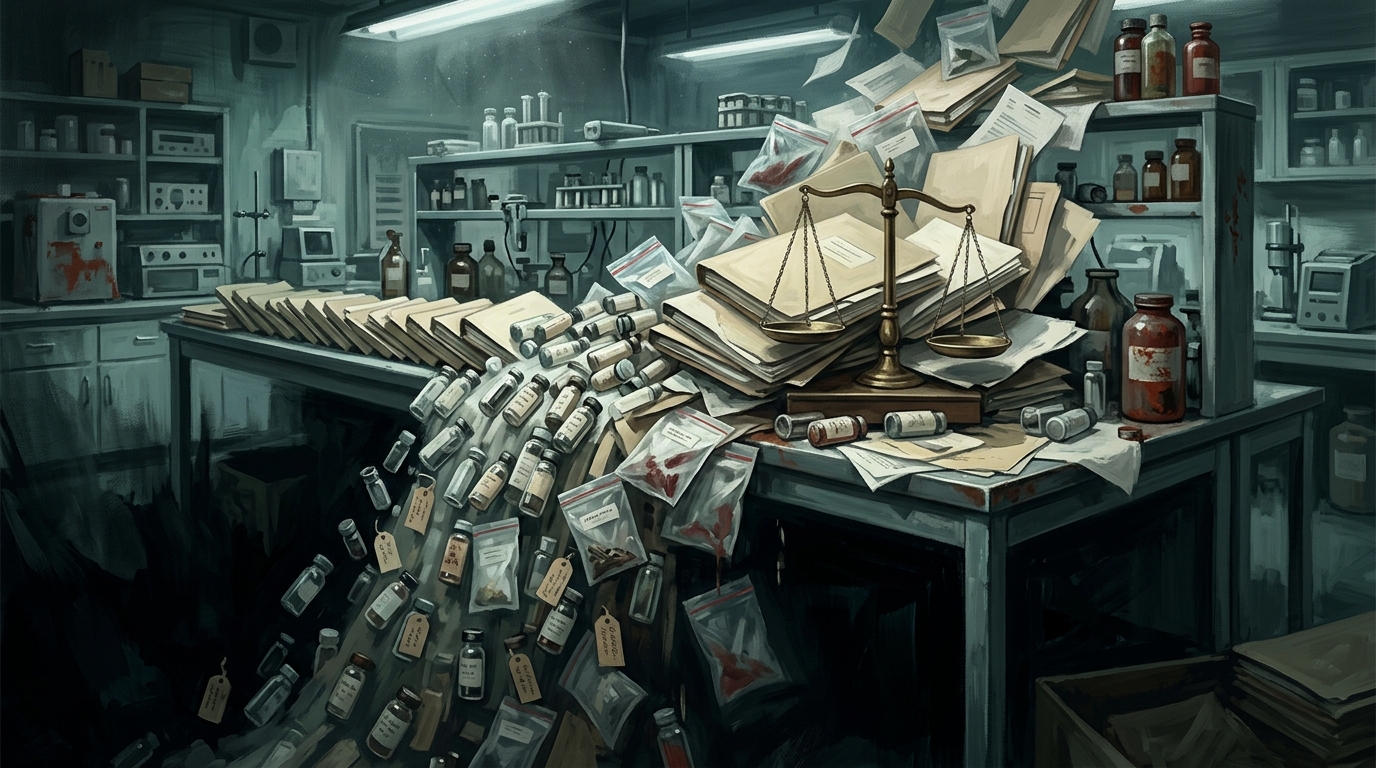
On a single day in April 2017, district attorneys across Massachusetts walked into courthouses and dismissed 21,587 criminal cases. Nothing like it had ever happened in the United States. The dismissals were not the work of a mass clemency or a change in the drug laws. They were the accounting, five years delayed, for one woman: a state chemist named Annie Dookhan, who for nearly a decade had certified the identity of seized drugs she had never tested, forged the initials of colleagues, contaminated samples to match her own false reports, and lied about all of it — on the stand, under oath, in thousands of prosecutions. And Dookhan, it turned out, was only half the scandal. A hundred miles west, in a state lab in Amherst, a second chemist named Sonja Farak had spent roughly eight years testing the Commonwealth’s drug evidence while consuming it — methamphetamine from the lab’s reference standards, crack cocaine she cooked from police submissions, a workday pharmacology so extensive that she was, by her own later account, under the influence during virtually every test she ran. When the state’s highest court finished with the two of them, and with the prosecutors who had concealed the scope of Farak’s addiction, the dismissals statewide approached forty thousand cases. The criminal-justice system of an American state had certified, at industrial scale, evidence that was fiction.
Superwoman
The Hinton State Laboratory Institute occupied an aging building in Jamaica Plain, a Boston neighborhood, where a small staff of chemists processed drug evidence for police departments across the eastern half of the state. The work is repetitive and exacting: weigh the sample, run the preliminary color tests, confirm with the mass spectrometer, write it up, keep the chain of custody intact. A competent chemist might complete fifty to a hundred and fifty samples a month. Annie Dookhan, who joined the lab in 2003, routinely certified more than five hundred. Her supervisors called her the most productive chemist in the building and treated her numbers as diligence rather than as the statistical impossibility they were. Colleagues noticed that she was never at the mass spectrometer long enough to generate the data she signed. Nobody audited her. Her output made everyone’s numbers look good.
What Dookhan was actually doing had a name in the forensic underworld long before Massachusetts learned it: dry-labbing. She would eyeball a batch of samples, test a fraction or none, and certify the lot. When retesting threatened to expose a false certification — when a sample she had called cocaine turned out to be nothing — she contaminated the evidence, adding known drug to the vial so the confirmation would match her lie. She forged the initials of an evidence officer to paper over unauthorized removals. She testified as an expert in trial after trial, embellishing her credentials with a master’s degree in chemistry from the University of Massachusetts that she did not have. And she cultivated prosecutors with a solicitousness that itself violated every norm of forensic neutrality — emailing one assistant district attorney that her job was to get drug dealers off the street, asking another what result he needed. A defense lawyer’s file was never going to catch her; the lab’s own controls should have, and were not run.
The unraveling began, as these things do, with a small procedural breach. In June 2011, Dookhan removed ninety samples from the evidence room without signing them out, then forged an officer’s initials in the log. The lab investigated with the urgency of a parking dispute: she was taken off testing duties but kept testifying, and months passed before anyone above the lab learned of the breach. In 2012, oversight of the Hinton lab transferred to the State Police, whose investigators asked the questions the Department of Public Health never had. Confronted, Dookhan confessed with unnerving composure: “I screwed up big-time,” she told them. “I messed up bad; it’s my fault.” The lab was shut down in August 2012. The governor’s office began the grim task of counting: Dookhan had touched evidence in the cases of more than twenty-four thousand defendants. In November 2013, she pleaded guilty to twenty-seven counts — obstruction of justice, perjury, evidence tampering — and was sentenced to three to five years in state prison. She was paroled in 2016, having served less time than many of the defendants convicted on her certificates.
The Chemist in the Vault
Two months before Dookhan’s guilty plea, in January 2013, a chemist at the state lab in Amherst was arrested after colleagues discovered that drug standards — the certified reference samples labs use to calibrate their instruments — were missing and that evidence in her workspace had been tampered with. Sonja Farak’s story inverted Dookhan’s: where Dookhan faked the science, Farak performed it — while profoundly impaired. The record eventually assembled from her own therapy worksheets and testimony was staggering. She had begun using the lab’s methamphetamine standard around 2005, within a year of arriving; progressed through amphetamine, ketamine, cocaine, and LSD; and by the end was smoking crack — some of it manufactured by her, at her lab bench, from police evidence — multiple times a day, including during work hours and, on at least one occasion, before testifying. She pleaded guilty in January 2014 to evidence tampering and drug theft and received eighteen months.
If the story had ended there, Farak would be a footnote to Dookhan. What made Amherst a second, independent institutional scandal was the conduct of the prosecutors. Attorneys in the state Attorney General’s office — principally Assistant Attorney General Anne Kaczmarek, who prosecuted Farak — possessed evidence, including Farak’s mental-health worksheets, showing her drug use stretched back the better part of a decade. Defense lawyers seeking to overturn convictions were told, and courts were allowed to believe, that the misconduct window was a matter of months. Another assistant attorney general, Kris Foster, told a judge that all responsive documents had been turned over when she had never reviewed the file. On that false record, judges denied relief to defendants whose evidence Farak had tested while addicted. When the worksheets finally surfaced — pried loose by defense attorneys years later — Superior Court Judge Richard Carey issued findings in 2017 that remain among the harshest ever directed at Massachusetts prosecutors: Kaczmarek and Foster, he wrote, had committed “a fraud upon the court,” deceit that “permeate[d]” the proceedings. The Supreme Judicial Court would later call the episode “egregious.” In 2023, the state’s highest court disbarred Kaczmarek; Foster, by then, had been suspended from practice. It took ten years for the lawyers’ reckoning to catch up to the chemist’s.
The Great Dismissals
The judicial response unfolded in two waves, both driven by litigation from public defenders and the American Civil Liberties Union of Massachusetts. In Bridgeman v. District Attorney for the Suffolk District, the Supreme Judicial Court in 2017 confronted the arithmetic that had paralyzed the system for five years: case-by-case relitigation of twenty-odd-thousand tainted convictions would take decades the defendants did not have. The court ordered the district attorneys to choose — identify the small subset of cases they could and would actually retry, and dismiss the rest with prejudice. The result was the April 2017 mass dismissal of 21,587 Dookhan cases. The following year, applying the same logic to Amherst and adding a sanction for the prosecutors’ concealment, the court ordered dismissal of the Farak-era cases wholesale — including, remarkably, categories of cases dismissed not because Farak had touched them but because the Attorney General’s office had forfeited the Commonwealth’s claim to them by its deceit. By 2021, the statewide toll stood at nearly thirty-eight thousand dismissed cases: roughly 21,400 tied to Dookhan, 16,400 to Farak. The court also ordered the repayment of fines and fees collected on vacated convictions. No mass exoneration in American history approaches the scale.
The Sole Bad Actor
In 2014, the state’s Inspector General completed a fifteen-month investigation of the Hinton lab and delivered a conclusion engineered for maximum reassurance: Dookhan was “the sole bad actor,” and the certificates signed by the lab’s other chemists could be trusted. The report was simultaneously true in its particulars and false in its architecture. No other Hinton chemist was shown to have fabricated results — but the same report documented a laboratory in which such fabrication was structurally invisible: supervisors without scientific management training, no independent quality-assurance unit, no proficiency audits, chain-of-custody practices that a first-year defense associate could shred, and a management culture that had responded to the 2011 evidence breach by keeping it quiet. “Sole bad actor” described the arson while certifying the tinder. Defense litigators treated the phrase as a settlement position rather than a finding, and the ensuing years vindicated them — not at Hinton, but at Amherst, where the second bad actor had been working all along, undetected by an oversight regime that the sole-bad-actor theory implied was sound.
The scandal also forced Massachusetts to confront a question American courts had barely considered: what does the state owe people whose convictions it manufactured? The Supreme Court supplied part of the answer in 2017 in Nelson v. Colorado, holding that states must refund fines, fees, and restitution collected on convictions later invalidated — without forcing exonerees to prove their innocence to get their own money back. Massachusetts courts applied the principle to the lab cases, and the Commonwealth began repaying probation fees, drug-analysis fees, and fines harvested from tens of thousands of void convictions — an accounting exercise that quantified, line by line, how much revenue the state had extracted on the strength of fraudulent chemistry. What no ledger could return was recorded instead in the Bridgeman filings: deportations already executed, parental rights already severed, jobs and licenses already lost to background checks that reported convictions the state now conceded were built on fiction.
Nor was Massachusetts an outlier so much as a jurisdiction that finally counted. West Virginia’s courts had confronted the serologist Fred Zain in the 1990s, whose fabricated blood evidence tainted more than a hundred cases across two states; Oklahoma City’s Joyce Gilchrist, celebrated for delivering convictions, was found to have overstated forensic conclusions in capital cases; Texas, New Jersey, and Oregon each produced their own lab scandals in the years surrounding Dookhan’s. A 2009 National Academy of Sciences report had warned, before any of the Massachusetts revelations, that American forensic science operated without the culture of blind verification that real science requires. The drug labs were the warning’s cheapest test — chemistry is the most objective forensic discipline, the one place fraud should be hardest — and the system failed it twice in one state, for a decade, at volume.
The Telling
The scandal owes its full excavation less to any official body than to a handful of unpaid obsessives, and the record should name them. The therapy worksheets that unraveled the Farak cover-up were found because a Northampton defense lawyer, Luke Ryan, spent years insisting on what the Attorney General’s office said did not exist — and finally, in the fall of 2014, examined the physical evidence seized from Farak’s car and discovered the mental-health records that prosecutors had reviewed, catalogued, and withheld while telling judges the file was complete. Ryan’s discovery became Judge Carey’s 2017 findings, the SJC’s dismissals, and eventually the bar cases against the lawyers. In 2020, the affair reached its widest audience through the Netflix documentary series “How to Fix a Drug Scandal,” which put the worksheets, the emails, and the empty assurances on screen — a civics lesson in how a state conceals its own arson investigation.
And Massachusetts was not finished counting. In April 2023, the Supreme Judicial Court extended the framework it had built for the drug labs to the state’s breath-test program, after litigation revealed that the Office of Alcohol Testing had withheld hundreds of failed calibration records from defendants. Roughly twenty-seven thousand drunk-driving cases tested on the state’s machines across an eight-year window, the court held, carried a conclusive presumption of “egregious government misconduct”; defendants could seek to undo their pleas wholesale. The doctrine forged in Bridgeman — that when the state corrupts its own evidence at scale, the remedy must be systemic rather than case-by-case — had become ordinary Massachusetts law, invoked a third time in a single decade. Whether that represents a state uniquely broken or uniquely honest is the open question. Every jurisdiction runs labs under production pressure. One, so far, has been made to publish the ledger.
What the Certificates Were Worth
It is worth pausing on what a drug certificate is, in the life of a criminal case. It is, in most prosecutions, the case — the single piece of paper that converts a plastic bag into a felony. The Supreme Court had held in 2009, in Melendez-Diaz v. Massachusetts — a case, with grim irony, about this very lab system — that defendants have a constitutional right to confront the analyst who signed it. The scandal demonstrated why that right matters and how little it can catch. Dookhan testified confidently and often; confrontation did not expose her, because the fraud lived upstream, in the untested vials and unaudited logs. The defendants pleaded guilty by the thousands — ninety-plus percent of drug cases end in pleas — because contesting a state lab certificate seemed hopeless. Most served their sentences in full before the dismissals came. They lost jobs, homes, immigration status, custody, years. The system returned them a docket entry.
The institutional lessons were catalogued in official reports and only partially implemented. The Hinton lab had no meaningful quality-assurance program, no blind retesting, no supervisory review of statistically impossible output. The Amherst lab had no drug inventory controls rigorous enough to notice a chemist consuming the standards for years. Both labs answered to agencies — public health, then public safety — whose customers were police and prosecutors, not courts, and whose incentives ran toward throughput. Massachusetts moved its forensic work under new oversight and spent millions on audits; the ACLU and the defense bar spent years litigating the refunds. National forensic-science reformers added Dookhan and Farak to the canon that already included discredited hair-comparison testimony and bite-mark analysis: proof that the white coat in the witness box is a human being under production pressure, and that a system which treats laboratory output as infallible has simply chosen not to look.
The deepest failure, though, belongs to the professionals who did look and looked away. Supervisors who promoted the impossible numbers. Prosecutors who cultivated a friendly chemist and, later, buried the file that would have freed the wrongly convicted. Agency lawyers who told a court the drawer was empty without opening it. Every safeguard the law provides — discovery, confrontation, the prosecutor’s Brady obligation — assumes a baseline of candor from the state’s own agents. Two chemists broke the science. It took lawyers to break the correction. Massachusetts dismissed the cases; the profession is still litigating, in bar proceedings and in its conscience, what it owes the tens of thousands of people who answered for crimes the Commonwealth could never actually prove.