American business culture believes in second acts the way other civilizations believed in transmigration of souls, and no life has tested that faith more rigorously than Barry Minkow’s. Consider the résumé in sequence. Teen-age founder of a carpet-cleaning company that reached the NASDAQ before he could legally rent a car. Convicted mastermind, at twenty-two, of one of the great stock frauds of the nineteen-eighties. Born-again prison convert. Ordained pastor of a San Diego congregation. Celebrated fraud investigator whose tips helped regulators and journalists unwind other people’s schemes — a reformed thief hired, in effect, as a locksmith. Then: convicted stock manipulator, again, in 2011. Then: convicted embezzler, again, in 2014 — this time of more than three million dollars from his own church, from the collection plates and building funds of the people who had believed in redemption most literally.
The Justice Department’s press release for the final conviction settled on the phrase “former inmate turned pastor,” which is accurate and hopeless, like describing a hurricane as former weather. The truer summary belongs to the sentencing judge from 1989, Dickran Tevrizian, who looked at the twenty-two-year-old wonder boy and told him he had no conscience. Every institution that encountered Minkow over the next quarter century — Wall Street, the parole board, the evangelical church, the F.B.I. itself — conducted its own experiment on the question of whether the judge had been too harsh. The data are now in.
The Boy Wonder
The legend was real, which is what made it dangerous. Barry Minkow started ZZZZ Best in 1982, at sixteen, in the garage of his family’s house in Reseda, in the San Fernando Valley — a kid with a carpet shampooer, a phone, and a monstrous gift for selling. The gift was genuine; the business never was. Almost from the beginning, ZZZZ Best ran on check kiting, credit-card overcharges, and borrowed money at loan-shark terms, because carpet cleaning is a miserable, low-margin trade and Minkow’s ambitions were not. The solution he found became the fraud’s engine: he invented a second business, “insurance restoration” — lucrative contracts to repair fire- and water-damaged buildings for insurers. The contracts did not exist. The buildings did not exist. But paper multiplied: by the time ZZZZ Best went public in December 1986, the restoration division supplied the overwhelming bulk of reported revenue — investigators later put the fictitious share of the business at roughly nine-tenths — and the numbers levitated a Valley carpet-cleaner into a market darling worth some two hundred million dollars at its 1987 peak. Minkow, twenty years old, was on Oprah, in the papers, at the wheel of a red Ferrari: the boy wonder of Reseda, capitalism’s favorite bedtime story about itself.
The fiction had co-authors. Minkow’s early financing came in part from figures on the fringes of Los Angeles organized crime, whose loans carried terms that kept the teen-ager perpetually scrambling; his restoration empire was documented by a confederate, Tom Padgett, an insurance appraiser who created a shell called Interstate Appraisal Services whose entire function was to generate paper confirming jobs that did not exist, while another lieutenant, Mark Morze, manufactured the invoices and financial statements that turned Padgett’s fictions into auditable revenue. Both men were eventually convicted alongside their boy employer. The professionals at the perimeter performed less honorably than the con men at the center: an investment bank underwrote the offering, lawyers papered it, and the accountants reviewed financial statements in which the dominant line of business was unverifiable — a NASDAQ listing built atop an appraisal shell and a rented telephone. Minkow, meanwhile, became a minor national celebrity, dispensing bootstrap wisdom on television as the teen-age millionaire who proved anyone could make it in America. He appeared on The Oprah Winfrey Show in 1987, months before the collapse, radiating the exact confidence the audience had come to consume.
Sustaining the illusion required set design, and the set pieces have entered the fraud-examination curriculum. When the auditors at Ernst & Whinney insisted on seeing a restoration site, Minkow’s confederates leased floors of a building in Sacramento, dressed them as an active job, bribed a security guard to greet the visitors, and walked the accountant through a construction project that had been assembled for his benefit like a film set — then struck it after the tour. The auditors, who had agreed to give advance notice of the visit and signed confidentiality commitments not to verify independently, saw exactly what they had arranged to be shown. It is the eternal ZZZZ Best lesson, taught in every auditing course since: confirmation choreographed by the client is not evidence; it is theatre with a sign-off.
The collapse came, fittingly, from the smallest ledger in the story. A Los Angeles homemaker whom Minkow’s operation had overcharged years earlier — fraudulent add-ons to a carpet-cleaning credit-card slip — had kept meticulous records and found a reporter. The Los Angeles Times story in May 1987 pulled the first thread; within weeks, lenders and journalists pulling harder found that the restoration contracts could not be verified because there was nothing to verify. The stock cratered, the board discovered its company was a hologram, and the bankruptcy that followed established a fact still cited with a kind of awe: a NASDAQ company whose audited financials described an enterprise that was, in substance, ninety per cent imaginary. Ernst & Whinney, to its partial credit, resigned the engagement in June 1987 upon encountering evidence of the fraud — though the resignation’s quietness, and the lag before the market understood what it meant, became its own case study in the inadequacy of auditor exit as an alarm system. The firm never issued an opinion on the fiscal year then in progress; the numbers investors were trading on were the prior year’s fictions, bearing a clean opinion that no one had withdrawn loudly enough to matter. In the collapse’s forensic aftermath, investigators concluded that the enterprise had been insolvent from the start — that there had never been a moment when ZZZZ Best, as described in its filings, existed. In December 1988 a federal jury convicted Minkow on fifty-seven counts — racketeering, securities fraud, money laundering, bank fraud, mail fraud, tax evasion, the full index. Twenty-five years, said Judge Tevrizian, and twenty-six million dollars in restitution, to a defendant not yet twenty-three.
The Convert
What happened next is the reason Minkow’s case belongs to the literature of ethics rather than merely of crime. In prison he converted, loudly and totally, to evangelical Christianity; he studied by correspondence, earned degrees from Liberty University, and emerged after seven and a half years as American redemption’s most marketable artifact: the fraudster who found God and now wanted to fight fraud. The performance — and the genuine talent underneath it — was irresistible. By the early two-thousands he was the senior pastor of Community Bible Church in San Diego, preaching to a growing congregation that knew his history and loved him partly because of it; the wolf who guards sheep is a better sermon than any shepherd.
And here the story develops its cruelest complication: for a while, he was good at it. Through his Fraud Discovery Institute, Minkow investigated Ponzi schemes and investment frauds with a savant’s eye for his own former species, and the work was real — regulators and prosecutors credited his tips with helping expose schemes worth hundreds of millions of dollars; the F.B.I., in its own later press materials, acknowledged that he had once been regarded as a fraud-buster who trained agents. News programs profiled him. He wrote books with titles like Cleaning Up. A biographical feature film went into production with Minkow playing himself — redemption as intellectual property, the con man’s life rights as his final asset. Uniquely among American felons, he had converted his crime into a profession twice over: first as its practitioner, then as its taxonomist.
The redemption years had their own texture, and honesty requires rendering it, because the con only worked to the degree the reform was plausible — and it was plausible. Released at the end of 1995, Minkow served an apprenticeship at a Los Angeles-area congregation before San Diego called him; he married, preached, counselled addicts and inmates, and spoke — compellingly, by every account — about the machinery of deception from the only vantage that fully understands it. The Fraud Discovery Institute’s work product was consumed by regulators, litigators, and business journalists precisely because some of it held up; companies he flagged drew genuine enforcement attention, and for a stretch in the mid-two-thousands he was profiled on national television as the rarest of specimens, the poacher turned honest gamekeeper. Meanwhile ZZZZ Best itself had entered the professional canon: the Association of Certified Fraud Examiners and a generation of auditing textbooks adopted the case as the definitive parable of confirmation theatre, and accounting students still watch the story unfold as a rite of passage. Minkow lectured to some of those students. There is a photograph-negative quality to this period that fraud scholars have never quite resolved: either a genuinely reformed man slowly re-corrupted by celebrity, debt, and opportunity, or a patient predator amortizing a fifteen-year setup. The church money argues for the second reading. The sermons, people who heard them still insist, argued for the first.
The Relapse
The unwinding began with an investigation that looked, from the outside, like all his others. In 2009, Minkow began publishing incendiary reports about the Lennar Corporation, one of the country’s largest homebuilders, accusing it of operating, in his phrase, like “a financial crime in progress.” Lennar’s stock fell hard. What the reports did not disclose was that Minkow was working in concert with a San Diego developer locked in bitter litigation with Lennar — and that Minkow had positioned himself to profit from the collapse he was manufacturing, trading against the company while presenting himself as a disinterested investigator. It was ZZZZ Best inverted with perfect symmetry: as a boy he had sold a fiction to inflate a stock he owned; as a fraud-buster he sold a fiction to crater a stock he was shorting. In March 2011 he pleaded guilty in Florida federal court to conspiracy to commit securities fraud, resigned his pulpit, and was sentenced to five years — along with a restitution judgment in Lennar’s favor so large, over half a billion dollars, that it functioned as a lifetime lien on his existence.
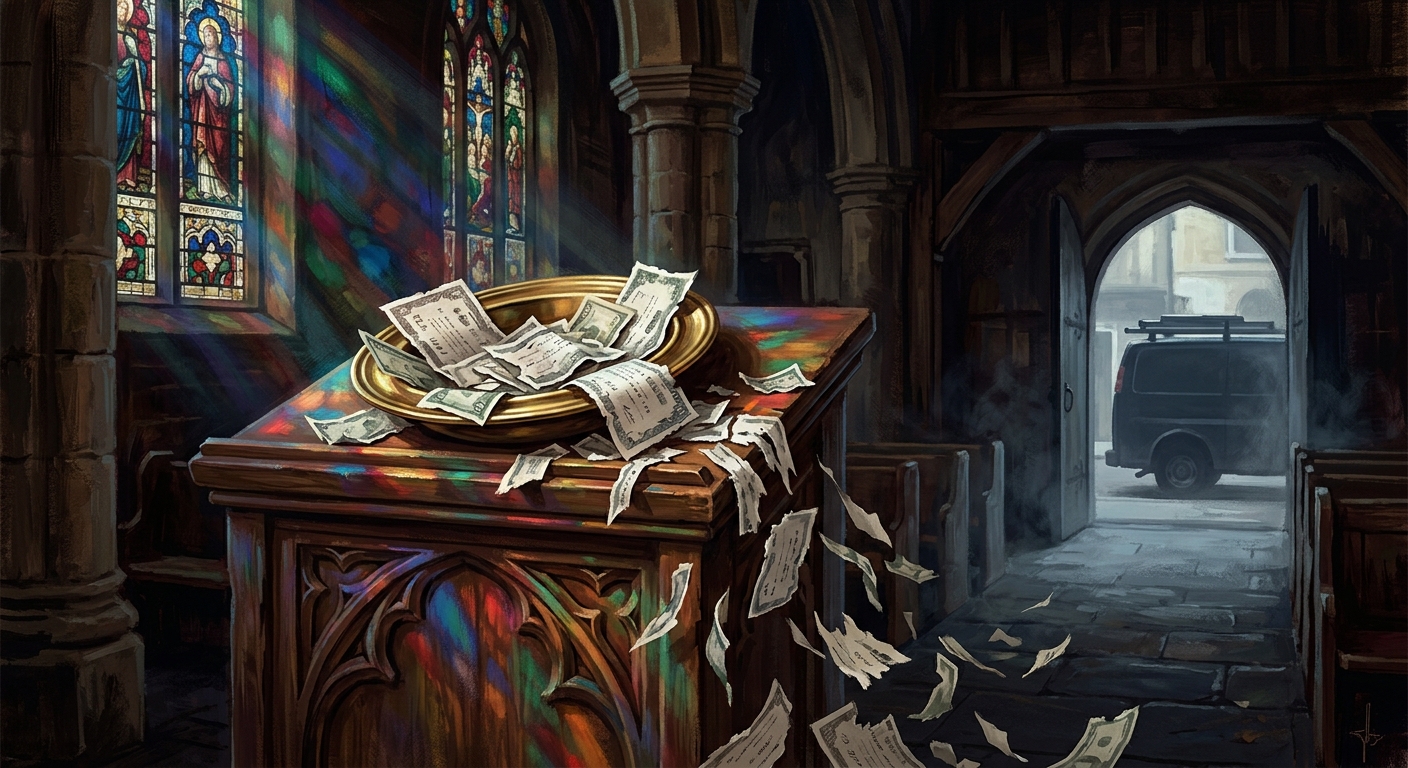
Even that was not the bottom. As prosecutors and the church’s own accountants worked backward through the books, they discovered that the pastor had been robbing the congregation for years — and the government’s eventual charging documents read like a manual of petty ecclesiastical predation: forged signatures on church checks; unauthorized church accounts opened and drained; parishioners’ donations, some earmarked for specific ministries and projects, diverted to his personal use; church credit exploited; the take concealed from the I.R.S. The total exceeded three million dollars, extracted from the institution whose entire function had been to certify his transformation. In 2014 he pleaded guilty — conspiracy and tax counts — and received another five-year federal term for bilking, as the F.B.I.’s announcement put it with bureaucratic understatement, his own congregation. The man who had been America’s proof that people change spent the rest of the decade in federal custody as its proof of the opposite.
The Lennar mechanics repaid study, because they showed how completely Minkow had weaponized his redemption brand. The reports carried the Fraud Discovery Institute’s letterhead and the moral authority of the reformed insider; they were amplified through the internet channels where short-side research circulates; and they were, in material part, opposition research for hire — the San Diego developer Nicolas Marsch, embroiled in failed litigation against the homebuilder, had engaged Minkow’s services. When Lennar’s lawyers fought back in Florida state court, the discovery process did what discovery does: it exposed the trading records, the undisclosed engagement, and the fabrications, and the litigation fed directly into the federal charge. The restitution judgment — five hundred and eighty-three million dollars, the diminution in Lennar’s value the court attributed to the campaign — made Minkow, almost incidentally, one of the largest individual judgment debtors in the country. He would later be ordered to pay millions more to the church. The numbers are unpayable and therefore permanent: a lifetime annuity of consequence, drawing interest.
The Auditor’s Prayer
The victims of the final act deserve more than a paragraph, though a paragraph is what history usually gives them. The San Diego congregation was not a hedge fund with a diligence department; it was schoolteachers and retirees and recovering addicts who tithed, some of whom had entrusted the church — which is to say, functionally, the pastor — with money for missions and building projects that never received it. Several had joined the church precisely because of Minkow’s testimony, drawn by the promise that grace could remake even the worst of men. Their pastor’s conviction cost them their savings and something less recoverable: the story itself. Betrayal by a stranger takes money. Betrayal by a redemption takes the theology.
It is tempting to close the Minkow file under psychology — the diagnosticians’ vocabulary of glibness, grandiosity, and simulated remorse fits him like a bespoke suit, and he has himself, in later confessional appearances, endorsed versions of it. But the case’s enduring value lies in what it reveals about the institutions, because every one of them failed in the identical way: they mistook narrative for evidence. The 1986 underwriters and auditors accepted a story about a wonder boy because the story was better than the verification was rigorous. The parole and ministry worlds of the nineties accepted a story about grace because their theology — and, one must say it, their fund-raising — runs on such stories. The financial press and even federal investigators of the two-thousands accepted a story about the reformed thief’s unique insight, granting Minkow a credibility no unconvicted analyst could have purchased, precisely because his record was terrible. Each institution believed that his past de-risked his present. His past was the risk.
The accounting profession, at least, metabolized its lesson formally: ZZZZ Best is a permanent fixture of fraud-examination training, the canonical case for why auditors must control their own evidence — why a site visit negotiated with the client, a confirmation routed through the client, a story corroborated only by the storyteller, are worth nothing. The church has no equivalent curriculum, and perhaps cannot have one; a faith built on the prodigal son cannot audit its prodigals without ceasing to be itself, which is exactly the vulnerability a Minkow prices. That may be the coldest finding in the whole file. Fraud examiners speak of the fraud triangle — pressure, opportunity, rationalization. Minkow’s career demonstrates a fourth vertex available only to the truly gifted: absolution. Given enough of it, opportunity regenerates indefinitely. The boy who built a fake company found, in redemption, the one commodity Americans will always restock for a good enough salesman — and he sold it until the very last register, the one by the altar, was empty.