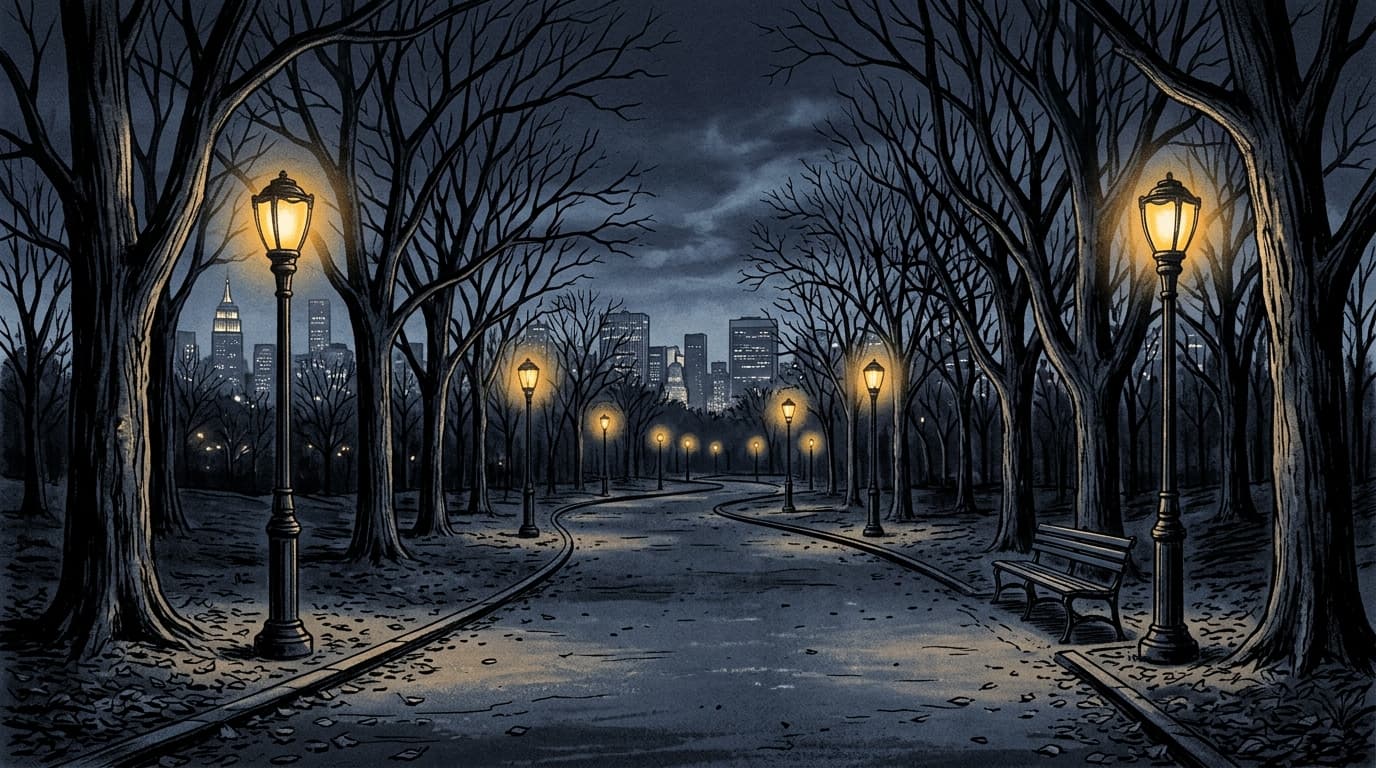
On the night of April 19, 1989, a twenty-eight-year-old investment banker went for a jog in Central Park and was beaten, raped, and left for dead in a shallow ravine near 102nd Street. She lost three-quarters of her blood. She was in a coma for twelve days. When she awoke, she had no memory of the attack. Within hours of the discovery of her body, the New York Police Department had detained dozens of Black and Latino teenagers who had been in the park that night, and within days, detectives had extracted video-recorded statements from five of them placing themselves at the scene of a crime that forensic evidence would never connect them to — not then, not at trial, not ever.
The five were Antron McCray, fifteen; Kevin Richardson, fourteen; Yusef Salaam, fifteen; Raymond Santana, fourteen; and Korey Wise, sixteen. Wise had not even been a suspect. He had accompanied Salaam to the precinct to support his friend, and detectives decided, in the middle of the interrogation, that they wanted him too. He would serve the longest sentence of all — nearly thirteen years in adult facilities — because he made the mistake of being loyal.
What happened in those interrogation rooms over the following two days is one of the most thoroughly documented cases of coerced juvenile confession in American history. And what happened in the thirteen years that followed — the media frenzy, the full-page newspaper advertisements calling for the return of the death penalty, the convictions built on confessions the physical evidence flatly contradicted, and finally the confession of the actual rapist, confirmed by DNA — is a parable about what the Founders feared most: a government, inflamed by public panic, that decides who is guilty before it asks what is true.
The Park, the Press, and the Price of Panic
The city in 1989 was a tinderbox. New York recorded 1,896 murders that year. Crime dominated every mayoral debate, every tabloid front page, every bar conversation. The phrase wilding — allegedly slang used by the teenagers to describe roaming the park — entered the national vocabulary overnight, though the teens themselves later said they had never used it. It did not matter. The story wrote itself: a white investment banker, a pack of Black and brown teenagers, the most famous park in America.
Before any of the five had been arraigned, the city's tabloids had convicted them. Donald Trump, then a Manhattan real estate developer, took out full-page advertisements in four major New York newspapers — reportedly costing $85,000 — addressed to the citizens of the city under the headline: BRING BACK THE DEATH PENALTY. BRING BACK OUR POLICE! The ad did not name the five boys. It did not have to. It ran on May 1, 1989, before any trial, before any defense, before the first piece of physical evidence had been analyzed. "I want to hate these murderers," the advertisement read, "and I always will... CIVIL LIBERTIES END WHEN AN ATTACK ON OUR SAFETY BEGINS!"
Read that sentence again, because it is the precise inversion of the American founding compact. The entire architecture of the Bill of Rights — the Fourth, Fifth, Sixth, and Eighth Amendments — was constructed on the premise that civil liberties exist precisely when the government is most tempted to suspend them. The Founders had watched the Crown suspend jury trials, extract confessions under pressure, and execute men on the wave of public fury. The ad in those four newspapers was a demand that the state do exactly that — and it was cheered.
Thirty Hours Without a Lawyer
The interrogations of the five boys were conducted by detectives working in relays, in a precinct under siege from the mayor's office, the press, and a frightened city. The boys were questioned for between fourteen and thirty hours. None had a lawyer present during the critical questioning. Some had parents in the room for portions; some did not. Korey Wise, sixteen but with the cognitive capacity of a much younger child and a hearing impairment, was questioned late into the night without any guardian present for much of it.
Detectives used the now-notorious playbook that interrogation researchers have spent decades documenting: they told each boy that the others had named him. They told them they could go home if they just told the truth as the police already knew it. They minimized — it was the other boys who did the bad thing, you just held her down. They maximized — you're going to prison for the rest of your life unless you help us. They fed details: the location, the clothing, the sequence. And then, one by one, exhausted children began to repeat the story back.
The videotaped statements that resulted would become the prosecution's entire case. Because there was nothing else.
The physical evidence, when it came back, was exculpatory to a degree that should have ended the prosecution. Semen recovered from the victim's sock — the only semen recovered from the scene — did not match any of the five. DNA testing available in 1989 excluded all of them. Hairs found on the defendants did not match the victim. There was no blood on any of the boys consistent with the massive blood loss the victim suffered. The prosecution's own forensic evidence said these five children were not the rapists.
Assistant District Attorney Elizabeth Lederer prosecuted the cases anyway. Her theory mutated to fit the absence of evidence: the boys may not have ejaculated; the semen might belong to an unknown sixth participant who got away. The confessions, riddled as they were with contradictions and fed details, were presented as the truth. The boys' statements placed the attack at the wrong locations, at times inconsistent with the timeline, and described implements of the assault that matched nothing found at the scene. Juries convicted anyway.
What Children's Confessions Are Worth
The legal system has known for more than a century that confession evidence is uniquely dangerous. The Founders inherited from English common law a deep suspicion of extracted admissions — the memory of the Star Chamber, where compulsory self-incrimination was policy, haunted the Fifth Amendment's drafting. No person, it says, shall be compelled in any criminal case to be a witness against himself. That clause is not a courtesy. It is a structural conclusion about human nature: that state power applied to an isolated individual, especially a frightened one, especially a child, can manufacture truth rather than discover it.
Modern exoneration data has proven the Founders' intuition with laboratory precision. False confessions are now documented as a leading contributor to wrongful convictions — present in roughly a quarter of DNA exonerations catalogued by the Innocence Project, and in a substantially higher share of juvenile exonerations. Children, research by Laurence Steinberg, Saul Kassin, and others has shown, are dramatically more compliant under interrogation, more likely to believe an adult who says they will be released if they confess, and less capable of understanding that a confession cannot simply be taken back later.
The Central Park Five case is the canonical example. Every element of the false confession research is present: youth, lengthy custodial isolation, no counsel, deception about the evidence, minimization and maximization, details supplied by questioners that later appeared in the statements as if they were the suspect's own knowledge, and — critically — physical evidence that disproved the confessions before trial and was simply argued around.
The jury system was supposed to be the last firewall. The Founders called the jury the anchor of democratic government; Jefferson considered trial by jury the only mechanism yet devised for keeping a people free. But a jury is only a firewall when the evidence reaching it is real. Twelve New Yorkers watched videotapes of children describing a rape and could not bring themselves to believe that children would confess to something they did not do. That belief — wrong, as a matter of documented science — sent five boys to prison.
The Jogger, and the Truth She Never Got Back
Trisha Meili survived — miraculously, given that doctors initially rated her chances as poor. But she lost twelve days of her life to the coma, and, permanently, the memory of the attack itself. She could not identify anyone. She never could. This fact matters legally, and it matters morally, for reasons that cut in two directions at once. On one side, it meant the prosecution could not present the one witness whose testimony would have been worth having; the case had to be built entirely from the boys' mouths, which is precisely the construction the law has been taught — since the Founders, since the common law before that — to treat with the deepest suspicion. On the other side, it meant that when the real rapist confessed thirteen years later, Trisha Meili had no memory against which to test him. She has said publicly that she continues to have questions. That is not a failure of hers; it is the residue of a system that gave her a story before it had facts, and then, when the facts arrived, had to hand her a second story. The first story was false. The city's inability to admit that cleanly for twenty-five years has compounded the injury to her, as well as to the five men. Denied an honest account, a victim is left holding both.
Two Trials, One Script
The five were tried in two groups. Richardson, Salaam, and McCray went first, in the summer of 1990, before Justice Thomas Galligan in Manhattan. Santana and Wise followed in the fall. The prosecution's presentation in both trials rested on the video statements and on the jury's natural inability to imagine an innocent child confessing. Defense counsel pointed out, futilely, that not one piece of forensic evidence — not one — connected any defendant to the rape: the victim's blood was on no one's shoes or clothing, her hair was on no one, the semen matched no one, and the timeline described in the confessions was inconsistent with the jogger's actual route as reconstructed by the police themselves. The confessions even conflicted with each other on who did what, with the statements describing the victim's clothing wrong and placing the attack at the wrong time of night. Juries deliberated eight and nine days in the first trial, asking for read-backs of the statements — they were struggling with the same contradictions — and then convicted anyway. The second jury took less time. Public opinion had already instructed them on the verdict the city required.
It is worth recording what the five boys looked like to the city while this was happening, because the dehumanization was the mechanism. Tabloid covers showed their faces under the word wilding. Television news replayed a fragment of video of Richardson in custody, smiling — a fourteen-year-old's nervousness read as a predator's glee. City Council members competed to demand the harshest possible response. No prominent official in New York stood up in 1989 or 1990 and said the sentence the cases cried out for: these are children, there is no physical evidence, and something is wrong here. Not one. The presumption of innocence did not fail in a courtroom that year; it failed in a culture, and the courtrooms followed the culture down.
Why Children Break: The Science the Precinct Ignores
The Supreme Court has been slowly converging on what interrogation researchers proved decades ago: that the developing brain is categorically different under pressure. In Roper v. Simmons (2005) the Court barred executions for crimes committed by juveniles; in Graham v. Florida (2010) it barred life without parole for most juvenile offenses; in J.D.B. v. North Carolina (2011) it held that a child's age must inform the Miranda custody analysis, because, in Justice Sotomayor's words for the Court, children often lack the experience, perspective, and judgment to recognize and avoid choices that could be detrimental to them. These were constitutional recognitions of a neurobiological fact. The prefrontal cortex — the structure that governs impulse control, long-range consequence assessment, and resistance to social pressure — is not fully myelinated until the mid-twenties. A fifteen-year-old in a windowless interrogation room with two armed adults telling him his friends have betrayed him and he can go home if he agrees is not a small adult making choices. He is a neurological system being administered to, and the literature on juvenile false confessions — the laboratory experiments of Kassin and others showing minors confess to impossible acts at rates that should embarrass any system that uses them — reads today like an unheeded warning label. It was available in 1989. It was ignored then, and the doctrine most jurisdictions apply to juvenile confessions still predates the science.
Prison, and the Years the City Stole
Antron McCray served six years. Kevin Richardson served seven. Yusef Salaam served nearly seven. Raymond Santana served seven. Korey Wise — tried as an adult at sixteen — served nearly thirteen, much of it in upstate facilities, hundreds of miles from family, in adult prisons where he was beaten repeatedly.
They entered as children. They emerged as men in their twenties and thirties, to a city that had forgotten their names but remembered their guilt. Santana, years later, described the experience of being a branded rapist as something that does not end with release: "You can get your freedom back, but you can't get your life back." Salaam has spoken of learning, in prison, to accept that he would die there if the truth never came out — because no mechanism existed to compel anyone to look again.
Here it is worth pausing on the structure of the failure, because it was not one bad actor. It was a system performing exactly as it was configured to perform under political pressure. The detectives who extracted the confessions faced no sanction. The prosecutors who tried a case their own DNA lab undercut faced no sanction. The tabloids that printed what amounted to wanted posters faced no reckoning. The real estate developer who bought newspaper pages to demand the execution of children who would later be proven innocent faced no consequence at all; he would, decades later, decline to apologize, on the grounds that the boys had, after all, confessed.
Every safeguard the Founders engineered — the presumption of innocence, the right to counsel, the privilege against self-incrimination, the trial jury, the free press as a check on power rather than its amplifier — was present on paper in New York in 1989. Every one of them failed, at the same time, under the same heat. That is the lesson: rights that depend on the courage of officials are not rights at all. They are suggestions.
A Serial Rapist Walks Into a Prison Cell
In 2001, a man named Matias Reyes was serving multiple life sentences for a string of rapes and a murder committed across Manhattan in 1989 — including a rape in Central Park two days before the jogger attack, a rape the NYPD had in its own files and never connected to the jogger case. Reyes encountered Korey Wise — the boy whose loyalty had earned him the longest sentence — inside Auburn Correctional Facility. They knew each other. Reyes and Wise had once gotten into a fight over a television at Rikers Island years earlier. Seeing Wise still behind bars for the jogger attack, Reyes would later say, was something he could not square with what he knew.
In January 2002, Reyes told a corrections officer, and then a prosecutor, that he alone had raped and beaten the Central Park jogger. He described details of the attack that had never been made public. He described how he had acted alone. And — unlike the five teenagers — his account could be tested. It was. The DNA from the victim's sock, preserved for thirteen years, was Matias Reyes's.
Manhattan District Attorney Robert Morgenthau's office spent eleven months reinvestigating. In December 2002, his office filed papers that are almost without precedent in American prosecutorial history: a recommendation that the convictions of all five men be vacated in their entirety. The reinvestigation found that Reyes's account was corroborated by the physical evidence and by newly reexamined hairs that, with improved mitochondrial DNA testing, matched him. The report concluded that the teenagers' confessions contained such pervasive discrepancies, on facts any actual participant would have known, that they could not be credited. Justice Charles Tejada of the New York State Supreme Court vacated every conviction — the rape conviction, the assault convictions, the riot convictions arising from other incidents in the park that night — every single one.
Thirteen years. Five childhoods. One sock. The evidence to free them had existed since before their trials.
The Interrogation Problem Nobody Fixed
The Morgenthau reinvestigation report of December 2002 did something else besides recommending vacatur: it recommended, in substance, that New York require the electronic recording of interrogations from start to finish — not just the final taped statement, but the whole encounter, so that a court could see what the police said before the suspect said anything. The recommendation pointed at the heart of the matter. In every false confession case, the finished tape shows the suspect confessing; what the finished tape never shows is the fourteen hours of suggestion that produced it. Scholars call the finished product the confession and everything before it the interview; interrogation researchers call the whole thing contamination — the process by which police-supplied facts migrate into a suspect's mouth and are then regurgitated as proof of guilt. Recording the whole encounter is the only known antidote, and in 2002 it was recommended, and for years thereafter in New York it was honored mainly in breach, adopted precinct by precinct, reform by lawsuit, until the state legislature finally moved. The gap between what the system knew in 2002 and what it was willing to do about it is itself an indictment.
$41 Million, and the Price of an Apology
In 2003, the five men sued the City of New York. The city fought them for eleven more years — through the Bloomberg administration, which argued that the police and prosecutors had acted in good faith and owed nothing. Mayor Michael Bloomberg's administration took the position that probable cause had existed and that the confessions justified the prosecutions, full stop. The case did not settle until 2014, when Mayor Bill de Blasio, who had campaigned on resolving it, agreed to a settlement of approximately $41 million — roughly one million dollars for each year each man spent in prison. Korey Wise received the largest share, $12.2 million, for his thirteen years.
No police officer was ever disciplined. No prosecutor was sanctioned. The city admitted no wrongdoing. The settlement, for all its size, purchased no reform of interrogation practice by itself; the broader change — New York's eventual move toward mandatory electronic recording of full custodial interrogations, recommended by the Morgenthau report and adopted haltingly over the following decade and a half — came from advocacy, not from the settlement's terms.
Consider what that means. From arrest to settlement, twenty-five years elapsed. In that entire span, the only institutional actor that ever voluntarily took responsibility for the wrongful convictions of the Central Park Five was the district attorney who agreed to vacate them — and even that act required the random chance of Matias Reyes's conscience stirrings in an upstate prison. Had Reyes said nothing, the five men would still be, in the eyes of the law and much of the public, the Central Park rapists. The system had no internal mechanism that would ever have found them.
The Founders' Question
John Adams, who defended the British soldiers of the Boston Massacre at considerable cost to his own safety and reputation, wrote that it is more important that innocence should be protected, than it is, that guilt should be punished. Blackstone's ratio — better ten guilty go free than one innocent suffer — was treated by the founding generation not as sentimentality but as engineering: the only stable design for government power is one that errs away from the state's appetite, because the state's appetite never stops growing.
The Central Park Five case is what happens when a society inverts the ratio in practice while keeping it in speeches. A terrified public, a political class feeding on the terror, armed interrogators who know what answer the city needs, and children in rooms without lawyers. The Bill of Rights was written for exactly that room, on exactly that night. It was not used.
There is a postscript that should shame everyone who profits from the machinery of accusation. After the exonerations, after the DNA, after the DA's own reinvestigation report and the court's vacatur and the $41 million, there were still prominent voices in American life — including the man who bought the ads — insisting the five must have done something, must have been there, must not be innocent. Innocence proven by DNA was not enough to overcome a story printed in 1989. Jefferson's warning about the people getting the government they deserve runs in both directions: a public that demands conviction first and evidence later will, sooner or later, get exactly that — and the people in the interrogation rooms will not be the ones who bought the newspapers.
The five men are free now. Antron McCray lives quietly out of the public eye. Kevin Richardson and Raymond Santana advocate for the wrongfully convicted. Yusef Salaam was elected to the New York City Council in 2023, representing Harlem — the same city government whose agents took his childhood, and whose voters, thirty-four years later, handed him a seat in its legislature. Korey Wise poured part of his settlement into the Korey Wise Innocence Project at the University of Colorado Law School, funding the exonerations of others like him.
The machine that consumed them is still running. The interrogation techniques documented in their case remain legal in most American jurisdictions — police may still lie to suspects about evidence, still isolate them for a day and a half, still feed details and harvest scripts — with children no less than adults. The only thing unusual about the Central Park Five is that anyone ever found out. That is not a comforting sentence to write. It is not a comforting fact to live under. And until confession law in America treats a child's words in a windowless room with the suspicion the Fifth Amendment was written to encode, it will happen again. It is, by every empirical measure, happening now.