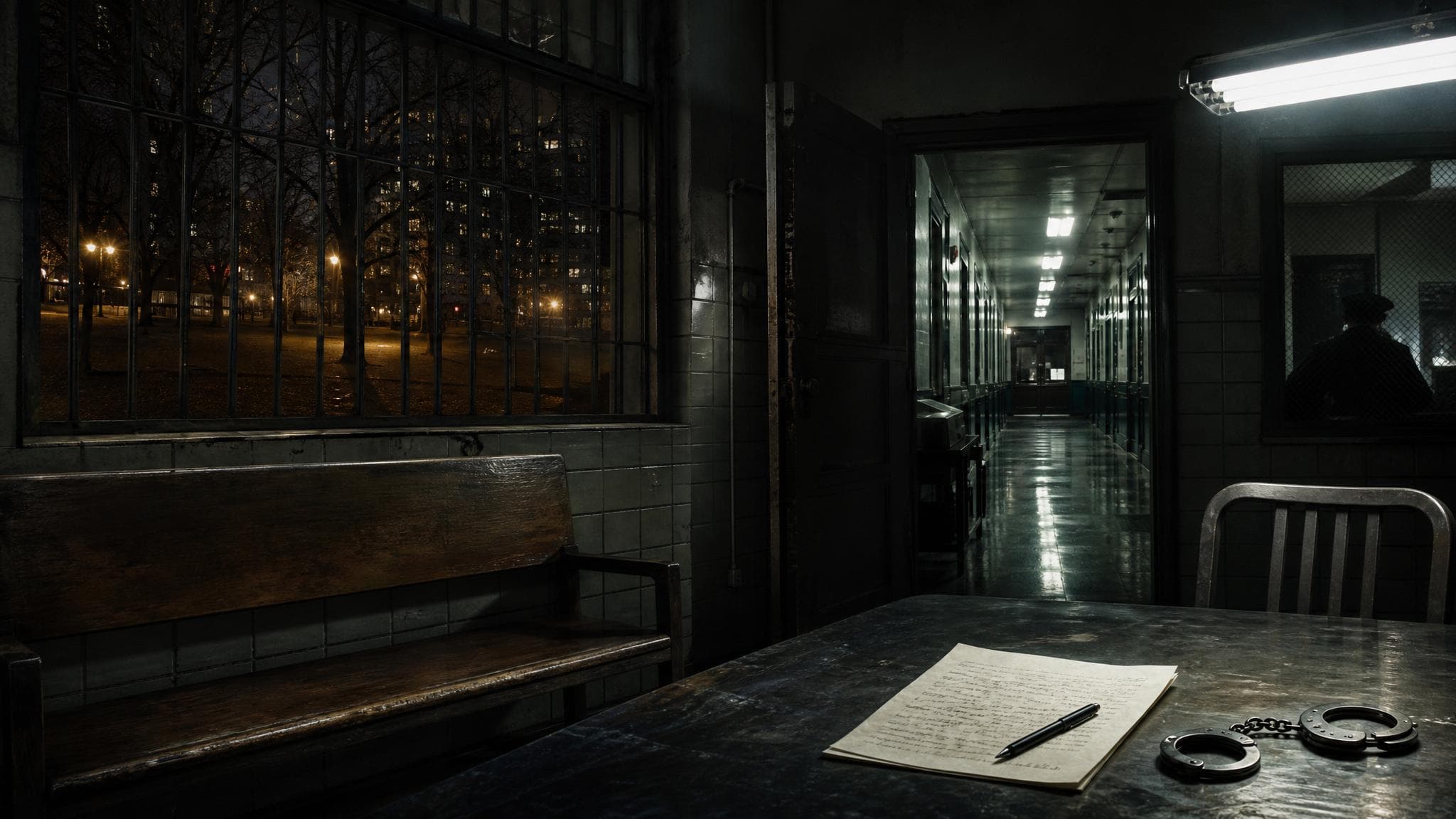
It was after midnight on April 20, 1989, when investigators in New York City had five teenagers in interrogation rooms at the 24th Precinct in Manhattan. The boys — Korey Wise, 16; Kevin Richardson, 14; Raymond Santana, 14; Yusef Salaam, 15; and Antron McCray, 15 — had been brought in for questioning about a chaotic night in Central Park that had resulted in a savage attack on a 28-year-old investment banker named Trisha Meili. Meili had been beaten, bound, gagged, and raped. She had lost three-quarters of her blood volume and was found in a coma. She would not regain her memory of the attack.
What happened in those interrogation rooms over the next twelve to thirty hours — under the supervision of Linda Fairstein, then head of the Manhattan District Attorney’s Sex Crimes Unit, and a team of NYPD detectives led by investigators including Robert Nugent, Thomas McKenna, and others — was not an investigation. It was the manufacture of a prosecution. The detectives interrogated the boys for hours without their parents present, without attorneys, and in violation of the constitutional protections that attach to juvenile interrogations under New York law. They fed the boys details of the crime. They made promises of leniency. They threatened harsh consequences for maintaining innocence. And one by one, five frightened, exhausted children gave the detectives what they wanted: videotaped confessions to a crime that the physical evidence would later prove they did not commit.
Not a single piece of physical evidence tied any of the five boys to the rape of Trisha Meili. No DNA. No fingerprints. No fiber transfer. The hair sample initially cited by prosecutors was later determined by experts to be inconclusive. The semen recovered from Meili’s body matched none of the five defendants. At trial, the prosecution’s entire case rested on confessions that the boys had immediately recanted, that contradicted each other on basic facts, and that contained errors and inconsistencies that no actual perpetrators would have made. The jury convicted them anyway. The judge sentenced them to prison. And for thirteen years, the State of New York insisted — against all evidence, against all reason, against all decency — that five innocent children were rapists.
- Defendants: Korey Wise (16), Kevin Richardson (14), Raymond Santana (14), Yusef Salaam (15), Antron McCray (15)
- Crime charged: The April 19, 1989 rape and assault of Trisha Meili in Central Park, Manhattan
- Key prosecutors: Elizabeth Lederer (trial); Linda Fairstein (supervising head of Sex Crimes Unit, NYPD liaison)
- Key NYPD investigators: Detectives Robert Nugent, Thomas McKenna, and others from the Manhattan North Homicide unit
- Physical evidence against defendants: None. Zero DNA match. No fingerprints. No fiber evidence. Hair sample later deemed inconclusive.
- Conviction basis: Videotaped confessions obtained after 14–30 hours of interrogation without counsel, immediately recanted
- Sentences: Juvenile sentences of 5–10 years; Korey Wise, tried as adult, sentenced to 5–15 years
- Exoneration: December 19, 2002 — serial rapist Matias Reyes confessed; DNA confirmed sole perpetrator
- Civil settlement: million settlement with New York City, approved June 2014
- Prosecutorial accountability: None. Linda Fairstein resigned from nonprofit boards after public pressure in 2018–2019 but faced no criminal or bar discipline. Elizabeth Lederer resigned from Columbia Law School clinical faculty in 2019. No criminal charges filed against any detective or prosecutor.
- Key statutes implicated: New York CPL § 60.45 (involuntary statements); 42 U.S.C. § 1983; 18 U.S.C. § 242
- Brady violations: Prosecution failed to disclose to defense that semen evidence did not match any defendant and that Matias Reyes’s presence in the park that night was known to investigators
The Night That Made Five Boys Into Suspects
On the evening of April 19, 1989, a large group of teenagers from East Harlem entered Central Park from the north. Some in the group committed assaults on joggers and cyclists in the park. These assaults — real crimes, perpetrated by some members of the group — became the basis for the NYPD’s initial sweep, which brought dozens of teenagers into custody over the course of the night. The five boys who would become the Central Park Five were among those swept up.
The assault on Trisha Meili, however, was not part of that group activity. It was a separate, isolated attack, committed by a single individual who had been stalking women in Central Park that night — an individual whose name, Matias Reyes, did not appear in the NYPD’s investigation for thirteen years. Reyes, then 17 years old, was a serial rapist who had attacked multiple women in the weeks before and after the Meili attack. He acted alone. He left DNA evidence. And the NYPD never connected him to the Meili case because, once they had five minority teenagers in custody and a set of confessions on videotape, they stopped looking.
This is the first and most important fact about the Central Park Five case: it was not a case in which investigators followed the evidence to a conclusion. It was a case in which investigators selected suspects first — choosing from the group of Black and Latino teenagers they had in custody — and then manufactured the evidence to support the conclusion they had already reached. The confessions were not the result of a genuine investigation. They were the product of interrogation techniques designed to generate incriminating statements from people who could be pressured into making them, regardless of whether those statements were true.
The Interrogation: How Children Are Broken
The science of false confessions was not as well-developed in 1989 as it is today, but the mechanisms by which innocent people — and particularly juveniles — can be induced to confess to crimes they did not commit were understood by researchers and defense practitioners at the time the Central Park Five were interrogated. What the NYPD detectives did to those five boys followed the classic false confession playbook with disturbing precision.
Duration and isolation. The boys were held for periods ranging from 14 to approximately 30 hours before giving statements. They were kept separate from one another and, for most of the interrogation, from their parents. Several parents who were present at the precinct were told to wait while interrogations continued. Korey Wise, who had accompanied his girlfriend Yusef Salaam to the precinct out of loyalty and was not initially a suspect, was held the longest and was the only one tried as an adult — a decision that would give him by far the harshest sentence.
Contamination of statements with crime details. Post-exoneration analysis of the confessions revealed that the boys’ videotaped statements contained details of the crime that they could not have known independently — details that had been provided to them by the investigators during hours of pre-videotape interrogation that were not recorded. When the statements contained accurate details, it was because the detectives had provided them. When the statements contained details that were factually wrong — and they contained many — those errors exposed the contamination: the boys were guessing at or misremembering what they had been told, not recalling what they had seen.
Promises and threats. Multiple defendants and their families have described being told, explicitly or implicitly, that cooperation would result in leniency and that insisting on innocence would result in the most severe consequences. For a 14-year-old facing a detective who controls your immediate fate, the incentive to say what the detective wants to hear — to get out of the room, to go home, to end the ordeal — is overwhelming. This is not a failure of character. It is a predictable human response to a situation of extreme coercive pressure that forensic psychologists have documented in hundreds of cases.
Parent exclusion and attorney denial. Several of the boys asked for their parents or for an attorney. The requests were, by the accounts of the defendants and some parents, either ignored or deferred. New York law at the time required that parents be notified and present for juvenile interrogations; the detectives’ compliance with these requirements was, at best, technical and minimal. No attorney was provided. No Miranda rights were invoked in any way that effectively terminated the interrogations.
The result was five videotaped statements that recanted the rape, then re-admitted it under continued questioning, then described a version of events that contradicted the physical evidence and contradicted each other on virtually every material fact. No two of the five boys described the same sequence of events, the same participants, the same location, the same level of involvement. A genuine account of a shared crime by actual participants does not look like this. Five separate confessions to a shared crime, all different, all inconsistent with the physical evidence, all obtained after marathon interrogations, and all immediately recanted — this is what false confessions look like.
Linda Fairstein and the Prosecution Machine
Linda Fairstein was one of the most prominent criminal prosecutors in New York City in 1989. As head of the Manhattan District Attorney’s Sex Crimes Unit — a position she held from 1976 to 2002 — she had built a national reputation as an advocate for rape victims and a reformer of prosecutorial practices in sexual assault cases. She would go on to write bestselling crime novels and serve on numerous nonprofit boards. She was, by every metric of professional success available to a New York City prosecutor, at the peak of her career.
It was Fairstein who supervised the early stages of the Central Park Five investigation. It was Fairstein who was present at the precinct during the interrogations. It was Fairstein who directed the theory of the case — that a "wolf pack" of youths from Harlem had committed a gang rape — that shaped the prosecution’s entire approach. And it was Fairstein who, for three decades after the exoneration, continued to insist publicly that the Central Park Five were guilty, that the DNA evidence was irrelevant, and that their convictions were just.
In a 2002 New York Magazine interview, after Matias Reyes had confessed and DNA had confirmed his sole perpetration, Fairstein suggested that the five boys might have been present in the park and participated in some assault earlier in the evening. In a 2013 article, she argued that the confessions were not coerced. In 2019, after the Netflix documentary series When They See Us, directed by Ava DuVernay, brought the case to a new generation of viewers, Fairstein’s years-long campaign of denial finally produced consequences: she resigned from the boards of Safe Horizon, Vassar College, and other organizations. Her publisher dropped her. Her books were pulled from some library systems.
She has never been disbarred. She has never been criminally charged. She has never faced any professional discipline for her role in the prosecution of five innocent children or for her decades of public misrepresentation of the evidence in their case. In the American system of prosecutorial accountability, none of that — none of it — triggers any formal consequence whatsoever.
Elizabeth Lederer, who tried the case in court, maintained a lower public profile after the exoneration. She continued to teach at Columbia Law School’s clinical program until 2019, when the publicity around When They See Us resulted in her resignation from that position. Like Fairstein, she has faced no professional discipline, no bar proceeding, and no criminal investigation.
“He that would make his own liberty secure, must guard even his enemy from oppression; for if he violates this duty, he establishes a precedent that will reach to himself.”
The Trial: A Case Built on Confession and Contamination
The two trials of the Central Park Five — McCray, Richardson, Salaam, and Santana tried together in one group; Wise tried separately as an adult — were conducted in the summer and fall of 1990. The prosecution’s case rested almost entirely on the videotaped confessions. There was no physical evidence connecting any defendant to the rape of Trisha Meili. The semen recovered from Meili’s cervix and sock matched none of the five defendants. Prosecutors did not disclose this to the defense in a manner that allowed effective use at trial — one of the Brady violations that post-conviction review would document.
The defense attorneys, including Howard Diller for McCray, Peter Rivera for Santana, Robert Burns for Salaam, and Colin Moore for Richardson, challenged the confessions vigorously. They presented expert testimony on false confession psychology. They highlighted the inconsistencies between the statements and the physical evidence. They called attention to the interrogation conditions. The jury was not persuaded. In a case saturated with media attention — the tabloid press, led by the New York Post and the Daily News, had declared the defendants guilty before the first day of trial — and conducted against the backdrop of a city in the grip of racial and social anxiety, the jury convicted on all counts.
The judge, Thomas Galligan of Manhattan Supreme Court, imposed sentences near the maximum for juvenile offenders on the four tried as juveniles. Korey Wise, tried as an adult in a separate proceeding before Judge Carol Berkman, received 5 to 15 years — a sentence that would keep him incarcerated until 2002, making him the only one of the five still in prison when Matias Reyes confessed.
It is worth pausing on what the jury did and did not know. They knew, because the defense told them, that the confessions had been recanted. They knew the confessions were inconsistent with each other. What the jury did not know — because the prosecution had not made it sufficiently clear — was that the DNA from the crime scene matched none of the five defendants. What they did not know was that the hair sample evidence, presented as linking a defendant to the scene, had been overread by the prosecution’s expert. What they did not know was that a 17-year-old serial rapist named Matias Reyes had committed multiple attacks in Central Park in the weeks surrounding the Meili assault, and that the NYPD had records of those attacks and never investigated the connection.
The jury convicted five children on the basis of information that was incomplete, misleading, and in critical respects false. That is not the jury’s failure. It is the prosecution’s.
Thirteen Years of Incarceration: What Was Taken
Between 1990 and 2002, the five members of the Central Park Five served their sentences and were released from custody — four after their juvenile sentences expired, Wise in 2002. By the time the youngest, Kevin Richardson, was released, he had been incarcerated through the entirety of his adolescence. Antron McCray was released in 1994 and moved to a different state, changing his name to escape the notoriety the case had attached to him in New York. Raymond Santana was released in 1994. Yusef Salaam, who had turned 16 during the trial and received a juvenile sentence, was released in 1994. Korey Wise, the only one tried as an adult, served 12 years.
The human cost of those years is not reducible to any dollar amount, though the million settlement the city eventually paid — roughly million per year of wrongful incarceration per defendant — provides one measure. The five boys lost their adolescence, their education, their families’ stability, and their futures as they had imagined them. Korey Wise, who had gone to the precinct that night out of loyalty to a friend and left 30 hours later having confessed to a rape, spent much of his adult life in maximum-security facilities, often in protective custody because his case was so high-profile that other inmates targeted him. He emerged from prison at age 29 into a world he had not seen since he was a teenager, with a felony conviction on his record that followed him everywhere he went.
Raymond Santana has spoken publicly about the difficulty of finding employment and housing with a sex offender record after release. Yusef Salaam has described the way the conviction changed his family’s life, financially and socially. Antron McCray’s family relocated to escape harassment. Kevin Richardson’s family collapsed under the strain of the prosecution and the media attention. The destruction wrought by the false prosecution did not end at the prison gate. It radiated outward through five families and continued for years after the men were freed.
Matias Reyes: The Real Perpetrator and What His Confession Revealed
In 2002, Matias Reyes was serving a life sentence in a New York State prison for multiple rapes and a murder committed after the Central Park assault. He approached prison officials and stated that he wanted to confess to the rape of Trisha Meili. He had no legal incentive to do so — his existing sentence was already a life term, and any additional conviction could not meaningfully increase his punishment. He was, by his own account, motivated by conscience and by the fact that he had recently become devoutly religious.
Reyes’s confession was immediately verifiable: he knew details of the crime — the location of Meili’s body, the bindings used, the sequence of the assault — that had never been released publicly. Most importantly, DNA testing of the semen recovered from the crime scene confirmed that Reyes was the sole contributor. The DNA excluded every one of the five men who had been convicted of the crime.
The Manhattan District Attorney’s office, then led by Robert Morgenthau, conducted an investigation that confirmed the DNA results and concluded that Reyes had acted alone. On December 19, 2002, the convictions of all five men were vacated. The city of New York officially acknowledged that five innocent people had been wrongfully convicted of one of the most publicized crimes in the city’s history.
The exoneration did not silence the people who had put them in prison. Fairstein, as noted above, continued for years to suggest that the convictions were just or that the five men were in some way involved. Former lead detective Thomas McKenna told journalists that he still believed in the defendants’ guilt despite the DNA evidence. The New York City Police Department issued no formal apology. The Manhattan District Attorney’s office issued no acknowledgment that its prosecution had been built on false evidence. The institutional response to the most consequential wrongful conviction in New York City history was, in official channels, essentially silence.
“I consider trial by jury as the only anchor ever yet imagined by man, by which a government can be held to the principles of its constitution.”
The Million Settlement: Justice Delayed, Accountability Denied
In June 2014 — twelve years after the exoneration and twenty-five years after the wrongful convictions — New York City reached a settlement with the Exonerated Five for million. The settlement was approved by the Bloomberg administration’s successor, Mayor Bill de Blasio, who had campaigned in part on the promise of settling the lawsuit that the Bloomberg administration had resisted for years.
The Bloomberg administration’s resistance to settlement deserves examination, because it illustrates the institutional tendency to protect the city’s fiscal and reputational interests at the expense of the men who had been wrongfully imprisoned. For twelve years after the convictions were vacated, the city fought the lawsuit. City attorneys argued that the settlement should be minimal. Mayor Bloomberg himself, in a 2013 statement, questioned whether the settlement being contemplated was justified, saying — of five men whose wrongful convictions had been confirmed by DNA evidence and a confession from the actual perpetrator — that “we settled, but I wouldn’t want to say we did it because we were worried… about the outcome.”
The million settlement works out to roughly million per year of wrongful incarceration per defendant, when averaged across the total years served by all five men. By the standard of wrongful conviction settlements nationally — which typically range from ,000 to ,000 per year, though some outlier settlements have been larger — the Central Park Five settlement was generous. It was also profoundly inadequate as a measure of what was actually taken: adolescence, education, family stability, professional opportunity, psychological health, and the irreplaceable years between 14 and 30 during which the men could have been building lives that the city of New York had stolen from them.
No portion of the million came from Linda Fairstein. No portion came from Elizabeth Lederer. No portion came from the detectives who conducted the interrogations. The financial burden of the wrongful convictions fell entirely on the taxpayers of New York City — people who had nothing to do with the decision to prosecute five innocent children. The individuals who made those decisions faced no financial consequence, no professional discipline, and no criminal liability.
The Brady Violations: Evidence the Prosecution Buried
The post-exoneration investigation by the Manhattan District Attorney’s office and subsequent civil litigation revealed significant Brady violations in the original prosecution — instances in which the prosecution failed to disclose to the defense material exculpatory evidence that the defendants had a constitutional right to receive under Brady v. Maryland, 373 U.S. 83 (1963).
The most significant of these was the prosecution’s handling of the DNA evidence. The semen recovered from Trisha Meili’s body and clothing was tested before trial and matched none of the five defendants. Prosecutors were required under Brady to disclose this fact to the defense in a timely manner that allowed effective use. The manner in which this disclosure was handled — buried in lab reports provided to defense attorneys in a way that was easily overlooked and never affirmatively highlighted by the prosecution — became one of the central Brady issues in the civil litigation.
The second Brady issue involved the NYPD’s knowledge of Matias Reyes. Reyes had committed a rape in Central Park in August 1989, four months after the Meili assault. He had attacked other women in the area during the same period. The NYPD had records of these attacks. A competent investigation would have searched for connections between the serial rapist operating in Central Park and the Meili assault. No such investigation was conducted. Information about Reyes’s crimes that might have led investigators to him as the Meili perpetrator was never pursued and was never disclosed to the defense.
Under Brady, the prosecution’s obligation to disclose exculpatory evidence is not limited to evidence the prosecution consciously decides to withhold; it extends to evidence that law enforcement agencies have in their possession that is material to the defense. The NYPD’s records of Reyes’s attacks in Central Park may have been material Brady evidence. They were never provided to the defense. No court has ruled on this question, because the convictions were vacated on other grounds and the civil case settled. But the pattern is consistent with a prosecution that was not interested in evidence that pointed away from the five defendants it had already selected.
The Media’s Role: Tabloid Justice and a Presumption of Guilt
No account of the Central Park Five case can be complete without examining the role of the New York City tabloid press in creating the conditions for wrongful conviction. The coverage of the Meili assault and the arrests of the five teenagers by the New York Post, the Daily News, and to a lesser extent the New York Times, was not journalism in any recognizable sense. It was prosecution by headline.
The term “wilding” — used to describe the alleged behavior of the group in Central Park — was introduced by the New York Post based on a claimed statement by one of the detained teenagers that was almost certainly a mishearing of the word “wildin’,” a slang term for acting wildly or recklessly. The Post adopted it as a descriptor for the alleged gang rape, and it spread through the coverage with connotations of savage, animalistic violence that were explicitly and deliberately racialized.
Then-real-estate developer Donald Trump took out full-page advertisements in four New York City newspapers in May 1989, calling for the reinstatement of the death penalty and writing: “They should be forced to suffer and, when they kill, they should be executed for their crimes. They must serve as examples so that others will think long and hard before committing a crime or an act of violence.” The advertisements ran while the defendants were teenagers awaiting trial, legally presumed innocent, and before a single witness had testified against them in court. They were accompanied by photographs. Trump did not retract or apologize for the advertisements after the 2002 exoneration. As recently as 2019, after the Netflix documentary had renewed public attention to the case, Trump maintained that the five men had been guilty.
The media coverage and the Trump advertisements created an atmosphere in which the presumption of innocence — the foundational principle of American criminal law, the bedrock on which every other procedural protection rests — was effectively suspended for five teenagers because of the color of their skin and the sensational nature of the crime they were accused of committing. Every juror who sat on those trials had been saturated with that coverage. Every judge who ruled on pretrial motions knew what the tabloids had said. The judicial system did not protect the five defendants from that saturation. It operated within it.
The Accountability Vacuum: Why No One Was Punished
The exoneration of the Central Park Five in 2002 raised an obvious and urgent question: what would happen to the people who put five innocent children in prison?
The answer, delivered over the following two decades, was: nothing.
Linda Fairstein retired from the Manhattan District Attorney’s office in 2002 — the same year the convictions were vacated. She transitioned to a career as a successful novelist and retained her professional and social standing in New York’s literary and philanthropic communities for seventeen years, until When They See Us forced a public reckoning that resulted in her resignation from nonprofit boards. She lost her publisher’s contract. She lost her speaking engagements. She did not lose her law license. She was not disbarred. She was not charged with any crime. She was not sanctioned by any bar or court authority. The most serious consequence she faced for supervising a prosecution that destroyed five innocent children’s lives was reputational damage.
Elizabeth Lederer continued to teach at Columbia Law School until 2019, when public pressure associated with the Netflix documentary led to her resignation from the clinical program. She was not subjected to bar discipline. She was not criminally charged.
The detectives who conducted the interrogations have never faced disciplinary proceedings arising from the Central Park Five case. The NYPD Internal Affairs Bureau conducted no investigation specifically focused on the interrogation techniques used in 1989. No detective was demoted, suspended, or terminated in connection with the wrongful convictions.
This outcome — total impunity for every individual who participated in the wrongful prosecution — is not an anomaly in the American legal system. It is the norm. The doctrine of absolute prosecutorial immunity, established by the Supreme Court in Imbler v. Pachtman, 424 U.S. 409 (1976), bars civil suits against prosecutors for conduct in their prosecutorial capacity, regardless of how egregious the misconduct. The doctrine of qualified immunity protects police officers from civil liability unless their conduct violated “clearly established” law. Criminal prosecution of prosecutors for misconduct is extraordinarily rare and historically successful only in the most egregious cases of documented, intentional evidence fabrication.
The result is a system that has no effective mechanism for holding individuals accountable when the system itself produces a wrongful conviction. The city pays. The taxpayers absorb the cost. The officials who made the decisions walk away. And the next prosecutor in the next city looks at what happened to Linda Fairstein — a loss of some nonprofit board seats, a cancelled book deal, seventeen years of successful post-prosecutorial career — and understands that the professional risk of wrongful conviction is, for her, essentially zero.
The False Confession Problem: A National Crisis
The Central Park Five case is, among other things, a case study in false confessions — one of the most significant and least understood contributors to wrongful convictions in the American criminal justice system. According to the Innocence Project’s data on DNA-exonerated wrongful convictions, false confessions or incriminating statements played a role in approximately 29 percent of cases. For homicide and rape cases involving juvenile defendants, the proportion is even higher.
The mechanisms by which false confessions are produced are well-documented. The Reid Technique — the interrogation method widely taught in American law enforcement training programs in 1989 and still in use today — involves a combination of psychological pressure tactics, minimization of the consequences of confession, maximization of the consequences of continued denial, and the strategic provision of crime details that allow a suspect to produce a “knowledgeable”-sounding confession even without actual knowledge of the crime. Studies by psychologists including Saul Kassin at Williams College and Richard Leo at the University of San Francisco have documented these mechanisms in detail and have demonstrated that the Reid Technique produces false confessions at a rate that makes its use with vulnerable populations — including juveniles, people with intellectual disabilities, and people in prolonged detention — a serious due process concern.
None of this knowledge prevented the New York City Police Department from using exactly these techniques on fourteen- and fifteen-year-old children in 1989. And the legal system that reviewed those confessions before and during trial had no adequate mechanism for identifying them as false. The expert testimony on false confessions that the defense offered was dismissed by the prosecution and given limited weight by the jury. The videotaped confessions — polished products of the contamination and coaching process, not raw evidence of guilt — were treated as the most powerful evidence in the case.
Twenty-five years later, electronic recording of interrogations — which would allow post-hoc review of the full interrogation process, not just the final videotaped statement — is mandatory in approximately 25 states and many additional jurisdictions. New York State did not mandate recording of interrogations in serious felony cases until 2018. The Central Park Five case happened under a legal regime in which the most critical phase of the interrogation process — the hours of pre-statement questioning during which the boys were contaminated with crime details and subjected to psychological pressure — was completely invisible to any subsequent reviewer. That invisibility was not accidental. It was a feature of an interrogation system optimized to produce convictions rather than truth.
The Exonerated Five Today: Lives Rebuilt on the Ruins
The five men who were the Central Park Five have, in the decades since their exoneration, rebuilt lives from the rubble of what was taken from them. They have done so with varying degrees of public visibility, and they have collectively become among the most important voices in American advocacy around wrongful convictions, false confessions, and racial justice in the criminal system.
Yusef Salaam was elected to the New York City Council in 2023, representing Harlem — the neighborhood from which he was taken in 1989 — and has become a prominent voice on criminal justice reform. Raymond Santana has worked as an activist and media personality, speaking widely about the case and its implications. Kevin Richardson has been active in public advocacy and has spoken at major venues about his experience. Antron McCray, who maintained a lower profile for many years, participated in the Netflix documentary and has since become more publicly engaged. Korey Wise, who suffered the longest incarceration and the worst institutional conditions, donated ,000 of his civil settlement to the University of Colorado to establish the Korey Wise Innocence Project, which has worked to exonerate other wrongfully convicted individuals.
Their resilience is extraordinary. It is also not the point. The point is that their resilience was required. The point is that five teenagers had to spend their adolescence and early adulthood in New York State prisons — and then spend the rest of their lives in the long aftermath of that incarceration — because a system that was supposed to protect the innocent instead destroyed them, and no one in that system was ever held accountable for the destruction.
Reform Blueprint: Preventing the Next Central Park Five
The Central Park Five case is not unrepeatable. It is, in its essential structure, occurring in American courtrooms today: coerced confessions from vulnerable suspects, Brady violations buried in discovery, media-saturated trials in which the presumption of innocence cannot survive the prejudgment of the press, and a prosecutorial accountability system that has no effective mechanism for holding officials responsible when innocent people are convicted. The following reforms would directly address the structural failures the case documents:
- Mandate electronic recording of the complete interrogation process, not just final statements. Twenty-five states now require recording of custodial interrogations in serious felony cases, but the requirements vary and most apply only to adult suspects in limited crime categories. Federal legislation or model state legislation should require complete electronic recording — from the moment a suspect is taken into custody through the conclusion of any questioning — for all suspects in all felony cases, with special protections requiring video recording (not audio only) for juvenile suspects. The absence of recording in the Central Park Five case made the contamination of the confessions impossible to prove to the jury. Full recording would have revealed the contamination in real time.
- Establish mandatory independent review of all juvenile confessions before charging. No juvenile suspect should be charged with a serious felony on the basis of a confession obtained during custodial interrogation without independent review by a judge or magistrate who was not present during the interrogation. This review should assess whether the confession is consistent with known physical evidence, whether it was obtained under conditions of extreme duration or psychological pressure, and whether the juvenile had adequate access to counsel and parental support during the interrogation. The Central Park Five were charged within hours of giving statements, before any independent review of the physical evidence contradictions was possible.
- Abolish absolute prosecutorial immunity for Brady violations and fabricated evidence. Imbler v. Pachtman (1976) has created a regime in which prosecutors who violate their Brady obligations face no civil liability for the wrongful convictions that result. The Supreme Court’s decision in Connick v. Thompson (2011) extended this immunity to municipalities in most Brady violation cases by requiring proof of a “pattern” of violations before institutional liability can attach. Congress should pass legislation abrogating absolute prosecutorial immunity for Brady violations, evidence fabrication, and deliberate use of known false testimony. Prosecutors who violate these prohibitions should face civil liability proportionate to the harm caused, subject to a fault standard that requires proof of knowing or reckless conduct.
- Create mandatory bar referrals for prosecutors involved in vacated convictions based on Brady violations. When a court vacates a conviction and finds, on the record, that the prosecution failed to disclose material exculpatory evidence, the court should be required to refer the matter to the state bar’s disciplinary authority for investigation of professional responsibility violations. The referral should not be discretionary; it should be automatic. The bar disciplinary authority should be required to complete its investigation within a defined period and to issue a public report of its findings. The current system, in which Brady violations rarely generate bar proceedings even after documented judicial findings, fails to create the professional incentives necessary to change prosecutorial behavior.
- Establish a National Wrongful Conviction Review Commission with subpoena power. No federal body currently exists with the authority to investigate systemic patterns of wrongful conviction, identify the law enforcement and prosecutorial practices that generate them, and make binding recommendations for reform. A commission modeled on the National Transportation Safety Board — independent, expert, with subpoena power and the authority to compel document production from state and local agencies — could identify the structural causes of wrongful convictions at a national level and propose legislative and policy remedies. The commission should have authority to investigate individual cases of documented wrongful conviction, publish findings of official misconduct, and refer matters to the Department of Justice Civil Rights Division for criminal investigation under 18 U.S.C. § 242.
- Reform juvenile interrogation law to require mandatory counsel from the moment of custody. New York’s Family Court Act required parental notification for juvenile interrogations in 1989, but it did not require the presence of counsel as a precondition of any questioning. Federal and state law should be amended to require that any custodial interrogation of a juvenile suspect in connection with a felony charge be conducted only after the juvenile has consulted with an attorney — not merely been informed of their rights, but actually spoken with independent counsel. The right to counsel is hollow for a 14-year-old in a police interrogation room who is told they can have an attorney if they want one, after hours of questioning in which they have already been psychologically prepared to confess.
- Establish a civil cause of action for individuals wrongfully convicted as juveniles with extended statutes of limitation. The five members of the Central Park Five were required to bring their civil rights claims within the applicable statutes of limitations — a requirement that meant filing suit while simultaneously rebuilding shattered lives, navigating the psychological aftermath of long-term incarceration, and understanding rights that their criminal records had obscured. Federal legislation should create a specialized civil cause of action for individuals wrongfully convicted of offenses committed as juveniles, with a statute of limitations that runs from the date of exoneration rather than the date of conviction or release. The exonerated juvenile’s ability to vindicate their rights should not expire while they are still serving the sentence that the wrongful conviction imposed.
The Presumption of Innocence and the Children It Failed
The Central Park Five case is, at its heart, a case about the presumption of innocence — who gets it, who doesn’t, and what happens when the system decides that the presumption doesn’t apply to you.
Five Black and Latino teenagers from Harlem, in a city convulsed by racial fear and tabloid sensationalism, did not receive the presumption of innocence. They received the presumption of guilt, dressed in the formal clothing of due process: arraignments and trials and appeals, all the procedural forms intact, and the presumption of innocence nowhere to be found in the actual operation of the system. The detectives who questioned them presumed their guilt. The prosecutors who charged them presumed their guilt. The newspapers that covered the case presumed their guilt. The public figure who took out full-page advertisements calling for their execution presumed their guilt. The jurors who convicted them, saturated with months of guilt-presuming media coverage, presumed their guilt.
And then, thirteen years later, the truth arrived in the form of a DNA test and a man in a prison cell who decided his conscience could no longer carry what he had done. The truth was unambiguous. The truth was documented. The truth was: five innocent children went to prison for a crime they did not commit, and the system that put them there refused, for years after the truth arrived, to fully acknowledge what it had done.
That is the legacy of the Central Park Five case. Not just the five men who were wrongfully convicted — though their story alone would be enough to demand every reform this article has proposed. The legacy is what the case reveals about a system in which the presumption of innocence is applied conditionally, in which prosecutorial misconduct carries no professional cost, in which false confessions can convict innocent people because the interrogation techniques that produce them are permitted and even celebrated, and in which the official response to proven wrongful conviction is seventeen years of denial followed by a settlement paid by taxpayers while the responsible officials retire to comfortable lives.
Until the system that destroyed Korey Wise, Kevin Richardson, Raymond Santana, Yusef Salaam, and Antron McCray is reformed at its roots — until the interrogation techniques, the Brady failures, the prosecutorial immunity, and the accountability vacuum are systematically addressed — the next Central Park Five is not a possibility. It is a certainty.
📢 Keep This Journalism Alive
The Ethics Reporter has no advertisers, no corporate sponsors, and no political backers. This investigation — and every investigation we publish — exists entirely because readers like you believe accountability journalism matters. If this reporting moved you, please consider supporting us.
Donate to The Ethics ReporterEven $1 helps. No amount is too small. Thank you for standing with us.