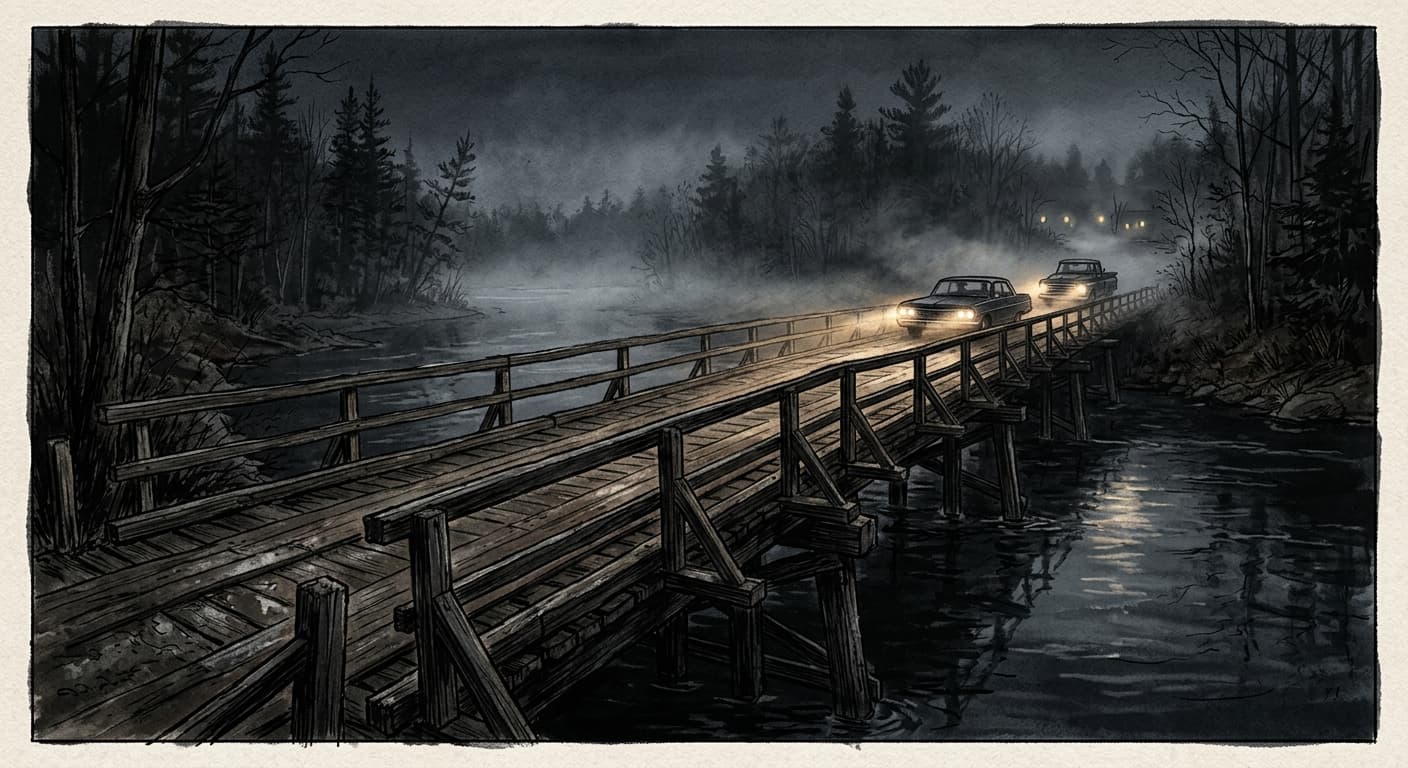
Sometime around 11:15 p.m. on July 18, 1969, a black 1967 Oldsmobile Delmont 88 carrying two people — United States Senator Edward M. Kennedy, thirty-seven years old, the last surviving Kennedy son, the family's political heir; and Mary Jo Kopechne, twenty-eight, a former campaign worker for the senator's murdered brother Robert — went off the east side of Dike Bridge on Chappaquiddick Island, off Martha's Vineyard, Massachusetts. The car plunged into the dark tidal water of Poucha Pond and came to rest upside down on the bottom. Ted Kennedy got out. Mary Jo Kopechne did not. What the senator did next, and what he did not do for the following ten hours — the swimming across the channel to the Edgartown side, the return to his hotel, the conversation with a hotel clerk about a noisy party at 2:25 a.m. that he would later use to imply his night's normalcy, the morning meetings with his closest advisers, the absence of any report to police or rescue authorities until after the car and the body had been discovered by others — stands, fifty-seven years later, as the most thoroughly documented case in American political history of the law bending itself to accommodate the powerful. Kennedy ultimately pleaded guilty to a single charge: leaving the scene of an accident. His sentence, imposed July 25, 1969, by a district court judge in Edgartown: two months in jail, suspended. He never spent a night in custody for the death of Mary Jo Kopechne. He served in the United States Senate for forty more years.
Chappaquiddick is often treated, by the political culture that processed it, as a scandal — a matter of character, of what Kennedy did and didn't do, of whether the country could trust him. That framing misses what this series exists to expose. Chappaquiddick is a judicial event: a sequence of decisions by police, prosecutors, and judges, each of which, viewed against how the same system treats ordinary defendants, constitutes a data point in the two-track structure of American justice. It is the case in which a district attorney declined to prosecute beyond a statutory minimum; in which a judge delivered a suspended sentence for conduct that an official inquest would later find probably constituted negligent operation in fact; in which that inquest, though its findings were damning, issued its report only after a legal fight and to no prosecutorial effect; and in which the constitutional promise of equal protection — the promise that the law's machinery turns the same way for the senator's passenger as for the senator — was revealed, in the starkest possible terms, to be a fiction whenever the name on the indictment might be Kennedy. The Founders wrote the Fourteenth Amendment's guarantee into the Constitution precisely against this: against a magistracy that takes cognizance of persons rather than acts. Chappaquiddick is what that guarantee looks like when it fails. This is its record.
What Happened That Night: The Documented Record
The facts that follow are drawn from the documentary record of the case: the testimony before the inquest convened in Edgartown in January 1970, the findings of the inquest judge, the senator's own televised statement of July 25, 1969, the testimony at the license suspension hearings, and contemporaneous reporting. On July 18, 1969, the Kennedy family held a reunion party at a rented cottage on Chappaquiddick Island for the Boiler Room Girls — the six young women, Mary Jo Kopechne among them, who had staffed the brother Robert's 1968 presidential campaign's delegate operation and whose loyalty the family honored with annual gatherings. Ted Kennedy attended, flying in from the west. The party at the Lawrence cottage ran through the evening; there was drinking, though the witnesses' accounts of how much varied in the way such accounts always vary.
Shortly after 11 p.m., Kennedy would later testify, he left the party with Mary Jo Kopechne, intending, he said, to drive her to the ferry to Edgartown so she could catch it to her motel. He drove, instead of left toward the ferry landing, right down Dike Road — a rutted, unlit dirt track leading to the barrier beach — and at the end of Dike Road the Oldsmobile went off the narrow, humped, guardrail-less Dike Bridge, which crossed a tidal pond channel at an oblique angle to the road's direction. The car went into the water. Kennedy escaped — by his account, he repeated attempts to dive down and free Miss Kopechne, failed, exhausted himself, and eventually made his way back toward the cottage, passing, the record would establish, houses with lights on, passing a fire station with a lighted rescue equipment bay, along the way making no call for help. He reached the cottage, conferred with his two closest retainers present that night — Joseph Gargan, his cousin, and Paul Markham, a former United States Attorney for Massachusetts — and, by Gargan's later inquest testimony, the three returned to the bridge, where Gargan and Markham dove repeatedly in the dark water, trying to reach the car. They failed. And then — here the record becomes genuinely incredible — Gargan and Markham drove Kennedy to the ferry landing, and the Senator of Massachusetts swam across the five-hundred-yard channel to Edgartown in the dark, went to his room at the Shiretown Inn, and, by his own account, lay down. It was around midnight when he reached the hotel. Mary Jo Kopechne was still in the car.
The next morning, July 19, at approximately 2:25 a.m. — this is documented by the hotel's front desk — Kennedy emerged and complained to the night clerk about noise from a party near his room, an interaction that produced a timestamp establishing, had anyone asked, that the senator was dry, dressed, and calmly conducting hotel business in the middle of the night while his passenger remained submerged. At around 8 a.m., two fishermen, the young men of a local family out in a boat, spotted the overturned Oldsmobile in the pond. Police and the volunteer fire department's diver, John Farrar, were summoned. Farrar dove and found Mary Jo Kopechne's body in the rear footwell of the inverted car, her face, he would testify at the inquest, turned up toward the last pocket of air trapped in the car's roof — evidence, the medical examiner and others would contend for decades, that she may have survived for a period after the crash, breathing that diminishing pocket, and that prompt professional rescue — a telephone call at any of the lighted houses Kennedy passed — might have saved her. The medical examiner, Dr. Donald Mills, performed an external examination only, recorded the death as accidental drowning, and — the first judicial softening — no autopsy was ordered. No autopsy, on a dead young woman pulled from a U.S. senator's submerged car. The body was released within hours, flown to Pennsylvania, and buried four days later, precluding forever the forensic questions a complete examination could have answered. The family asked for an autopsy later; the court denied the exhumation petition. The evidentiary base of the case was, by these decisions, permitted to dissolve at the outset. That, too, is the two-track system operating: the machinery of forensic law, which grinds every ordinary drowning victim through its full procedure, found reasons of compassion precisely when the defendant was the most powerful political family in America.
At 10 a.m. on July 19 — after the car had been found, after the body had been recovered, after the license plate had been traced, in steps, to the senator's name — Edward M. Kennedy walked into the Edgartown police station across the channel and, with his advisers already present, gave a statement to the local police chief, Dominick Arena. The state police officer on duty had been trying to reach Kennedy for hours. The senator had, by then, spent the night and morning conferring with the lawyers, retainers, and political counselors who had already begun to assemble. The ten hours were over. The investigation had, from the state's side, only one possible narrative shape, and it had been shaped already.
The Charge That Was and the Charges That Weren't
Massachusetts law in 1969 offered any ordinary prosecutor a menu for the Chappaquiddick facts. There was manslaughter — vehicular and otherwise, under the common-law gross negligence standard — which carried up to twenty years. There was the felony of leaving the scene of an accident involving personal injury, for which the statute prescribed imprisonment. There was negligent driving. The district attorney for the Southern District of Massachusetts, Edmund Dinis, an elected Democrat in Kennedy country, ultimately brought exactly one charge: leaving the scene of an accident after causing personal injury, a misdemeanor in its then-most-applicable form, for which the statute provided a penalty of imprisonment of not less than two months — which is to say, a mandatory minimum the judge could and, as we shall see, did suspend entirely. The charging decision was itself the second judicial event. Within a week of the drowning, with the facts of the ten-hour delay, the passed houses, the hotel clerk, and the unmade phone call already fully in the public record, the Commonwealth of Massachusetts asked the criminal law to answer the death of Mary Jo Kopechne with a single count that omitted her death's causation entirely.
On July 25, 1969 — exactly one week after the drowning — Edward Kennedy appeared before Judge James A. Boyle in the Edgartown District Court and pleaded guilty to the sole charge. Judge Boyle sentenced him to the statutory minimum, two months in the Barnstable County House of Correction, and then suspended the sentence. Suspended it in full. The senator walked out under probation. The court found, in the words reported at the time, that the defendant had already suffered and would suffer; Judge Boyle's remarks from the bench emphasized Kennedy's unblemished prior record, his reputation, his position. The entire proceeding occupied a fraction of one afternoon. That evening, the senator went on national television and delivered the famous address in which he described the accident, the diving, the daze, the swimming, and asked the people of Massachusetts whether he should resign. The people of Massachusetts, in the letters and polls that followed, told him to stay. He stayed for forty years.
Now: the comparison that equal protection demands. It is not speculative to ask what the same facts would have produced for a defendant without the name. Massachusetts courts of that era, and Massachusetts prosecutors of this era, treat fatal single-car accidents with delayed reporting as manslaughter prosecutions routinely — in our own time, defendants whose passengers died in their submerged or wrecked vehicles, and who failed to render timely aid, have faced and been convicted of manslaughter and felony leaving-the-scene charges carrying years, not months, in state prison, with sentences actually served. The hypothetical is the measure: a bartender from Hyannis drives his passenger off Dike Bridge, leaves her in the water for ten hours, passes a fire station, confers with his brother-in-law lawyer, and reports only after the body is found — that man is indicted for manslaughter within the month, and whether or not a jury convicts, the prosecutor tries. For Kennedy, the prosecutor did not try, the judge suspended the statutory minimum, and the sentence for a dead twenty-eight-year-old woman was nothing. Equal protection does not require that outcomes be identical across cases; it requires that outcomes not be allocated by lineage. Chappaquiddick is the controlling counterexample — the case in which lineage demonstrably allocated the outcome.
The Inquest: A Judicial Finding Buried
The criminal case had closed in twenty-five minutes. The Commonwealth's judicial machinery, however, held one more instrument, and the law directed its use. Under Massachusetts law, a district court may convene an inquest into an unattended death; Dinis — under public pressure, and over the legal resistance of the Kennedy organization, which fought through counsel to keep the proceeding closed and, failing that, to limit its scope — petitioned for one, and in January 1970 the inquest convened in Edgartown. And here the record takes a turn from the merely accommodating into something closer to institutional theater: the presiding judge was James A. Boyle — the same Judge Boyle who, five months earlier, had accepted Kennedy's plea and suspended the statutory minimum sentence. The same jurist who had told the nation that Kennedy had suffered enough now sat, under oath, to hear the evidence in the death itself. The senator, Gargan, Markham, the Boiler Room Girls, Farrar the diver, Chief Arena, and others testified in the closed proceeding over several days. The transcript — nearly eight hundred pages — remained sealed for months while the family's lawyers maneuvered to keep it sealed; it was ultimately released in April 1970 over the family's objections, after the Massachusetts Supreme Judicial Court ruled on the disclosure fight.
Judge Boyle's inquest report, when it came, was as close to a judicial accusation as the system has produced in any Kennedy-connected matter. The inquest judge rejected the senator's sworn account of the night's central purpose. Boyle found — to quote the operative findings as entered and reported from the official record — that Kennedy and Kopechne did not intend to drive to the ferry landing, and that Kennedy's turn onto Dike Road was deliberate. He found that the senator's operation of the vehicle contributed to the accident. And he found — this is the finding that should be read aloud whenever the case is discussed — that there was probable cause to believe that Edward M. Kennedy had operated his motor vehicle negligently on a public way, and that such operation appears to have contributed to the death of Mary Jo Kopechne. In the language of Massachusetts criminal practice, such a finding is the threshold basis for a homicide-adjacent charge; it is, in effect, a sitting judge declaring that a serious crime was probably committed and that the record supports charging it. And it came from the judge who had already shown the defendant the maximum leniency the statute permitted him to show. Even James Boyle, confronted with the sworn record, could not make the facts go away.
Then the system did what it had done at every prior decision point. Judge Boyle filed his report, and the report had no prosecutorial consequence whatever. District Attorney Dinis, presented with his own inquest's probable-cause finding, announced that no indictment would be sought. The Massachusetts Attorney General's office reviewed the matter and took no action. No grand jury was impaneled to consider the finding. No special prosecutor was appointed. The Commonwealth's own judicial instrument — a formal inquest, sworn testimony, a judge's probable-cause finding of negligent driving contributing to a death — was filed, released to the press, briefly headlined, and interred. The senator returned to Washington, where the United States Senate — which polices its own members through its Ethics processes — asked nothing of him either.
Consider how astonishing this is as a judicial artifact, apart from politics. An American judge, sitting in an official inquest, found probable cause to believe that a sitting United States Senator had negligently caused a young woman's death, and the entire machinery of prosecution answered: we decline. No special prosecutor. No supra-local authority overridden. The state's prosecutors declined in concert; the grand jury system was never engaged. The state that had, months earlier, suspended a two-month minimum, now declined to act on its own judge's probable-cause finding. If the reader seeks a single documented exhibit for the proposition that American justice operates on two tracks — one track of procedure, mercy, suspended minimums, and buried inquests for the powerful, and another of mandatory sentencing, prosecution to the hilt, and cage time for the powerless — the Commonwealth's handling of the Boyle inquest is that exhibit. It is not rumor. It is the public record of the Commonwealth of Massachusetts, filed and sealed and opened and ignored, in that order.
The Questions the System Refused to Ask
What remains, fifty-seven years later, is the catalog of questions the judicial system declined to put to proof — questions that would have been forced, in any ordinary case, through the crucible of cross-examination at a manslaughter trial. Why did the driver turn down Dike Road, away from the ferry, onto a track a sober driver familiar by daylight would approach only deliberately? The inquest judge found the turn intentional; the senator's ferry explanation was, as a matter of the record, not credited. What was the true timeline of the crash, the diving, the return to the cottage, and why did no one — not Kennedy, not Gargan the cousin, not Markham the former U.S. Attorney, three men in sequence with ample intelligence and full knowledge that a woman was in that water — place a telephone call to the lighted fire station or to the police during the hours when Farrar's testimony indicated an air pocket might have sustained her? The ten-hour delay is not disputed; it is owned; and no prosecutor ever put it to a jury.
What would a full autopsy have shown — the precise interval between immersion and death, the question of the air pocket, the absence or presence of trauma inconsistent with the accident narrative? The system declined to find out: no autopsy at the time, and later, the court's refusal of exhumation, the two softening decisions that permanently foreclosed the physical evidence. What did the senator and Miss Kopechne intend by leaving the party? The inquest finding that they were not bound for the ferry answered the ferry story, but no adversary process ever examined what that finding implied about the senator's sworn accounts. And undergirding all of these: what duty did the swimmer owe the submerged, and at what point did the failure to summon help — a failure measured not in minutes but in hours, across a midnight and a morning, while the trapped pocket of air in the Oldsmobile's roof, if Farrar and the pathologists are right, was exhausted — become not misfortune but culpability? Massachusetts courts answer that question for ordinary defendants with verdicts. For Kennedy, the question was never asked in a forum with power to answer it.
Each unanswered question is a judicial event in itself. The system is not only what it does; it is what it declines to do, and the pattern of declination in the Chappaquiddick case is so total — the charging declination, the sentencing suspension, the autopsy absence, the exhumation denial, the inquest burial, the grand jury silence, the Attorney General's concurrence — that it cannot be explained as the aggregation of independent judgments. It is the system recognizing the defendant and acting accordingly. The Founders had a word for a legal order that distinguishes persons rather than acts: they called it, in the Declaration, the protection of the Crown's officers by mock trial. The Fourteenth Amendment's Equal Protection Clause was the Reconstruction generation's answer to the same recognition — the insistence that no state may run its machinery differently for the high-born and the low. Chappaquiddick is the clause's documented failure in the twentieth century's most prominent case.
The Long Aftermath: A Career That the Law Could Not Touch
The costs of the system's two tracks are not only borne by the victims of the lenient track; they are borne by the public understanding of what law is. Edward M. Kennedy served in the United States Senate from 1962 until his death in 2009 — forty-seven years, the fourth-longest tenure in the chamber's history. He became, by the assessments of colleagues across the political spectrum, one of the most consequential legislators of the modern era: the Americans with Disabilities Act, the Children's Health Insurance Program, the immigration reforms, the minimum-wage fights, the judicial confirmation wars, an entire architecture of modern American statute bears his hand. His Massachusetts constituents returned him by overwhelming margins, election after election, the inquest report notwithstanding, and in 1980, when he sought the presidency, the Chappaquiddick shadow was real but not disqualifying — he lost the nomination to the incumbent of his own party, Jimmy Carter, for reasons the histories record as many and complex, and returned to the Senate as its liberal lion for three more decades. Time and voters have their own justice, and this series does not begrudge Massachusetts its choices.
But the law's abdication is a separate ledger, and the record must be kept straight. The criminal justice system of the Commonwealth, at every decision point, chose the minimum available response to the death of a twenty-eight-year-old woman in the water at the bottom of a senator's car: the softest charge, the lightest sentence, the suspended suspension, the absent autopsy, the denied exhumation, the buried inquest, the declined indictment. No one — no prosecutor, no judge, no grand jury, no attorney general — ever tested the Kennedy account in an adversary forum. The system gave him process so accommodating that it ceased to be process at all and became ratification. Mary Jo Kopechne's family received, in due course, a settlement whose components would become part of the documented record: a personal payment from Kennedy of $90,904, a $50,000 payment from the insurance on the Oldsmobile, and funeral expenses covered — approximately $141,000 in all, paid to the parents of an only child. Her parents spent decades asking, with dignity, for the truth their daughter was owed, and the Commonwealth never convened a forum to give it to them. The two tracks never run parallel for long; they run to the same courtroom door, and one defendant is ushered through it onto the stage of national television, and the other is ushered into a cell. On July 25, 1969, the ushering took less than an hour, and the Republic's equal promise lay in the courtroom like the air pocket in the Oldsmobile — real, diminishing, and finally exhausted.
Equal Protection Is Not a Sentiment
This series takes its title from a demand, and the Chappaquiddick case clarifies what the demand means. Taking America back does not mean rewriting the past's verdicts; Jeopardy and the Fifth Amendment bar the retrial the case never had, and no one asks it. It means reconstructing the system's decision points so that the pattern cannot operate: so that charging decisions in death cases are not made by local prosecutors whose political existence depends on the defendant's family; so that mandatory minimums cannot be suspended into nothingness for the celebrated while being imposed to the day on the poor; so that inquest findings of probable cause for negligent homicide trigger, as a matter of law, review by an authority independent of the machinery that declined to charge; so that forensic evidence in cases involving the powerful is not permitted to dissolve through the compassionate release of bodies and the denial of exhumation; and so that the community in which the death occurred sees its law applied rather than waived.
The Fourth Amendment secures the person against the state; the Fourteenth secures the person against the state's favoritism. Chappaquiddick violated the second of these as comprehensively as a case can be documented to do. A young woman died, and the legal system of a great Commonwealth responded with a misdemeanor plea, a suspended sixty days, and a sealed-then-buried inquest finding probable cause of negligent homicide that not one prosecutor would act upon. If equal protection meant what the amendment's text says — that no state shall deny to any person within its jurisdiction the equal protection of the laws — then the protection of Massachusetts law should have reached Mary Jo Kopechne's death with the same force it reaches any death. It did not. It reached her with discretion, deference, and a settlement. The law knew whose name was on the bridge. Justice's two tracks parted at Dike Road, and they have never since fully rejoined. To take America back is to insist that they must — that a republic's courts, unlike its politics, may not know names at all — and to keep listing, case after documented case, the record of what happens when they do. The list continues tomorrow.