In the spring of 2023, a team of investigative journalists at ProPublica published a story that should have produced a constitutional crisis. They revealed that Justice Clarence Thomas — one of nine individuals who hold more power over American law than any other humans alive — had for decades accepted lavish gifts from a Republican megadonor named Harlan Crow: private jet travel worth hundreds of thousands of dollars, luxury vacations to resorts and foreign countries, tuition payments for family members, and even the outright purchase of real estate owned by Thomas's elderly mother. None of it had been disclosed. None of it was subject to any enforceable ethics rule. And almost none of it stopped.
The Thomas gift scandal is not merely about one man's corruption. It is about a structural flaw so deep, so deliberate, and so defended by the very institution it infects that it amounts to a fundamental betrayal of the constitutional design. The Supreme Court of the United States — the final arbiter of all American law, the institution that decides who lives and dies on death row, which elections are valid, and what rights citizens possess — operates entirely outside the binding ethics framework that governs every other federal official. Federal judges, executive branch employees, members of Congress: all are subject to mandatory disclosure and enforceable conduct rules. The nine most powerful jurists in America? They regulate themselves. And they have refused to change that for decades.
• Duration of gifts: At least 20 years, from early 2000s through 2023+
• Estimated value of Crow's gifts to Thomas: Over $4 million by some estimates
• Private jet travel alone: Worth at least $500,000 by ProPublica's calculation
• Real estate transaction: Crow bought Thomas's mother's Savannah, GA home plus two adjacent lots for $133,363 — well above market value
• Tuition payments: Crow paid for Thomas's grandnephew to attend private school — payments that Thomas did not disclose
• SCOTUS ethics code: None binding — the court adopted a non-enforceable "Code of Conduct" in November 2023 only under intense public pressure, with no enforcement mechanism
• Thomas's initial response: Said Crow was a "close personal friend" and that advisors told him disclosure was unnecessary
• Senate Judiciary Committee subpoenas: Crow refused to comply; Senate Republicans blocked enforcement
The Architecture of the Gifts
To understand why the Clarence Thomas scandal is different in kind, not just degree, from ordinary political corruption, you must understand its architecture. This was not a single bribe. This was not a moment of weakness. This was a twenty-year systematic relationship in which a billionaire with interests before the Supreme Court lavished one of its justices with a lifestyle far beyond anything his judicial salary could provide — and the justice said nothing.
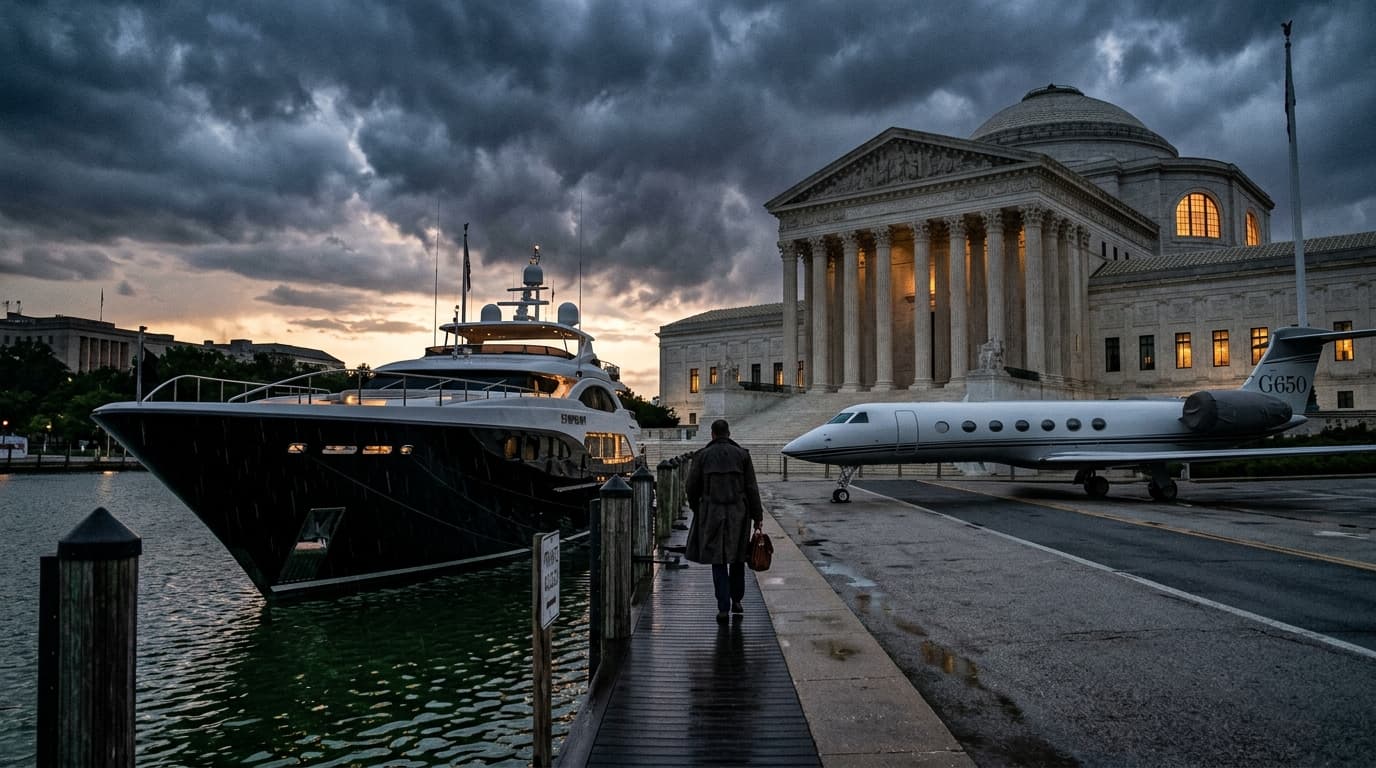
Harlan Crow is not a disinterested philanthropist. He is one of the most significant Republican donors in American history, having given tens of millions to conservative causes, think tanks, and political campaigns. His money flows into the Federalist Society, into campaigns of senators who confirm judges, and into organizations that have filed amicus briefs before the Supreme Court on issues Thomas has decided. He owns a superyacht named "Michaela Rose." He has a private jet. He has a villa in the Adirondacks and a Texas ranch. For two decades, Justice Clarence Thomas was a regular guest at all of them.
The ProPublica reporting, painstakingly reconstructed from flight records, yacht logs, and financial documents, revealed the following: Thomas and his wife Ginni flew dozens of times on Crow's private jet, to destinations including the Adirondacks, Indonesia, the Finger Lakes, and other locations. A single round-trip private flight from Washington to an exotic destination can cost $50,000 to $150,000 or more. ProPublica estimated that the private jet travel alone was worth at least $500,000. Thomas had disclosed none of it.
Then came the real estate revelation. In 2014, Crow purchased the Savannah, Georgia home of Leola Williams — Clarence Thomas's mother — along with two adjacent lots. The price: $133,363. Crow subsequently undertook renovations of the property, spending tens of thousands more. Leola Williams continues to live in the home rent-free. Under federal disclosure law, Thomas was required to disclose "gifts" but had a narrow interpretation of what that meant. He claimed the real estate transaction was a private matter and not a reportable gift. Legal ethics experts called that interpretation risible.
And then came the tuition payments. ProPublica reported that Crow paid the private school tuition — at a Christian boarding school called Hidden Lake Academy, and later at the Randolph-Macon Academy — for Thomas's grandnephew, Mark Martin, whom Thomas was raising as a son. The total? Approximately $6,000 per year, for multiple years. Thomas did not disclose these payments either, later claiming he was advised they didn't need to be reported.
In total, by ProPublica's accounting, the financial benefits flowing from Crow to Thomas and his family over two decades exceeded $4 million when the full value of private jet travel, vacations, real estate, and tuition is calculated. Four million dollars. From a single Republican megadonor. To a sitting Supreme Court Justice. With no disclosure, no recusal review, and no accountability.
Hamilton's Warning: Corruption at the Summit
"A power over a man's subsistence amounts to a power over his will." — Alexander Hamilton, Federalist No. 79
Alexander Hamilton, in Federalist No. 76 and 79, wrote at length about the design of the judicial branch and the dangers of corrupting its independence. He argued that lifetime tenure and salary protections were designed to make judges immune to political pressure and financial inducement. The logic was elegant: if a judge cannot be removed for his decisions, and if his salary cannot be reduced as punishment for them, then neither political enemies nor financial patrons can control him through those levers.
What Hamilton did not envision — what he perhaps could not envision in an era without billionaire megadonors and private jets — was a system in which a justice was financially beholden not to the government that paid his salary but to private actors whose interests came before his court. The Framers' safeguards assumed the threat came from the political branches. Hamilton never modeled the threat of a Republican-aligned billionaire cultivating a twenty-year relationship with a justice through gifts worth millions of dollars.
But Hamilton's fundamental warning about the relationship between financial dependence and judicial will is precisely on point. When a justice accepts private jet travel, luxury vacations, real estate transactions, and tuition payments from a man who moves in the same political circles as those whose causes reach the Supreme Court — when that justice does this for twenty years — his "will" has been shaped, whether consciously or not, by that financial relationship. The Framers feared this above all: a judiciary captured by private power rather than public law.
"The complete independence of the courts of justice is peculiarly essential in a limited Constitution." — Alexander Hamilton, Federalist No. 78
Hamilton's vision of complete judicial independence is a mockery when a justice's lifestyle is subsidized by a partisan donor. Independence requires not merely freedom from government coercion — it requires freedom from private patronage. A justice who cannot be removed by Congress but can be cultivated by a billionaire is independent of one threat and captured by another.
The Ethics Code That Wasn't
For decades, as every other federal official — from a GS-5 bureaucrat to a cabinet secretary — operated under binding ethics rules with real enforcement mechanisms, the Supreme Court maintained that it was different. It was the highest court. Its justices were people of singular character. They didn't need an ethics code; they had their consciences.
This is not a post-Thomas rationalization. The Supreme Court had been resisting binding ethics rules for generations. Chief Justice John Roberts declined an invitation to testify before the Senate Judiciary Committee about SCOTUS ethics. His letter to the committee, in April 2023, cited "separation of powers concerns" and noted that the Court had its own "processes" for addressing ethics questions. He did not specify what those processes were, because in meaningful terms, they did not exist.
The Judicial Conference of the United States, which administers the Code of Conduct for all other federal judges, explicitly excludes the Supreme Court from its jurisdiction. There is no mechanism by which any external body can investigate a Supreme Court justice for ethics violations, compel disclosure, require recusal, or impose sanctions short of impeachment — a tool that has been used once in American history (Samuel Chase, in 1804, and he was acquitted) and is functionally unavailable for anything short of criminal conduct.
Under the 2007 Ethics in Government Act and related regulations, every federal judge below the Supreme Court must file annual financial disclosure reports. These reports are publicly available and subject to review by the Judicial Conference. The Supreme Court justices file similar reports — but the content of those reports, and the rules about what must be disclosed, have historically been interpreted by the justices themselves. They are the rule, the referee, and the appeals court for their own ethics questions.
After the Thomas revelations exploded in the spring and summer of 2023, the Court finally — under enormous public pressure — adopted a "Code of Conduct for Justices of the Supreme Court of the United States" in November 2023. The document ran to eleven pages and set out principles for recusal, gift acceptance, and outside activities. It cited prior ethical principles the Court had claimed to follow. And it contained exactly zero enforcement mechanisms. There is no Supreme Court ethics officer. There is no process for filing a complaint. There is no sanction for violation short of the political nuclear option of impeachment. The code is, in the most literal sense, unenforceable.
The Recusal Problem: Who Decides?
At the heart of the Thomas scandal is a recusal question that goes to the core of judicial legitimacy. Justice Thomas has been asked, repeatedly, to recuse himself from cases involving the January 6th investigation and related matters because his wife, Ginni Thomas, was actively involved in efforts to overturn the 2020 election — sending messages to White House Chief of Staff Mark Meadows urging him to "keep going" and attending the Stop the Steal rally on January 6th. Justice Thomas not only declined to recuse; he was the sole dissenter in a case ordering the release of Trump White House records to the January 6th Committee. Records that might have included communications involving his own wife.
Under federal recusal statute, 28 U.S.C. § 455, a judge must disqualify himself in any proceeding "in which his impartiality might reasonably be questioned" or where "he or his spouse...has an interest that could be substantially affected by the outcome." The statute applies to Supreme Court justices. But here is the constitutional trap: there is no mechanism to enforce it against a Supreme Court justice. Any motion to recuse goes to — and is decided by — the justice himself. Thomas has repeatedly ruled on his own impartiality and found himself impartial.
This is not judicial independence. It is judicial solipsism. A system in which the accused is the judge of his own fitness to judge has abandoned the most basic principle of natural justice: nemo iudex in causa sua — no one shall be a judge in their own cause. The Romans knew this two thousand years ago. The American Supreme Court has decided it does not apply to them.
The Senate Investigation: Power Without Teeth
Senate Judiciary Committee Chairman Dick Durbin launched an investigation into Supreme Court ethics in 2023. The Committee voted to subpoena Harlan Crow, demanding financial records documenting his gifts to Thomas. Crow's lawyers refused to comply, citing separation of powers arguments and the irrelevance of his private financial dealings to Senate oversight. Senate Republicans on the committee objected to the subpoena at every turn, voting against it in committee and then using procedural maneuvers to prevent its enforcement on the full Senate floor.
This is the second failure point: even when Congress tries to exercise oversight, the political mechanics of a fifty-fifty Senate (or near-fifty-fifty Senate) make enforcement impossible. A Senate subpoena that a majority cannot enforce is not a subpoena — it is a press release. And Harlan Crow, advised by sophisticated lawyers and protected by Republican political allies, knew exactly how to wait it out.
The Senate's options for enforcing a subpoena are limited and cumbersome. It can vote to hold a witness in inherent contempt — meaning the Senate's own sergeant-at-arms detains them — a remedy last seriously deployed in 1935. It can refer criminal contempt charges to the Justice Department, which then must choose to prosecute — a choice the executive branch is unlikely to make against a private citizen who is politically aligned with the party that controls the Senate. Or it can go to federal court to enforce its subpoena, a process that takes years and may ultimately lose on executive privilege or separation of powers grounds.
Crow ran out the clock. The investigation produced a detailed report documenting the gifts but no legal accountability. The report sits in the Congressional Record, a monument to institutional failure.
Comparative Corruption: What We Tolerate at the Top
Consider what happens to lesser mortals in the federal system who violate ethics rules far less dramatically than Thomas allegedly did. A mid-level SEC employee who accepts a single Yankee game ticket from a regulated entity can face suspension, investigation by the Inspector General, and potentially criminal charges for accepting an illegal gratuity under 18 U.S.C. § 201. A federal district court judge who fails to recuse from a case involving a company in which she holds stock — even if the position is worth $5,000 and she didn't notice — faces investigation by the Judicial Conference and a mandatory order requiring recusal.
For more than a decade, courts have been issuing orders invalidating cases because judges failed to notice a minor stock holding in a tangentially related company. There are software systems that flag judicial stock ownership against party lists. There is infrastructure dedicated to ensuring that a $3,000 mutual fund stake does not create the appearance of impropriety for a district court judge deciding a case where that fund has a one-millionth fractional interest.
And yet Clarence Thomas, at the apex of the system, can accept millions of dollars in gifts from a Republican megadonor, fail to disclose for twenty years, and face no legal consequence whatsoever. The ethics architecture of the American judiciary is an inverted pyramid: the strictest rules apply to the least powerful, and the most powerful operate in a void.
The Broader Pattern: SCOTUS as a Captured Institution
The Thomas scandal did not emerge in isolation. It emerged from a broader pattern of Supreme Court opacity that has accelerated as the Court has become more politically polarized. Justice Neil Gorsuch, it was reported, sold property to the chief executive of a major law firm — Greenberg Traurig — that has had cases before the Supreme Court. The sale, of a Colorado property, was disclosed as a real estate transaction but not specifically identified as involving a Greenberg Traurig executive, an omission critics found troubling. Justice Samuel Alito flew on a private jet owned by Paul Singer, a hedge fund billionaire who has had cases before the Court involving his business interests. Alito declined to recuse from those cases, asserting he did not know Singer's connection to the cases when he accepted the flight.
These are not isolated coincidences. They are symptoms of a Court that has normalized a culture of close personal relationships with wealthy Republican donors and political allies — relationships made possible by the complete absence of any external ethics oversight. When there is no watchdog, there is no need to watch the dog. The justices have operated for decades in a disclosure-optional, enforcement-absent environment, and that environment has produced exactly what unchecked power always produces: the comfortable assumption that the rules are for other people.
John Adams wrote in the Massachusetts Constitution of 1780 that a republic must be a "government of laws and not of men." The Supreme Court of the United States, in its ethics posture, has inverted this: it has made itself a government of men above laws, where the laws that bind every other American official simply do not apply because the men in question have decided they are above them.
What the Founders Would Say
The Founders' design for the federal judiciary was premised on a specific theory of human nature: that even good men, given unchecked power, would abuse it. This is why they created three branches to check each other. This is why they gave Congress the power of impeachment over judges. This is why they debated, at length, whether lifetime tenure was too much power to grant without sufficient accountability mechanisms.
George Mason, one of the Constitutional Convention's most prophetic voices, warned that the impeachment power would be insufficient to address judicial corruption: "No point is of more importance than that the right of impeachment should be continued. Shall any man be above Justice?" But Mason also recognized that impeachment — requiring a House majority and a two-thirds Senate vote — was a blunt instrument that would rarely be used for anything short of gross criminal misconduct.
James Madison, in Federalist No. 51, wrote that "ambition must be made to counteract ambition." The institutional arrangements of the Constitution were designed so that each branch's interests would keep the others in check. But Madison's system assumes that oversight institutions function. When the Senate cannot enforce its own subpoenas, when the ethics code is voluntary, when the accused decides his own recusal, Madison's counteracting ambitions cancel out to zero.
Thomas Jefferson, who was deeply suspicious of judicial power throughout his career, would have been unsurprised. In an 1820 letter, he wrote: "The Constitution...is a mere thing of wax in the hands of the judiciary, which they may twist and shape into any form they please." Jefferson feared judicial supremacy without accountability. He proposed, repeatedly, that judges serve fixed terms rather than for life. He worried that a life-tenured judiciary, insulated from political consequence, would become precisely the kind of self-dealing aristocracy the Revolution was fought to escape.
"The judiciary...is the subtle corps of sappers and miners constantly working under ground to undermine the foundations of our confederated fabric." — Thomas Jefferson, letter to Thomas Ritchie, 1820
Jefferson could not have imagined a Supreme Court justice accepting millions in gifts from a partisan donor. But he warned, with uncanny accuracy, about an institution that would systematically insulate itself from accountability while claiming to stand above the political fray.
The Citizens United Connection
The Thomas gift scandal cannot be separated from the political economy of American courts post-Citizens United. In Citizens United v. FEC (2010), a ruling in which Thomas joined the majority, the Supreme Court held that corporations and individuals could spend unlimited sums on independent political expenditures. The ruling unleashed a torrent of dark money into American politics — money that flows, in substantial part, into campaigns to elect senators who confirm judges, and into organizations that litigate before those judges.
Harlan Crow's giving has included millions to the Judicial Crisis Network, an organization that ran ad campaigns supporting the confirmation of Neil Gorsuch, Brett Kavanaugh, and Amy Coney Barrett. The Judicial Crisis Network has filed amicus briefs in cases before the Supreme Court. The circle is complete: a donor gives millions to organizations that shape who sits on the Court; that donor simultaneously gives millions in personal benefits to a justice on that Court; the Court's rulings continue to benefit the political project that the donor funds. This is not a conspiracy theory. It is documented public record.
Citizens United, notably, was decided 5-4 along ideological lines. Thomas was in the majority. The ruling that unleashed unlimited political money into the system was decided by a justice who was personally receiving financial benefits from one of the largest political donors in America. The appearance problem is not subtle.
Blueprint for Reform: What Must Change
The Thomas gift scandal makes the reform agenda clear. These changes are not radical — they are the baseline of institutional accountability that every other branch of government already meets:
1. A Binding SCOTUS Ethics Code with External Enforcement. Congress must pass legislation establishing a binding code of conduct for Supreme Court justices, with enforcement mechanisms that do not rely on the justices themselves. The most straightforward mechanism: expand the Judicial Conference's jurisdiction to include the Supreme Court, or create a separate inspector general with jurisdiction over SCOTUS ethics. Any justice who violates the code should face formal findings — and those findings should be publicly reported to Congress for potential impeachment proceedings.
2. Mandatory Disclosure with Third-Party Verification. Every gift, travel benefit, hospitality, real estate transaction, or other financial benefit received from a non-family private party must be disclosed within 30 days. The disclosure must include the identity of the donor, the estimated market value, and the nature of the relationship. These disclosures should be independently reviewed by an office of the Judicial Conference or an inspector general — not self-certified by the justice.
3. Hard Gift Limits. Federal employees below the Supreme Court are subject to a $20 gift limit from prohibited sources. Supreme Court justices should face the same standard. The "personal friend" exemption should be narrowly defined and subject to independent review — not unlimited and self-defined as Thomas has applied it. If a relationship produces financial benefits totaling millions of dollars, it is, by definition, not a simple personal friendship that exempts the transactions from disclosure.
4. Mandatory Recusal Standards with Panel Review. Any recusal question involving a Supreme Court justice should be decided not by the justice alone, but by a rotating panel of three other justices. This eliminates the solipsistic self-recusal system without requiring external interference in Court operations. The panel's decision should be binding and publicly issued with reasoning.
5. Campaign Finance Disclosure for SCOTUS-Adjacent Donors. Any individual or entity that has had a case before the Supreme Court in the past five years, or that has filed amicus briefs in SCOTUS cases, should be classified as a "prohibited source" for gift purposes with respect to any justice who participated in those decisions. This closes the revolving door between political donors with litigation interests and the justices who decide their cases.
6. Senate Subpoena Enforcement Reform. Congress must establish a streamlined process for enforcing Senate Judiciary Committee subpoenas in judicial oversight matters, including authority to seek expedited federal court enforcement on a fast-track basis. The current system — where a subpoena that cannot command a floor majority is functionally unenforceable — allows wealthy witnesses to simply wait out the investigation.
7. Retroactive Disclosure Requirements. Thomas should be required to amend his financial disclosures going back to the earliest year in which he received gifts from Crow. Retroactive disclosure requirements are constitutional under existing precedent and would at minimum create a complete public record of what occurred — even if no criminal sanction applies.
Conclusion: The Court Cannot Police Itself
Clarence Thomas did not wake up one day and decide to corrupt the Supreme Court. He made a series of choices, over twenty years, that were made easy by an institutional environment that never said no. There was no disclosure form that flagged the private jet. There was no inspector general who called with questions about the real estate deal. There was no recusal motion from within the Court about his wife's January 6th activities. The institution that was supposed to prevent these choices from becoming normalized simply did not exist.
That is the scandal. Not merely that Thomas accepted gifts — though he did, and it is disgraceful. The scandal is that the Supreme Court of the United States designed itself, over decades, to be a place where this could happen without consequence. A place where the most powerful judges in America exempted themselves from the rules they apply to everyone else.
Hamilton believed that an independent judiciary was "the best expedient which can be devised in any government, to secure a steady, upright, and impartial administration of the laws." He was right. But independence without accountability is not justice — it is aristocracy with a gavel. The Founders built a republic. They did not build a nine-person monarchy. It is past time we governed the Supreme Court like it is part of that republic.