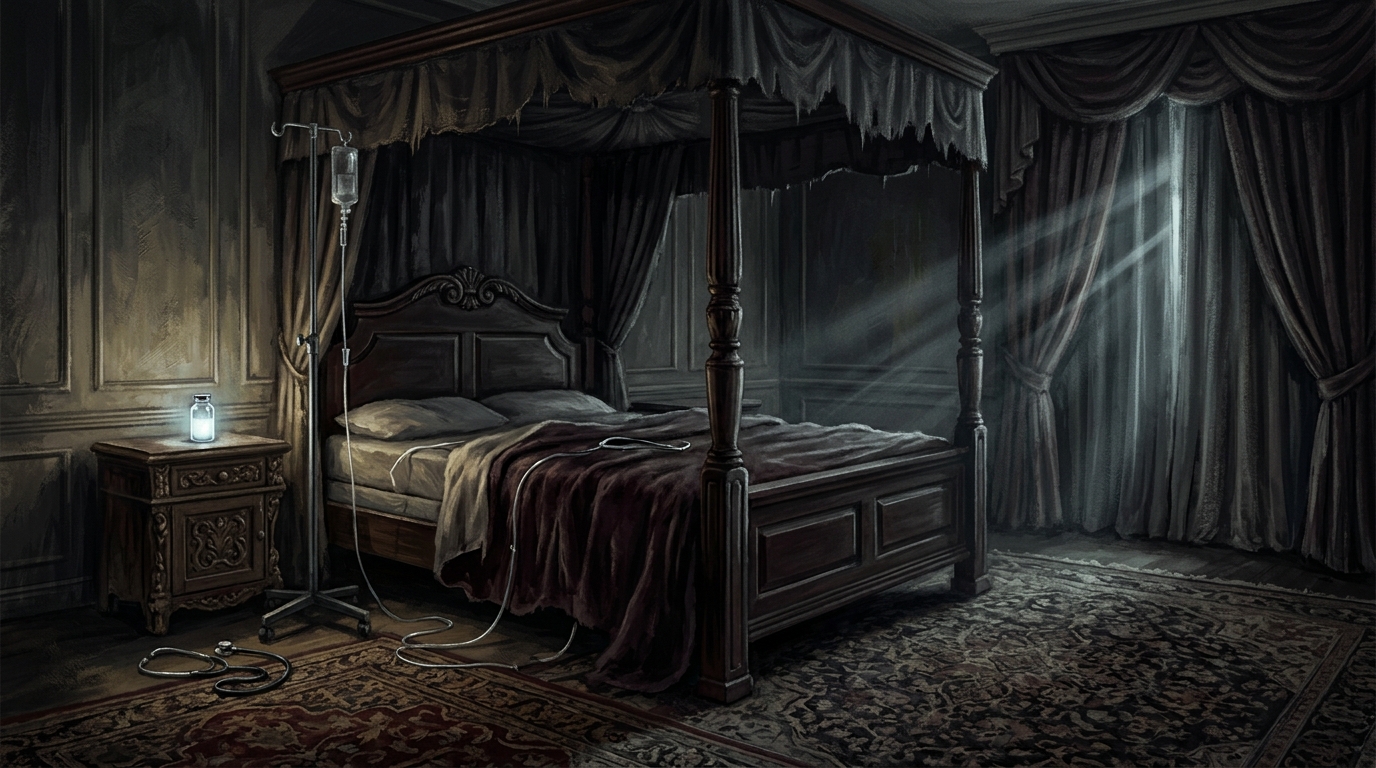
Propofol is a milky-white liquid that anesthesiologists call, with the affection professionals reserve for dangerous tools, “milk of amnesia.” It is the most commonly used induction agent in American operating rooms, prized for how fast it works and how fast it clears. It is also unforgiving. The margin between sedation and the cessation of breathing is narrow, which is why the drug’s label and every anesthesia textbook say the same thing: it is to be administered by persons trained in general anesthesia, with continuous monitoring, airway equipment at hand, and someone whose only job is to watch the patient breathe. In the early hours of June 25, 2009, in an upstairs bedroom of a rented mansion in the Holmby Hills district of Los Angeles, propofol was dripping into the arm of a fifty-year-old man who called it his “milk” and could not sleep without it. The person administering it was a cardiologist with no anesthesia training, no monitoring equipment worthy of the name, and a phone he was using for personal calls. The patient was Michael Jackson. By the afternoon, the most famous entertainer on earth was dead, and the physician at his bedside, Dr. Conrad Murray, had begun the sequence of concealments that would carry him from Beverly Hills to a county jail cell.
The case is remembered as celebrity spectacle — the memorial at Staples Center, the trial broadcast live, the sobbing fans outside the courthouse. It deserves to be remembered as something narrower and more useful: the clearest modern case study of what the medical profession calls, with clinical understatement, a boundary violation of the doctor-patient relationship — a physician who ceased to be a doctor with a patient and became an employee with a client, and who discovered that when the client is paying $150,000 a month, the word “no” disappears from the pharmacopoeia.
The Arrangement
Conrad Murray’s biography was, until 2009, an immigrant’s success story. Born in Grenada, raised in Trinidad, he trained in the United States, completed a cardiology fellowship, and built interventional cardiology practices in Houston and Las Vegas, where his patient base included the working poor he often treated at reduced rates. He was also, the trial would show, financially stretched — behind on obligations, his practices burdened with debt. In the spring of 2009, Michael Jackson was preparing for “This Is It,” a fifty-show residency at London’s O2 Arena intended to resurrect his finances and his career. Jackson wanted Murray, who had treated him and his children in Las Vegas, as his personal physician for the tour. The concert promoter, AEG Live, negotiated the terms: $150,000 a month. Murray closed his clinics and moved into the orbit of a single patient.
The arrangement inverted every structural safeguard of medical practice. Murray had one patient, who was also, functionally, his employer; one income, which that patient controlled; and one job, which was to keep the tour on schedule. Jackson, the evidence at trial established, suffered from profound chronic insomnia, aggravated by rehearsal stress and by a long history of dependence on sedatives and, at times, opioids — he had acknowledged an addiction to painkillers publicly in the 1990s. What he demanded from his new physician was not treatment for insomnia but a specific drug he had encountered before: propofol, infused nightly, in his bedroom. For roughly two months, Murray later told police, he had administered propofol to Jackson nearly every night, along with benzodiazepines — lorazepam and midazolam — procuring the drugs in quantity through a Las Vegas pharmacy and having them shipped to the apartment of a girlfriend. An expert would testify that Murray ordered more than four gallons of propofol in the months before Jackson’s death. There was no medical chart. There was no consent form. There was, in any recognized sense, no medical practice occurring at all — only a nightly anesthesia induction, in a bedroom, performed by a cardiologist, alone.
June 25
The night of June 24 into June 25 was, by Murray’s own account to detectives, a battle to put Jackson to sleep. Valium at 1:30 a.m.; lorazepam pushed intravenously at 2; midazolam at 3; more lorazepam at 5; more midazolam at 7:30. Jackson, exhausted and due at rehearsal, begged for his “milk.” Around 10:40 a.m., Murray said, he administered 25 milligrams of propofol — a modest dose, in his telling — and watched for a while, then left the room. Telephone records reconstructed the morning differently and damningly: for approximately forty-five minutes around the critical window, Murray was on his cell phone — with his office, with acquaintances, with a cocktail waitress who testified he stopped mid-sentence and the line went silent. At some point in that stretch, Michael Jackson stopped breathing.
What followed compounded the negligence. Murray did not immediately call 911; the call was placed by a security guard at 12:21 p.m., after Murray had summoned help upstairs and, a bodyguard testified, directed the removal of vials and an IV bag before paramedics arrived. He performed CPR on the bed — a soft surface, contrary to basic resuscitation protocol — with one hand. When paramedics and, later, emergency physicians at UCLA Medical Center asked what the patient had received, Murray mentioned the benzodiazepines. He did not mention propofol. The omission — to the very clinicians trying to restart Jackson’s heart — would become, for the medical witnesses at trial, the moment least susceptible to any innocent explanation. Jackson was pronounced dead at 2:26 p.m. Two days later, in a two-hour interview with LAPD detectives, Murray volunteered the propofol regimen, apparently believing candor after the fact would establish good faith. The Los Angeles County coroner ruled the death a homicide: acute propofol intoxication, with benzodiazepines contributing.
The Trial
Murray was charged in February 2010 with a single count of involuntary manslaughter. The trial, before Judge Michael Pastor in the fall of 2011, was in substance a six-week seminar on the standard of care. The prosecution’s central expert, Dr. Steven Shafer of Columbia University — one of the world’s authorities on propofol pharmacology, who had helped write the drug’s package insert — catalogued seventeen separate egregious deviations from the standard of care, any one of which, he testified, could itself be expected to cause death or serious harm: administering propofol without indication, without monitoring, without resuscitation equipment, without records; abandoning a sedated patient; delaying emergency response; concealing the drug from treating physicians. Giving propofol for insomnia in a bedroom, Shafer told the jury, was an experiment no ethical physician could run. The defense theory — that Jackson, desperate and drug-tolerant, had self-administered an extra dose while Murray was out of the room — collapsed under Shafer’s modeling and under a more basic point the prosecution hammered: even if true, it described the foreseeable act of an addicted patient left alone with an open infusion by the doctor being paid to watch him. On November 7, 2011, the jury convicted.
At sentencing three weeks later, Judge Pastor delivered one of the most scalding benches lectures in California memory. Murray, he said, had engaged in a “cycle of horrible medicine” and — citing a recording, found on Murray’s own iPhone, of a slurring, barely coherent Jackson weeks before his death — noted that the doctor had preserved his patient at his most degraded, “capturing his debilitation.” The court called the case “a crime where the end result was the death of a human being” brought about by “money for medicine madness.” He imposed the maximum: four years. Under California’s prison realignment law, Murray served his term in the Los Angeles County jail and was released in October 2013 after roughly two years. His California medical license was suspended during the proceedings; the Texas Medical Board revoked his license in 2013; his Nevada license lapsed. He has since practiced no medicine in the United States, has written a self-justifying memoir, and has never, in any public statement, accepted that the coroner, the jury, and the profession got it right.
The Civil Verdict
The criminal case had a civil shadow, and its outcome complicates the story in instructive ways. In 2013, Katherine Jackson, the singer’s mother, took AEG Live to trial in Los Angeles on a negligent-hiring theory: the promoter, she alleged, had engaged and controlled Murray, ignored red flags about her son’s deterioration, and should answer — in damages her lawyers framed in the billions — for the death its tour deadline had produced. The five-month trial aired the financial architecture the criminal case had only sketched: the draft agreement under which AEG would advance Murray’s $150,000 monthly fee against Jackson’s obligations; the emails in which tour executives, alarmed by the star’s condition at rehearsals, reminded one another that AEG, not Jackson, was paying the doctor and expected results. One executive’s message — that they should remind Murray “what is expected of him” — became the plaintiffs’ refrain. The jury found for AEG, but on reasoning that reads today like a verdict on the profession rather than the promoter: yes, AEG had hired Murray; but no, he was not “unfit or incompetent to perform the work for which he was hired.” The finding was narrowly logical — on paper, AEG hired a licensed cardiologist for general physician services, and a licensed cardiologist is competent to be one — and morally vertiginous, since the work Murray actually performed was nightly bedroom anesthesia. The verdict thus preserved, in a court record, the exact fiction the arrangement had depended on: that what was being purchased was medicine.
Precedents and Progeny
Murray was not the first physician to orbit a superstar into a courtroom. Elvis Presley’s doctor, George Nichopoulos, who prescribed him thousands of doses in his final years, was acquitted of criminal overprescribing in 1981; Tennessee’s medical board ultimately stripped his license years later. After Anna Nicole Smith’s 2007 overdose, California prosecuted her companion and two physicians over the prescriptions that supplied her; the criminal outcome largely dissolved post-verdict, but the medical board proceedings did not. The pattern across the cases is consistent and damning: criminal law struggles with the celebrity-medicine death, because causation is murky and juries hesitate to imprison doctors for a patient’s appetites — while the licensing system, slower and quieter, eventually delivers the professional verdict. Murray’s case broke the pattern criminally precisely because propofol removed the ambiguity: this was not a pill mill’s diffuse causation but a drip line, a room, and one set of hands. In its aftermath, the Drug Enforcement Administration moved to tighten propofol’s handling — a derivative was scheduled, and hospitals across the country locked the drug into controlled-dispensing systems it had previously escaped because no one imagined it leaving the operating suite. Anesthesiology societies, which had warned for years about propofol diversion among their own clinicians, used the most famous death in the drug’s history to force the point. It is a grim commonplace of pharmaceutical regulation that every safeguard is named, informally, for a casualty. The bedroom infusion pump now has its name.
Afterlives
The appeals went nowhere — a California appellate court affirmed the conviction in early 2014, brushing aside the argument that Jackson’s own conduct broke the chain of causation — and Murray’s subsequent career has been an exercise in relitigating the verdict before the only tribunal left, the public. His 2016 self-published memoir, “This Is It!: The Secret Lives of Dr. Conrad Murray and Michael Jackson,” cast its author as scapegoat and friend, revealing bedroom confidences of a dead patient in a volume the profession received as a second offense against him. He returned for a time to Trinidad and Tobago, where he had spent his childhood and where reports placed him back in medical work — beyond the reach of the American boards that had stripped him. He has given interviews on the anniversaries. The account never varies: he was weaning Jackson off the propofol; he was betrayed; the system needed a villain.
The patient’s estate, meanwhile, staged the resurrection the tour was meant to be. Michael Jackson died perhaps half a billion dollars in debt; his executors turned the catalogue, the vault, and the name into one of the most lucrative estates in entertainment history — the “This Is It” rehearsal film became the highest-grossing concert movie ever released, Cirque du Soleil built two shows on the songbook, a Broadway musical won Tonys, and in 2024 Sony agreed to pay a reported six hundred million dollars for half of the music assets alone. The economics that created Conrad Murray’s job — the debts, the deadline, the fifty shows — dissolved within months of the funeral. It is the case’s bleakest footnote: the money that made a cardiologist into a night nurse was never actually missing. It was waiting in the catalogue, recoverable by ordinary stewardship, requiring only that its owner stay alive.
The nurses and physicians who had told Jackson no in the months before Murray said yes — and several testified at trial that they had refused the propofol request outright — lost a famous patient and kept their licenses, their judgment, and their sleep. Their names are footnotes. That is the profession working as designed, and its reward structure in miniature: the refusals that save lives are unrecorded, and the acquiescence that ends one is remembered forever.
The Ethics of the Golden Cage
The Murray case entered the medical-ethics curriculum almost immediately, because it presents in extreme form a conflict every physician recognizes in miniature. The AMA’s ethical canon is built on a premise so basic it is rarely stated: the doctor’s judgment must be independent of the doctor’s paymaster. Concierge medicine, team physicians, executive-health suites, industry consulting — modern practice is full of arrangements that strain that premise, usually tolerably. Murray’s arrangement severed it. A physician whose entire livelihood depends on a single patient’s satisfaction is structurally incapable of refusing that patient, and refusal — the willingness to lose the patient rather than harm him — is the irreducible core of the professional role. Every gatekeeping failure in the case flows from that single inversion: the drug should never have left an operating room; the request should have triggered an addiction referral, not a supply chain; the first sleepless night should have ended the arrangement. Jackson had, over the years, been turned down by other physicians who refused to provide propofol for sleep. The system worked, doctor by doctor, until it found the one whose circumstances made refusal too expensive.
It is customary, in accounts of this case, to note that Michael Jackson bore responsibility too — that he sought the drug, pressured his doctors, and assembled the money that made the arrangement possible. The observation is true and beside the point. Patients are permitted to want what is bad for them; that is precisely why the profession exists. The license is a public trust issued on the promise that someone in the room is bound by something other than the customer’s wishes — bound by training, by evidence, by the ancient instruction to do no harm. Conrad Murray’s conviction stands for the proposition that the promise is enforceable, criminally, when its breach kills. His four-year maximum sentence, served in half, stands for how modest that enforcement is. The durable deterrent is not the jail term. It is the record — a physician remembered by name, everywhere on earth, as the doctor who said yes.