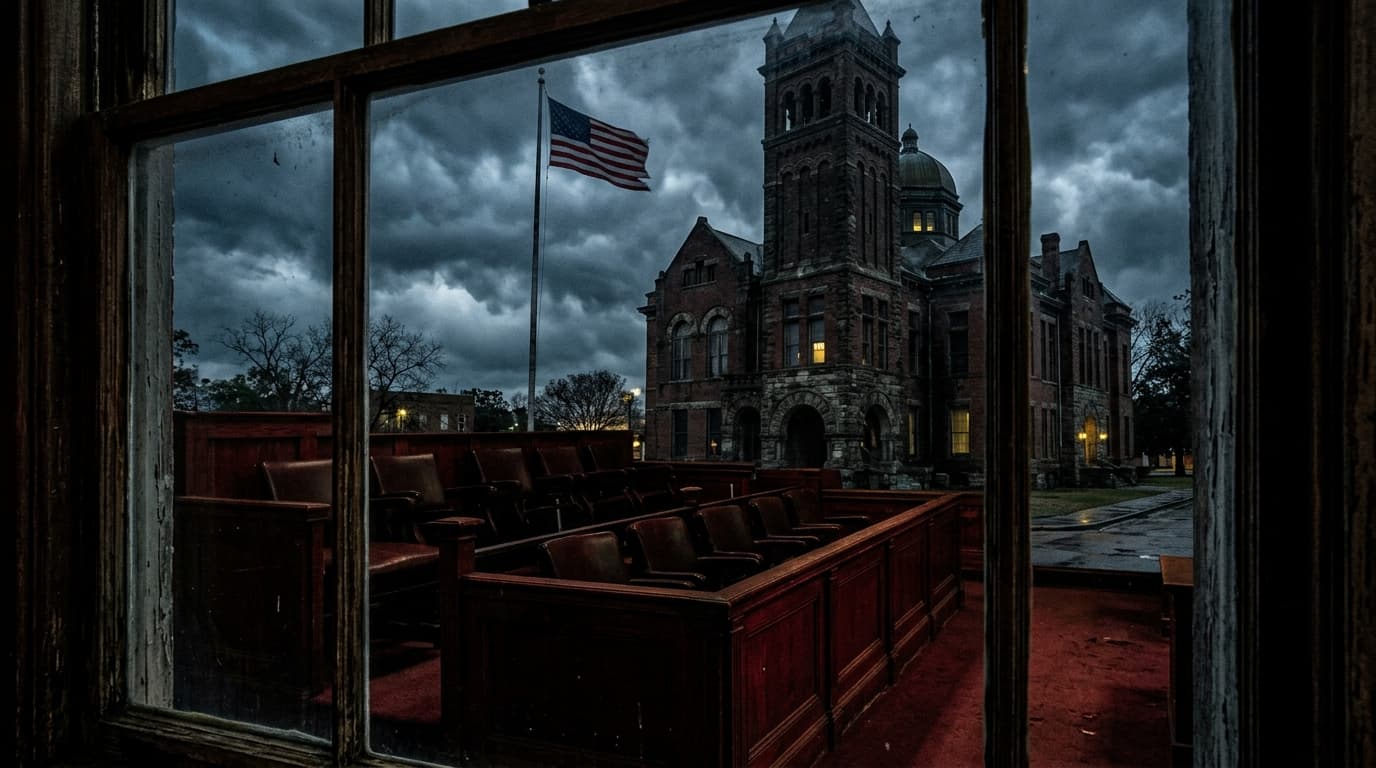
On a sweltering Mississippi morning in July of 1996, four people were shot to death inside a small furniture store in Winona, a town of roughly five thousand souls in Montgomery County. The victims — Bertha Tardy, the store's owner; Robert Golden, her store manager; Carmen Rigby; and Derrick Stewart — were found with bullet wounds to the head, execution-style, amid the ordinary clutter of a working Southern business. It was a brutal, senseless crime, and the community demanded justice. Within weeks, a 21-year-old local man named Curtis Flowers, who had briefly worked at the store before being fired, was arrested and charged with all four murders. He would spend the next twenty-three years cycling through courtrooms, death sentences, reversals, and retrials in a legal odyssey so grotesque, so saturated with racial animus and prosecutorial misconduct, that the United States Supreme Court would eventually intervene — and still, the man responsible for the abuse would walk away without so much as a formal reprimand.
This is not a story about whether Curtis Flowers committed the murders at Tardy Furniture. That question remains, to this day, legally unanswered — the charges were finally dismissed in September 2020, not because a court declared him innocent, but because the prosecution's case had so thoroughly collapsed under the weight of its own corruption that proceeding was no longer tenable. This is a story about what a single prosecutor — Doug Evans, the elected District Attorney for Mississippi's 5th Circuit District — did with the awesome and largely unchecked power of his office. It is a story about a man who personally tried Curtis Flowers six times over twenty-three years, who was reversed by Mississippi's own Supreme Court three times, who was found by the U.S. Supreme Court to have violated the Constitution by systematically excluding Black citizens from the jury, and who — having left a trail of wreckage that would end most legal careers — continued to serve as District Attorney with no meaningful consequence whatsoever.
It is, in short, a story about everything the Founders feared.
- Crime: Four homicides at Tardy Furniture, Winona, Mississippi — July 16, 1996
- Defendant: Curtis Flowers, Black man, age 21 at time of arrest
- Prosecutor: Doug Evans, D.A., Mississippi's 5th Circuit District — personally tried Flowers all six times
- Trial 1 (1997): Death sentence — reversed by Mississippi Supreme Court for prosecutorial misconduct in closing argument
- Trial 2 (1999): Death sentence — reversed by Mississippi Supreme Court, again for prosecutorial misconduct
- Trial 3 (2004): Death sentence — reversed by Mississippi Supreme Court for Batson violations (Evans struck 15 of 36 qualified Black prospective jurors)
- Trial 4 (2007): Mistrial — hung jury
- Trial 5 (2008): Mistrial — hung jury
- Trial 6 (2010): Death sentence — reversed by U.S. Supreme Court, Flowers v. Mississippi (2019), for racial discrimination in jury selection
- Charges dismissed: September 4, 2020
- Time imprisoned: Nearly 23 years, including long stretches on death row
- Accountability for Evans: None
The Murder Scene and the Case Against Curtis Flowers
The facts of the underlying crime, stripped of prosecutorial spin, are less conclusive than the State of Mississippi ever wanted the public to believe. On the morning of July 16, 1996, between approximately 7:30 and 9:00 AM, four people were shot inside Tardy Furniture on Winona's main street. Bertha Tardy, 59, had owned the store for years. Robert Golden, 42, managed it. Carmen Rigby, 45, was a clerk. Derrick Stewart, 16, was a part-time worker. All four were shot at close range with a .380 caliber firearm; none survived. The store's safe had been opened, and an undetermined amount of cash was missing.
Curtis Flowers had worked at the store briefly in June 1996, reportedly about two weeks before the murders, and had been fired. That, combined with his physical proximity to the area that morning — he lived nearby — constituted the core of the prosecution's theory. There was no murder weapon ever recovered. No physical evidence directly linking Flowers to the scene was produced at any trial. The prosecution's case rested primarily on two pillars: testimony from a jailhouse informant named Odell Hallmon, who claimed Flowers had confessed to him, and a collection of circumstantial evidence that multiple juries found insufficient to produce unanimous verdicts.
Hallmon himself was a deeply compromised witness. He had a substantial criminal record and had received assistance from Evans in connection with his own legal troubles — creating an obvious incentive to fabricate testimony. Years later, Hallmon would recant his account entirely, telling investigators for APM Reports' landmark podcast In the Dark that he had lied on the stand. The prosecution also presented a witness who said she saw Flowers near the store that morning — testimony that was itself inconsistent across the six trials.
None of this necessarily proves innocence. It does prove — beyond any serious dispute — that the evidence supporting conviction was thin, contested, and heavily dependent on the integrity of witnesses who lacked it. In such circumstances, one might expect a seasoned prosecutor to proceed with humility, or at least with the recognition that the system requires more than zeal. What Doug Evans brought instead was something quite different.
The Six Trials: A Prosecutorial Obsession Becomes a Constitutional Crisis
The American system of criminal justice is built on the premise that the government, with its vast resources and coercive power, can prosecute a citizen once. If the state fails to prove its case, if juries deadlock or convictions are reversed for fundamental error, the law recognizes limits on how many bites at the apple the government may take. Double jeopardy protections, while technically permitting retrial after certain reversals, carry with them an implicit understanding: repeated prosecution of the same individual for the same crime, particularly when driven by the same flawed evidence and the same unconstitutional practices, begins to look less like justice and more like persecution.
Doug Evans tried Curtis Flowers six times. He was present at every trial. He personally conducted the voir dire — the jury selection process — at each proceeding. He made the opening statements and closing arguments. He chose which witnesses to call and which evidence to present. The six trials stretched across thirteen years, from 1997 to 2010. And across those six trials, a pattern emerged that was not subtle.
In the first trial in 1997, the jury — all white — convicted Flowers and sentenced him to death. The Mississippi Supreme Court reversed the conviction because Evans had made improper and prejudicial remarks during closing arguments, vouching for witnesses in a manner that violated professional conduct rules. Evans was admonished. He retried Flowers anyway.
The second trial in 1999 produced another conviction and another death sentence. The Mississippi Supreme Court reversed again — this time citing eight separate instances of prosecutorial misconduct by Evans, including improper references to facts not in evidence and inflammatory arguments designed to inflame rather than inform the jury. The court's opinion was unusually pointed in its criticism of the prosecutor. Evans was admonished again. He retried Flowers a third time.
The third trial, in 2004, raised the stakes considerably. The Mississippi Supreme Court reversed the resulting conviction — Curtis Flowers' third death sentence — on Batson grounds. In Batson v. Kentucky (1986), the U.S. Supreme Court held that prosecutors may not use peremptory strikes to remove jurors on the basis of race. The Constitution is unambiguous: a Black defendant has the right to be judged by a jury selected without racial discrimination. In Flowers' third trial, Evans had struck 15 of 36 qualified Black prospective jurors — an extraordinary rate that left a nearly all-white jury empaneled in a case where the defendant was Black and the community itself was racially mixed. The Mississippi Supreme Court found this violated Batson. Evans was admonished. He retried Flowers again.
"The accumulation of all powers, legislative, executive, and judiciary, in the same hands, whether of one, a few, or many... may justly be pronounced the very definition of tyranny."
The fourth and fifth trials, in 2007 and 2008, ended without conviction — hung juries in both cases. The evidence had not materially changed. What had changed, perhaps, was that some jurors — Black jurors who had survived Evans' peremptory strikes — were no longer willing to convict on the available evidence. The hung juries were not exonerations; they were expressions of reasonable doubt. But they were also a message that the prosecution's case, such as it was, could not command unanimous agreement from the community it claimed to represent.
Evans brought Curtis Flowers to trial a sixth time in 2010. By then, the case had become something beyond an ordinary prosecution. It had become, for Doug Evans, a project. He had invested decades of his professional life in the conviction of Curtis Flowers. The sunken costs — reputational, emotional, political — were enormous. And so, perhaps inevitably, the sixth trial featured the same racially discriminatory jury selection that had tainted the trials before it.
The In the Dark Investigation: Journalism Accomplishes What Courts Could Not
The American legal system, in theory, is self-correcting. Appellate courts exist to identify constitutional errors. Bar associations exist to discipline lawyers who violate professional rules. Yet the Curtis Flowers case had been before the Mississippi Supreme Court three times, with the court finding reversible error each time — and Doug Evans had simply kept going. No bar complaint resulted in meaningful sanction. No special prosecutor was appointed. No external investigation was launched. The system's self-correction mechanism had failed completely.
The correction, when it finally came, arrived not from within the legal system but from journalism.
In 2018, the investigative podcast In the Dark, produced by APM Reports and led by journalist Madeleine Baran, published a season-long investigation into the Curtis Flowers case. The reporting was meticulous, data-driven, and devastatingly effective. Baran and her team did something that, strikingly, no court had done in two decades: they systematically examined Doug Evans' jury selection practices not just in the Flowers trials, but across every capital case Evans had tried over a fifteen-year period.
What they found was breathtaking. Across all six of Flowers' trials, Evans had used peremptory strikes to remove 41 of 42 Black prospective jurors who were qualified and seated for questioning — a strike rate of 97.6%. When the In the Dark team examined Evans' other capital trials during the same period, they found a consistent pattern: Evans struck Black jurors at dramatically higher rates than white jurors, even when controlling for other factors. He asked Black prospective jurors different questions than white prospective jurors — more questions, more probing, more designed to find a pretext for exclusion. He accepted white jurors with characteristics he used to disqualify Black jurors.
The podcast also documented that Odell Hallmon, the key jailhouse informant, had received substantial benefits from Evans in connection with his own prosecutions — benefits that were not fully disclosed to the defense, raising serious Brady concerns. Hallmon had been tried and convicted multiple times on Evans' watch; his sentencing had been handled with a lightness that contrasted sharply with Evans' treatment of other defendants. And when Hallmon recanted entirely — telling Baran's team on tape that he had fabricated his testimony against Flowers — the prosecution's narrative crumbled further.
The journalism did what the courts had not: it assembled the full picture. It showed that what had happened to Curtis Flowers was not a series of isolated errors but a sustained, systemic pattern of unconstitutional conduct by a single prosecutor who had been permitted, over and over again, to start fresh without consequence.
Flowers v. Mississippi: The Supreme Court Speaks
In November 2018, while the In the Dark investigation was still generating national attention, the U.S. Supreme Court agreed to hear Curtis Flowers' appeal from his sixth conviction. The central question was straightforward: had Doug Evans violated Batson in the sixth trial by using peremptory strikes to exclude Black jurors on the basis of race?
On June 21, 2019, the Court issued its answer. In a 7-2 decision authored by Justice Brett Kavanaugh, the Court held that Evans had indeed violated the Equal Protection Clause of the Fourteenth Amendment by discriminating on the basis of race in jury selection. Kavanaugh's majority opinion was thorough and pointed, examining four specific Black prospective jurors whom Evans had struck in the sixth trial and comparing Evans' treatment of them to his treatment of similarly situated white jurors. The disparities were stark: Evans had asked Black jurors extensive follow-up questions designed to surface pretextual reasons for exclusion, then accepted white jurors with similar or identical characteristics without equivalent scrutiny.
The majority opinion went further, invoking the full history of Evans' conduct across all six trials. Kavanaugh wrote: "In the six trials combined, Evans used peremptory strikes against 41 of the 42 black prospective jurors he could have struck — a statistic that the State cannot adequately explain away." The Court did not declare Flowers innocent. It did not suggest that Evans had committed crimes. But it held, in terms that could not have been clearer, that the prosecutor had spent twenty-three years systematically violating the constitutional rights of a Black defendant in order to seat white juries.
"It is a principle of our law that no man shall be condemned without being heard; and if this principle is violated in criminal cases, where the law affects the liberty and life of the subject, nothing can be more contrary to our constitution."
Justices Clarence Thomas and Neil Gorsuch dissented. Thomas, in a lengthy dissent, argued that the majority had reweighed credibility determinations that should have been left to the trial court and that the record did not support a finding of discriminatory intent. Thomas's dissent was characteristically careful in its legal analysis and characteristically indifferent to the broader pattern — treating each strike in isolation rather than viewing the full record of twenty-three years of racialized prosecution.
The legal significance of the ruling was substantial. Flowers v. Mississippi became one of the most important Batson decisions since the doctrine was established in 1986, standing for the proposition that courts must consider a prosecutor's history of racially discriminatory jury selection across multiple trials when evaluating whether a specific strike is discriminatory. It was a direct repudiation of the argument that each trial exists in a vacuum, immune to evidence of the systemic patterns preceding it.
The ruling was also a rebuke of an entire apparatus — the Mississippi courts that had, repeatedly, accepted Evans' explanations for his jury strikes despite glaring inconsistencies; the Mississippi Bar that had failed to discipline Evans despite three reversals for misconduct; and the broader culture of prosecutorial deference that treats elected district attorneys as beyond serious scrutiny as long as they continue to win elections.
The Collapse of the Case and the Dismissal of Charges
After the Supreme Court's ruling, Curtis Flowers' sixth conviction was vacated and the case was remanded. By late 2019, the Mississippi Supreme Court had reversed the conviction on remand. Evans initially indicated his intent to pursue a seventh trial. The statement — that a prosecutor whose conduct had been repudiated by the state's highest court and then by the nation's highest court would simply try again — was remarkable in its brazenness.
But the wheels were coming off. The In the Dark reporting had attracted national attention and significant pressure. New evidence had emerged about Odell Hallmon's recantation and about broader credibility problems with the prosecution's witnesses. Civil rights organizations, legal scholars, and journalists had focused a level of scrutiny on the 5th Circuit D.A.'s office that it had never before experienced. In July 2020, Evans recused himself from the case, citing unspecified personal matters — a concession that itself acknowledged the impossibility of his continued involvement.
A special prosecutor was appointed. On September 4, 2020, after examining the state of the evidence, the special prosecutor dismissed all charges against Curtis Flowers. He walked out of prison twenty-three years after his arrest, having served time on death row for crimes the State of Mississippi ultimately declined to prove. He was 45 years old. He had entered the system at 21.
There was no apology from the State of Mississippi. There was no formal acknowledgment that what had been done to Curtis Flowers was wrong. There was no financial reparation offered, no truth commission convened, no systematic examination of how many other defendants in the 5th Circuit District had been subjected to similarly discriminatory jury selection. Doug Evans retired from his position as District Attorney in 2022, having served the full term to which he had been elected after the Supreme Court ruled against him. He was not disbarred. He was not criminally charged. He was not, so far as the public record reflects, sanctioned by the Mississippi Bar in any meaningful way.
He simply retired. With his pension. And his reputation, such as it was, intact among those who had not been following the case closely.
The Structural Rot: Why This Keeps Happening
The Curtis Flowers case is not an aberration. It is, in the terminology of systems analysis, a feature — the predictable output of a system designed, intentionally or not, to insulate prosecutors from the consequences of their misconduct.
Consider the architecture of the problem. Prosecutors in Mississippi, as in most states, are elected officials. Their electoral success depends on conviction rates and on the perception that they are "tough on crime." Losing a high-profile murder case — particularly one in which they have already invested years of effort — carries significant political costs. Winning, however, carries almost no legal risk, regardless of how the victory is achieved. Absolute prosecutorial immunity, established by the Supreme Court in Imbler v. Pachtman (1976), shields prosecutors from civil liability for their conduct in prosecuting cases. A prosecutor who knowingly presents perjured testimony, suppresses exculpatory evidence, and discriminates in jury selection cannot be personally sued by the victim of that misconduct.
The only formal mechanisms for holding prosecutors accountable are criminal prosecution (almost never pursued, since prosecutors control who gets charged), bar discipline (rarely applied with any rigor to sitting elected prosecutors), and appellate reversal (which produces retrials rather than accountability). None of these mechanisms, applied to Doug Evans over twenty-three years, produced any meaningful consequence. Three reversals from the state supreme court. One reversal from the U.S. Supreme Court. And the man responsible for it all retired on schedule.
The racial dimension of the Flowers case compounds the structural problem. Batson's prohibition on racially discriminatory jury selection is widely understood, among legal scholars and practitioners, to be largely unenforceable in practice. The doctrine requires the defendant to make a prima facie showing of discrimination, after which the prosecutor must offer a "race-neutral" explanation for the challenged strike. Courts are then required to determine whether the explanation is a pretext. But the "race-neutral explanation" standard is extraordinarily easy to satisfy: virtually any explanation — the juror seemed inattentive, the juror worked in a related field, the juror had a family member who was convicted of a crime — can be dressed up as race-neutral, even when it is transparently pretextual. The result is that Batson, despite being the law for nearly forty years, has done relatively little to actually prevent racially discriminatory jury selection. The Flowers case required the U.S. Supreme Court to look at an entire decade of prosecution and issue a ruling that anyone paying attention had been able to see for years.
This is not a Mississippi problem. It is an American problem. Studies consistently show that prosecutors across the country strike Black jurors at substantially higher rates than white jurors. The disproportionality is most pronounced in capital cases, where the stakes are highest and the impulse toward "favorable" jury composition most acute. The legal architecture surrounding prosecutorial discretion has consistently prioritized the efficient exercise of prosecutorial power over the rights of defendants to be tried by juries selected without discrimination.
The Founders' Vision and the Prosecutor's Betrayal
The American republic was founded, in substantial part, on a specific fear: the fear of concentrated, unaccountable governmental power turned against the individual citizen. The Declaration of Independence's grievances against King George III are essentially a catalog of prosecutorial and judicial abuses: judges whose tenure depended on royal favor, trial by jury undermined by royal prerogative, arbitrary imprisonment without adequate cause. The Founders had lived under a system where the machinery of the state could be weaponized against dissenters, minorities, and the politically inconvenient. They built constitutional protections for criminal defendants not because they were soft on crime but because they understood that the difference between a republic and a tyranny lay precisely in the rules governing how the state could treat the individual.
Doug Evans inverted that vision. He was not a foreign king but an elected representative of the people of the 5th Circuit District. He held office by democratic mandate. And yet what he did with that office — pursuing a single Black man across six trials, systematically excluding Black citizens from the juries that would judge that man, doing so over and over again even after being told repeatedly by appellate courts that what he was doing was unconstitutional — was precisely the kind of governmental abuse against which the Constitution was designed to protect. He used the awesome resources of the state, resources that no individual defendant could hope to match, in service of a personal and institutional project that the highest court in the land ultimately condemned as racially discriminatory.
The irony is complete: a man whose life was defined by prosecuting crime was, in the most precise constitutional sense, a constitutional violator. Not a criminal, perhaps — the law, as written, gave him immunity. But a violator of the principles that the law is supposed to embody.
The Human Cost: Twenty-Three Years of Curtis Flowers' Life
Statistics can obscure the human reality of what the Flowers case represents. Curtis Flowers was 21 years old when he was arrested. He spent the following twenty-three years — his entire young adulthood, his thirties, the early part of his forties — in the Mississippi correctional system. Much of that time was spent on death row, in conditions of near-total isolation, knowing that the state had decided he should die for crimes whose proof kept collapsing under appellate scrutiny.
He did not choose to pursue his case through the courts. He did not choose to become a symbol of prosecutorial abuse. He was the subject of a system that moved around him like weather — sometimes in his direction, mostly not. He did not write a memoir while incarcerated. He did not become a national celebrity. He was, in the terminology of the law, a defendant; in the language of the state, a capital murderer; in human reality, a man to whom an extraordinary wrong was done.
His family spent twenty-three years in the shadow of a capital case — attending trials, watching convictions, watching reversals, attending more trials. His father, Archie Flowers, became a fixture of the Winona courthouse, present at every proceeding, an act of loyalty and resilience that speaks volumes about what the case cost the people around Curtis Flowers, not just Curtis Flowers himself.
When the charges were dismissed in September 2020, there was no ceremony. There was no official acknowledgment that anything had gone wrong. There was simply a motion, a hearing, and a dismissal — the bureaucratic conclusion to a bureaucratic catastrophe. Curtis Flowers walked out of prison and tried to rebuild a life that had been taken from him at 21.
What does that accounting look like, in concrete terms? Twenty-three years of wages not earned. Twenty-three years of relationships not formed or sustained. Twenty-three years of experience — the ordinary accumulation of a life lived in freedom — simply absent. The state of Mississippi has no mechanism for compensating him. Mississippi's wrongful conviction compensation statute covers only individuals who have been affirmatively exonerated by a finding of factual innocence, not those whose charges have been dismissed. Flowers has received nothing.
The Blueprint: Reforms That Would Actually Work
The Flowers case is not merely a story about one man and one prosecutor. It is an instruction manual — a detailed, fully documented account of how the prosecutorial system fails when the internal and external checks on prosecutorial power are inadequate. From its wreckage, a serious reform agenda can be constructed.
- Abolish Absolute Prosecutorial Immunity. The doctrine of absolute immunity for prosecutors, established in Imbler v. Pachtman (1976), is a judicial invention without constitutional foundation. It shields intentional misconduct as thoroughly as it shields good-faith mistakes. Congress should enact legislation providing that prosecutors may be personally liable for intentional violations of defendants' constitutional rights — including Brady violations, Batson violations, and witness coaching. The qualified immunity standard that applies to police officers, imperfect as it is, would be a substantial improvement over absolute immunity.
- Establish Independent Prosecutorial Misconduct Commissions. Bar associations are structurally unsuited to discipline elected prosecutors. They are composed of lawyers, many of whom work alongside or in deference to elected prosecutors, and they face no electoral accountability for failing to act. Every state should establish an independent, adequately resourced commission specifically charged with investigating and sanctioning prosecutorial misconduct — with authority to suspend law licenses, recommend criminal prosecution, and publish findings.
- Reform Batson to Require Objective, Documented Justifications. The current Batson framework, which accepts any facially race-neutral explanation at near face value, must be strengthened. Courts should be required to conduct statistical analysis of a prosecutor's striking patterns across multiple cases, and prosecutors should be required to document their reasons for strikes in writing before exercising them. A strike rate that exceeds statistical norms by two standard deviations should create a rebuttable presumption of discrimination.
- Limit the Number of Retrials in Capital Cases. No prosecutor should be permitted to try a defendant for a capital offense more than three times. After three attempts — especially after three attempts involving documented constitutional violations — the state's interest in conviction must yield to the defendant's interest in finality. A statutory cap on capital retrials, with exceptions only for newly discovered DNA evidence, would prevent the kind of prosecutorial attrition that characterized the Flowers case.
- Mandate Disclosure of Jailhouse Informant Benefits. Jailhouse informant testimony is among the most unreliable evidence admitted in American courts. Studies have found that informant testimony is a leading contributor to wrongful convictions. Every benefit provided to an informant in connection with his testimony — sentence reductions, dropped charges, case assistance, informal accommodations — must be disclosed to the defense in writing, under penalty of automatic reversal. The Brady doctrine theoretically requires this; prosecutorial practice routinely circumvents it.
- Create State Wrongful Prosecution Compensation Funds. Every state should establish a compensation mechanism for individuals whose convictions are reversed due to proven prosecutorial misconduct or newly discovered evidence, regardless of whether formal factual innocence has been established. The burden of decades of unconstitutional prosecution should not fall entirely on the defendant. A uniform federal standard, with minimum compensation of $100,000 per year of wrongful incarceration plus non-economic damages, would provide baseline accountability and create financial incentives for states to prevent misconduct in the first instance.
- Require Judicial Tracking of Appellate Reversals by Prosecutor. Courts should maintain and publicly publish databases tracking the number of reversals attributable to each prosecutor's conduct in each jurisdiction. This information, currently fragmented across case reporters that few non-lawyers consult, should be aggregated, made searchable, and incorporated into bar disciplinary proceedings. An elected prosecutor with five reversals for misconduct should not be able to obscure that record from voters or from the bar.
- Federalize Prosecutorial Misconduct Reporting. The Department of Justice should establish a National Prosecutorial Conduct Registry — modeled on existing databases for police misconduct — that tracks sustained findings of prosecutorial misconduct across state and federal systems. Prosecutors found to have committed intentional misconduct should be ineligible to serve in federal law enforcement roles and should be reported to their state bars automatically. The current system's siloed, jurisdiction-by-jurisdiction approach allows serial violators to evade reputational consequences.
Conclusion: The Republic Cannot Survive This
The Curtis Flowers case endured for twenty-three years because the systems designed to prevent it either failed or were never robust enough to succeed. The Mississippi Supreme Court reversed convictions three times and Evans tried Flowers again. The bar failed to sanction Evans meaningfully. The media, until Madeleine Baran and the In the Dark team arrived, largely ignored the pattern. And the United States Supreme Court, having ruled against Evans' conduct in the strongest possible terms, could not undo the two decades of abuse that preceded its ruling or compensate the man who bore the cost of it.
The Founders' deepest fear was not foreign invasion or economic collapse. It was the corruption of republican institutions from within — the slow rot of a system designed for liberty being captured by those with the ambition and the power to use it for their own ends. "Power tends to corrupt," Lord Acton would write a century after Philadelphia, "and absolute power corrupts absolutely." The power of a district attorney in a small Mississippi district is not absolute in the philosophical sense. But for Curtis Flowers, for twenty-three years, it was absolute enough.
A republic worthy of the name does not permit this. It does not allow elected officials to pursue single defendants across six trials over two decades, violating the Constitution repeatedly along the way, and then retire with dignity and a pension when the game is finally called. It creates systems that identify abuse early, sanction it meaningfully, and compensate its victims adequately. It takes seriously the Founders' insight that the rights of the most powerless citizen are the truest measure of the health of the republic.
We are not that republic yet. The Flowers case tells us exactly how far we have to go.
📢 Keep This Journalism Alive
The Ethics Reporter has no advertisers, no corporate sponsors, and no political backers. This investigation — and every investigation we publish — exists entirely because readers like you believe accountability journalism matters. If this reporting moved you, please consider supporting us.
Donate to The Ethics ReporterEven $1 helps. No amount is too small. Thank you for standing with us.