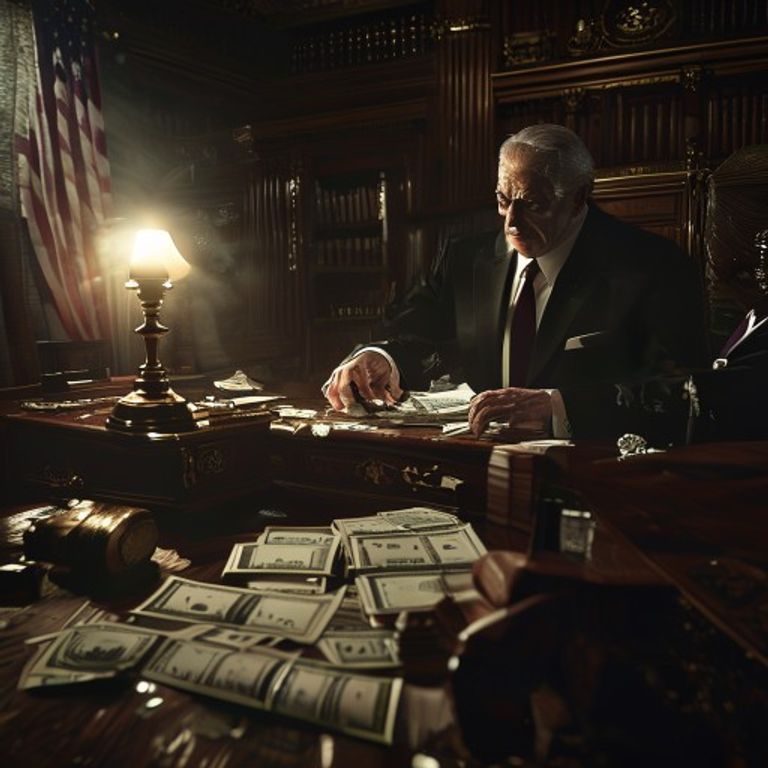
In the pantheon of modern American legal mythology, few figures stood taller than Mississippi Circuit Court Judge Bobby DeLaughter. In 1994, as a crusading prosecutor, DeLaughter achieved the impossible: he secured the conviction of white supremacist Byron De La Beckwith for the 1963 assassination of civil rights leader Medgar Evers. The case made DeLaughter a national hero. He wrote a book. Hollywood came calling, immortalizing him in the film Ghosts of Mississippi, with Alec Baldwin portraying him as the unyielding embodiment of southern justice.
He was the quintessential American legal hero—a man who proved that the system could right its historical wrongs. But less than fifteen years later, the hero was sitting in a federal courtroom, disgraced, stripped of his robe, and heading to federal prison for obstruction of justice. The man who brought down Beckwith had sold his judicial office to Dickie Scruggs, the most powerful plaintiffs' attorney in America.
The Scruggs-DeLaughter bribery scandal of 2007 is not a tragedy about the fall of a single good man. It is a devastating, empirical indictment of the American judicial framework. It demonstrates that the self-policing legal establishment is so structurally corrupt, so deeply infected by what Thomas Jefferson called the "privilege of their corps," that it can turn even its most celebrated heroes into common extortionists. It proves that the Founders' greatest fears about an unaccountable legal oligarchy have been entirely realized, and that the current system is fundamentally incompatible with the survival of a constitutional republic.
- The Judge: Bobby DeLaughter, Hinds County Circuit Court Judge, famous for prosecuting the Medgar Evers assassination.
- The Lawyer: Richard "Dickie" Scruggs, billionaire plaintiffs' attorney famous for the $246 billion tobacco settlement (portrayed in The Insider).
- The Dispute: Wilson v. Scruggs, a multi-million-dollar lawsuit over the division of asbestos legal fees.
- The Bribe: Scruggs needed a favorable ruling from DeLaughter. Instead of cash, Scruggs used his brother-in-law, U.S. Senator Trent Lott, to promise DeLaughter a lifetime appointment to the federal bench.
- The Bagman: Ed Peters, the former District Attorney of Hinds County and DeLaughter's former boss and mentor, was paid $1 million by Scruggs to secretly influence DeLaughter.
- The Fallout: Scruggs pleaded guilty to bribery and went to federal prison. DeLaughter pleaded guilty to obstruction of justice and served 18 months.
The Marketplace of Justice: The Architecture of the Bribe
To understand the sheer audacity of the Scruggs-DeLaughter conspiracy, one must understand the absolute power that a few elite attorneys wield within the localized American legal system. Dickie Scruggs was not just a lawyer; he was a political and economic titan. Having engineered the multi-billion-dollar national tobacco settlement in the 1990s, Scruggs possessed unfathomable wealth and unparalleled political connections, primarily through his brother-in-law, United States Senator Trent Lott.
In 2006, Scruggs found himself entangled in a bitter, high-stakes dispute over the division of legal fees from mass asbestos litigation. The case, Wilson v. Scruggs, landed in the Hinds County courtroom of Judge Bobby DeLaughter. Scruggs stood to lose millions if the judge ruled against him. But in the American legal cartel, billionaires do not leave their fortunes to the unpredictable whims of impartial justice. They buy the outcome.
Scruggs knew that DeLaughter desperately coveted a federal judgeship—an Article III lifetime appointment. He also knew that DeLaughter’s former boss and mentor, former District Attorney Ed Peters, wielded immense psychological and professional influence over the judge. Scruggs hired Peters, not to file briefs or argue in open court, but to act as a secret emissary. Scruggs paid Peters $1 million to illegally contact DeLaughter ex parte (outside the presence of opposing counsel) and secure the rulings Scruggs needed.
The bribe was elegant in its corruption. It wasn't an envelope of cash slid under a table. It was the ultimate currency of the legal guild: power. Scruggs promised DeLaughter that if the judge ruled in his favor, Senator Trent Lott would champion DeLaughter’s nomination for a vacant seat on the federal bench. DeLaughter took the bait. He secretly shared draft orders with Peters, allowing Scruggs’s team to edit the judge’s rulings before they were officially issued. The judge had become a wholly owned subsidiary of the Scruggs law firm.
The Betrayal of Federalist 78 and the Failure of "Integrity"
When Alexander Hamilton drafted Federalist No. 78 to defend the proposed structure of the federal judiciary, he made a profound philosophical gamble. He argued that the judiciary would be the "least dangerous" branch of government because it possessed "neither force nor will, but merely judgment." The courts, Hamilton asserted, could not threaten the liberty of the people because they relied entirely on the integrity of their reasoning.
Hamilton’s entire premise rested on a crucial, fragile assumption: the character of the judges. He believed that the gravity of the office would naturally attract individuals of exceptional "integrity and moderation." He wrote that the qualifications necessary for the bench "are of such a nature as to demand long and laborious study," which would filter out the ambitious and the corrupt.
The Scruggs-DeLaughter scandal shatters Hamilton’s assumption into a thousand pieces. Bobby DeLaughter was the very embodiment of the "integrity" Hamilton envisioned—a celebrated prosecutor who had faced down the Ku Klux Klan. Yet, when confronted with the promise of elevated power and the whispering influence of his mentor, that integrity evaporated instantly. Hamilton failed to anticipate that the legal profession would evolve into an insular, hyper-lucrative cartel where "judgment" is simply another commodity to be traded by power brokers.
When a judge allows a billionaire plaintiff's attorney to secretly draft the court's orders in exchange for a federal appointment, the judiciary is no longer exercising "judgment." It is exercising the raw, tyrannical "will" of the highest bidder. Hamilton’s "least dangerous branch" had become, in Mississippi, a weapon of mass financial extortion.
Jefferson's Sickness: The Privilege of Their Corps
Unlike Hamilton, Thomas Jefferson viewed the legal establishment with profound suspicion. He recognized that lawyers, if permitted to consolidate their power and self-regulate, would inevitably form an oligarchy. In a prophetic 1820 letter, Jefferson diagnosed the exact pathology that consumed the Mississippi judicial system:
"Our judges are as honest as other men, and not more so. They have, with others, the same passions for party, for power, and the privilege of their corps."
The "privilege of their corps" is the defining sickness of the American legal system. The corruption in Mississippi was not a secret among a select few. Ed Peters was known to have the ear of his former subordinates on the bench. Dickie Scruggs’s influence was legendary. The intertwining of plaintiff attorneys, judges, and politicians in the Deep South was a recognized, accepted reality by the local bar association.
Yet, the self-policing mechanisms of the legal profession did absolutely nothing. The Mississippi Bar Association did not stop it. The judicial conduct commission did not expose it. The legal guild closed ranks. They viewed Scruggs, Peters, and DeLaughter not as criminals undermining the republic, but as elite members of their own corps operating within the accepted parameters of the game.
The conspiracy was only exposed because Scruggs grew so arrogant that he attempted to bribe another judge, Henry Lackey, with $40,000 in cash in a completely separate case. Judge Lackey, in a rare display of actual integrity, reported the bribe to the FBI and wore a wire. It took federal law enforcement, wiretaps, and a cooperating judge to bring down the cartel. A system that requires the FBI to stage sting operations against its own judges is a defunct system. It is proof that the legal profession is entirely incapable of policing itself.
John Adams and the Illusion of a Government of Laws
In drafting the Massachusetts Constitution in 1780, John Adams enshrined the foundational principle of the American republic: that it must be "a government of laws and not of men." The premise is that the law applies equally to all, regardless of wealth, status, or political connection. It is the defining line between a republic and a tyranny.
Dickie Scruggs and Bobby DeLaughter operated a government of men. In DeLaughter's courtroom, the law did not dictate the outcome of Wilson v. Scruggs. The law was completely irrelevant. The outcome was dictated by a backroom negotiation between two men (Scruggs and Peters) who used a United States Senator as a bargaining chip to buy the obedience of a third man (DeLaughter).
When the outcome of a multi-million-dollar lawsuit is determined by who has the better connections to the judge’s mentor, the Constitution has been functionally suspended. The Declaration of Independence severed America's ties to a hereditary British aristocracy that dispensed justice based on patronage and royal favor. But the American legal profession has simply replaced the British aristocracy with an oligarchy of the robes. They wear suits instead of crowns, but their contempt for the rule of law is identical.
Madison and the Catastrophic Failure of Checks and Balances
James Madison, the primary architect of the Constitution, understood that human nature is inherently flawed. In Federalist No. 51, he wrote:
"If men were angels, no government would be necessary... In framing a government which is to be administered by men over men, the great difficulty lies in this: you must first enable the government to control the governed; and in the next place oblige it to control itself."
Madison’s solution was the separation of powers: ambition must be made to counteract ambition. No single institution could be trusted with unchecked power.
But the American legal system completely abandoned Madison's safeguards. By convincing legislatures that the practice of law is a specialized science, the legal profession secured a monopoly over its own regulation. They created a system where lawyers police lawyers, and judges judge judges. There is no external ambition to counteract their power.
The Scruggs-DeLaughter scandal is the catastrophic result of this failure. The system placed blind trust in a "hero" judge and a "titan" lawyer, providing no structural oversight to monitor their interactions. Because there was no independent, civilian-led body actively auditing the communications and financial relationships of the judiciary, Scruggs was able to purchase a branch of government.
The Necessity of Systemic Reconstruction
When the scandal concluded, Dickie Scruggs went to federal prison. Bobby DeLaughter pleaded guilty to obstruction of justice and served eighteen months. Ed Peters surrendered his law license in exchange for immunity. The legal establishment issued solemn press releases condemning their actions, declaring them to be "bad apples," and insisting that the integrity of the system remained intact.
This is a lie. The system is not intact; it is fundamentally broken. You cannot reform a system where the heroes are for sale and the watchdogs are asleep by design. We do not need ethics seminars or updated guidelines. We need immediate, systemic reconstruction to align the judiciary with the founding principles of this republic.
1. Eradicate Self-Policing and the Guild Monopoly
The absolute authority of bar associations and judicial conduct boards to police their own members must be abolished. The discipline of attorneys and judges must be transferred to independent, civilian-run regulatory commissions with unhindered subpoena power and no ties to the legal profession. The "privilege of their corps" must be destroyed. The people must regulate the legal monopoly.
2. End Judicial Immunity for Corrupt Acts
The doctrine of absolute judicial immunity currently shields judges from civil liability for their official acts, even when those acts are the product of bribery. This is a judge-made doctrine designed to protect judges from accountability. If a judge is convicted of accepting a bribe to alter a ruling, the victims of that corrupted ruling must have the immediate, unhindered right to sue the judge personally for the destruction of their livelihoods. The robe cannot be a shield for civil liability in cases of criminal corruption.
3. Mandatory Surveillance and Communication Auditing
The idea that a judge's chambers are a sacred sanctuary of legal contemplation is a myth used to hide ex parte communications and extortion. Judicial chambers, particularly when judges are meeting with attorneys, must be subject to mandatory audio and video recording. Furthermore, all communications between judges and attorneys must be logged and subject to routine auditing by an independent inspector general. Privacy is a right of the citizen; absolute transparency is the obligation of the jurist.
4. Decriminalize the Unlicensed Practice of Law (UPL)
The root of Scruggs's power was the artificial scarcity created by the legal monopoly. By aggressively prosecuting the "unauthorized practice of law," bar associations ensure that citizens are forced to hire licensed attorneys at exorbitant rates, concentrating immense wealth and political power in the hands of a few elite litigators. By dismantling the UPL laws and opening the legal market to technological and non-lawyer alternatives, we break the economic engine that funds the corruption of the judiciary.
Conclusion: The Fall of the Oligarchy
Bobby DeLaughter stood before the nation as a symbol of justice redeemed. He ended up as a symbol of justice monetized. The tragedy of his fall is eclipsed only by the horror of the system that facilitated it. The American judiciary has become exactly what Thomas Jefferson feared: an unaccountable oligarchy that places its own wealth and power above the Constitution.
The Founding Fathers fought a revolution to escape a government of men. We must not surrender our republic to a cartel of lawyers and judges. The Scruggs-DeLaughter scandal was a warning. It is time to tear down the legal aristocracy and reconstruct a system that answers to the people.
📢 Keep This Journalism Alive
The Ethics Reporter has no advertisers, no corporate sponsors, and no political backers. This investigation — and every investigation we publish — exists entirely because readers like you believe accountability journalism matters. If this reporting moved you, please consider supporting us.
Donate to The Ethics ReporterEven $1 helps. No amount is too small. Thank you for standing with us.