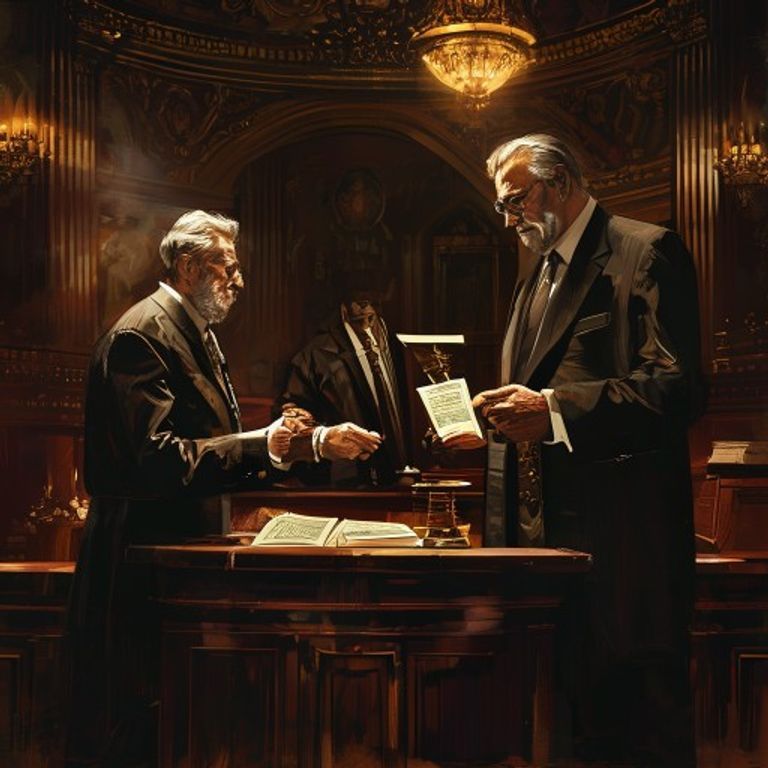
In the pantheon of American legal mythology, the courtroom is a sacred space where the wealth and influence of the litigants are stripped away, leaving only the impartial application of the law. But in the reality of the American legal establishment, the courthouse often functions as a private country club—an exclusive marketplace where the "privilege of the corps" dictates who wins, who loses, and how much it costs to guarantee the outcome.
No story shatters the myth of American judicial integrity more completely than the spectacular collision of Richard "Dickie" Scruggs and Hinds County Circuit Judge Bobby DeLaughter. It is a story of a billionaire trial lawyer, a celebrity judge, bags of cash, and the trading of a lifetime federal appointment as if it were a poker chip. Their conspiracy did not merely corrupt a single case; it laid bare the systemic rot of a judicial framework that allows the legal elite to commoditize justice with absolute impunity.
The Mississippi judicial bribery scandals of the late 2000s prove that the Founding Fathers’ most profound anxieties about an unaccountable legal aristocracy were entirely justified. When the legal profession is permitted to police itself, and when judges are insulated from the democratic consequences of their actions, the system inevitably descends into an oligarchy.
- The Lawyer: Richard "Dickie" Scruggs, one of America's wealthiest trial lawyers, famous for the $246 billion tobacco settlement. Brother-in-law to former U.S. Senator Trent Lott.
- The Judge: Bobby DeLaughter, Hinds County Circuit Judge. Formerly the hero prosecutor who secured the conviction of Byron De La Beckwith for the murder of civil rights leader Medgar Evers.
- The Scheme: Scruggs was sued by former partners over $15 million in asbestos litigation fees. The case landed before DeLaughter.
- The Bribe: Scruggs paid former District Attorney Ed Peters (DeLaughter's mentor) $1 million to influence the judge. Scruggs also promised to use his brother-in-law, Senator Lott, to get DeLaughter a lifetime appointment to the federal bench.
- The Downfall: In a separate case, Scruggs tried to bribe Judge Henry Lackey with $50,000 in cash. Lackey wore an FBI wire, leading to the collapse of Scruggs' entire empire and the exposure of the DeLaughter scheme.
- The Fallout: Both Scruggs and DeLaughter pleaded guilty and served time in federal prison.
The King of Torts and the Hero Prosecutor
To understand the magnitude of the corruption, one must understand the sheer untouchability of the men involved. Dickie Scruggs was not just an attorney; he was an institution. Known as the "King of Torts," Scruggs orchestrated the massive state lawsuits against the tobacco industry in the 1990s, earning an estimated $1.4 billion in legal fees for his firm. He flew on private jets, commanded an army of politicians, and utilized his brother-in-law, U.S. Senator Trent Lott, to exert massive influence in Washington. In Mississippi, Scruggs was virtually a sovereign entity.
Judge Bobby DeLaughter possessed a different, but equally potent, form of invulnerability: moral prestige. In 1994, as an assistant district attorney, DeLaughter successfully prosecuted white supremacist Byron De La Beckwith for the 1963 assassination of civil rights leader Medgar Evers. The prosecution was a watershed moment in civil rights history, earning DeLaughter national acclaim. He was portrayed by Alec Baldwin in the Hollywood film Ghosts of Mississippi. When he was subsequently appointed to the bench, he was widely regarded as a paragon of judicial righteousness.
But when millions of dollars are on the line, the American legal system rarely relies on righteousness. It relies on leverage.
The Architecture of the Bribe
In the mid-2000s, Scruggs found himself entangled in a bitter, high-stakes dispute with his former law partners over the division of $15 million in fees generated from asbestos litigation. The lawsuit, Wilson v. Scruggs, was assigned to Judge Bobby DeLaughter.
Scruggs did not intend to litigate the case on its merits. Instead, he deployed the tactics of the legal oligarchy. He hired Ed Peters, the former Hinds County District Attorney. Peters had been DeLaughter’s boss, his mentor, and his close personal friend. Scruggs paid Peters a $1 million "reverse contingency fee"—a payment made explicitly to exploit Peters' deeply rooted relationship with the presiding judge.
Peters operated as a shadow counsel. He met privately with Judge DeLaughter, conveying Scruggs' desires and securing inside information on how the judge intended to rule. DeLaughter even secretly reviewed a draft order prepared by Scruggs' legal team, adopting its language to secure a ruling in Scruggs' favor.
But the most chilling aspect of the conspiracy was the ultimate currency of the bribe. While Peters received cash, DeLaughter was bribed with the architecture of the state itself. DeLaughter desperately wanted an appointment to the federal bench—a lifetime position that comes with immense prestige, absolute job security, and unparalleled power. Scruggs promised to leverage his brother-in-law, Senator Trent Lott, to fast-track DeLaughter for the federal judgeship. DeLaughter traded the integrity of his state courtroom for the promise of a lifetime appointment to a federal one.
The Accidental Discovery: Judge Henry Lackey Wears a Wire
The Scruggs-DeLaughter conspiracy was executed flawlessly and would have remained buried forever in the sealed vaults of the Mississippi legal establishment. The state's judicial conduct commission did not detect it. The local bar association did not report it. The "privilege of the corps" operated exactly as intended, protecting the elite from the consequences of their actions.
The scheme only collapsed because Scruggs grew so arrogant that he attempted to replicate it. In a separate legal fee dispute arising from Hurricane Katrina litigation, Scruggs dispatched an associate to offer a $50,000 cash bribe to Circuit Judge Henry L. Lackey.
But Judge Lackey was not Bobby DeLaughter. Deeply offended by the overt corruption, Lackey immediately contacted the FBI and agreed to wear a wire. The ensuing federal sting operation caught Scruggs' associates handing over cash. When the conspirators realized they were facing decades in federal prison, they flipped on Scruggs and revealed the entire breadth of his criminal enterprise, including the secret manipulation of Judge DeLaughter.
Scruggs eventually pleaded guilty to conspiracy charges related to both judges and was sentenced to federal prison. DeLaughter pleaded guilty to a federal charge of obstruction of justice, admitting he lied to the FBI about his interactions with Peters. The hero of Ghosts of Mississippi was marched into a federal penitentiary.
Hamilton's Flawed Premise in Federalist No. 78
The Mississippi bribery scandal strikes at the very heart of the American constitutional design. When Alexander Hamilton defended the structure of the judiciary in Federalist No. 78, he argued that the courts would be the "least dangerous" branch because they possessed "neither force nor will, but merely judgment." Hamilton insisted that the insulation of judges from direct political accountability was necessary to ensure the "steady, upright, and impartial administration of the laws."
Hamilton’s thesis rested on a fragile, almost naive assumption: that the prestige of the office would naturally attract men of "integrity and moderation." He assumed that if you removed a judge from the pressures of the electorate, the judge would rely solely on the law.
Bobby DeLaughter completely dismantled Hamilton's premise. DeLaughter possessed judgment, but he sold it. Scruggs possessed the will, and he bought the court. The system did not attract integrity; it attracted an auction. By insulating judges from the immediate accountability of the public, the American system created a vacuum that was quickly filled by the wealth and influence of the legal elite. A judge who is independent of the people is not independent of corruption; he is merely available to the highest bidder.
Jefferson's Warning and the Privilege of the Corps
Unlike Hamilton, Thomas Jefferson viewed the legal establishment with profound suspicion. He recognized that the legal profession, left unchecked, would inevitably coalesce into a self-protecting oligarchy. In an 1820 letter, Jefferson diagnosed the exact pathology that drove Scruggs, Peters, and DeLaughter:
"Our judges are as honest as other men, and not more so. They have, with others, the same passions for party, for power, and the privilege of their corps."
The "privilege of their corps" is the defining sickness of the modern American legal system. Scruggs, Peters, and DeLaughter did not view themselves as criminals; they viewed themselves as members of an exclusive fraternity who were simply conducting the business of the state among friends. The courthouse was their private domain. Ed Peters could walk into the judge's chambers because he was part of the corps. Scruggs could dangle a federal appointment because he commanded the political apparatus of the corps. The litigants whose millions of dollars were being decided were merely the raw material from which the legal cartel extracted its wealth and power.
If Judge Lackey had not possessed the extraordinary moral courage to wear a wire, the Mississippi legal establishment would have continued to celebrate Scruggs as a titan of industry and DeLaughter as a paragon of justice. The system was utterly incapable of policing its own elite.
The Illusion of Reform and the Necessity of Reconstruction
When Scruggs and DeLaughter went to prison, the legal establishment predictably declared that "the system worked." They pointed to the convictions as evidence that no man is above the law.
This is a dangerous, self-serving lie. The system did not work. The system was comprehensively hacked by a billionaire, facilitated by a former district attorney, and executed by a celebrity judge. It was only exposed by a fluke—a single honest judge who refused to play the game.
We cannot reform a system that is fundamentally designed to protect the "privilege of the corps." The American judicial framework requires immediate, systemic reconstruction to align it with the founding principles of this republic.
1. Eradicate Judicial Self-Policing
The investigation and discipline of judges and attorneys must be completely severed from the control of the bar associations and the judicial branch. We must establish independent, civilian-run oversight commissions with absolute subpoena power and mandatory public reporting. The legal profession has proven, over two centuries, that it will always protect its apex predators. The people must police the courts.
2. End the Lifetime Appointment Illusion
The Scruggs scandal reveals the terrifying reality of Article III lifetime appointments: they are not just constitutional guarantees; they are commodities traded by the elite. The promise of a lifetime appointment is the ultimate bribe. We must institute mandatory term limits for all federal judges, ending the era of the judicial aristocracy and returning the bench to a temporary public service.
3. Mandatory Surveillance of Judicial Chambers
The backroom deals between Ed Peters and Judge DeLaughter occurred in the absolute secrecy of the judge's chambers. The concept of "judicial privacy" has been weaponized to conceal extortion and bribery. Judicial chambers, particularly when a judge is meeting with counsel, must be subject to mandatory audio and video recording. Transparency is the only antidote to the shadow dockets of the legal elite.
4. Decimate the Legal Monopoly
The power of men like Dickie Scruggs stems from the artificial scarcity of legal representation, enforced by the state bar associations. By monopolizing access to the courts, the legal cartel generates billions of dollars in exorbitant fees, which are then used to buy political influence and corrupt the judiciary. We must dismantle the "unauthorized practice of law" statutes, open the legal market to competition, and destroy the financial engine of the legal oligarchy.
Conclusion: Destroying the Cartel
Dickie Scruggs and Bobby DeLaughter did not break the American judicial system. They operated it exactly as it was designed to be operated by those at the highest levels of the legal aristocracy. They proved that beneath the black robes and the marble columns, the system is nothing more than a coin-operated machine, dispensing justice to whoever possesses the right combination of wealth, political leverage, and inside access.
The Founding Fathers warned us that any institution permitted to police itself will inevitably descend into tyranny. They warned us that a judiciary insulated from the people would become an oligarchy. The Mississippi bribery scandal is not a historical anomaly; it is the natural consequence of ignoring those warnings. Until we tear down the legal cartel and reconstruct the judiciary on a foundation of absolute democratic accountability, the courtroom will remain a marketplace, and justice will remain for sale.
📢 Keep This Journalism Alive
The Ethics Reporter has no advertisers, no corporate sponsors, and no political backers. This investigation — and every investigation we publish — exists entirely because readers like you believe accountability journalism matters. If this reporting moved you, please consider supporting us.
Donate to The Ethics ReporterEven $1 helps. No amount is too small. Thank you for standing with us.