At 3:02 on the afternoon of April 5, 2010, the longwall shearer at the Upper Big Branch mine in Montcoal, West Virginia, cutting through sandstone a thousand feet underground, threw a spark into a pocket of methane that should not have been there. The small gas fire that resulted should have been quenched by water sprays on the cutting head; the sprays, clogged and missing, failed. The fireball that followed should have died in yards; instead it found mile upon mile of accumulated coal dust that federal law requires be neutralized with pulverized limestone, and was not. The dust turned a methane ignition into a shock wave that ran through two and a half miles of underground workings in seconds, around corners, up entries, past lunch tables — killing twenty-nine of the thirty-one men working in its path. It was the deadliest American coal-mine disaster in forty years. Every official body that examined it — the federal Mine Safety and Health Administration, an independent panel appointed by the governor, the state’s own investigators, the United Mine Workers — converged on the same conclusion: this was not an act of God. It was, in the words of the independent panel led by the former federal mine-safety chief Davitt McAteer, “a failure of basic coal mine safety practices” — ventilation, rock-dusting, equipment maintenance, the unglamorous fundamentals — at a mine owned by Massey Energy, a company whose safety culture the panel described as the inevitable product of its management. And Massey’s management was, to a degree unusual in modern corporate America, one man.
The King of the Coalfields
Don Blankenship was not an outsider who bought his way into Appalachia; he was its own son, raised poor by a single mother who ran a gas station in Delorme, in Mingo County, hard against the Kentucky line. He trained as an accountant, joined a Massey subsidiary in the early nineteen-eighties, and rose on a reputation for extracting profit from operations others had given up on — partly through relentless cost discipline, partly through a campaign, pursued over decades with genuine strategic patience, to break the United Mine Workers in southern West Virginia. By the two-thousands he was chairman and chief executive of the region’s dominant producer and its most powerful private citizen, a man who spent millions of his own dollars on state politics and did not pretend otherwise. In 2004 he put roughly three million dollars behind the campaign of Brent Benjamin for a seat on the West Virginia Supreme Court of Appeals; Benjamin won, then twice declined to recuse himself from an appeal in which a jury had ordered Massey to pay fifty million dollars to a smaller coal operator it had been found to have destroyed. The United States Supreme Court, in Caperton v. A. T. Massey Coal Co. (2009), held that Benjamin’s participation violated due process — a landmark ruling on judicial ethics occasioned entirely by Blankenship’s money. Photographs surfaced, the same era, of Blankenship vacationing on the French Riviera with another sitting justice of the court that heard his company’s cases. He ran Massey, and to a considerable extent the state, from a hilltop office overlooking the hollows where his miners lived.
His management method was total surveillance of production. Section foremen at Massey mines were required to report tonnage every half hour; the reports flowed up to Blankenship, who was known to call underground telephones personally when the numbers lagged. In October 2005 he sent the memo that prosecutors would later hold up as the company’s constitution — an instruction to all deep-mine superintendents that if anyone asked them to spend time on anything other than producing coal, “you need to ignore them and run coal.” A follow-up softened the language for the file; the miners understood which memo was real. At Upper Big Branch, the operational reality documented by investigators was a mine chronically starved of the labor that safety requires: ventilation systems altered and inadequate, water sprays unmaintained, rock-dusting so neglected that the crew assigned to the entire sprawling mine amounted to a handful of men with broken equipment. In 2009 alone, federal inspectors wrote nearly five hundred citations at UBB and repeatedly ordered sections closed. The company treated citations, MSHA’s district staff later testified, as a cost of production — contested en masse, absorbed, ignored.
The record of what it was like to mine coal under that regime survives in the testimony the investigations gathered. Miners described crawling through sections where the airflow was too weak to move dust off their goggles; foremen described the arithmetic of the half-hourly calls — that stopping the belts to hang ventilation curtains or spread rock dust meant a phone conversation nobody wanted; veterans described Upper Big Branch, in the months before the explosion, as a mine where the methane detectors and the management’s expectations could not both be obeyed. Stanley Stewart, a UBB miner who survived because his shift had him near the portal, told Congress afterward that the men called the place a ticking time bomb and kept it to themselves because, in a hollow where Massey was the wage-payer of last resort, a safety complaint was understood to be a resignation letter. That — more than any single clogged sprayer — was the condition the prosecutors would eventually put before a jury: not an accident inside a company, but a company arranged, from the chairman’s office downward, so that the accident’s preconditions were everyone’s daily job.
Two Sets of Books
What elevated Upper Big Branch from negligence to conspiracy, in the government’s eventual telling, were the books. Massey maintained the safety-examination records that federal law requires — the official books, available to inspectors, in which hazards must be recorded and their correction certified. And its foremen kept a second, internal record of production delays in which the same hazards — ventilation failures, water over the tracks, dust accumulations — appeared candidly, because production planning required the truth even when the law got the sanitized version. The McAteer panel called the practice what it was: two sets of books, the signature of concealment rather than mere failure. Alongside it ran the advance-warning system, ubiquitous at Massey operations and flatly illegal: when MSHA inspectors pulled into a mine’s parking lot, security guards and dispatchers radioed word underground, giving crews an hour to hang ventilation curtains, wet the dust, and stage compliance before the inspector arrived at the face. A security chief at UBB, Hughie Elbert Stover, was convicted of lying to investigators about the practice and ordering the destruction of documents; a UBB miner and a superintendent pleaded guilty to related deceptions; the president of the Massey subsidiary that ran a nearby mine, David Hughart, pleaded guilty to conspiracy and — decisively — told prosecutors the advance-warning policy came from the top.
The United States Attorney for the Southern District of West Virginia, Booth Goodwin, and his lead prosecutor, Steve Ruby, spent four years climbing that ladder, and in November 2014 they reached its final rung: a federal grand jury indicted Blankenship himself — the first chief executive of a major coal company ever charged in connection with the deaths of miners. The indictment’s architecture reflected the brutal constraints of the mine-safety statute: willfully violating safety standards, even fatally, is a misdemeanor, so the felony counts had to travel through securities law — charges that Blankenship had lied to shareholders and the S.E.C. in Massey’s post-disaster statements about its safety compliance. Trial in Charleston lasted from October to December 2015. Jurors heard the half-hourly production reports, the “run coal” memo, recordings Blankenship himself had made of his own phone calls — a habit that supplied prosecutors with his voice discussing citations as a routine cost — and testimony that he had personally reviewed and rejected requests that would have added safety labor. On December 3, 2015, the jury convicted him of conspiring to willfully violate mine safety and health standards — and acquitted him of the felonies. The conviction carried a maximum of one year.
The ladder had middle rungs as well. Gary May, a superintendent at Upper Big Branch, pleaded guilty in 2012 to defrauding the government — admitting he had disabled a methane monitor and falsified examination records, and that advance warning of inspectors was routine — and was sentenced to twenty-one months. Stover, the security chief, received three years for his lies and the ordered document destruction, a sentence longer than his chief executive’s would be. Hughart, the subsidiary president who connected the advance-warning practice to Blankenship personally, received forty-two months. The government’s own house did not escape examination either: MSHA’s internal review of its performance at UBB, released in 2012, catalogued its enforcement failures at the mine — inspections that missed the accumulating dust, tools like the pattern-of-violations sanction that the agency had never once successfully deployed against Massey despite years of eligibility. The disaster, the review conceded in bureaucratic cadence, had been preceded by warnings the regulator possessed and did not act upon with the force the law allowed. None of this diluted the company’s culpability; it completed the picture of it, a system in which the operator gamed the inspections, the regulator under-enforced the rules, and the miners — who told investigators they had known the mine was a time bomb and had feared for their jobs if they said so aloud — absorbed the difference.
One Year
Judge Irene Berger — a coal miner’s daughter, the first Black woman appointed to the federal bench in West Virginia — gave him every day of it. On April 6, 2016, a year and a day after the explosion, she sentenced Blankenship to twelve months in prison and the maximum $250,000 fine, telling him that instead of being able to tout his rise from the coalfields, he would forever carry a federal conviction earned by placing profit above the safety of the men who made the profit possible. Families of the dead sat in the courtroom and called the sentence, to the cameras outside, an insult measured in days per life — roughly twelve and a half, one of them calculated. The Fourth Circuit affirmed; the Supreme Court declined review; Blankenship served his year at a federal facility in California and emerged in 2017 unrepentant in a manner so complete it approached performance art. He had commissioned and circulated, from prison, a pamphlet styling himself an “American political prisoner”; he maintained that the explosion was caused by an uncontrollable inundation of natural gas and MSHA’s own ventilation mandates — a theory every investigation had considered and rejected; and in 2018 he ran for the United States Senate from West Virginia as, in his phrase, “Trumpier than Trump,” finishing third in the Republican primary after a campaign best remembered for his epithets against the Senate majority leader’s family. He litigated for years — unsuccessfully — to overturn the misdemeanor, seizing on the government’s embarrassing post-trial disclosure of documents it had failed to turn over; courts found the lapses real but immaterial. He sued news organizations for defamation for calling him a felon — the conviction being, of course, a misdemeanor — and lost.
The Arithmetic of Deterrence
There is also a shareholder’s epilogue that gives the securities-law architecture of the case its irony. The felony counts on which Blankenship was acquitted rested on Massey’s public assertions, after the explosion, that the company did not condone safety violations and did not place profits ahead of safety — statements the government called lies to the market, designed to prop a stock price battered by the disaster. The jury would not convict on them, and some jurors told reporters afterward that the securities counts had seemed a prosecutor’s workaround for the statute’s weakness — which, of course, they were; the workaround was the only route to a felony that Congress had left open. The acquittals thus performed, in a single verdict, the exact critique reformers had been making for decades: the law could reach the press release but not the mine.
Massey Energy itself did not survive the disaster; Alpha Natural Resources absorbed it in 2011 and, that December, signed a $209 million non-prosecution resolution with the government — restitution to families, safety investments, penalties — that was then the largest settlement in the history of American mine enforcement. Civil suits were resolved; MSHA tightened its pattern-of-violations enforcement; Congress considered, and declined to pass, legislation making the willful safety violations that kill workers a felony. That last fact is the disaster’s most durable monument. The asymmetry the Blankenship case exposed — that lying to shareholders about safety is a felony worth decades, while conspiring to gut the safety itself is a misdemeanor worth a year — was not an oversight of the prosecution but the actual content of federal law, unchanged since 1977 and unchanged since. Goodwin and Ruby prosecuted to the ceiling of the statute; the ceiling was the scandal.
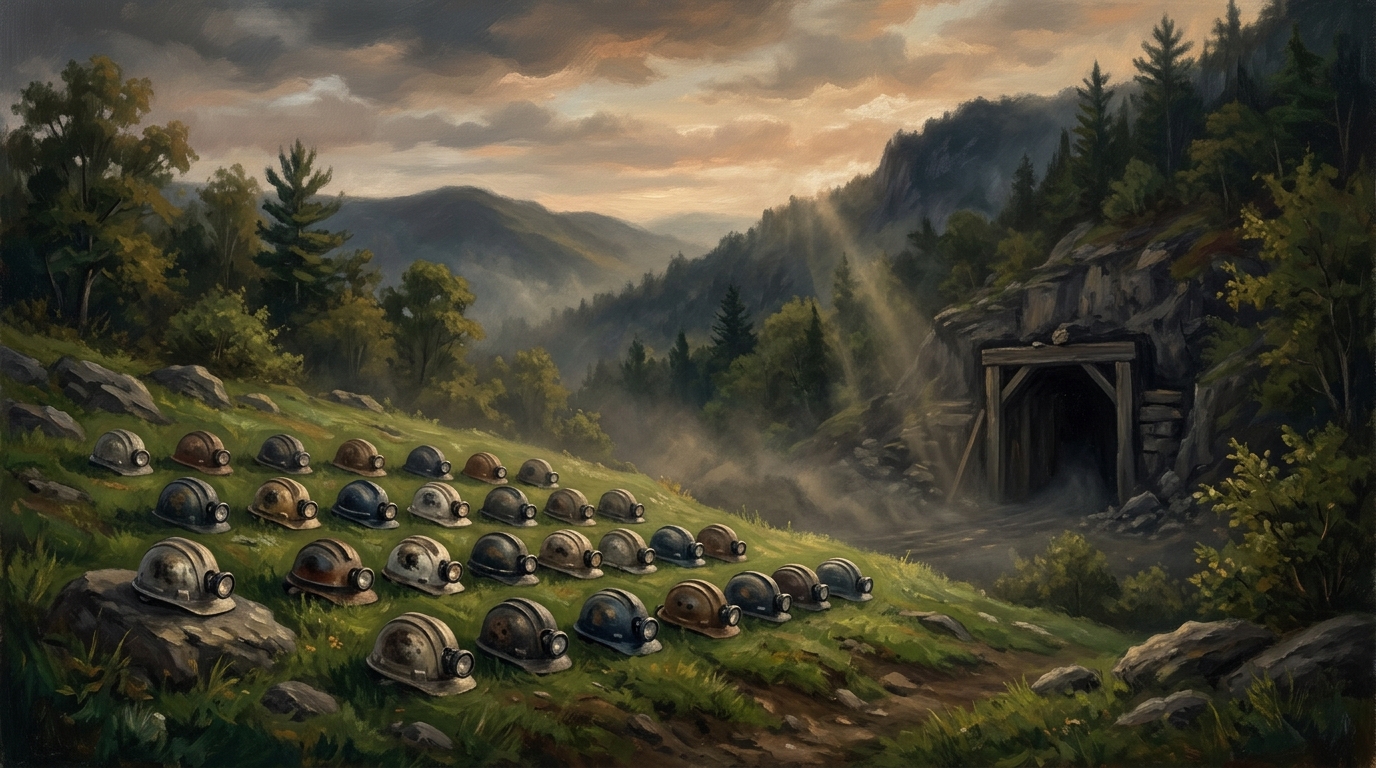
The families’ presence ran through every proceeding like a bass line. Men like Gary Quarles, whose only son died at the longwall, and the fathers, widows, and brothers of the twenty-eight others sat through the nine-week trial daily, learned the vocabulary of ventilation plans and rock-dust surveys, and delivered, outside the courthouse and in letters to Judge Berger, the case’s moral accounting: that their sons had radioed production figures every thirty minutes to a man they never met, and that the law had priced each of the twenty-nine lives at less than two weeks of his time. Several became, in the years after, the disaster’s institutional memory — testifying before Congress for the felony legislation that never passed, appearing each April fifth at the memorial in Whitesville where twenty-nine granite silhouettes stand against the ridgeline. Their persistence is the reason the case never fully receded into the archives: every subsequent American workplace catastrophe — every collapsed trench and exploded refinery prosecuted, if at all, as a misdemeanor — gets measured against Upper Big Branch, because the families insisted on converting their grief into a standing question addressed to Congress, which has now declined to answer it under administrations of both parties.
Blankenship’s defenders, who exist, make a version of the argument his jury partially accepted: that no evidence showed he ordered the specific failures of April 5th; that he spent on safety programs and said so at length; that twenty-nine deaths were converted by political appetite into a case against an unlikable man. The record assembled by four separate investigations answers most of this — the failures of that afternoon were not specific but systemic, the predictable output of a machine calibrated, memo by memo and half hour by half hour, to price hazard against tonnage. But the deeper answer is the one the McAteer panel put at the front of its report: disasters of this kind are never events; they are cultures, built deliberately, over years, by identifiable decisions. American law has learned to imprison executives for cultures of accounting fraud, because money left a paper trail Congress chose to criminalize. At Upper Big Branch the trail was written in production reports and rock dust and twenty-nine names read aloud each April in Raleigh County — and the maximum the culture’s author could be made to pay was a year. He paid it, called himself a political prisoner, and ran for office. The families endowed scholarships and built a memorial of black granite, twenty-nine silhouettes against the sky. Both monuments are accurate. Only one of them is the law’s.