The document is a single note card, embossed with the seal of the United States Congress, of the kind members use for thank-you notes. On it, in the handwriting of the representative from California’s Fiftieth District, are two columns of figures. The left column tracks the value, in millions, of federal contracts the congressman could deliver. The right column tracks what each increment would cost the contractor buying them: the card opens with “16” paired against “140” — sixteen million dollars in contracts for a hundred-forty-thousand-dollar boat — and then descends in an orderly schedule, fifty thousand dollars per additional million, discounted after a point to twenty-five. Prosecutors, who have seen most of what the genre has to offer, had never recovered anything like it, and said so in their sentencing memorandum: a bribe menu, written by a sitting member of the United States Congress on his own official stationery. Corruption ordinarily takes such care to remain unwritten. Randy “Duke” Cunningham priced it out like a diner placemat.
What gave the menu its lasting horror in Washington was the identity of its author. Cunningham was not a machine hack from some pay-to-play statehouse. He was among the most decorated aviators of the Vietnam War — a Navy pilot credited with five MiG kills, the war’s first American ace, a recipient of the Navy Cross, an instructor at the Navy Fighter Weapons School whose exploits fed the legend that became “Top Gun.” When he arrived in Congress in 1991, representing San Diego’s northern suburbs, the war record was his entire politics, and it carried him to the committees where the money lived: Appropriations, and its defense subcommittee, and the intelligence committee — the small rooms where classified budgets are marked up and a single member’s insistence can move a contract that no public process will ever audit.
The Ace
The hero was real, which is what made the sequel unbearable. On May 10, 1972, flying an F-4 Phantom off the carrier Constellation, Lieutenant Randy Cunningham and his radar intercept officer, William Driscoll, shot down three North Vietnamese MiGs in a single engagement — the last of them, by legend, flown by the ace the Americans called Colonel Tomb — before a surface-to-air missile blew their aircraft out from under them and they parachuted into the Gulf of Tonkin to be plucked out by helicopter. The three kills, added to two earlier ones, made Cunningham the war’s first American ace; the Navy gave him the Navy Cross, the nation’s second-highest decoration for valor, and a posting to the Fighter Weapons School at Miramar — Top Gun — where he taught air combat and accumulated the sea stories he would retail for the rest of his life, including the durable, unverifiable claim that he was a model for the movie. The persona translated seamlessly to politics: blunt, sentimental, quick to weep and quicker to brawl, a man who campaigned in a flight jacket and treated opponents like MiGs. San Diego, a Navy town, sent him to Congress five times by wide margins. Colleagues found him crude and occasionally unhinged — his floor outbursts and locker-room asides were legend — but the war record functioned as a permanent character witness. It did not occur to the people who mattered that a man who had faced death with conspicuous courage might face money with none at all.
The House on Arampana Drive
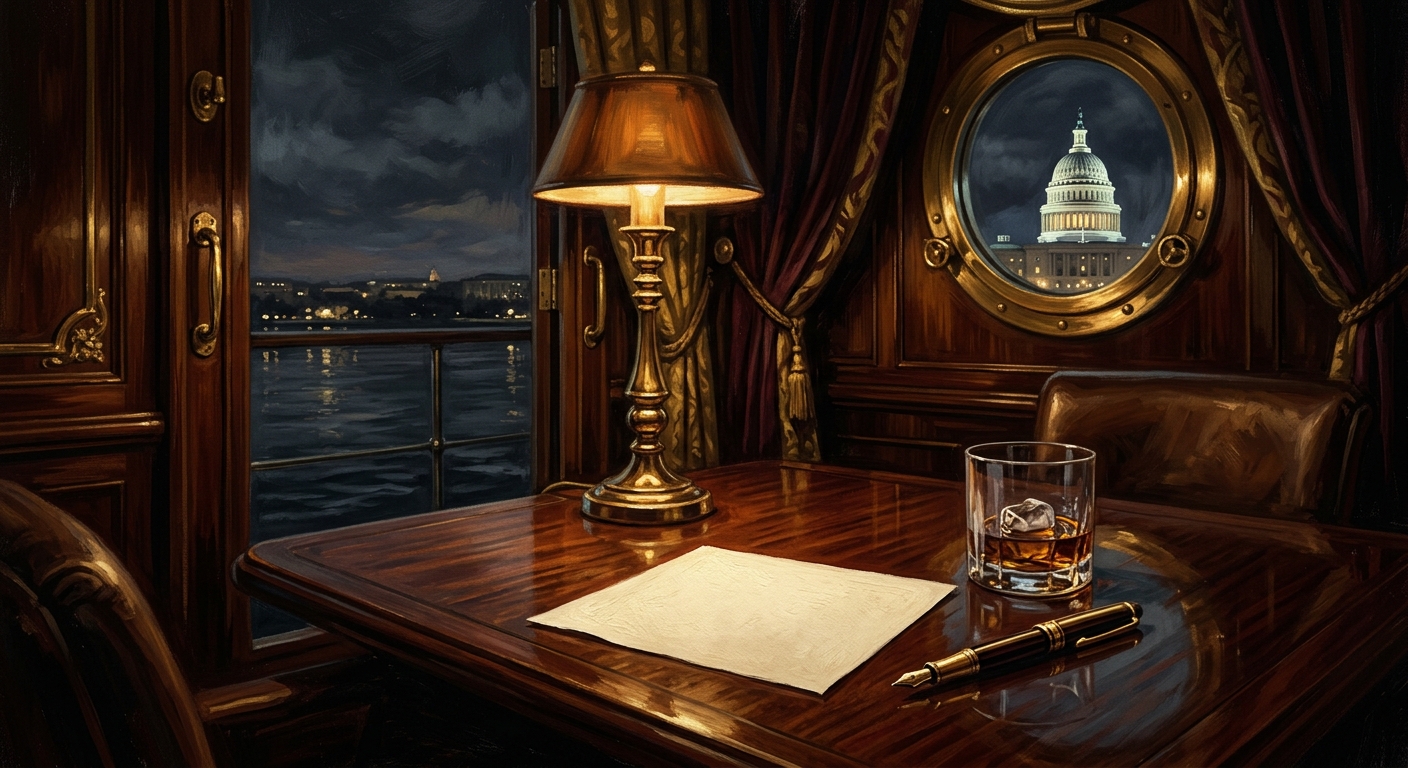
The scheme surfaced, as Washington schemes so often do, through real estate. In June 2005, Copley News Service and the San Diego Union-Tribune reported a curiosity: in late 2003, a defense contractor named Mitchell Wade had bought Cunningham’s house in Del Mar for $1,675,000, held it briefly, and resold it — in a hot San Diego market — at a loss approaching $700,000. In the interval, Wade’s company, MZM Inc., a firm that had held essentially no federal prime contracts before 2002, had accumulated on the order of $150 million in defense and intelligence work, much of it steered by earmarks and pressure from Cunningham’s seats on the defense appropriations and intelligence panels. The inflated house purchase, investigators established, was simply a bribe with a deed attached. It bought Cunningham a new $2.55 million house in Rancho Santa Fe; the rest of the relationship furnished it. Wade paid for antiques, Persian rugs, silver candelabra, and the item destiny selected for the headlines: a pair of nineteenth-century commodes. When the congressman was in Washington, he lived aboard Wade’s forty-two-foot yacht at the Capital Yacht Club — rechristened, with a wit no satirist could improve, the Duke-Stir — while Wade covered the dockage.
Wade’s generosity extended to rolling stock: among the items the government catalogued was a used Rolls-Royce, purchased for the congressman’s use, which joined the rugs and the candelabra in the forfeiture inventory and in the folklore. The sums were, by the standards of Gilded Age graft, almost modest; the audacity was in the documentation. Cunningham did not merely take bribes — he invoiced them, tracked them, and, prosecutors showed, escalated his demands over time with the confidence of a man who believed the appropriations process was a personal annuity. When MZM employees balked at the political contributions Wade pressured them to make — contributions later reimbursed by the company, itself a felony — the machine simply absorbed the friction and continued.
Behind Wade stood the scheme’s senior partner, Brent Wilkes, a San Diego contractor and Republican fund-raiser who had been cultivating Cunningham since the 1990s — nearly $90 million in contracts for his firm ADCS, much of it for document-digitization work the Pentagon repeatedly said it did not want, secured over the objections of program officers by a congressman who bullied procurement officials in ways a later House ethics vocabulary would call, mildly, aggressive. Wilkes supplied campaign money, mortgage help, vacations, and hospitality suites; Wade, his former associate turned rival, learned the model and improved on its directness. Between them, the government concluded, Cunningham collected at least $2.4 million in bribes — the most, prosecutors noted, ever documented against a member of Congress.
Wilkes’s cultivation ran to a standing Washington operation: hospitality suites at the Watergate and the Westin Grand, stocked with liquor and cigars, where congressmen and staff and, fatefully, Wilkes’s boyhood best friend Kyle “Dusty” Foggo — a career CIA logistics officer — gathered for poker nights that investigators would later reconstruct subpoena by subpoena. The suites were the scheme’s salon, the place where the line between lobbying and procurement dissolved in bourbon. When Porter Goss became Director of Central Intelligence in 2004, Foggo was elevated to executive director — the agency’s third-ranking official, its chief of logistics and contracts — and Wilkes’s companies began appearing in agency procurement in ways that ended, in 2009, with Foggo’s guilty plea to honest-services fraud and a federal prison term: the highest-ranking CIA officer ever convicted of crimes committed in office, a man brought down, in the end, by poker games thrown to grease a congressman from San Diego.
The Fall
The unraveling took five months. Cunningham first blustered — the house sale was proper, the yacht an arrangement between friends — then announced he would not seek re-election, and then, on November 28, 2005, stood outside the federal courthouse in San Diego and dissolved. He had pleaded guilty that morning to conspiracy to commit bribery, mail fraud, wire fraud, and tax evasion. The statement he read — in my life I have known great joy and great sorrow, and now I know great shame — was delivered through tears by a man who had once outflown MiGs over Haiphong, and even his prosecutors found the spectacle more sad than satisfying. In March 2006, U.S. District Judge Larry Burns sentenced him to eight years and four months — then the longest federal sentence ever given a former congressman — plus $1.8 million in restitution and the forfeiture of the house, the rugs, the antiques, and the commodes, which the government auctioned with a straight face.
The context magnified the fall. Cunningham’s plea landed in the middle of what the 2006 midterm campaigns would brand the culture of corruption — the season of Jack Abramoff’s guilty plea, of Representative Bob Ney’s bribery conviction, of ninety thousand dollars discovered in Representative William Jefferson’s freezer, of Tom DeLay’s indictment and resignation from the leadership. Of all of it, the bribe menu was the artifact the public could hold in its mind, and Democrats ran against it by name on their way to recapturing both chambers. Within the Republican conference the damage was more intimate: Cunningham had been the member whose biography was the party’s argument that character was its brand, and his fall license-plated every subsequent lecture about integrity in national security. The House intelligence committee, embarrassed at what had moved through its own markups, commissioned an internal review of Cunningham-tainted earmarks whose findings remained, fittingly, classified.
The satellites fell in sequence. Mitchell Wade pleaded guilty in February 2006, cooperated extensively — his information helped expose the wider netherworld of earmarked contracting — and received thirty months. Brent Wilkes refused to fold, went to trial, and was convicted in November 2007 of bribery, fraud, and money laundering; he drew twelve years, and his separate entanglement with his lifelong friend Kyle “Dusty” Foggo — whom he had wined toward contracts while Foggo served as the CIA’s executive director, its third-ranking officer — ended with Foggo’s own guilty plea and prison term, the highest-ranking CIA official ever convicted of a crime connected to his duties. The Cunningham case, prosecutors liked to say, was never really about one greedy congressman; it was a core sample of how classified appropriations actually moved, extracted for public inspection exactly once.
The investigation’s reach into the intelligence budget gave the case a significance beyond its principals. Classified appropriations are the least auditable money in the American government — line items visible to a handful of members and staff, shielded from public bid protest and press scrutiny alike. Cunningham sat at the exact intersection of the defense and intelligence purses, and what the prosecutors’ core sample showed was that the shielding worked in both directions: the secrecy that protects sources and methods had protected, with equal efficiency, a bribery schedule written on a note card. Congressional reformers cited the case for years afterward in arguing that earmark disclosure was not a transparency nicety but a counterintelligence necessity; the earmark moratorium eventually adopted in 2011 owed as much to the Duke-Stir as to any think-tank white paper, and when earmarks crept back a decade later under the gentler name of community project funding, the rules that accompanied them — public disclosure, certification of no financial interest — were, in effect, anti-Cunningham clauses. He achieved, in disgrace, the legislative legacy that had eluded him in office.
The reporting that started it earned its own place in the story. Marcus Stern of Copley News Service, following a tip, pulled the property records that showed Wade’s purchase and quick resale of the Del Mar house — a public document, available to anyone, sitting unexamined while the congressman’s lifestyle inflated around it — and the Copley and Union-Tribune team’s subsequent excavation of the yacht, the contracts, and the contributions won the 2006 Pulitzer Prize for National Reporting. The episode became journalism-school scripture for a reason worth stating plainly: no inspector general, no ethics committee, no procurement auditor, and no intelligence overseer found the most documented bribery scheme in congressional history. A reporter with a real-estate database found it in an afternoon.
The Long Epilogue
The human wreckage extended past the principals. Cunningham’s marriage dissolved while he was in custody; his co-conspirators’ companies collapsed, taking with them the jobs of employees who had known nothing; and the procurement officers who had resisted his bullying — the civil servants who told him no about ADCS’s document conversions and were overridden by appropriations language — received, in the case’s aftermath, the melancholy vindication that is the whistleblower’s usual pension. The Pentagon quietly unwound what it could of the tainted work. MZM, renamed and sold, dissolved into the contracting ecosystem that had produced it, an ecosystem the case illuminated without particularly reforming: the earmark was the instrument of Cunningham’s corruption, but the enabling condition was a procurement world in which a single legislator’s displeasure could redirect classified money faster than any auditor could follow it.
Cunningham served his time in federal prison in Arizona, mostly quietly, occasionally sending letters to judges and journalists that cycled between contrition and grievance — he had pleaded guilty, he came to insist, only under financial and emotional siege. Released in June 2013, he retired to Arkansas, a felon stripped of the pension of his rank but never of his war record, which even the sentencing judge had taken pains to honor. On January 19, 2021, in the final hours of his first term, President Donald Trump granted him a conditional pardon — clemency that restored civil rights while, the White House specified, leaving his restitution obligations intact. The pardon placed Cunningham on a list alongside Steve Bannon and Elliott Broidy and occasioned a brief national remembering of the bribe menu, the commodes, the Duke-Stir. He died on August 27, 2025, at eighty-three; the obituaries led, as he must have known they would, not with the MiGs but with the menu.
Even the artifacts had afterlives. The government’s auction of the forfeited antiques drew gawkers and collectors of political memorabilia; the note card itself remains in the federal record, reproduced in the sentencing papers, studied by prosecutors as the rarest of exhibits — corruption’s own bookkeeping, in the corrupted hand.
Two decades on, the case reads as a hinge. Before Cunningham, the earmark — the member-directed appropriation, unexamined and unattributed — was a routine courtesy of congressional life; the scandal, together with the Abramoff affair unspooling in the same seasons, forced disclosure rules and eventually a moratorium that reshaped how Congress spends. The reforms, characteristically, addressed the instrument rather than the appetite. What has never been explained, because it is not explicable, is the note card. A man who had survived surface-to-air missiles understood risk; a twelve-term appropriator understood evidence. He wrote it down anyway — the tell, perhaps, of a man who had stopped experiencing corruption as crime and begun experiencing it as administration, a schedule of fees for services genuinely rendered. That is the true lesson the Duke left the republic. The danger is less the official who knows he is betraying his office than the one who has come to regard the betrayal as part of the job, worth organizing neatly, in two columns, on the stationery of the United States Congress.
Sources: United States v. Cunningham, No. 05-cr-2137 (S.D. Cal.), plea agreement Nov. 28, 2005, government sentencing memorandum (reproducing the “bribe menu”), and sentencing Mar. 3, 2006; United States v. Wade (D.D.C. 2006); United States v. Wilkes (S.D. Cal. 2007); United States v. Foggo (E.D. Va. 2008); Copley News Service/San Diego Union-Tribune investigative reports beginning June 12, 2005 (reporting awarded the 2006 Pulitzer Prize for National Reporting); White House pardon statement, Jan. 19–20, 2021; obituaries in the New York Times and San Diego Union-Tribune, Aug. 2025.