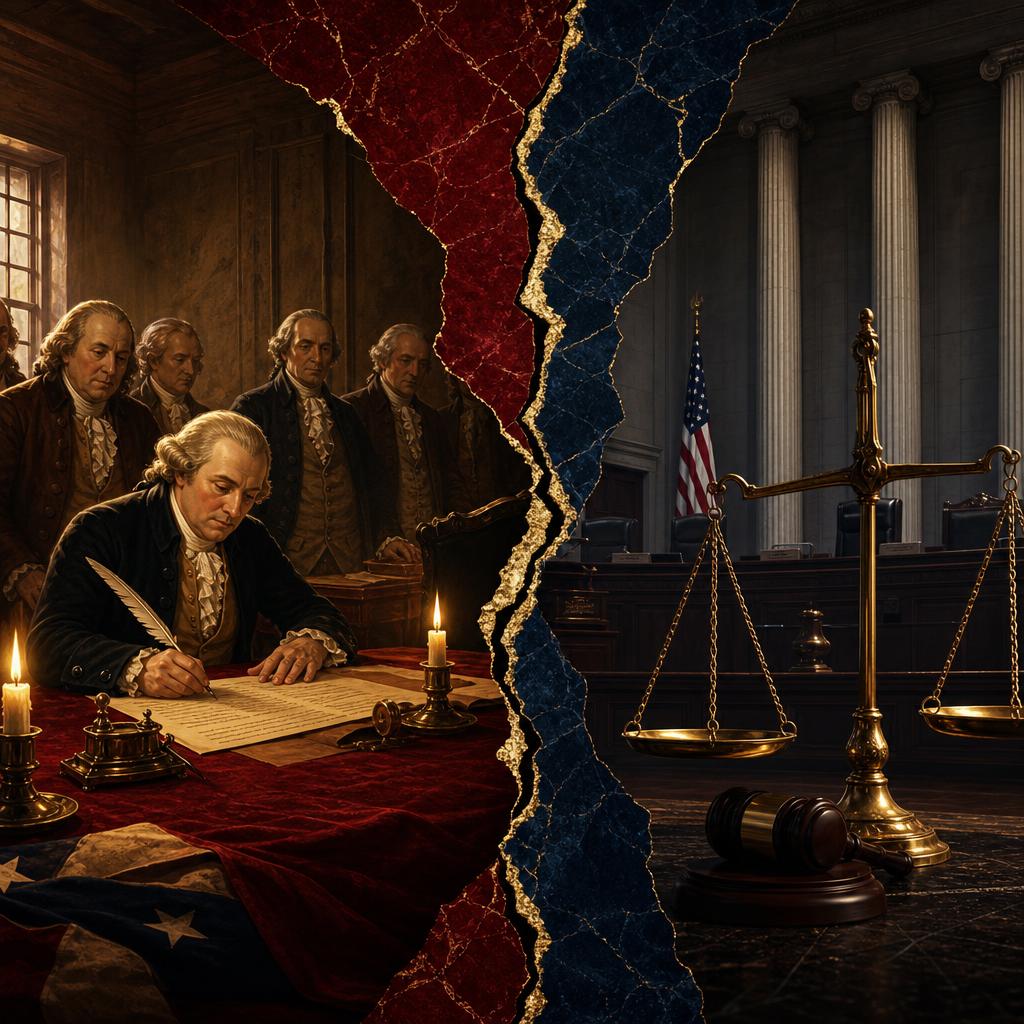
On the second of July, 1776, in a hot room in Philadelphia, fifty-six men committed a capital crime. They knew it was a capital crime. They said so, plainly, in the document they were about to sign. Benjamin Franklin's famous quip — “We must, indeed, all hang together, or most assuredly we shall all hang separately” — may be apocryphal, but the sentiment was not. Under the laws that governed them at that moment, the laws of the British Crown to which they still owed allegiance, they were traitors. Treason, under the English Treason Act of 1351 and every legal authority they had ever studied, was punishable by death. The men who signed the Declaration of Independence were not engaged in a lawful act. They were engaged in the most serious unlawful act a subject could commit: they were levying war against their king.
This is the fact that American civic mythology works hardest to obscure, and it is the fact from which everything interesting about the American founding actually proceeds. The United States was born in an illegal act. Not a technically illegal act, not a gray-area act, but a straightforwardly, unambiguously illegal act of armed rebellion against a lawful sovereign. There was no clause in British constitutional law that authorized the colonies to secede. There was no court to which the Continental Congress could have appealed. There was only the sword, and the willingness to die on it.
And yet — here is the paradox that has never been resolved, that cannot be resolved, that sits at the foundation of the republic like a fault line under a cathedral — the men who committed that illegal act then spent the next thirteen years building a government whose entire purpose was to make such an act unnecessary ever again. Having overthrown one government by force, they designed the next one so that force would never again be the answer. Having claimed a right to revolution, they built a constitution to render that right dormant. Having made themselves criminals in the eyes of the old law, they wrote a new law under which the crime they had just committed would be defined, named, and punished.
The Constitution of the United States, ratified in 1788, contains in Article III, Section 3, the only crime the Founders thought important enough to define in the founding charter itself: treason. “Treason against the United States,” it reads, “shall consist only in levying War against them, or in adhering to their Enemies, giving them Aid and Comfort.” Levying war. The exact thing they had just done to Britain. They made it a crime. They made their own founding act a crime against the thing they founded.
This is not hypocrisy, though it is easy to mistake it for hypocrisy. It is something far more profound and far more uncomfortable. It is a deliberate, conscious, philosophically coherent attempt to have it both ways — to preserve the moral right of a people to overthrow a tyranny while simultaneously constructing a machine of government designed to ensure that no such tyranny could arise, and therefore that the right would never need to be exercised. The Founders were not confused. They understood exactly what they were doing. They were trying to be the last successful revolutionaries in their own country’s history.
Whether they succeeded — whether the machine they built has in fact rendered revolution unnecessary, or merely rendered it illegal — is a question that has haunted every serious crisis in American history, from Shays’ Rebellion in 1786 to the Whiskey Rebellion of 1794, from John Brown’s raid on Harpers Ferry in 1859 to the secession of the Confederacy in 1861, and, most recently and most contentiously, to the events at the United States Capitol on January 6, 2021. This is an investigation into that paradox. It is not a call to any action. It is an attempt to say, honestly and with the sources laid open on the table, what the Founders actually believed, what they actually wrote, and what the machinery they built was actually for.
I. What the Declaration Actually Says
Most Americans can recite the opening of the second paragraph of the Declaration of Independence, or at least its most famous phrases. “We hold these truths to be self-evident, that all men are created equal, that they are endowed by their Creator with certain unalienable Rights, that among these are Life, Liberty and the pursuit of Happiness.” It is one of the most quoted sentences in the English language. It is also, crucially, not the operative part of the document. It is the premise. What follows is the argument, and the argument is a justification for revolution.
Read the sentence that comes next, the one that schoolchildren rarely memorize: “That to secure these rights, Governments are instituted among Men, deriving their just powers from the consent of the governed, — That whenever any Form of Government becomes destructive of these ends, it is the Right of the People to alter or to abolish it, and to institute new Government, laying its foundation on such principles and organizing its powers in such form, as to them shall seem most likely to effect their Safety and Happiness.”
Stop and consider what this sentence is doing. It is not describing a right to vote. It is not describing a right to petition, or to protest, or to write angry letters to the editor. It is describing a right to abolish a government — to tear it down and replace it. And the trigger for this right is precise: when a government “becomes destructive of these ends,” meaning when it fails to secure the life, liberty, and pursuit of happiness of the people, and when it does so having lost “the consent of the governed.” The right of revolution, as the Declaration frames it, is not a right that floats free. It is tied specifically to the collapse of consent. A government that governs without the consent of the governed has forfeited its just powers, and a people whose consent has been withdrawn may “alter or abolish” it.
Thomas Jefferson, the document’s primary author, immediately qualified this with a warning that is too often ignored by those who quote him for their own purposes. The very next sentence reads: “Prudence, indeed, will dictate that Governments long established should not be changed for light and transient causes; and accordingly all experience hath shewn, that mankind are more disposed to suffer, while evils are sufferable, than to right themselves by abolishing the forms to which they are accustomed.” Jefferson is saying, in effect: this is a right, but it is not to be invoked lightly. People will and should endure a great deal before resorting to it. Revolution is the last resort, not the first, and the Declaration is at pains to establish that the colonists have exhausted every other avenue.
That is what the long central section of the Declaration — the part almost no one reads — is for. It is a bill of particulars. “The history of the present King of Great Britain is a history of repeated injuries and usurpations, all having in direct object the establishment of an absolute Tyranny over these States. To prove this, let Facts be submitted to a candid world.” What follows are twenty-seven specific charges against George III: that he refused assent to necessary laws, that he dissolved representative assemblies, that he obstructed the administration of justice, that he kept standing armies among them in peacetime, that he imposed taxes without consent, that he deprived them of trial by jury, that he “plundered our seas, ravaged our Coasts, burnt our towns, and destroyed the lives of our people.”
The structure is legal. It is prosecutorial. The Declaration is not an emotional outburst; it is an indictment, drafted by a lawyer, laying out a case that the government of Britain had systematically destroyed the consent of the governed in America and had therefore forfeited its just authority. Only after establishing this record does the Declaration reach its conclusion: “We, therefore, the Representatives of the united States of America… do, in the Name, and by Authority of the good People of these Colonies, solemnly publish and declare, That these United Colonies are, and of Right ought to be Free and Independent States.”
And it ends with a sentence that modern readers rush past but which the signers understood in the most literal and lethal terms: “And for the support of this Declaration, with a firm reliance on the protection of divine Providence, we mutually pledge to each other our Lives, our Fortunes and our sacred Honor.” Their lives. This was not rhetorical flourish. They were signing a document that, if the revolution failed, would serve as a signed confession of treason. Each signature was a wager against the gallows. Nine of the fifty-six signers would die during the Revolutionary War. Five were captured by the British and treated as traitors. Several lost their homes, their fortunes, their families. The pledge of “our Lives” was not a metaphor. It was an actuarial statement.
This is the first thing that must be understood clearly, because everything else depends on it: the Declaration of Independence is a justification for an armed uprising. It is a document that asserts, in the plainest possible language, that when a government destroys the consent on which its legitimacy rests, the people have not merely the option but the right to abolish it and build another. The Founders did not hide this. They engraved it in marble. They put it at the head of the nation’s founding canon. And they meant it.
II. The Natural Law Foundation: Locke, Consent, and the Moral Versus the Legal
To understand what Jefferson meant, one must go behind Jefferson to the philosophical tradition he was drawing on, because the Declaration did not invent the right of revolution. It borrowed it, almost verbatim in places, from a body of political philosophy that the educated men of the eighteenth century treated as settled science. The central figure is the English philosopher John Locke, and the central text is his Second Treatise of Government, published in 1689 in the wake of England’s own Glorious Revolution.
Locke’s argument runs as follows. In a state of nature, before governments exist, human beings possess natural rights — to life, to liberty, and to property (Jefferson would famously alter the third term to “the pursuit of Happiness,” a change worthy of its own essay). These rights do not come from any king or parliament; they precede all governments and belong to persons simply by virtue of their humanity. Because life in the state of nature is insecure — because there is no impartial judge to settle disputes and no common power to enforce the law of nature — people consent to form governments. They surrender a portion of their natural liberty to a common authority in exchange for the security of their remaining rights. This is the social contract: a bargain, freely entered, in which the governed grant power to the government on the condition that the government protect their rights.
The crucial move — the one that makes revolution not merely permissible but, in extremity, a duty — comes in Locke’s chapter “Of the Dissolution of Government.” When a government violates the terms of the contract, when it uses its power to destroy the very rights it was instituted to protect, it dissolves itself. The people owe no further obedience, because obedience was always conditional. “Whenever the legislators endeavour to take away and destroy the property of the people, or to reduce them to slavery under arbitrary power,” Locke wrote, “they put themselves into a state of war with the people, who are thereupon absolved from any farther obedience.” The government, by breaking the contract, has made war on its own citizens; the citizens are entitled to defend themselves, and to reconstitute a government that will keep the bargain.
Locke anticipated the obvious objection — that this doctrine would produce endless upheaval, that every faction would claim a broken contract and take up arms. His answer is essentially the same one Jefferson would echo in the Declaration’s “light and transient causes” passage. Revolutions, Locke argued, do not happen over small grievances. People are patient, even to a fault; they will tolerate “great mistakes in the ruling part,” “many wrong and inconvenient laws, and all the slips of human frailty” without rising up. It is only “a long train of abuses, prevarications and artifices, all tending the same way” — a phrase Jefferson lifted nearly word for word as “a long train of abuses and usurpations” — that finally rouses a people to reclaim their sovereignty.
Here we must be precise about a distinction that the entire remainder of this analysis depends upon: the distinction between the moral right of revolution and the legal status of revolution. Locke and Jefferson were making a moral and natural-law argument. They were claiming that, in the eyes of God and reason and the law of nature, a people whose consent has been destroyed may justly overthrow their government. They were not, and could not have been, claiming that revolution was legal under the positive law of the government being overthrown. That would be a contradiction in terms. No government’s laws authorize its own violent destruction. British law did not contain a clause permitting the colonies to make war on the Crown. It contained, instead, the Treason Act.
This is the point that cannot be blurred, because it is the hinge on which the whole paradox turns: revolution is, by definition, illegal under the law of the regime it seeks to overthrow. It has to be. A right of revolution that were legal would not be a right of revolution at all; it would be a mere administrative procedure, an amendment clause, a scheduled election. The revolutionary act is precisely the act that steps outside the existing legal order and appeals to a higher law — natural law, the law of God, the inalienable rights of man — against the positive law of the state. When Jefferson invoked “the Laws of Nature and of Nature’s God” in the Declaration’s first sentence, he was doing exactly this: appealing over the head of British law to a higher authority that, he claimed, sanctioned what British law forbade.
The Founders knew this. They were not naifs who imagined that George III might read the Declaration and concede its legal force. They knew they were committing treason and staking their claim on a moral right that could only be vindicated by force of arms — that is, by winning. Had they lost, they would have been hanged, and the Declaration would be remembered, if at all, as the delusional manifesto of a failed insurrection. The moral right of revolution, in the actual world, is only ever ratified retroactively, by victory. This is the harshest truth in the whole tradition, and the Founders stared straight at it. Washington understood that he was not the lawful commander of a lawful army but the leader of an armed rebellion whose legitimacy would be settled on the battlefield and nowhere else.
Jean-Jacques Rousseau, writing in France in the same intellectual generation, pushed the logic of consent even further in The Social Contract (1762). For Rousseau, sovereignty resided permanently and inalienably in the people — the “general will” — and any government was merely an agent, a trustee, revocable at the people’s pleasure. Where Locke tended to see revolution as a remedy for a broken contract, Rousseau saw the people’s sovereignty as continuously and permanently superior to any government it established. The American Founders were more Lockean than Rousseauian — they distrusted the raw, unmediated will of the majority as much as they distrusted kings — but the underlying premise was shared across the whole Enlightenment tradition: legitimate authority flows upward from the consent of the governed, never downward from the throne. A government that loses that consent loses its legitimacy, whatever the positive law may say.
So the Founders inherited a coherent and, in its own terms, rigorous doctrine: that the moral right of revolution is real, that it is triggered by the destruction of consent, that it is a last resort to be invoked only after a long train of abuses, and that it is — necessarily, unavoidably — illegal under the law of the regime it overthrows. They accepted all of this. And then they did something no previous generation of revolutionaries had quite done. Having won their revolution, they set out to build a government that would honor the doctrine while making it moot.
III. Jefferson’s Explicit Writings: The Tree of Liberty
If the Declaration is the public, official statement of the right of revolution, Jefferson’s private letters are where he said, without the constraints of committee drafting or diplomatic caution, exactly how far he was willing to take the idea. These letters are frequently quoted, frequently misquoted, and almost always ripped from their context. It is worth reading them slowly and in full, because Jefferson’s actual position was both more radical and more carefully bounded than either his admirers or his critics tend to admit.
The most famous is his letter to William Stephens Smith, written from Paris on November 13, 1787. Smith was John Adams’s son-in-law, and Jefferson was responding to news of Shays’ Rebellion, the armed uprising of indebted farmers in western Massachusetts that had thrown the young republic into a panic. While the political establishment in America recoiled in horror, Jefferson — safely across the Atlantic — took a startlingly calm, even approving, view. “God forbid,” he wrote, “we should ever be twenty years without such a rebellion.”
Then came the line that has been printed on countless bumper stickers, and misused by countless people who never read the sentences around it: “The tree of liberty must be refreshed from time to time with the blood of patriots and tyrants. It is its natural manure.” It is a shocking sentence, and Jefferson meant it to be. But the paragraph that contains it is an argument for something specific and, in its way, restrained. Jefferson was arguing that occasional rebellion is a healthy sign in a free society — that it keeps rulers honest, that it demonstrates the people’s vigilance, and that the appropriate response of a wise government is not brutal suppression but a kind of forgiving correction. “What signify a few lives lost in a century or two?” he wrote, in a passage that reveals both the grandeur and the coldness of his vision. He went on: “The people cannot be all, and always, well informed. The part which is wrong will be discontented, in proportion to the importance of the facts they misconceive. If they remain quiet under such misconceptions, it is lethargy, the forerunner of death to the public liberty.”
Note what Jefferson is actually saying here, because it is subtler than the bumper-sticker version. He is not calling for revolution. He is saying that the capacity for rebellion, the willingness of a free people to rise when they believe they have been wronged, is itself a safeguard of liberty — even when the people are, in a given instance, mistaken about the facts. He explicitly concedes that the Shaysite rebels were partly “wrong,” acting on “misconceptions.” His point is that a government should be secure enough, and forgiving enough, to weather such episodes without either collapsing or turning tyrannical in response. “Honest republican governors,” he wrote, should be “so mild in their punishment of rebellions, as not to discourage them too much.”
Earlier that same year, on January 30, 1787, Jefferson had made a related argument in a letter to James Madison — the man who would become the principal architect of the Constitution then being contemplated. Comparing forms of government, Jefferson wrote: “I hold it that a little rebellion now and then is a good thing, and as necessary in the political world as storms in the physical.” He continued: “It is a medicine necessary for the sound health of government.” He even offered a strikingly lenient assessment of Shays’ Rebellion specifically: “The late rebellion in Massachusetts has given more alarm than I think it should have done. Calculate that one rebellion in 13 states in the course of 11 years, is but one for each state in a century and a half. No country should be so long without one.”
This exchange between Jefferson and Madison is one of the most important in the entire founding, because the two men were staking out the opposite ends of the paradox this essay is about. Jefferson, the theorist of revolution, was arguing that periodic rebellion is healthy and should be treated with a light hand. Madison, the theorist of institutions, was even then designing a constitution whose explicit purpose was to channel political conflict into peaceful, structured, non-violent forms — to make rebellion unnecessary by building a government responsive enough that grievances could be redressed within the system. They were friends and lifelong collaborators, and they were, on this precise question, in productive tension. Jefferson wanted to keep the fire of revolution burning as a warning to rulers; Madison wanted to build a fireplace so the house would not burn down.
Jefferson returned to the theme again and again across his life. In a 1787 letter to Abigail Adams, wife of John Adams, he wrote of Shays’ Rebellion: “The spirit of resistance to government is so valuable on certain occasions, that I wish it to be always kept alive. It will often be exercised when wrong, but better so than not to be exercised at all. I like a little rebellion now and then.” Decades later, near the end of his life, he wrote to John Adams — the two former rivals having reconciled into one of history’s great correspondences — reflecting on the meaning of the Revolution and the fragility of self-government.
It is essential, in fairness to Jefferson and to the truth, to note that his enthusiasm for rebellion had limits he did not always acknowledge and consequences he did not always foresee. When he became President in 1801 and faced actual challenges to federal authority, he was considerably less romantic about armed resistance than his Paris letters suggested. And his “blood of patriots and tyrants” rhetoric, thrilling in the abstract, becomes something colder and more troubling when one remembers that Jefferson himself owned more than six hundred human beings over the course of his life and did not extend his theory of the right to overthrow tyranny to the enslaved people on his own plantation. The man who wrote that all men are created equal, and that a people may abolish a government that becomes destructive of their liberty, held hundreds of people in bondage and left most of them enslaved at his death. The right of revolution he articulated was, in his own practice, a right for some and not for others. This is not a footnote. It is a central, damning fact about the founding, and it will return with full force when we come to John Brown.
But on the narrow question of what the Founders believed about the right of a people to overthrow a tyrannical government, Jefferson’s testimony is unambiguous. He believed it was real. He believed it was, in extremity, a duty. He believed that the willingness to exercise it was itself a safeguard of freedom. And he believed — this is the part his selective quoters always omit — that it was a last resort, to be invoked only against genuine tyranny, only after every lawful remedy had failed, and only at the price of one’s life and honor.
IV. The Machine Built to Make Revolution Unnecessary
Here is where the paradox becomes not merely an intellectual curiosity but the organizing principle of American government. The same generation of men who justified revolution in 1776 sat down in 1787 to write a constitution, and the animating question of that document was: how do we build a government so responsive, so self-correcting, so hemmed in by checks, that the people will never again need to resort to the terrible remedy of armed revolution? The Constitution is, read one way, an elaborate machine for making the right of revolution obsolete — not by denying it, but by removing the conditions that would ever justify its use.
James Madison, in Federalist No. 51, gave the classic statement of the design philosophy. The problem of government, Madison wrote, is that you must first enable the government to control the governed, and then oblige it to control itself. “If men were angels, no government would be necessary. If angels were to govern men, neither external nor internal controls on government would be necessary.” Since men are not angels, and since those who govern are men, the solution is structural: “Ambition must be made to counteract ambition.” Divide power among branches. Set the legislative against the executive against the judicial. Divide the legislature itself into two houses. Divide sovereignty between the national government and the states. Make it so that no single faction, no single office, no single tyrant, can capture the whole and turn it against the people.
The genius of this design, for our purposes, is what it does to the Declaration’s trigger condition. Recall that the right of revolution activates when a government “becomes destructive of these ends” and loses “the consent of the governed.” Madison’s constitutional machine is engineered to prevent both. It prevents the government from becoming destructive of the people’s rights by fragmenting power so thoroughly that tyranny cannot easily assemble itself. And it preserves the consent of the governed by building in regular, structured mechanisms — elections, representation, amendment — through which consent can be continually renewed or withdrawn without violence. The ballot replaces the bullet. The amendment replaces the abolition. The peaceful transfer of power replaces the coup.
This is why the peaceful transfer of power — a phrase that would become suddenly and painfully relevant in 2021 — is not a mere norm or courtesy in the American system. It is the substitute for revolution. It is the mechanism by which the consent of the governed is measured and honored on a schedule, so that no one ever has to march on a capital to change a government. When John Adams handed power to Thomas Jefferson in 1801 after a bitter, vicious election — the first transfer of power between opposing parties in the nation’s history — the significance was understood by everyone: the losers accepted the result, the winners took office, and no one raised an army. The consent mechanism worked. Revolution had been rendered, in that instance, unnecessary.
Alexander Hamilton, in Federalist No. 84, addressed the paradox from a different angle in his famous argument against including a Bill of Rights. Hamilton contended that a bill of rights was not only unnecessary but potentially dangerous in a government of enumerated powers. But buried in his argument is a revealing claim about where rights ultimately reside. “The truth is,” Hamilton wrote, “that the Constitution is itself, in every rational sense, and to every useful purpose, A BILL OF RIGHTS.” The security of liberty, in his view, lay not in parchment declarations but in the structure of the government itself — in its representative character, its divided powers, its accountability to the people. The whole edifice was the guarantee.
Hamilton lost that argument, and it is fortunate that he did. The Anti-Federalists — the skeptics who feared the new national government would grow into exactly the kind of consolidated tyranny the Revolution had been fought against — demanded explicit protections, and the promise of a Bill of Rights was the price of ratification. The first ten amendments were adopted in 1791. And it is in the First Amendment that we find the most direct answer to the question this essay began with: what did the Founders tell us to do when a government fails us? The First Amendment is the peaceful machinery of grievance, built precisely so that the extralegal machinery of revolution would not have to be used.
“Congress shall make no law… abridging the freedom of speech, or of the press; or the right of the people peaceably to assemble, and to petition the Government for a redress of grievances.” Read those clauses as a system. Freedom of speech: you may say the government is wrong, loudly and without permission. Freedom of the press: you may publish that argument and spread it to the whole nation. The right to assemble: you may gather with others who agree, in numbers, in public. The right to petition for redress of grievances: you may formally demand that the government fix what it has broken. This is the revolution, disassembled and rebuilt as a set of legal, protected, non-violent rights. Everything the colonists had done illegally against Britain — the pamphlets, the committees of correspondence, the mass meetings, the formal remonstrances — the First Amendment now made legal against the American government itself. The word that matters most in the assembly clause is peaceably. The Founders drew the line exactly there.
This is the shape of the paradox fully revealed. The Founders did not repudiate the right of revolution when they wrote the Constitution. They could not repudiate it without repudiating themselves; the legitimacy of their own government rested on the same principle of popular consent that justified the Revolution. What they did instead was more subtle. They built a government designed to satisfy the conditions of legitimacy so continuously and so reliably that the trigger for revolution would never be pulled. They kept the emergency exit — the moral right of a people to abolish a tyranny remained, and remains, part of the American creed — but they built a building with so many ordinary doors that no one would ever need the emergency exit. The right of revolution became, in effect, a fire axe behind glass: real, present, legitimate in genuine catastrophe, but meant never to be used, because the ordinary machinery of self-government was supposed to make the catastrophe impossible.
V. The Precedents: Shays, the Whiskey Rebellion, Dorr, and John Brown
The paradox was not left to gather dust in the philosophical archive. Within a single decade of the founding, and repeatedly across the following century, Americans tested it directly. Each of these episodes is a case study in the collision between the moral right the Founders proclaimed and the legal order they built. Each was resolved differently. And together they map the boundaries of the paradox with more precision than any theory could.
Shays’ Rebellion (1786–1787). The first test came before the Constitution even existed, under the weak government of the Articles of Confederation. Daniel Shays, a former Continental Army captain, led a force of debt-ridden Massachusetts farmers — many of them Revolutionary War veterans — who were losing their land to foreclosure and being jailed for debt. They shut down courthouses to stop foreclosure proceedings and, in January 1787, marched on the federal arsenal at Springfield. The uprising was put down by a privately financed militia, but it terrified the political class. To many, including Washington, it was proof that the government under the Articles was too weak to maintain order — a direct spur to the Constitutional Convention that would convene months later. To Jefferson, watching from Paris, it was the “little rebellion” that a healthy republic should absorb without panic. Shays’ Rebellion is the pivot point of the paradox: it simultaneously prompted the creation of the stronger government meant to make rebellion unnecessary and elicited from Jefferson the most famous defense of rebellion in American letters. The same event drove both halves of the contradiction at once.
The Whiskey Rebellion (1791–1794). The second test came after the Constitution, and its resolution could not have been more different. When the new federal government imposed an excise tax on distilled spirits, farmers in western Pennsylvania — for whom whiskey was both a product and a currency — rose in armed resistance, attacking tax collectors and threatening secession. This time the response was decisive. President Washington, invoking his authority under the new Constitution and the Militia Acts, personally led an army of nearly thirteen thousand men — larger than most forces he had commanded during the Revolution — to suppress the rebellion. The uprising collapsed without a battle. The message was unmistakable, and it was delivered by the commander of the first American revolution: under the new constitutional order, armed resistance to a lawfully enacted tax is not revolution but insurrection, and it will be crushed. Washington, who had led an illegal armed rebellion against Britain, now led a lawful army against an armed rebellion of his own citizens. The paradox walking on two legs. The distinction he drew was the whole point of the Constitution: grievances against a legitimate, consent-based government must be pursued through law, through the ballot, through the courts — not through the musket. The whiskey farmers had representatives in Congress. They had votes. They had the courts. They had the First Amendment. They had, in short, the entire peaceful machinery, and their resort to arms against a government that provided that machinery was not the Founders’ right of revolution. It was crime.
Dorr’s Rebellion (1841–1842). The third test raised the hardest theoretical question of all: what happens when the peaceful machinery itself is rigged to deny the consent of the governed? In Rhode Island, which still operated under its colonial charter of 1663, the vote was restricted to landowning men, disenfranchising a majority of the adult male population — including most of the urban working class created by industrialization. Reformers led by Thomas Wilson Dorr, unable to change the system through a system that excluded them, held their own extralegal constitutional convention, wrote a new “People’s Constitution,” and elected Dorr governor in a parallel government. They were making a pure Lockean argument: the existing government did not rest on the consent of the governed, because it had structurally excluded most of the governed from consenting. When Dorr attempted to seize a state arsenal, the established government declared martial law, suppressed the movement, and convicted Dorr of treason against the state — sentencing him to life at hard labor (he was later released and his conviction annulled). The case reached the Supreme Court in Luther v. Borden (1849), where the Court, through Chief Justice Roger Taney, declined to decide which of Rhode Island’s two competing governments was legitimate, holding that the question of a government’s republican legitimacy was a “political question” for Congress and the President, not the courts. It was a landmark of judicial abdication, and it left the deepest question of the paradox — who decides when consent has been destroyed? — formally unanswered. Notably, though, the Rhode Island establishment did respond to the pressure: it adopted a new constitution in 1843 that dramatically expanded suffrage. The rebellion failed as an insurrection but succeeded as a reform. The peaceful machinery, having been shown to be broken, was repaired — which is exactly what the Founders’ system was supposed to do.
John Brown and Harpers Ferry (1859). And then there is John Brown, who forces the paradox to its breaking point and exposes the moral rot at its core. Brown was a militant abolitionist who believed, with absolute conviction, that American slavery was a monstrous tyranny — that four million human beings were being held in bondage by a government that called itself free. In October 1859 he led a raid on the federal armory at Harpers Ferry, Virginia, intending to arm the enslaved and ignite a general uprising against slavery. The raid failed within thirty-six hours. Brown was captured by a detachment of U.S. Marines under the command of Colonel Robert E. Lee, tried for treason against the Commonwealth of Virginia, and hanged.
Apply the Founders’ own logic to John Brown and the result is devastating. What was slavery, if not a government “becoming destructive of these ends” — life, liberty, the pursuit of happiness — for millions of people who had never consented to be governed at all, let alone owned? If the right of revolution belongs to those whose consent has been destroyed and whose liberty has been abolished, then no one in American history had a stronger claim to it than the enslaved. Jefferson’s own words — “the tree of liberty must be refreshed from time to time with the blood of patriots and tyrants” — describe John Brown’s enterprise more literally than they describe almost anything else in the nation’s history. Brown believed he was the patriot; the slaveholders were the tyrants; and blood was the natural manure. He was, in the strict terms of the Founders’ philosophy, applying their doctrine to the greatest tyranny the nation contained. And the government founded on that doctrine hanged him for treason.
This is the fault line running straight through the founding, and it cannot be plastered over. The right of revolution was proclaimed by men who denied it, by force, to the people among them who needed it most. Brown’s raid was legally treason — there is no serious argument otherwise; he made war against the state. But morally, by the Founders’ own natural-law reasoning, his cause was the purest application of their principle in the whole national record. Abraham Lincoln, threading this needle with characteristic care in his Cooper Union address of February 1860, condemned Brown’s method while implicitly acknowledging the justice of his cause. Brown’s effort, Lincoln said, was “peculiar,” “an attempt by white men to get up a revolt among slaves, in which the slaves refused to participate,” and it “was so absurd that the slaves, with all their ignorance, saw plainly enough it could not succeed.” Lincoln rejected violent insurrection as a means. But within five years, Lincoln himself would preside over a war that killed some three-quarters of a million Americans and ended slavery by force — the blood of patriots and tyrants indeed, on a scale Brown could never have imagined. The distinction between Brown the criminal and Lincoln the emancipator is not a distinction of ends. It is a distinction of legitimacy, means, and authority — and it points directly at the analysis we must now undertake.
VI. January 6: A Legal and Constitutional Analysis
It is impossible to write honestly about the right of revolution in American thought without confronting the events of January 6, 2021, when a crowd of thousands breached the United States Capitol in an effort to stop Congress from certifying the results of the 2020 presidential election. The question this essay must answer is narrow and precise, and it is not a political question. It is a constitutional and legal one: Does the Founders’ right of revolution — the doctrine of the Declaration, of Locke, of Jefferson’s letters — apply to January 6? Was this an exercise of the right the Founders proclaimed, or was it something the Founders’ philosophy specifically condemns?
To answer this, we must return to the exact trigger condition that the entire tradition specifies. The right of revolution, in Locke, in the Declaration, in Jefferson, activates upon the destruction of the consent of the governed. A government forfeits its legitimacy when it ceases to rest on that consent — when it governs by force against the will of the people rather than by the authority the people have granted it. The remedy is to reclaim that consent by abolishing the illegitimate government and instituting one that honors it. Consent is the alpha and omega of the whole doctrine. Everything turns on it.
Now consider what an election is, in the constitutional architecture Madison and the others built. An election is the consent mechanism. It is the peaceful, scheduled, institutionalized procedure by which the consent of the governed is measured and expressed. It is the machinery the Founders constructed precisely so that consent could be renewed or withdrawn without violence — the ballot that replaces the bullet, the fireplace that keeps the house from burning down. When the people vote and the votes are counted and the result is certified, the consent of the governed has just been expressed through the exact channel the Constitution provides for expressing it. The peaceful transfer of power that follows is not a threat to the consent of the governed; it is the consent of the governed, operating as designed.
This is the hinge of the entire legal and constitutional distinction, and it is sharp enough to cut cleanly. The Founders’ revolution was aimed at a government that had destroyed the consent mechanism — that taxed without representation, dissolved the colonists’ assemblies, denied them a voice, and ruled them by a distant power in which they had no vote and no say. The colonists had no peaceful, institutional channel to withdraw their consent; that is precisely why their appeal to the extralegal remedy of revolution was, in the Founders’ framing, justified. They rose up because the consent mechanism did not exist for them.
An effort to disrupt the certification of a completed election is the structural inverse of that. It is not an attempt to reclaim a consent mechanism that has been destroyed; it is an attempt to override a consent mechanism that has just functioned. The votes had been cast. The count had been conducted, and where contested, recounted. The results had been litigated in the courts — more than sixty lawsuits, adjudicated by judges across the political spectrum, including judges appointed by the very President contesting the outcome, and rejected for want of evidence. The states had certified their electors through the lawful process. The consent of the governed had been expressed through every channel the Constitution provides. To attempt to halt the certification by force was therefore not a defense of the consent of the governed against a government that had destroyed it. It was an attack on the consent mechanism itself — an effort to prevent the peaceful transfer of power that the expressed consent of the governed had mandated.
This is why the Founders’ philosophy does not merely fail to justify such an act — it specifically condemns it. The whole point of the constitutional machine was to substitute the peaceful transfer of power for revolution. An assault on the peaceful transfer of power is an assault on the substitute itself, an attempt to reintroduce force into the one place the Founders labored hardest to remove it. It inverts the Declaration. Where the Declaration justified force to restore the consent of the governed against a government that had destroyed it, an attack on a certified election deploys force to override the consent of the governed after it has been expressed. These are not two versions of the same principle. They are opposites. One defends the consent mechanism; the other attacks it.
The legal system treated it accordingly, and the legal treatment tracks the constitutional logic exactly. The events of January 6 did not produce charges of “revolution,” a category unknown to American law. They produced charges under specific statutes: obstruction of an official proceeding (18 U.S.C. § 1512, later narrowed by the Supreme Court in Fischer v. United States in 2024 as applied to some defendants), civil disorder, assaulting federal officers, and, for the leaders of certain organized groups, the rare and serious charge of seditious conspiracy (18 U.S.C. § 2384) — a statute that criminalizes conspiring to overthrow the government by force or to oppose by force the authority of the United States or the execution of its laws. Leaders of the Oath Keepers and the Proud Boys were convicted of seditious conspiracy and sentenced to lengthy prison terms. Seditious conspiracy is, notably, the modern statutory descendant of the treason concern that Article III addresses: the crime of using force against the constitutional order itself.
It is worth being scrupulously clear about what this analysis does and does not claim, because the terrain is treacherous and honest journalism must not overstate. It does not claim that everyone present was a criminal, or that the political grievances animating the crowd were felt insincerely, or that the underlying passions were not real. Sincerity of belief is not the question; the enslaved of 1859 were sincere, the whiskey farmers of 1794 were sincere, and sincerity did not make their armed acts lawful or, in the whiskey farmers’ case, philosophically justified under the Founders’ own doctrine. The question this essay poses is narrower and cleaner: does the specific, structured right of revolution that the Founders articulated — a right triggered by the destruction of the consent of the governed and aimed at restoring it — extend to an effort to halt by force the certification of an election whose consent had been expressed and adjudicated through every lawful channel? The answer, on the Founders’ own terms, is no. It does not fit the trigger condition. It fits the inverse. It is the thing the machine was built to prevent.
There is a further and subtler point that the paradox illuminates. Revolution, in the Founders’ understanding, is an appeal away from the existing legal order to a higher law — a stepping outside the system when the system has failed. It is, definitionally, extralegal and, under the regime it opposes, illegal. It does not claim to be operating within the constitutional order; it claims that the constitutional order has forfeited its legitimacy. An effort to disrupt certification, by contrast, was framed and defended by many of its participants as an attempt to vindicate the Constitution — to enforce a supposed constitutional duty, to correct a supposedly fraudulent count. But this reveals its incompatibility with the revolutionary tradition rather than its kinship with it. One cannot simultaneously claim the mantle of revolution — which appeals over the head of the existing order — and the mantle of constitutional fidelity — which appeals to that order’s authority. The two are logically exclusive. The Founders’ revolution knew what it was: an illegal act justified by a higher moral law, wagered on victory, its participants’ lives forfeit if they lost. It did not pretend to be enforcing British law. It declared British law void as to America and appealed to the laws of nature and of nature’s God. That clarity — that willingness to name the act as revolution and accept its legal consequences — is precisely what the January 6 framing lacked, and its absence is diagnostic.
VII. The English Inheritance: 1688 and the Right the Founders Thought They Already Had
One of the most persistent misunderstandings of the American Revolution is that it was, at the outset, a revolution at all. For most of the long crisis between the Stamp Act of 1765 and the shooting at Lexington in 1775, the colonists did not think of themselves as revolutionaries seeking to overthrow the British constitution. They thought of themselves as loyal British subjects defending the British constitution against a Parliament and ministry that were violating it. This is not a minor point of chronology; it is essential to understanding why the Founders came to the right of revolution the way they did, and why they treated it as a conservative recovery of ancient liberties rather than a radical leap into the unknown.
The colonists had inherited, and studied intensely, the tradition of the English “ancient constitution” — the belief that Englishmen possessed immemorial rights, predating and constraining any king, secured by documents stretching back to Magna Carta in 1215. Magna Carta had established, at least in principle, that even the king was subject to law, that free men could not be deprived of liberty or property but by the lawful judgment of their peers or the law of the land. The English Petition of Right of 1628 and the Bill of Rights of 1689 had extended and codified these protections: no taxation without the consent of Parliament, no standing army in peacetime without consent, the right to petition the king, freedom of speech in Parliament, no cruel and unusual punishments. The educated colonist regarded these not as gifts of the Crown but as the birthright of every Englishman, and he regarded the colonial assemblies as the local equivalents of Parliament, entitled to the same authority over taxation and internal governance.
Behind all of this stood the towering precedent of the Glorious Revolution of 1688, in which Parliament had deposed King James II, declared the throne vacant, and installed William and Mary on conditions — the acceptance of the Bill of Rights. Here was a revolution that the entire English political establishment had come to regard as legitimate, even glorious, and that had been given its philosophical justification by John Locke, whose Two Treatises was in significant part a defense of exactly that upheaval. The lesson the colonists drew was profound: even in England, even against a hereditary monarch, there was a recognized right to resist and depose a king who broke the fundamental compact. If Englishmen in England had rightfully deposed James II for violating their liberties, then Englishmen in America might rightfully resist a Parliament and king who violated theirs. The Americans were not, in their own minds, inventing a new right. They were claiming a right their own tradition had already exercised and celebrated within living memory.
This is why the Declaration’s long bill of particulars against George III is framed the way it is — as a catalog of constitutional violations, of the king breaking the compact, rather than as a philosophical treatise on abstract natural rights. The abstract natural-rights language of the second paragraph is the universal premise, but the twenty-seven grievances are the concrete, English-constitutional case: he has done what a king may not lawfully do, and in doing so has dissolved the bond of allegiance. Only late in the crisis, when it became clear that neither king nor Parliament would recognize the colonial claim, did the Americans cross from defending the British constitution to abolishing British authority altogether — from reform to revolution. And at that moment, the natural-law argument of Locke became indispensable, because it supplied the higher ground from which to declare the entire existing legal relationship void.
The significance of this inheritance for the paradox is considerable. The Founders did not experience the right of revolution as a wild, destabilizing idea. They experienced it as a settled principle of their own constitutional tradition, exercised gloriously in 1688 and theorized rigorously by Locke. This is part of why they could enshrine popular consent as the basis of legitimate government without feeling that they were writing a recipe for perpetual upheaval: their whole tradition told them that the right of resistance was compatible with, and indeed protective of, stable constitutional order — that a people who could depose a tyrant were, precisely for that reason, unlikely to have to, because rulers who knew the right existed would think twice before becoming tyrants. The right of revolution, in this understanding, functions less as a sword that is drawn than as a sword that is seen: its deterrent presence keeps the peace it never has to enforce. That is the theory. Whether rulers are in fact deterred by a right that has become, in practice, a hanging offense is another question — and one the Whiskey farmers and John Brown answered in blood.
VIII. Secession: The Confederacy’s Claim and Lincoln’s Answer
No episode in American history tested the paradox more violently, or resolved it more consequentially, than the secession of the Confederate states and the war that followed. And no episode better illustrates why the right of revolution, precisely because it can only be settled by force and ratified by victory, is so dangerous to invoke and so difficult to adjudicate. For the Confederacy did not describe itself as engaged in an illegal rebellion. It described itself, explicitly and repeatedly, as exercising the very right the Founders had proclaimed in 1776.
The secessionists made a straightforward argument from the Declaration and from the compact theory of the Union. The states, they contended, had voluntarily entered the Union as sovereign entities; the federal government was their agent; and when that government — captured, they claimed, by a sectional majority hostile to their interests and institutions — ceased to serve the ends for which it was instituted, the states retained the right to withdraw their consent and resume their separate sovereignty. South Carolina’s 1860 declaration of the causes of secession reads, in its structure, as a deliberate echo of the Declaration of Independence: a list of grievances, an assertion of broken compact, a claim of the right to dissolve the political bands. The Confederacy was, in form, making the Founders’ argument.
Abraham Lincoln’s answer to this claim is one of the most important pieces of constitutional reasoning in American history, and it goes to the very heart of the paradox. Lincoln did not deny the right of revolution. In his First Inaugural Address of March 1861, and elsewhere, he explicitly affirmed it: “This country, with its institutions, belongs to the people who inhabit it. Whenever they shall grow weary of the existing government, they can exercise their constitutional right of amending it, or their revolutionary right to dismember or overthrow it.” He conceded, in principle, the moral right of a people to revolution. What he denied was that secession was an exercise of that right rather than a corruption of it.
Lincoln’s distinction turned, once again, on the consent mechanism. Secession, he argued, was not revolution but its counterfeit — because the South had not been denied the consent mechanism. Southerners voted. They were represented in Congress, where for decades they had wielded disproportionate power. They had access to the courts, which had recently, in Dred Scott, ruled emphatically in their favor. They had lost a single presidential election, conducted under the constitutional rules they had agreed to, in which their preferred candidates had run and been defeated. To break up the Union by force because they had lost an election was not to reclaim a consent mechanism that had been destroyed; it was to reject the outcome of a consent mechanism that had functioned. “The rule of a minority, as a permanent arrangement, is wholly inadmissible,” Lincoln argued; a people who will not abide by the constitutional decision of the majority, and who resort to force whenever they lose, make all government impossible. “Ballots are the rightful and peaceful successors of bullets,” he would later say, “and… when ballots have fairly and constitutionally decided, there can be no successful appeal back to bullets.”
This is precisely the analysis that will recur, in a different key, when we consider the disruption of an election’s certification: an armed rejection of a lawful electoral outcome is not the Founders’ right of revolution, because the Founders’ right presupposes the destruction of the consent mechanism, whereas rejecting an election you lost is a refusal to accept the consent mechanism’s result. Lincoln saw this with perfect clarity in 1861. Secession, he held, was “the essence of anarchy,” because it established the principle that any minority could dissolve the government whenever it was outvoted. And there is the deep irony, which honest history must record: the Confederacy invoked the Declaration’s right of revolution in defense of the largest system of human bondage in the modern world — invoked the language of consent and liberty on behalf of the men who denied both, absolutely, to four million people. The same document, the same right, that John Brown had tried to vindicate for the enslaved, the Confederacy now invoked to preserve the machinery that enslaved them. The right of revolution, unmoored from the moral substance of its trigger condition — the genuine destruction of genuine consent — can be claimed by anyone, for anything, including the defense of tyranny itself. That is the danger the Founders’ hedges were meant to guard against, and it is why the trigger condition, and who gets to claim it, matters more than the ringing words.
The war settled the question the only way the right of revolution is ever settled: by force, and by victory. The Union prevailed, and with its victory came a retroactive constitutional ratification of Lincoln’s theory. In Texas v. White (1869), the Supreme Court held that the Union was “an indestructible Union, composed of indestructible States,” and that secession had been legally void from the start — that no state had ever actually left, because no state constitutionally could. The right of unilateral secession was thus judicially extinguished. But note what this ruling actually rests on: not on a repudiation of the right of revolution, which Lincoln himself had affirmed, but on the distinction between the extralegal, extraconstitutional right of revolution — which remains, by its nature, outside the law and beyond judicial cognizance — and any purported legal, constitutional right to leave the Union at will, which the Court held did not and could not exist. Revolution remained what it always was: an appeal to a higher law, illegal under the existing order, wagered on victory. What the Court denied was that the Constitution itself contained a tidy exit clause. The messy, mortal, extralegal right of the Declaration was never at issue, because it never claimed to be legal in the first place.
IX. The Vindication of the Peaceful Machinery
If the paradox has a hopeful resolution — a demonstration that the machine the Founders built can in fact do the work of revolution without the blood — it is found not in the founding generation but in the movements that later forced the American promise closer to the American reality. The abolitionists (the nonviolent majority of them), the suffragists, and above all the civil rights movement of the twentieth century constitute the strongest evidence that the First Amendment machinery — speech, press, assembly, petition — can accomplish transformations as profound as any revolution, and can do so without stepping outside the constitutional order.
Consider the position of Black Americans in 1955. By any honest application of the Founders’ own doctrine, they had as strong a claim to the right of revolution as any people in the nation’s history. They were governed without their genuine consent; the consent mechanism — the vote — had been systematically stripped from them across the South by poll taxes, literacy tests, grandfather clauses, and terror. A government that violently prevents a class of citizens from voting has, as to them, destroyed the consent mechanism in the most literal sense. The Lockean trigger was present. The Declaration’s trigger was present. If the right of revolution meant anything, it arguably applied to them.
And yet the movement’s greatest strategists chose, deliberately and philosophically, not the sword but the perfected use of the peaceful machinery — and in doing so they achieved what armed rebellion had failed to achieve for a century. Martin Luther King Jr., in his “Letter from Birmingham Jail” (1963), articulated a theory of civil disobedience that is, in its own way, a resolution of the Founders’ paradox. King distinguished between just and unjust laws, invoking a natural-law tradition running from Augustine and Aquinas straight through to the Founders themselves: “An unjust law is no law at all.” But crucially, King’s civil disobedience was not revolution. It did not seek to overthrow the constitutional order; it sought to compel that order to honor its own stated principles. And King accepted the same legal price the Founders had accepted: he broke unjust laws openly, nonviolently, and “with a willingness to accept the penalty.” He went to jail. The willingness to pay the legal price, he argued, was precisely what distinguished principled civil disobedience from mere lawlessness, and what “in reality” expressed “the very highest respect for law.”
This is a profound refinement of the Founders’ doctrine, and it points toward the paradox’s most humane resolution. King found a path between the two horns — between passive submission to injustice and violent revolution against the state. That path was disciplined, public, nonviolent lawbreaking aimed not at destroying the constitutional order but at awakening the conscience of the majority and compelling the peaceful machinery to work as designed. And it succeeded. The Civil Rights Act of 1964 and the Voting Rights Act of 1965 accomplished, through the constitutional machinery of legislation — forced into motion by speech, press, assembly, petition, and disciplined civil disobedience — a transformation of American society more sweeping than most armed revolutions achieve. The consent mechanism that had been destroyed for Black Americans was restored, and it was restored without a war, through the very machinery the Founders had built for exactly this purpose: the redress of grievances by peaceful means.
The civil rights movement is, therefore, the strongest available answer to the question the whole paradox poses. When the consent mechanism has genuinely failed for a class of people, must they resort to the extralegal, illegal, mortal remedy of revolution? The movement demonstrated that they need not — that the peaceful machinery, used with sufficient courage, discipline, moral clarity, and willingness to pay the legal price of nonviolent resistance, can force the restoration of consent without the destruction of the constitutional order. This is precisely what Madison and the others hoped their machine could do: absorb even the most profound grievances, even grievances that would fully justify revolution under the Founders’ own theory, and resolve them through the peaceful processes of self-correction. That the machinery required a century, and immense suffering, and the blood of martyrs to be forced into working is a grave indictment of how slowly it turned. But that it worked at all — that the most legitimate revolutionary grievance in twentieth-century America was resolved by ballots and marches and courts rather than by rifles — is the closest thing the paradox has to a vindication.
X. The Unresolved Tension in the American Present
It would be comforting to end the analysis there, with a tidy distinction drawn and the paradox safely resolved. But honest journalism does not get to be comforting, and the paradox is not, in fact, resolved. It cannot be resolved, because it is built into the foundation. The tension between the moral right of revolution and the legal order that criminalizes it is not a bug in the American system; it is a permanent feature, and every generation that takes the founding seriously must live inside it.
Consider the genuine difficulty. The Founders bequeathed to Americans a creed that says: your government derives its just powers from your consent, and when it destroys that consent and becomes destructive of your rights, you have the right to abolish it. This is not a fringe reading; it is the plain text of the Declaration, read aloud every Fourth of July. But the same Founders bequeathed a Constitution that says: the way you change your government is through elections, courts, amendments, and the peaceful transfer of power, and if you take up arms against the constitutional order you are committing sedition or treason. Both of these are true. Both are authentically American. And they point in opposite directions the moment anyone claims that consent has, in fact, been destroyed.
The whole system therefore rests on a question that the Founders deliberately left open and that Luther v. Borden confirmed the courts will not answer: who decides when the consent of the governed has been destroyed? The Declaration says the people have the right to abolish a tyrannical government, but it does not say who determines that the government has become tyrannical, or by what measure, or subject to what check. In the ordinary case, the Constitution answers it: the people decide, continuously, through elections. Consent is measured at the ballot box. But the right of revolution is invoked precisely in the extraordinary case — the case where the claimant asserts that the ordinary machinery has itself been corrupted, that the elections are shams, that the courts are captured, that the consent mechanism no longer registers the true will of the people. And in that case, there is no neutral arbiter. There is only the clash of assertion against assertion, ultimately settled — as it was in 1776, as it was in 1861 — by force, and ratified after the fact by victory.
This is why the distinction drawn in the previous section, however sharp, does not dissolve the tension. It resolves the specific case — an attack on a functioning consent mechanism is the inverse of the Founders’ revolution, not an instance of it — but it does not and cannot resolve the general question of what a people may do if the consent mechanism genuinely fails. The Founders’ answer to that question was the right of revolution, and they never withdrew it. They only tried, through the Constitution, to make the conditions that would trigger it impossible. The right remains on the books of natural law, as it were, even as the Constitution works to ensure it never has to be exercised.
The honest position — the one this publication is committed to — is to name the tension rather than to pretend it away. It is dishonest to teach the Declaration’s right of revolution as inspiring poetry while implying that it could never, under any circumstances, be relevant. The Founders did not mean it as poetry. They meant it, and they proved they meant it by staking their lives on it. It is equally dishonest, and considerably more dangerous, to invoke that right promiscuously — to claim, at every electoral defeat or policy disappointment, that consent has been destroyed and the emergency exit must be used. The Founders anticipated this abuse too, which is why they hedged the right with the demand for “a long train of abuses and usurpations,” the warning against “light and transient causes,” and the whole architecture of peaceful remedies that must be exhausted first. The right of revolution is real, but it is the last thing on a very long list, and everything above it on the list — speech, press, assembly, petition, the vote, the courts, the amendment process — is the peaceful machinery the Founders built precisely so that the last thing would never be reached.
What the Founders actually told us to do when the government fails us, then, is not a single answer but a sequence, and the sequence matters more than any single term in it. Speak. Publish. Assemble. Petition. Organize. Vote. Litigate. Amend. Persuade your fellow citizens, because in a system built on consent, the only legitimate way to change the government is to change the minds of enough of the governed. Use the machinery, all of it, relentlessly, because the machinery is the answer — it is the whole of what the Constitution offers, and it is what distinguishes a self-governing people from a mob. The right of revolution sits at the end of that sequence as it always has: as the acknowledged last resort of a people whose consent has been truly and comprehensively destroyed, invoked at the price the Founders themselves named, and legitimate — if ever — only in the extremity they described and only under the terms they set.
XI. The Price of the Last Resort
There is one final element of the Founders’ doctrine that modern invocations of the right of revolution almost always omit, and it is the element that gives the whole thing its terrible integrity. The Founders did not believe that the right of revolution made revolution legal. They knew it did not. They understood, with perfect clarity, that to exercise the right was to commit a capital crime under the existing law, and that the only vindication available was victory. If they won, they would be founders. If they lost, they would be traitors, and they would hang. There was no third option. There was no clause that would protect them, no court that would acquit them, no technicality that would save their necks. The right of revolution was, and is, a right that can only be exercised at the risk of everything.
This is what the closing line of the Declaration means when the signers pledge “our Lives, our Fortunes and our sacred Honor.” It is a statement of stakes. They were not claiming immunity; they were accepting liability. Patrick Henry’s cry — “Give me liberty, or give me death” — is not rhetorical hyperbole but a literal statement of the two possible outcomes of the course he was urging. Nathan Hale, hanged by the British as a spy at twenty-one, is said to have regretted only that he had but one life to give. These were people who understood that the moral right they claimed came attached to a mortal price, and they paid it, many of them, in full.
This matters enormously for how we think about the right today, because it is the feature that most sharply separates the Founders’ understanding from its cheap modern imitations. The Founders’ right of revolution is not a loophole. It is not a get-out-of-jail-free card, not a legal defense you can raise at trial, not a technicality that transforms a crime into a lawful act. It is the opposite. It is the acknowledgment that some acts are morally justified and legally criminal at the same time, and that a person who believes a tyranny so complete that revolution is warranted must be prepared to be hanged as a traitor if he is wrong — or even if he is right and simply loses. The right of revolution is a right you exercise with a rope around your neck. That is not a defect in the doctrine. It is the doctrine’s entire moral seriousness. It ensures that no one invokes the right lightly, because everyone who invokes it stakes their life.
When Robert E. Lee took up arms against the United States in 1861, he did so knowing that if the Confederacy lost, he could be hanged for treason. He was not hanged — the reconciliationist politics of Reconstruction spared the Confederate leadership — but the legal exposure was real and he knew it. When John Brown mounted the scaffold in 1859, he did so having told the court that he was “yet too young to understand that God is any respecter of persons” and that he believed his actions justified before a higher law, even as he accepted the verdict of the earthly one. “Now, if it is deemed necessary that I should forfeit my life for the furtherance of the ends of justice,” Brown told the Virginia court, “and mingle my blood further with the blood of my children and with the blood of millions in this slave country whose rights are disregarded by wicked, cruel, and unjust enactments — I submit; so let it be done.” That is what it looks like to invoke the right of revolution the way the Founders meant it: with full acceptance of the legal price, staking one’s life on a moral claim that the law itself will not honor.
And this is the deepest reason the January 6 analysis comes out the way it does. The Founders’ revolutionaries never claimed they were acting legally. They claimed they were acting rightly, and they accepted that the law would call them criminals and might kill them for it. The defendants who invoked constitutional grievance as a legal shield — who argued they were enforcing the Constitution, following the President, exercising their rights — were making a claim the Founders’ revolutionaries never made and would have regarded as incoherent. You cannot claim the moral grandeur of revolution while also claiming that what you did was legal all along. Revolution, in the American tradition, is precisely the choice to do the illegal thing because a higher law demands it, and to pay the earthly price. It is the fire axe behind the glass, and the Founders wrote in blood the rule that governs its use: you may break the glass only in a true and total emergency, and if you break it wrongly, you will be treated as the criminal that breaking it makes you. There is no version of the right that comes without the rope.
The Founders’ paradox, in the end, resolves not into a contradiction but into a discipline. A nation born of illegal revolution built a constitution to make revolution unnecessary, and it kept the right of revolution alive as a moral truth precisely by making its legal price so absolute that it could never be invoked casually. The right survives as the ultimate check on tyranny — the Founders would not, could not, deny it without denying themselves — but it survives sheathed, its edge turned inward, guarded by a legal order that says: use the ballot, the press, the assembly, the petition, the court, the amendment; use them all, exhaust them all, because they are what a free people has instead of the sword; and know that the sword remains, at the very end of the line, at the price the signers named, for the extremity they hoped their handiwork would forever prevent. That is the paradox. It was never meant to be comfortable. It was meant to keep us free without letting us tear ourselves apart, and the fact that it still strains against itself, two and a half centuries on, is not evidence that it has failed. It is evidence that it is still working exactly as designed.