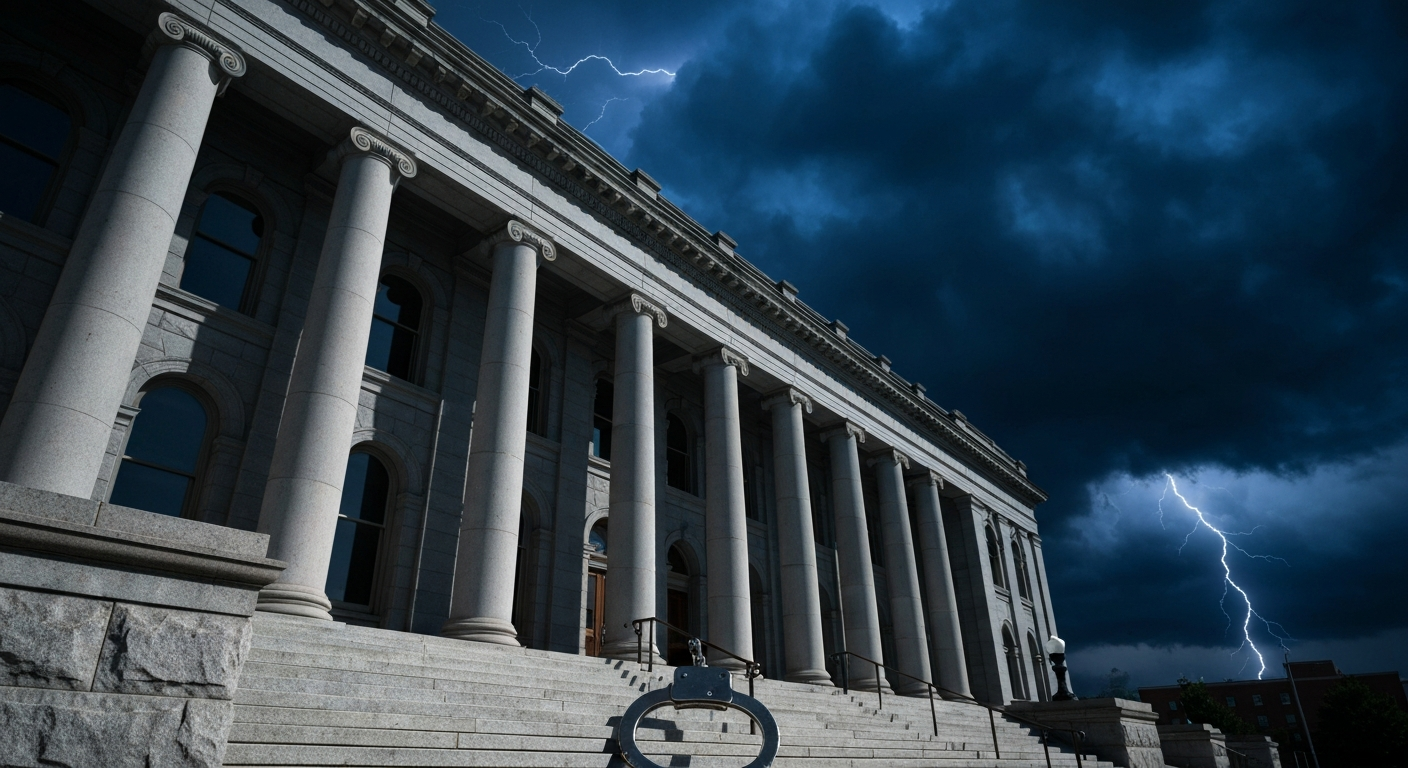
In the summer of 2008, a contractor named J. Kevin Kelley walked into the Cuyahoga County Courthouse in Cleveland, Ohio, and handed an envelope stuffed with cash to a sitting judge. The judge — Steven Terry of Cuyahoga County Common Pleas Court — had, by that point, already accepted thousands of dollars in bribes in exchange for favorable rulings in civil cases. Kelley, a construction contractor who depended on county projects for his livelihood, knew the game: in Cuyahoga County, justice was not blind. It was for sale, and the price list was well understood by anyone close enough to the machine that ran it.
The machine had two masters. One was Frank Russo, the Cuyahoga County Auditor who had held office since 1997 and who, over the next decade, turned a government office meant to assess property values into a sprawling patronage empire. The other was Jimmy Dimora, the Cuyahoga County Commissioner who had once been the chairman of the Cuyahoga County Democratic Party and who operated with the blunt confidence of a man who believed, correctly for many years, that he was untouchable. Together, Russo and Dimora did not merely commit corruption. They systematized it. They institutionalized it. They turned Cuyahoga County — Ohio's largest county, home to Cleveland, home to more than 1.2 million residents — into a tribute economy where contracts were auctioned, judgeships were purchased, and court decisions were negotiated like real estate transactions.
When the FBI finally moved in — with raids, wiretaps, and a grand jury investigation that lasted for years — the scope of what they uncovered was staggering. More than 60 public officials and private citizens were eventually convicted. Russo himself pleaded guilty to 21 federal counts and received a 22-year prison sentence. Dimora was convicted after a bruising federal trial and sentenced to 28 years. Sitting judges were removed from the bench. County employees lost their jobs and their freedom. Contractors were barred from public work. The entire structure of Cuyahoga County government was dismantled and rebuilt from the ground up.
And yet — as with so many corruption scandals of this magnitude — the deeper questions went largely unanswered. How did this go on for more than a decade without a single whistleblower triggering meaningful intervention? Why did the Ohio Supreme Court, which has supervisory authority over all judges in the state, fail to detect or act upon any of the warning signs? Who enabled this machine by looking the other way? And what does it tell us — about the structural vulnerabilities of our court system, about the failure of legal professional self-regulation, about the way power insulates itself from accountability — that the most documented judicial corruption enterprise in Ohio history ran in broad daylight for so many years?
- Key figures: Frank Russo (County Auditor), Jimmy Dimora (County Commissioner)
- Duration of scheme: Approximately 1998–2008 (active FBI investigation began 2008)
- Total convicted: More than 60 public officials and private citizens
- Russo sentence: 22 years federal prison (guilty plea, 21 counts)
- Dimora sentence: 28 years federal prison (convicted at trial, 33 counts)
- Judges implicated: At least 5 sitting or former Cuyahoga County Common Pleas judges
- Estimated value of bribes: Millions in cash, contracts, services, and sexual favors
- Result: Complete restructuring of Cuyahoga County government; new county charter adopted 2009
- Federal statutes: 18 U.S.C. § 1962 (RICO), 18 U.S.C. § 666 (federal program bribery), 18 U.S.C. § 1341 (mail fraud)
Frank Russo and the Auditor's Office as Patronage Machine
To understand the Cuyahoga corruption machine, you have to understand what Frank Russo built, and how he built it over so many years that it became the baseline assumption of county politics.
Russo had been in Cuyahoga County Democratic politics since the 1980s, working his way up through party infrastructure until he was elected County Auditor in 1997. The auditor's office in Ohio controls property assessment — the process that determines tax values for every parcel of land in the county. It is not a glamorous office. It is, however, an enormously powerful one, because it touches every property owner, every business, every contractor, and every developer operating in the county. And Russo understood from early in his tenure that the auditor's office could be something else entirely: a gatekeeper, a favor machine, and a revenue stream.
What Russo ran was, at its core, a jobs-for-money scheme of extraordinary breadth. He maintained a so-called "Russo list" — a roster of politically connected individuals whose employment in the county auditor's office or elsewhere in county government was contingent on their loyalty to Russo, their willingness to pay him cash assessments from their salaries, and their participation in the broader patronage network. Court records from the FBI investigation document hundreds of instances in which Russo placed individuals in government jobs in exchange for cash payments, sexual favors (which Russo received from multiple women in county employment), and political support.
The FBI wiretaps — which would eventually capture thousands of conversations — documented Russo explicitly discussing the quid pro quos: a county job in exchange for cash, a favorable tax assessment in exchange for a bribe, a contract award in exchange for a kickback. Russo kept meticulous records of debts owed and favors rendered. His office employed individuals whose primary job function was not auditing property values but maintaining the political machine that kept Russo in power and profitable.
But what made the Cuyahoga corruption machine more than just a garden-variety patronage operation was what Russo and Dimora did with the judiciary.
Jimmy Dimora and the Purchase of the Bench
Jimmy Dimora was, by most accounts, the more charismatic of the two men — and the more dangerous. As both County Commissioner and longtime Democratic Party chairman, he had a reach that extended across every dimension of Cuyahoga County public life. He controlled who got slated for party nominations. He influenced who received county contracts. He shaped who was appointed to fill vacancies on the bench. And from roughly 2000 onward, according to the federal evidence compiled against him, he used all of that influence for personal enrichment on a scale that was almost operatic in its audacity.
The most explosive element of the Dimora case — the part that set it apart from ordinary political corruption — was the evidence that he had directly intervened in pending judicial matters in exchange for cash and other benefits. The FBI documented at least five Common Pleas Court judges who had received benefits from the Russo-Dimora network or had directly participated in case-fixing arrangements. These were not hypothetical benefits — they were documented cash payments, home renovations performed by contractors who received county contracts, and other tangible corruption.
Judge Steven Terry, one of the most extensively documented cases, had received cash from contractor J. Kevin Kelley in exchange for favorable rulings in civil litigation. Kelley, who needed county contracts and also had civil matters pending before the court, understood the transaction perfectly. He paid. Terry ruled in his favor. The circuit was closed.
Judge Bridget McCafferty — a Common Pleas judge who had been elected to the bench with Democratic Party support — was convicted in 2011 of lying to the FBI about her relationship with Dimora. Prosecutors alleged that she had contacted Dimora about a pending case involving a contractor in his network, and that Dimora had intervened on behalf of that contractor. McCafferty denied the allegations and was convicted specifically of making false statements to federal investigators, a charge that itself revealed the depth of entanglement between the Dimora machine and the bench.
What emerged from the wiretaps and the grand jury testimony was a picture of judicial elections as commercial transactions. In Cuyahoga County, Common Pleas judges are elected in partisan primaries where the Democratic Party's endorsement is nearly determinative. And the Cuyahoga County Democratic Party, for much of the period in question, was Jimmy Dimora's party. Candidates for judgeships understood — or came to understand — that access to the party's endorsement and its campaign machinery came with expectations. The expectations were not always explicit. They did not need to be. The culture had been set. Everyone in the courthouse knew who Dimora was and what he expected.
"The accumulation of all powers, legislative, executive, and judiciary, in the same hands, whether of one, a few, or many, and whether hereditary, self-appointed, or elective, may justly be pronounced the very definition of tyranny."
The FBI Investigation: Wiretaps, Raids, and the Scale of the Evidence
The FBI's investigation into Cuyahoga County corruption — codenamed Operation Clean Sweep — formally began in 2008, though agents had been receiving tips and gathering preliminary evidence for years before that. The investigation was run out of the FBI's Cleveland Field Office, with prosecutors from the United States Attorney's Office for the Northern District of Ohio leading the grand jury work.
What the investigators found when they began systematic wiretapping was almost incomprehensible in its scope. The phone calls between Russo, Dimora, and their network of contractors, employees, judges, and political allies documented corruption at every level and in virtually every transaction of county government. County contracts were openly discussed as revenue-sharing arrangements. Judicial appointments were discussed as rewards for political and financial loyalty. The fixing of individual court cases — civil matters involving connected contractors, domestic relations cases, probate disputes — was negotiated with the casual familiarity of men who had been doing this for so long that it had ceased to feel like crime and had become simply the way things worked.
The wiretap recordings would eventually become exhibit after exhibit in the federal trials. Dimora, listening to himself on tape, had no credible innocent explanation for conversations in which he discussed arranging favorable outcomes in pending matters in exchange for the renovations being done on his home. Russo's conversations documented the Russo list in granular detail — who owed him money, who had been placed in county jobs, who was expected to deliver.
The FBI executed search warrants on the homes and offices of both men in July 2008, seizing documents, financial records, computers, and evidence of the home renovations that had been performed by contractors — renovations valued at hundreds of thousands of dollars that Russo and Dimora had received essentially for free in exchange for county contracts and favorable treatment.
The cascading guilty pleas that followed the raids were staggering. County employees. Contractors. Political operatives. A former county sheriff's deputy. Court officials. Each new guilty plea generated new cooperation, new names, new evidence. The investigation had what prosecutors described as a "self-generating" quality: every cooperator led to more cooperators, because the corruption had been so normalized that virtually everyone who had operated in Cuyahoga County government during this period had some exposure.
The Judges: What the Bench Knew and When They Knew It
The most damaging element of the Cuyahoga scandal — the element that should have prompted a national conversation about judicial accountability that never quite materialized — was not the corruption of Frank Russo's patronage machine or Jimmy Dimora's contract-rigging. It was the corruption of the judiciary itself.
At least five Common Pleas Court judges were named in the investigation. Several were convicted. Several others were named as unindicted co-conspirators or entered into agreements with federal prosecutors. The specifics varied, but the pattern was consistent: judges who had risen through the Democratic Party's endorsement machinery understood that they were part of a network, and that network had expectations.
Judge Steven Terry pleaded guilty in 2010 to accepting bribes from contractor Kelley and was sentenced to 27 months in federal prison. The bribes he accepted — cash delivered in envelopes, home repairs performed by Kelley's company — were directly connected to favorable civil rulings in cases in which Kelley had interests. Terry's case was, in some respects, the most classically corrupt: a judge taking money and ruling accordingly. The transaction was clean, ugly, and fully documented.
Judge Bridget McCafferty's case was more complex. Convicted of making false statements to federal investigators — a charge distinct from bribery — McCafferty had denied under oath that she had contacted Dimora about a pending case. The FBI had recordings that contradicted her denials. Her 2011 conviction resulted in a sentence of 14 months in federal prison.
Former Common Pleas Judge Carolyn Friedland was convicted in 2012 of bribery charges connected to her relationship with a county contractor who had performed work on her home. The work — valued at tens of thousands of dollars — had been provided at below-market or no cost in exchange for favorable treatment.
What these convictions established, beyond the individual culpability of the judges involved, was something deeply disturbing about the institutional culture of the Cuyahoga County Common Pleas Court: that judges who sat on that bench during the Dimora era were operating in an environment where corruption was normalized, where the line between the party machinery and the judicial office had been deliberately blurred, and where the formal mechanisms of judicial oversight — the Ohio Supreme Court's disciplinary processes, the Board of Professional Conduct, the presiding judges who supervised the court — had either failed to detect what was happening or had chosen not to look.
"The judiciary of the United States is the subtle corps of sappers and miners constantly working under ground to undermine the foundations of our confederated fabric. They are construing our constitution from a co-ordination of a general and special government to a general and supreme one alone."
The Cases That Were Fixed: Real People, Real Harm
Behind the indictments and the wiretap recordings were real people whose lives were damaged by the corruption of Cuyahoga County's courts. These were not abstract legal abstractions. They were litigants — in custody disputes, in civil cases, in probate matters — who came to the Cuyahoga County Common Pleas Court believing that their case would be decided on its merits by a neutral arbiter, and who did not know that the game had already been fixed.
The FBI investigation documented specific instances in which Dimora had been contacted about pending cases and had passed instructions — or at minimum, had expressed preferences — to judges who understood that his preferences were not optional. Contractors involved in civil litigation who had paid into the Dimora network received favorable rulings. Parties in domestic relations cases whose attorneys had connections to Russo or Dimora received outcomes that their connections had helped arrange.
These litigants — the ones on the losing end of fixed rulings — had no recourse. They had no way of knowing that the judge who ruled against them had been compromised. They could not petition for a new trial on the grounds of judicial corruption because they did not know the corruption had occurred. Their appeals, if they filed them, went to panels of the Ohio Court of Appeals and potentially the Ohio Supreme Court — courts that were reviewing the record of proceedings they had no reason to suspect were tainted.
Some of these cases were eventually identified during the FBI investigation. Some were not. The Ohio Supreme Court, in the aftermath of the convictions, undertook a review of cases handled by the convicted judges to determine whether any could be reopened. That process was limited, slow, and resulted in relatively few case reversals — a fact that itself reflects a structural problem: the justice system's mechanisms for remedying corruption are deeply inadequate to address systemic judicial bribery of the kind that Cuyahoga County saw.
The Structural Failure: Why Did This Last So Long?
The Cuyahoga County corruption machine operated for approximately a decade before the FBI moved in. In that decade, hundreds of county employees and contractors participated in or had knowledge of corruption. Multiple sitting judges accepted bribes or received inappropriate benefits. The Democratic Party's endorsement machinery was openly understood to be a transactional system. And yet — through all of that — no formal institutional mechanism triggered an intervention.
The Ohio Supreme Court, which is responsible for disciplining attorneys and judges in Ohio, received no complaints about the Cuyahoga County bench during this period that led to meaningful investigation. The Ohio Board of Professional Conduct — the body that handles attorney ethics complaints — had no visible investigative role in the unfolding of this scandal. Local journalism, which in earlier eras had been the primary accountability mechanism for courthouse corruption, had been hollowing out for a decade; the Cleveland Plain Dealer, the region's primary newspaper, was operating with a fraction of the investigative capacity it had once had. The political opposition — Republicans in a county where Democrats held structural dominance — lacked the standing or the resources to investigate executive branch corruption at this depth.
What ultimately broke the case open was not a whistleblower, not a judicial disciplinary proceeding, not an opposition opposition investigation. It was an FBI field office running a wiretap and a grand jury. Without federal intervention, this machine would almost certainly have continued.
That fact — that only federal law enforcement, not any state institutional mechanism, was capable of detecting and dismantling this corruption — is a damning indictment of the oversight architecture governing American courts. State judicial conduct commissions are chronically underfunded, structurally timid, and populated by members who often have professional relationships with the judges they are supposed to oversee. Partisan judicial elections, like those in Ohio, create exactly the conditions that Dimora exploited: a system in which judicial candidates are financially and politically dependent on party machinery, and in which the distinction between judicial independence and party loyalty is functionally erased.
The Trials: Dimora Fights, Russo Folds
Frank Russo, faced with the evidence the FBI had assembled — the wiretap recordings, the financial records, the testimony of cooperators who had been inside his operation — did what many defendants in his position do. He pleaded guilty. In October 2010, Russo entered guilty pleas to 21 federal counts including bribery, conspiracy, mail fraud, and tax charges. His cooperation with federal prosecutors was extensive. In exchange for his cooperation — which produced additional evidence against Dimora and other defendants — prosecutors agreed to recommend a sentence at the lower end of the applicable guidelines range.
It did not help him much. In February 2012, U.S. District Judge Sara Lioi sentenced Russo to 22 years in federal prison. He was 66 years old. The sentence was, in effect, a life sentence. Russo appealed. He lost. He was ordered to pay more than $1 million in restitution. He would serve his sentence at a federal medical facility due to health conditions.
Jimmy Dimora, by contrast, went to trial. His defense — that the wiretap recordings were taken out of context, that the witnesses against him were liars and criminals seeking leniency, that the renovation work done on his home was either paid for or unrelated to any official action — was creative and aggressively presented. It was not persuasive. After a trial that lasted several weeks in early 2012, the jury convicted Dimora on 33 of the 34 counts against him, including RICO conspiracy, bribery, and extortion. In June 2012, Judge Lioi sentenced him to 28 years in federal prison — a sentence that Dimora appealed, unsuccessfully, through the Sixth Circuit and to the United States Supreme Court, which declined to hear his case.
Dimora has continued to maintain his innocence from prison. He has given interviews and made public statements claiming that he was selectively prosecuted, that the witnesses against him were motivated by personal animus or self-interest, and that the federal government had exceeded its authority. These claims have found no traction in the courts. The evidence against him — including the recorded conversations, the financial records, and the testimony of more than 30 cooperating witnesses — was overwhelming.
County Government Rebuilding: The Charter Reform
One of the few constructive outcomes of the Cuyahoga County corruption scandal was the adoption of a new county charter that fundamentally restructured county government. In November 2009 — before the trials had concluded but after the scope of the corruption had become publicly known — Cuyahoga County voters approved a new charter that replaced the three-member Board of Commissioners (the structure that had empowered Dimora and his colleagues) with a single elected County Executive and an eleven-member County Council.
The new structure was designed explicitly to break up the patronage networks that had enabled Dimora. A single elected executive, subject to direct accountability from voters and without the cover provided by a commission structure, would face more visible scrutiny. The council's oversight role would provide a check on executive authority. An independent Ethics Commission with actual enforcement powers would replace the toothless oversight mechanisms of the previous era.
These were meaningful reforms. Ed FitzGerald, elected as the county's first County Executive in 2010, moved aggressively to professionalize county government, establish competitive bidding processes, and implement conflict-of-interest policies that had been absent under the commission structure. The county eventually completed a number of deferred infrastructure and courthouse projects that had been stalled by the corruption scandal's fallout.
But structural reforms, however well-designed, cannot by themselves address the judicial accountability gap that the Cuyahoga scandal exposed. The judges who were corrupted were state officers, not county officers. Their oversight fell to the Ohio Supreme Court and the state's judicial conduct machinery — machinery that had failed completely during the decade of the Dimora era. And that machinery remains, in Ohio and in virtually every other state, substantially unchanged in the years since.
The Accountability Gap: What the Law Does Not Reach
One of the most troubling aspects of the Cuyahoga case is not who was convicted, but who was not. The FBI investigation was necessarily limited by what could be proven beyond a reasonable doubt in federal court. RICO conspiracies require documented acts. Bribery charges require documented transactions. The wiretaps were enormously helpful, but they only captured a fraction of the conversations that had occurred over more than a decade.
What the wiretaps could not capture — what no law enforcement investigation can fully document — was the ambient corruption: the understanding, shared throughout the courthouse community, that certain judges could be reached through certain channels; that certain case outcomes were more likely if you had the right connections; that the formal neutrality of the court was supplemented by an informal network that everyone in the building understood existed.
Attorneys who practiced in Cuyahoga County during the Dimora era and who knew what was happening — who had clients come to them with stories of inexplicable adverse rulings, who heard courthouse gossip about which judges were in the network — largely said nothing. The bar association's obligation to report judicial misconduct under Ohio's Rules of Professional Conduct is, in practice, almost never enforced. The culture of the bar in any county courthouse is heavily shaped by the reality that attorneys who report judges can expect those judges to remember the report the next time the attorney appears before them. The incentives run entirely against disclosure.
This is not a problem unique to Ohio. It is a structural feature of the American legal system that has never been adequately addressed. Attorneys are simultaneously the people best positioned to observe judicial misconduct and the people least incentivized to report it. The result is that the bar functions as a de facto suppression mechanism for information that the public has an overwhelming interest in receiving.
The Forgotten Victims: Litigants Whose Cases Were Never Reviewed
In the aftermath of the Cuyahoga convictions, the Ohio Supreme Court undertook what it described as a review of cases handled by the convicted judges. The review was limited in scope, underpublicized, and resulted in relatively few case reversals. Most litigants who had cases before the convicted judges during the relevant period had no practical mechanism to challenge their outcomes, and no effective notification that the judge who had decided their case had been convicted of corruption.
Consider the practical situation of a litigant who lost a civil case before Judge Terry in 2007. They lost. They may have appealed and lost at the appellate level. They moved on. In 2010, Terry pleaded guilty to bribery. That litigant — if they even followed the news — would have had no clear mechanism to seek reopening of their case. The Ohio Rules of Civil Procedure provide limited grounds for relief from final judgments, and judicial corruption of which the moving party was unaware does not neatly fit into the enumerated categories of relief under Rule 60(B). The federal courts have even stricter limitations on collateral attacks on state court judgments.
This gap — between the documented corruption and the remediation available to its victims — is one of the most serious accountability failures of the Cuyahoga case. The people who lost cases before corrupted judges are not abstractions. They are real Ohioans whose property rights, custody arrangements, business disputes, and civil claims were resolved by a corrupted process. They deserved a remedy. The legal system's answer — essentially, "the statute of limitations has run, the judgment is final, move on" — is a failure of justice as fundamental as the corruption itself.
A Blueprint for Reform: What Would Actually Change This
The Cuyahoga County courthouse corruption case is not an isolated aberration. It is a case study in structural vulnerabilities that exist in every state court system in America. Addressing those vulnerabilities requires reforms that go beyond prosecuting individual wrongdoers after the fact. Here is what would actually make a difference:
- End partisan judicial elections for trial courts. The Dimora corruption was made possible by a judicial election system in which Democratic Party endorsement was a prerequisite for election, and in which party machinery controlled by Dimora was the gatekeeper for that endorsement. Merit selection systems — in which judicial candidates are reviewed by independent commissions and nominated to the governor for appointment, subject to retention elections — break the direct financial and political dependency between judges and party bosses. Seventeen states currently use merit selection in various forms. All should.
- Fund and empower judicial conduct commissions. Every state has a judicial conduct commission or its equivalent. Almost all of them are chronically underfunded, minimally staffed, and structurally reluctant to pursue sitting judges. These commissions should be funded at levels that allow for proactive investigation — not merely reactive complaint processing — and should be staffed by investigators who are independent of the bar and the bench. Commission members should be prohibited from having active practices before state courts during their terms of service.
- Require mandatory, anonymous reporting by attorneys. The current system, in which attorneys are ethically obligated to report judicial misconduct but face professional retaliation for doing so, effectively guarantees silence. A mandatory anonymous reporting system — with whistleblower protections enforceable in federal court against state retaliation — would change the information environment that judicial conduct commissions operate in. Attorneys who know something would have a protected path to report it.
- Create a federal civil rights cause of action for case-fixing victims. Litigants whose cases were decided by corrupted judges currently have no federal civil rights cause of action that provides meaningful relief. 42 U.S.C. § 1983 and the Racketeer Influenced and Corrupt Organizations Act (18 U.S.C. § 1962) provide some hooks, but judicial immunity doctrine — which extends to judges acting in their judicial capacity — creates enormous barriers even where corruption is proven. Congress should enact targeted legislation providing a federal civil damages cause of action for litigants who can demonstrate, by clear and convincing evidence, that a judgment against them was obtained through judicial corruption or bribery. This cause of action should not be subject to judicial immunity doctrine and should include a tolling provision beginning from the date of the corrupt judge's conviction.
- Require financial disclosure for all state court judges. Federal judges are required to file annual financial disclosure statements under the Ethics in Government Act. State judges in most states are not subject to equivalent requirements, or are subject to disclosure requirements so weak as to be meaningless. A uniform national standard requiring comprehensive financial disclosure — including gifts, home renovation work, below-market services, and other non-cash benefits — would have made the Cuyahoga renovation scheme detectable years before the FBI moved in.
- Establish independent court monitors for high-corruption-risk jurisdictions. Where judicial corruption investigations have identified systemic problems — as the Cuyahoga investigation clearly did — there should be a mechanism for appointing an independent monitor with authority to review case assignments, audit case outcomes for statistical anomalies suggesting corruption, and report directly to the state supreme court and the public. This is analogous to the consent decree and monitoring mechanisms used in police misconduct cases, and should be equally available as a remedy for systemic judicial corruption.
- Implement automatic case review and notification for convicted judges' dockets. When a judge is convicted of bribery or corruption charges, every party who had a case before that judge during the period of the corruption should be automatically notified and given an extended window — at least five years from the conviction — to seek reopening of their case based on the corruption. The burden of proof for reopening should be reduced in light of the proven corruption: a showing that the case was before the convicted judge during the covered period should create a rebuttable presumption of prejudice sufficient to warrant de novo review.
The Lesson Cuyahoga Never Stops Teaching
Frank Russo died in federal custody in February 2020, having served roughly eight years of his 22-year sentence. He was 73. Jimmy Dimora remains in federal prison, having had his appeals denied and his petitions for compassionate release rejected. The judges who were convicted served their sentences — shorter than Russo's and Dimora's — and emerged into a world in which, in most cases, they are simply private citizens again.
The Cuyahoga courthouse is still standing. The Common Pleas Court still operates. Judges are still elected in partisan elections. The Democratic Party's endorsement machinery still plays a decisive role in who sits on the bench. The Ohio Board of Professional Conduct still processes complaints reactively. The structures that enabled the Dimora machine for a decade have been modified at the margins but not fundamentally reformed.
What has changed is that an entire generation of Cuyahoga County attorneys, contractors, and political operatives lived through the FBI investigation and the convictions. That experience created an informal deterrent that the formal institutional mechanisms had never managed to create. The knowledge that wiretaps happen, that cooperators cooperate, that a decade of corruption can be unspooled in a federal courtroom in a matter of weeks — that knowledge is not codified in any statute or rule, but it is real. It is, in many ways, the most durable legacy of Operation Clean Sweep: not the convictions themselves, but the awareness that federal law enforcement, when it decides to look, can see everything.
But relying on federal law enforcement as the sole backstop against judicial corruption is not a system. It is the absence of a system. The FBI cannot investigate every courthouse in every county in America. It does not have the resources, the jurisdiction, or the mandate to serve as a permanent monitor of state court integrity. That work — the daily work of ensuring that the judges who decide the most intimate and consequential matters of people's lives are doing so honestly, without corruption, without the thumb of a political machine on the scale — that work must be done by institutional mechanisms that currently do not exist in adequate form.
Until they do, the Cuyahoga story will be repeated. Different county. Different names. Different machine. Same fundamental failure: a court system that is constitutionally charged with being the last line of defense against tyranny, used instead as a tool of the very power it was designed to check.
James Madison warned us. Thomas Jefferson warned us. The Founders built a system premised on the assumption that institutional checks would restrain human venality. What Cuyahoga County showed us — what it shows us still — is that those checks require active maintenance. They require funding, and political will, and citizens who are willing to be angry enough about courthouse corruption to demand real reform rather than settling for the prosecution of a few individuals while the structural rot continues.
Frank Russo and Jimmy Dimora are in prison, or in the ground. The machine they built is dismantled. But the vulnerabilities they exploited are everywhere. Every partisan judicial election in America is a potential Cuyahoga waiting to happen. Every underfunded judicial conduct commission is a gap in the wall. Every attorney who knows something and says nothing is a brick in the fortress of impunity.
The question is not whether this will happen again. It is happening now, somewhere, in ways we do not yet know. The question is what we are willing to do to find out — and what we are willing to change when we do.
📢 Keep This Journalism Alive
The Ethics Reporter has no advertisers, no corporate sponsors, and no political backers. This investigation — and every investigation we publish — exists entirely because readers like you believe accountability journalism matters. If this reporting moved you, please consider supporting us.
Donate to The Ethics ReporterEven $1 helps. No amount is too small. Thank you for standing with us.