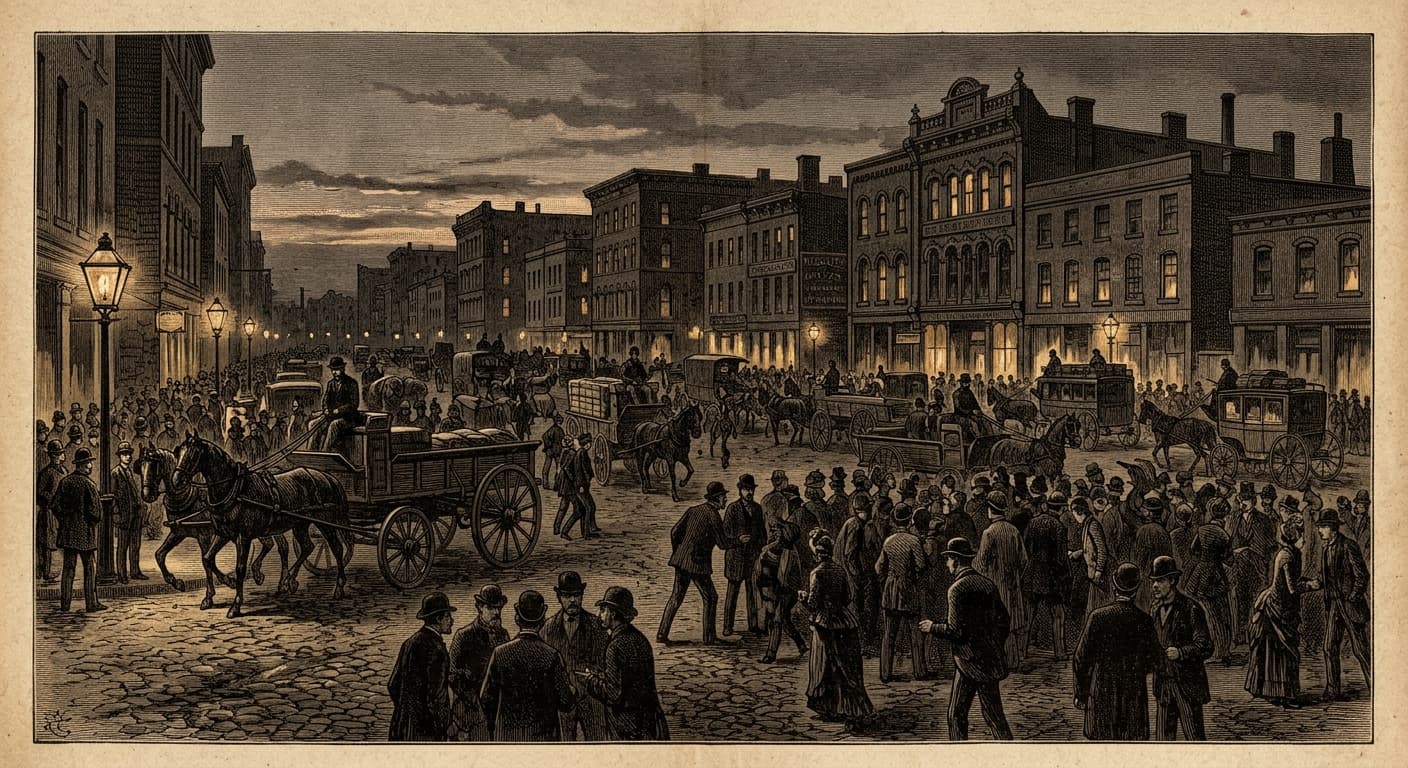
On the evening of May 4, 1886, a crowd of workingmen gathered in Haymarket Square in Chicago to protest police violence — specifically, the killing of striking workers by Chicago police at the McCormick Reaper Works the previous day. The rally was peaceful, dwindling, and nearly over; the mayor of Chicago, Carter Harrison, had attended part of it himself and gone home, satisfied there would be no trouble. Then, as police moved in to disperse the remnant of the crowd, someone threw a bomb. It exploded among the police ranks, killing Officer Mathias Degan almost immediately; six more officers would die of their wounds, and dozens were injured, some by bomb fragments, many by police gunfire in the chaos that followed. To this day, no one has ever established who threw the bomb. What happened next, however, is entirely established — because it happened in open court, in a trial that even its defenders at the time struggled to describe as fair, and that stands as the founding generation's worst nightmare made flesh: a jury trial conducted in a panic, for an audience baying for blood, against defendants convicted of what they believed rather than what they did.
Eight anarchists were tried for the murder of Officer Degan: August Spies, Albert Parsons, Adolph Fischer, George Engel, Louis Lingg, Michael Schwab, Samuel Fielden, and Oscar Neebe. None was proven to have thrown the bomb. Most were not even present when it exploded. Parsons had left the rally to drink at a nearby saloon before the bomb went off; Spies was on the speakers' wagon when the explosion happened; Schwab had gone home early. The prosecution never seriously attempted to prove otherwise, because it never had to. Its theory, announced before trial and ratified by the judge, was that the defendants' words — their speeches, their editorials, their advocacy of dynamite as the workingman's weapon — had inspired an unknown person to throw the bomb, and that this made them murderers. Conspiracy by utterance. Homicide by opinion.
The Road to Haymarket: 1877, McCormick, and the Eight-Hour War
To see the trial plainly, begin with the decade. The Great Railroad Strike of 1877 — crushed by federal troops and militia, with scores of workers killed — taught American labor that the state would choose property over life when pressed. Chicago remembered: in that strike the city saw days of street fighting and police and militia killings that radicals would cite for years. Out of the ashes grew a labor movement with real strength: the Knights of Labor surged toward a million members, and a harder, immigrant-led anarchist movement — skeptical of ballot-box politics after watching captured legislatures and compliant courts — grew in parallel, especially in German Chicago. The demand that unified them, the demand on which the nationwide May 1, 1886 strikes were called, was modest in modern terms: eight hours of work, eight hours of rest, eight hours for what we will. Employers and their press treated the demand as the front edge of revolution.
On May 3, 1886, at the McCormick Reaper Works on Chicago's South Side, police fired into a crowd of striking workers, killing at least two — some accounts say more — and wounding many. The anarchist press in Chicago had been built for just such a moment. August Spies, editor of the Arbeiter-Zeitung, witnessed the aftermath and produced that evening one of the most provocative pieces of American radical journalism: a circular headlined REVENGE! WORKINGMEN, TO ARMS!!! — the famous Revenge Circular — calling workers to the Haymarket rally the following night. That circular, which Spies hastily corrected with a milder revision, would become a centerpiece exhibit at his trial. The state would read it as the fuse of the bomb. Posterity reads it as a newspaperman's fury at a police killing — intemperate, certainly, and evidence of nothing more than opinions the First Amendment is supposed to shelter.
The City That Wanted Hangings
The atmosphere in Chicago in the weeks after the bombing cannot be overstated. The bomb had exploded at a moment of acute class conflict. The national movement for the eight-hour workday had called a general strike for May 1, 1886 — three days before Haymarket — and hundreds of thousands of American workers had walked out. Chicago, a city of immigrants, factories, and ferocious labor militancy, was the movement's center. The city's newspapers, owned by the industrialist class, had spent months portraying anarchists as foreign vermin. After the bombing, the press dispensed with any pretense. Newspapers demanded immediate convictions and executions. The Chicago Tribune would later concede that the very newspapers of Chicago called for blood first and investigated afterwards; demands that the defendants be hanged were printed before indictments were even returned. The police rounded up hundreds of suspects, ransacked homes and meeting halls without warrants, held people incommunicado, and — by the account of State's Attorney Julius Grinnell's own later admissions and the testimony given at trial — built their case through threats of lynching against those who would not cooperate.
The lead detective, Michael Schaack, would later write a book about the case in which he described interrogation methods that included extended secret confinement. Captain William Ward, commanding the station where many suspects were held, testified about the conditions. The state's star informants — men who testified that the defendants had plotted violence — included individuals who had been arrested themselves and released after agreeing to cooperate, and whose testimony changed conspicuously between the grand jury and the trial. This was the raw material from which a capital case was built.
The Bomb, the Evidence, and the Man Who May Have Thrown It
The physical evidence at trial was thin to the point of embarrassment. The bomb fragments recovered were of a type inconsistent with the explosives associated with the defendants. No witness identified the thrower with any reliability. The state's own witnesses placed the thrower variously, and the single most consistent candidate in the historical record — Rudolph Schnaubelt, Michael Schwab's brother-in-law, seen by some witnesses near the wagon and with access to the movement's dynamite rhetoric — was arrested, questioned, released, and promptly fled the country, never to stand trial. Whether Schnaubelt threw the bomb remains genuinely uncertain; historians are divided, and some suspect an agent provocateur or an individual acting wholly alone. What is not uncertain is that the state could not prove who did it, and responded by prosecuting the men it could find rather than the man it could not.
The trial exhibits tell the story better than any indictment: shelf after shelf of printed matter entered into evidence — Spies's editorials, Parsons's speeches, The Alarm's exhortations, the Arbeiter-Zeitung's columns — as if the publishing history of a political movement were the corpus delicti of a murder. The defendants were tried for their library. Judge Gary's instructions ensured the jury could convict on exactly that basis: the actual bomber need not be found, need not be connected, need only have been, in some inferential sense, encouraged by the atmosphere the defendants had made.
Judge Joseph Gary and the Mechanics of a Fixed Trial
The presiding judge was Joseph E. Gary of the Cook County Criminal Court. His conduct of the Haymarket trial has been condemned in the annals of American jurisprudence for reasons that begin before the first juror was sworn and end with his instructions on the law — instructions so expansive that they effectively abolished the distinction between advocating violence and committing it.
Begin with the jury. Under then-prevailing Illinois practice, the conventional methods of summoning jurors were supplanted: Judge Gary permitted the appointment of a special bailiff, one Henry Ryce, to summon the venire. Ryce did not merely summon jurors; he selected them, approaching men known to be hostile to the defendants. One member of the panel, asked by Ryce to serve, later reported Ryce's approach in terms that remove all doubt about the enterprise: "I am managing this case, and know what I am about. These fellows are going to be hanged as certain as death. I would like to have you as a juror." This was not a rogue courthouse rumor; it was sworn testimony, later recounted by Governor John Peter Altgeld in his famous pardon message as part of the documented record of the trial's corruption. Defense attorneys objected. Gary permitted the process to proceed.
The jurors who were seated included men who admitted to pre-existing opinions of guilt. One juror had relatives in the police force and conceded he had formed an opinion; he was accepted. Another acknowledged a fixed opinion that would require evidence to dislodge; he was accepted. When the defense exhausted its peremptory challenges, it was left with a jury whose impartiality existed mostly as a courtroom formality. The Founders had designed the jury as the citizen's shield against the state. At Haymarket, the shield was handed to the state with the handle inward.
Then there were Gary's rulings on evidence and his instructions. The prosecution's theory required the jury to find the defendants guilty of murder without finding that any defendant threw the bomb, procured the bomb, or knew of the bomb's existence. Gary's instructions obliged. He told the jury, in substance, that if the defendants, by print and speech, had advised or encouraged the commission of violence generally, and a killing followed in furtherance of the conspiracy thus created, all conspirators were guilty of murder — and, most damningly, that the jury could convict even if the actual thrower was unknown and unproved to have been incited by the defendants at all. The instruction converted murder, the most specific of crimes, into a referendum on anarchism. Defendant Oscar Neebe — who was barely connected to the movement's rhetoric, let alone any bomb — was swept in on the theory that he associated with anarchists. He was sentenced to fifteen years. The others were sentenced to hang.
The United States Supreme Court declined to intervene. In a procedural posture typical of the era — Spies v. Illinois (1887) — the Court found no federal constitutional defect it was prepared to remedy, and the state machinery rolled on.
The Appeal: Spies v. Illinois and the Doctrine of Looking Away
The defense appealed. The Illinois Supreme Court affirmed in full, brushing past the jury-selection irregularities and the unprecedented instructions with the confidence of a court that knew the public temper of 1887 and had no wish to test it. The United States Supreme Court, in Spies v. Illinois, decided in November 1887 — with the executions ten days away — declined to find a federal constitutional question worthy of its intervention. The Court's treatment foreshadowed a century of habeas jurisprudence in which federal courts professed inability to reach state convictions for want of a properly raised federal issue, no matter the magnitude of the underlying injustice. The doctrine would eventually be dignified with names — exhaustion, procedural default, deference to state factfinding — but at Haymarket its function was plain: the bomb had panicked a city, and every court that could have slowed the gallows chose deference to the panic.
The Gallows
Of the eight convicted, seven received death sentences. Oscar Neebe, as noted, got fifteen years. Samuel Fielden and Michael Schwab petitioned for mercy, and on November 10, 1887 — the day before the scheduled executions — Governor Richard Oglesby commuted their sentences to life imprisonment, citing their remorse and the doubts surrounding the proceedings. Louis Lingg did not live to be hanged: he was found dead in his cell on the morning of November 10, killed by an explosion from a blasting cap that had been smuggled to him — or, as some suspected, planted. The official verdict was suicide.
On November 11, 1887, August Spies, Albert Parsons, Adolph Fischer, and George Engel were hanged in the Cook County Jail courtyard before a selected audience. Their last words have entered the permanent record of American martyrdom. Spies declared: "The time will come when our silence will be more powerful than the voices you strangle today." Parsons asked, "Will I be allowed to speak, O men of America? Let me speak, Sheriff Matson! Let the voice of the people be heard!" The voice was not heard; the trap was sprung while he was still speaking.
Albert Parsons deserves a paragraph of his own, because his fate demonstrates most purely what the trial was. Parsons was the one defendant who was not in hiding after the bombing. A native-born Alabama Confederate veteran turned radical labor editor, married to Lucy Parsons — a woman of mixed Black, Mexican, and Native American ancestry who became one of the great orators of the labor movement — Parsons had escaped Chicago's police dragnet and was safe from arrest. There was no warrant out that could not have eventually been contested. He walked into the courtroom on the first day of trial, surrendered voluntarily, and took his place at the defense table, announcing through his lawyer that he could not leave his comrades to face the charges alone. He trusted, at some level, that an American jury would not hang a man for his speeches. He was hanged for his speeches.
Altgeld's Pardon: The Document That Killed a Governor
Six years later, on June 26, 1893, Governor John Peter Altgeld of Illinois issued full and absolute pardons to the three surviving Haymarket defendants in prison — Fielden, Schwab, and Neebe — and died politically for it. The pardon message, some eighteen thousand words long, is one of the bravest documents in American political history, and every serious student of American courts should read it in full. Altgeld — no radical, a German-born businessman and former prosecutor — did not pardon the men as an act of mercy. He pardoned them as an act of justice, and said so: after a methodical review of the record, he concluded that the trial had been not a legal trial, that the defendants were not proven guilty, and that the jury had been selected by a process packed to produce conviction. He catalogued the evidence: the bailiff Ryce's boast, the jurors' admitted prejudices, the paid and coerced testimony, the physical impossibility of the state's timeline, Judge Gary's instruction that a conviction could rest on the unknown bomb-thrower being incited by the defendants even without proof of any connection between them.
The reaction was savage. Newspapers across the country called Altgeld a traitor, an anarchist sympathizer, a foreign subversive. His governorship ended at the next election. His business interests withered under organized boycott. He never recanted and never apologized. In the judgment of subsequent generations of historians and lawyers — including the official historians of the Illinois bar — Altgeld was right on every material point. The Haymarket trial had been a lynching conducted by court order.
What the Trial Killed, and What It Taught the Next Panic
It is conventional, and true, to say the Haymarket trial set back the eight-hour movement and the Knights of Labor for a generation. It is less often noted that it also taught the American state a lesson it has never unlearned: that a sensational act of violence, ascribed to a disfavored political movement, can be converted into legal license to destroy the movement itself — that murder charges can carry the payload of political suppression so long as a judge's instructions are drawn widely enough and a jury is selected carefully enough. The line from Haymarket runs directly to the Palmer Raids, to the Smith Act trials, to the prosecution of dissent in every national fever that has followed, and it runs, too, into the present era's expansions of conspiracy and material-support law. Each generation rediscovers the Gary instruction in modern dress: guilt by association, upgraded to guilt by atmosphere.
What the Founders Built Against, and What Panic Did to It
The founding generation did not have to imagine a Haymarket. They had lived through equivalents. The trials that followed the Boston Massacre — in which John Adams and Josiah Quincy defended British soldiers accused of murdering Bostonians in a city howling for their blood — were the founding generation's model of what courts were supposed to be: deliberative, evidence-bound, insulated by oath and procedure from the crowd at the door. Adams famously said in his summation that facts are stubborn things, and that the law would not bend to passion. The soldiers were acquitted of murder (two were convicted of manslaughter and branded). That acquittal, in 1770, was the seedbed of the Sixth Amendment: the right to an impartial jury, the right to confront witnesses, the right to assistance of counsel — guarantees written by men who had proven, at personal risk, that such guarantees could work even when the public wanted vengeance.
At Haymarket, every one of those guarantees was present on paper and absent in practice. The jury was empaneled, but it was not impartial — the man who selected it promised hangings. The defendants had counsel — capable, diligent counsel — but counsel cannot win when the rules of evidence are rewritten mid-trial. The defendants confronted their accusers — but the accusers testified under the shadow of police coercion, and their shifting stories were admitted anyway. They had a jury of the vicinage — in the exact jurisdiction where the press had spent a year and a half demanding their execution. On paper, the trial of the Haymarket anarchists satisfied the Constitution. In substance, it was everything the Constitution was written to prevent.
This is the deepest lesson of the case, and the reason it must be told now. Rights on paper are inert. They move only through institutions — judges willing to enforce them against popular fury, prosecutors willing to lose rather than cheat, jurors selected for impartiality rather than outcome, governors willing to be destroyed for saying the truth. At Haymarket, every institution failed except one: a governor, six years too late, who traded his career for a correct judgment. That is the thinnest possible margin for liberty, and it is the margin on which the entire American experiment has always run.
The Monument, and the Memory the City Could Not Kill
The aftermath had its own architecture. Chicago erected a monument — not to the dead anarchists, but to the police: a statue of a policeman, arm raised, erected in Haymarket Square in 1889. It was bombed twice, once in 1969 by the Weathermen and once again the following year; it was moved repeatedly, and today it sits inside the protected courtyard of the Chicago Police Academy, where the public it commemorates cannot easily approach it. Near the old Haymarket site stands a second monument, dedicated in 2004: bronze figures of the men at the speaker's wagon, honoring the rally and its martyrs. The two memorials, in their locations, summarize the argument the city has had with itself ever since — the police state's version of May 4, 1886, installed behind walls; the martyrs' version standing on the street.
In 1898, Illinois erected the Haymarket Martyrs' Monument in Waldheim Cemetery over the graves of the hanged, with a statue of Justice placing a wreath on a slain worker. Lucy Parsons, who outlived her husband by more than half a century and spent that half-century vindicating him, asked to be cremated with his ashes; the state obliged her into a pauper's handling after the FBI seized and destroyed her library when she died in 1942. The government that hanged Albert Parsons managed, at his widow's death, one final confiscation of the record. It did not work. The record survived anyway — in Altgeld's pardon message, in the monument's bronze, and in the fact, celebrated on every continent except, pointedly, the one where it happened, that the working day those men died demanding now carries their names around the world.
The Eight-Hour Day, and the Price of Memory
There is one more thing the Haymarket trial did, and it is worth ending on because it reveals what the trial was really about. The men convicted were not the leaders of a bomb plot; they were the leaders of a labor movement. Spies edited the Arbeiter-Zeitung, the most influential radical newspaper in the Midwest. Parsons had edited The Alarm. The eight defendants between them organized unions, published newspapers, and spoke for the eight-hour day. The prosecution's exhibits included their manifestos. Judge Gary's instructions asked the jury to weigh their teachings. And after the hangings, the labor movement was decapitated — briefly. The eight-hour movement that was supposed to die in Haymarket Square instead spread worldwide: May Day, celebrated internationally on May 1 as International Workers' Day in most countries on earth, dates from the 1886 strikes and was fixed upon that date by the international socialist congress of 1889 in memory of Haymarket. The United States, pointedly, celebrates its Labor Day in September.
So the story ends in irony — but the irony is bitter. A bomb thrown by an unknown hand killed seven police officers and a bystander. In answer, the state of Illinois hanged four men it could not connect to the bomb, imprisoned others, and called it justice; and the cause for which the hanged men lived outlasted the men who hanged them. Judge Gary is remembered, where he is remembered at all, as the man who presided over a disgrace. Altgeld, though destroyed, is remembered as a hero of American conscience. And the four men on the gallows got their prophecy: their silence, purchased by the state at the price of its legitimacy, has been louder for a hundred and forty years than any court that condemned them.
Fear convicts. That was true in 1886, and nothing in the architecture of American courts has changed to make it false today. The Founders knew it — they wrote a Bill of Rights precisely because they knew that in every generation there would be a Haymarket, a bomb, a crowd, and a demand that the accused be what the crowd needs them to be. What they could not do was make men brave enough to enforce the parchment. That part, it turns out, is still up to us.