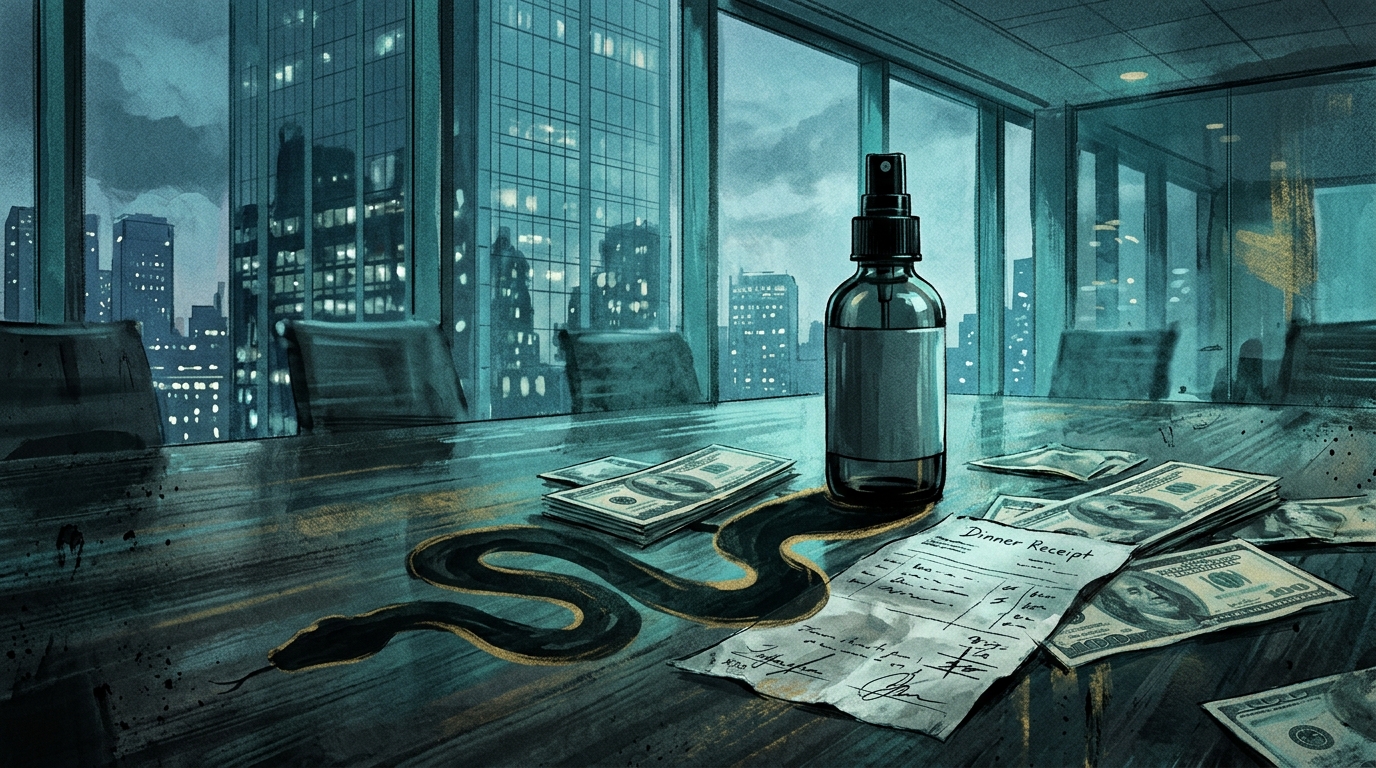
The product was a spray. Subsys, approved by the FDA in 2012, delivered fentanyl — the synthetic opioid roughly fifty to a hundred times more potent than morphine — under the tongue, where it reached the bloodstream in minutes. It was approved for exactly one population: cancer patients already tolerant to around-the-clock opioids, suffering breakthrough pain that ordinary dosing could not touch. That population is small, and dying, and it does not sustain a growth stock. The company that made Subsys, Insys Therapeutics of Chandler, Arizona, became for a time the best-performing IPO in America. The arithmetic connecting those two facts — a tiny lawful market and a soaring revenue line — was the entire case, and it took federal prosecutors in Boston the better part of a decade to write it down in the language of the racketeering statute.
When they did, the result was a legal landmark. On May 2, 2019, a jury convicted Insys’s billionaire founder, John Kapoor, and four subordinate executives of racketeering conspiracy — the first time, prosecutors noted, that a pharmaceutical company’s leadership had been convicted under RICO for conduct that helped feed the opioid crisis. The statute Congress built for the Mafia had been applied to a boardroom in a business park, and the fit, the trial demonstrated, was uncomfortably good. There was a scheme to bribe. There were sham fronts to launder the bribes. There was a unit dedicated to defrauding the institutions that guarded the money. There was even, in the government’s exhibit list, a promotional rap video — produced for a national sales meeting, featuring a dancing bottle of Subsys — celebrating the practice of cranking patients’ doses higher. The chorus celebrated titration. The dancers were sales staff. The logic was volume.
The Honorarium
Every pharmaceutical company operates “speaker programs” — paid engagements at which physicians ostensibly educate peers about a drug over dinner. The practice lives in a gray zone the industry has defended for decades: education on one reading, relationship-building on another, and, at its cynical edge, a legal-looking channel for paying prescribers. What distinguished Insys, the trial evidence showed, was that the company dispensed with the gray. Its speaker program was a price list.
Internal spreadsheets tracked, doctor by doctor, the “return on investment” of speaker fees: dollars paid against Subsys prescriptions written. Doctors who prescribed heavily got more programs; doctors who slowed down were cut off, and sales staff said so out loud, in emails the jury read. Many of the “programs” were fictions — sign-in sheets forged with the names of physicians who had never attended, dinners at which the only attendees were the speaker, the sales rep, and the restaurant staff. One of the government’s central witnesses, former sales vice president Alec Burlakoff — who pleaded guilty and cooperated — described the philosophy with the candor of a man past embarrassment: the fees were bribes, everyone understood they were bribes, and the paperwork existed so that no one would have to say so.
The personnel choices followed the philosophy. Insys hired for salesmanship over science — most notoriously in the case of Sunrise Lee, a former exotic dancer with no pharmaceutical background whom Burlakoff elevated to regional sales director on the theory, he testified, that certain doctors responded to certain kinds of attention. Lee was convicted alongside Kapoor; trial testimony included an account of her giving a lap dance to a prescribing physician at a Chicago club. The detail made every headline, which was in one sense unfair — the spreadsheet was the crime; the club was the color — and in another sense perfectly fair, because it captured what the company understood itself to be doing. It was not persuading physicians. It was purchasing them, by whatever currency each one accepted.
The Spell
Bribing the prescriber solved only half the business problem. Fentanyl for breakthrough cancer pain is expensive — thousands of dollars a month — and insurers required prior authorization, typically confirming the patient actually had cancer. Most Subsys prescriptions, as the volume grew, were being written off-label for back pain, neuropathy, headaches — patients who would never clear the review. So Insys built a solution in-house: the Insurance Reimbursement Center, a boiler room in Arizona whose employees called insurers posing as staff from prescribing doctors’ offices.
They followed a script the government called “the spell” — a sequence of artful evasions engineered to imply, without quite stating, that the patient had cancer: references to “breakthrough pain,” recitations that the diagnosis was consistent with the approved use, strategic deployment of a diagnostic code for unspecified pain. Employees testified to blocking their caller ID and inventing office details. Michael Gurry, the executive who ran the unit, was convicted with the others. The unit’s victims — pharmacy-benefit managers and insurers — were institutions no jury loves, but the fraud’s downstream casualties were human: patients without cancer, approved for pharmaceutical fentanyl at escalating doses, because a call center two thousand miles away had implied a tumor.
Among the names that recur in the record and the litigation around it is Sarah Fuller, a New Jersey woman prescribed Subsys off-label for fibromyalgia and back pain after a car accident; she died in 2016 with fentanyl in her system, thirty-two years old. Her physician later surrendered her medical license; her family’s lawsuit and her father’s testimony before Congress put a face on the reimbursement unit’s work. The doctors themselves — the sellable prescribers the spreadsheets ranked — generated their own line of prosecutions: practitioners in Michigan, Rhode Island, Alabama, and New York convicted of taking Insys money in exchange for their prescription pads, several of them among the highest Subsys prescribers in the nation.
The Prescribers
Bribery is a market with two sides, and the government prosecuted both. The physicians who anchored Insys’s revenue were, by definition, outliers — the top decile of the top decile, individually responsible for prescription volumes that dwarfed entire states’. In Michigan, the neurologist Gavin Awerbuch, for a time among the nation’s most prolific Subsys prescribers, pleaded guilty to health-care fraud and unlawful prescribing. In Rhode Island, Jerrold Rosenberg was convicted for taking sham speaker fees tied to his prescriptions. In New York, Manhattan physicians who had collected tens of thousands in program money were tried and convicted. And in Alabama, the pain physicians Xiulu Ruan and John Patrick Couch — whose clinics moved more Subsys than almost any practice in America — received sentences of twenty and twenty-one years, in a case that traveled all the way to the Supreme Court: in 2022, in Ruan v. United States, the Court held that convicting a licensed prescriber requires proof he knew or intended his prescriptions were unauthorized, tightening the standard for every opioid prosecution after — a ruling that complicated retrials without unwinding the underlying story the Insys spreadsheets told.
The spreadsheet, in the end, was the case’s great document. The industry euphemism for physicians receptive to marketing is “movable”; Insys simply measured movability in dollars per prescription and managed to it, quarter by quarter, like any sales pipeline. When jurors saw the return-on-investment tables — program spend in one column, Subsys revenue attributed to each doctor in the next — the defense’s vocabulary of education and awareness had nothing left to stand on. It is one thing to suspect that money moves medicine. It is another to see medicine denominated, physician by physician, in a company’s own arithmetic.
The Trial of the Boardroom
Kapoor’s defense was the classic architecture of executive deniability: a founder focused on the science — he held a Ph.D. in medicinal chemistry and had made his first fortune in generics — betrayed by rogue salesmen who overreached. The government’s answer was documentary. Kapoor had been personally briefed on the speaker program’s ROI tracking, the evidence showed; he had approved the strategy of concentrating on high-decile prescribers; cooperating executives, including former CEO Michael Babich, testified that the bribery model was not a deviation from the founder’s plan but its execution. The jury convicted everyone. Judge Allison Burroughs later pared portions of the verdict — finding the evidence insufficient on some predicate theories against some defendants — but the core convictions stood, and in January 2020 she sentenced Kapoor to sixty-six months in federal prison. Burlakoff and Babich, the cooperators, received twenty-six and thirty months respectively; Lee, Gurry, and the others months to years; the company itself, by then, had agreed to pay $225 million in a global resolution with the Justice Department — its subsidiary pleading guilty to fraud — and had filed for bankruptcy within days, in June 2019. Insys, as a corporate entity, effectively ceased to exist. It remains the rare opioid-era defendant to have died of its own case.
Sixty-six months for the architect of a fentanyl bribery scheme struck many observers — including relatives of the dead who addressed the court — as a rounding error against the harm. The comparison that circulated was unanswerable: street-level fentanyl dealers routinely draw decades. Judge Burroughs acknowledged the tension and imposed what the guidelines and the paring of the verdict would bear. But the sentence’s length was never the case’s significance. Its significance was the theory: that a lawful corporation, FDA-approved product in hand, had operated as a criminal enterprise — that the org chart was the conspiracy. Every subsequent settlement in the opioid reckoning, from the distributors’ global deal to the Sackler family’s tortured bankruptcy odyssey, was negotiated in a world where executives knew a Boston jury had once said the word “racketeering” to people like them.
The sales culture the trial exposed deserves a paragraph of its own, because culture was the mechanism by which the design became conduct. Former representatives testified to a regime in which quotas were denominated not in prescriptions but in dosage strength — the “titration” the rap video celebrated — because higher doses meant higher revenue per patient, and in which reps were coached to treat physicians’ offices as territories to be captured through whatever combination of catering, flattery, employment for staff, and money the target required. New hires with pharmaceutical experience were, several witnesses said, less prized than hires with sales hunger and no habits of regulatory caution to unlearn. The org chart’s incentives ran one direction, from the founder’s growth targets down through regional managers’ bonuses to the rep at the door of the pain clinic; the jury’s racketeering verdict was, in essence, a finding that the culture was the conspiracy’s operating system.
The Corporate Corpse
The company’s own end came with unusual completeness. In June 2019, weeks after the verdicts, Insys reached a global resolution with the Justice Department totaling $225 million — an operating subsidiary pleaded guilty to mail-fraud counts arising from the speaker program, and the civil settlement resolved False Claims Act liability for the prescriptions the reimbursement unit had conjured through federal programs. Within days, the company filed for Chapter 11, its liabilities to states, insurers, and victims having outrun any conceivable enterprise value; its assets, including the spray technology itself, were sold off in bankruptcy. Among opioid-era defendants — an industry roster that negotiated survival through multibillion-dollar settlements amortized over decades — Insys stands nearly alone in having been simply extinguished by its conduct, a corporate capital sentence carried out by balance sheet.
The prosecution’s foothills had been climbed years earlier, and lower down the org chart. As early as 2015, a Connecticut nurse practitioner named Heather Alfonso — among Medicare’s most prolific Subsys prescribers in New England — pleaded guilty to accepting tens of thousands of dollars in Insys “speaker” payments for dinners at which no education occurred; her case, unglamorous and local, was the first public confirmation that the program was a payments channel, and her cooperation helped investigators read the spreadsheets from the inside. The Boston case was built the way racketeering cases have always been built: from the bottom, plea by plea, each cooperator surrendering the layer above, until the man at the top — who had never written a prescription, called an insurer, or forged a sign-in sheet — was left holding the design.
The Founder
Kapoor’s biography made the case’s morality play almost too neat. He had come to the United States from India as a young man of modest means, earned a doctorate in medicinal chemistry at the University at Buffalo, and built a fortune — more than one — in generic drugs, where his reputation was that of a ferociously exacting operator. He was, by the time of Subsys, a billionaire philanthropist with buildings bearing his name. His defenders insisted, not implausibly, that a personal grief lay near the company’s origins: his wife had died of cancer, and he spoke of Subsys as a product born of watching her pain. The jury was permitted to believe all of it and convict him anyway, because the charge was not that he founded a company in bad faith but that he ran one — that when the lawful market proved too small, the founder’s exactitude turned to the engineering of an unlawful one, with the same attention to metrics he had brought to manufacturing. The tragedy defense, such as it was, dissolved against the ROI tables bearing his briefings.
The Lawful Envelope
The disquieting part of the Insys record is not what was illegal but how little of the machinery had to be invented. Speaker programs were industry standard; Insys merely removed the deniability. Prior-authorization gamesmanship was endemic; Insys merely centralized it. Targeting high-prescribing doctors with money and attention was — is — the core method of pharmaceutical detailing; Insys merely kept honest spreadsheets about it. The company’s crime, in a sense, was literalism: it did openly, internally, and measurably what the marketing apparatus of the industry does with layers of consultancy and euphemism. That is why the case is taught not only in law schools but in medical ones. The physicians who took the fees were not outliers ambushed by a uniquely evil company; they were participants in an economy of influence that ordinary medicine has normalized, presented with a version of it blunt enough to indict.
Kapoor, in his late seventies, pursued his appeals and lost — the First Circuit affirmed the core of his conviction in 2021 — and the executives scattered into the afterlives of the convicted. The spray itself, and the tiny population of cancer patients it genuinely served, passed into other hands. What remains is the file: the ROI spreadsheets, the forged sign-in sheets, the script for the spell, the rap video the jury watched — a complete, discovery-grade anatomy of how medical judgment is purchased in America, preserved because, for once, the purchasers kept receipts.
The medical profession’s own reckoning was quieter than the courtrooms’. The physicians Insys purchased were licensed, board-certified, and, in several cases, prominent in their specialty societies until the day of their indictments; the boards that credentialed them acted, as boards do, after the convictions rather than before, ratifying the criminal system’s work rather than anticipating it. The prescription data that identified every one of them — outlier volumes, outlier doses, geographic clusters — sat in state monitoring programs and payer databases throughout, visible to any regulator with the appetite to look. The appetite arrived with the subpoenas.