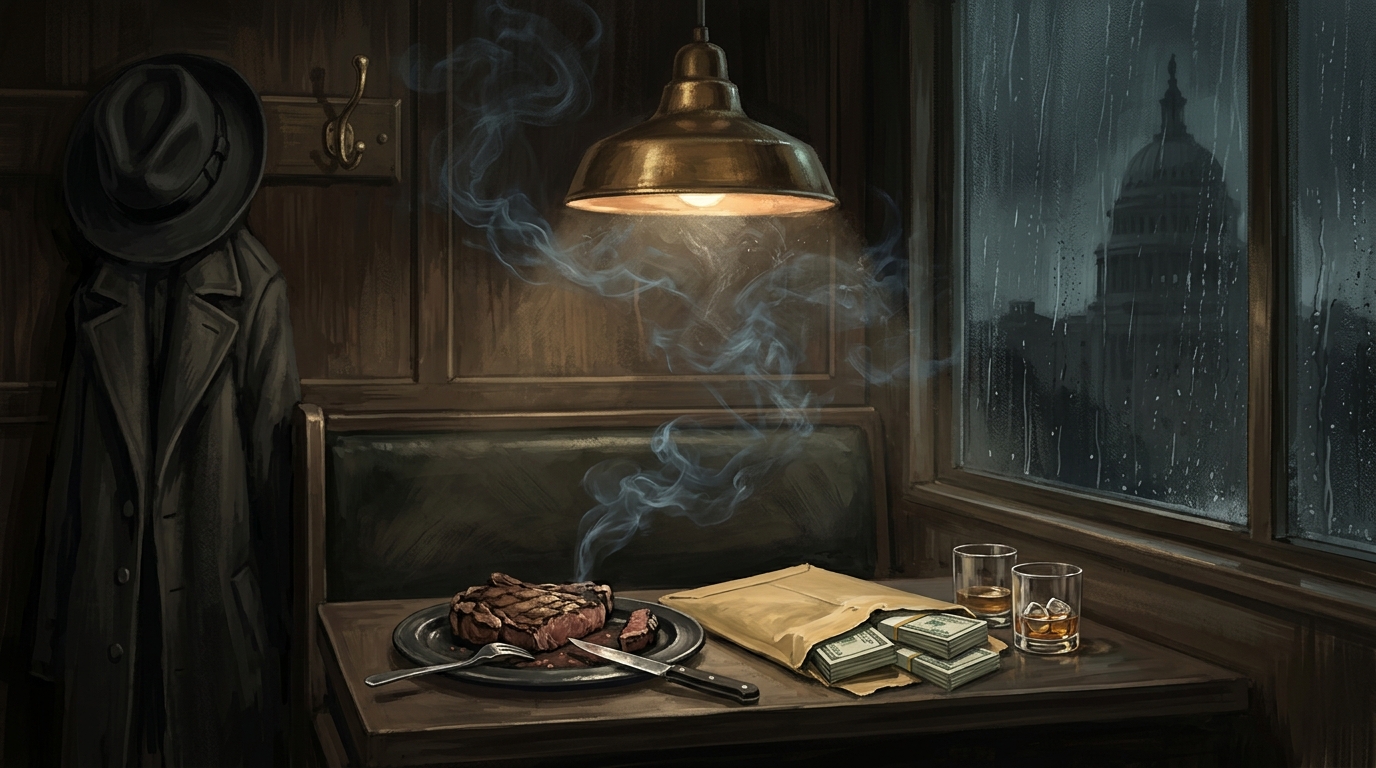
The emails were the thing. Washington had survived bribery scandals before — had survived Teapot Dome and Abscam and Koreagate — but it had never seen its own contempt typed out in real time. “I have to meet with the monkeys from the Choctaw tribal council,” the town’s most successful lobbyist wrote to his partner. His clients were “troglodytes,” “morons,” “idiots.” They were also paying him and his associates roughly eighty million dollars — some of the poorest and some of the newly richest communities in America, Indian tribes with casino revenues to protect, wiring fortunes to a man who mocked them in writing while secretly working, in several instances, to manufacture the very threats they were paying him to fight. When the Senate Indian Affairs Committee began releasing those emails in 2004, under the chairmanship of John McCain, Washington experienced something rare: not the discovery of corruption, which everyone assumed, but the discovery of its tone.
Jack Abramoff pleaded guilty on January 3, 2006, in federal court in Washington, to conspiracy, fraud, and tax evasion. The following day, in Miami, he pleaded guilty to fraud in a separate case involving the purchase of a casino cruise line with a fabricated twenty-three-million-dollar wire transfer. Before the investigation ended, it had produced convictions or guilty pleas from a sitting congressman, congressional aides, a deputy secretary of the Interior, and a senior White House procurement official. It remains the most complete anatomy of influence-peddling the modern capital has produced — complete not because it caught everything, but because, for once, the participants wrote everything down.
The Making of Casino Jack
Abramoff came up through the ideological trenches. As national chairman of the College Republicans in the early 1980s, he ran the organization alongside two men who would become fixtures of the conservative movement, Grover Norquist and Ralph Reed — a trio whose later entanglements would give the scandal its reach into the movement’s respectable institutions. After a detour producing action movies, Abramoff arrived at lobbying in the mid-1990s with a specific insight: the 1988 Indian Gaming Regulatory Act had created a new class of wealthy clients — tribes with casinos — whose fortunes depended entirely on decisions made in Washington and in state capitals. Their revenue could be created, protected, or destroyed by a committee vote, an Interior Department ruling, a compact negotiation. For a lobbyist, that dependency was the product.
By the early 2000s, at the firm Greenberg Traurig, Abramoff was among the highest-grossing lobbyists in the country. He operated less like a hired advocate than like a political machine: two restaurants, including the downtown steakhouse Signatures, where lawmakers and staff ate at his expense; skyboxes at Washington’s stadiums, offered up for fundraisers; golf junkets to Scotland aboard chartered jets, with members of Congress in the foursomes; a charity, the Capital Athletic Foundation, that functioned substantially as a slush fund, financing among other things a sniper-scope program for settlers in the West Bank and a private religious school he founded. The structure blurred every line the ethics rules assumed: gifts became fundraisers, charity became lobbying, clients’ money became the machine’s fuel.
The Scheme
The core fraud, the one the Justice Department put at the center of his plea, was known inside the operation as “gimme five.” It worked like this. Abramoff would advise a tribal client to hire a public-relations and grassroots firm, Capitol Campaign Strategies, run by his partner Michael Scanlon, a former press aide to House Majority Whip Tom DeLay. Abramoff did not disclose that Scanlon was kicking back roughly half the profits to him. The tribes believed they were paying a lobbyist a disclosed fee and a vendor a market rate; in fact they were paying both ends of a concealed partnership that had every incentive to inflate the work. The Senate committee tallied the take from six tribes at approximately eighty-two million dollars. The Mississippi Band of Choctaw Indians, the Coushatta Tribe of Louisiana, the Saginaw Chippewa of Michigan — sophisticated governments with real money — were systematically overbilled for work that ranged from the padded to the fictitious.
The Tigua chapter remains the scandal’s purest expression. In 2002, the Tigua tribe of El Paso lost its Speaking Rock casino after a campaign to enforce Texas gambling restrictions — a campaign that Abramoff and Scanlon had themselves helped engineer, working with Ralph Reed, whose anti-gambling coalition of Christian conservatives was being paid, through cutouts, with gambling money from rival tribal clients who wanted the competition closed. Then, with the casino shuttered, Abramoff approached the Tigua and offered to get it reopened — for a fee, through a legislative fix he promised his congressional contacts would deliver. “I’m on the phone with Tigua!” he emailed Scanlon as the tribe, unaware it was speaking to the author of its ruin, considered hiring him. The fix never came. The fees did.
The Government for Rent
What gave the scheme its power was that Abramoff could actually deliver, often enough, the official acts his clients were paying for — because he had cultivated, with meals and tickets and trips and jobs, a network of public officials who treated his interests as their own. Representative Bob Ney of Ohio, chairman of the House Administration Committee, inserted statements into the Congressional Record to assist the SunCruz casino purchase and agreed to support legislation for Abramoff clients; he took the Scotland golf trip, the meals, the tickets. Ney pleaded guilty in 2006 to conspiracy and making false statements and was sentenced to thirty months — the only member of Congress imprisoned in the affair. Tony Rudy and Neil Volz, senior aides to DeLay and Ney respectively, pleaded guilty to conspiracy, having moved through the revolving door onto Abramoff’s team while their old bosses remained in power. David Safavian, the chief procurement officer at the White House Office of Management and Budget, was convicted of lying and obstruction in connection with the Scotland trip and his assistance to Abramoff on federal property matters. J. Steven Griles, the deputy secretary of the Interior — the department that decides tribal gaming questions — pleaded guilty to obstructing the Senate’s investigation. Kevin Ring, a former Abramoff associate, was convicted at trial. Tom DeLay, whose orbit overlapped Abramoff’s at a dozen points, was never charged federally in the matter; he resigned his leadership post and then his seat as the scandal metastasized.
The SunCruz case supplied the scandal’s noir subplot. In 2000, Abramoff and a partner, Adam Kidan, bought SunCruz Casinos, a Florida fleet of gambling boats, from the businessman Konstantinos “Gus” Boulis — closing the leveraged deal with a counterfeit wire transfer purporting to show a twenty-three-million-dollar equity contribution that did not exist. The sale curdled into litigation and threats. In February 2001, Boulis was shot dead in his car in Fort Lauderdale, a gangland-style hit for which three men with organized-crime connections — men to whom Kidan had funneled SunCruz consulting payments — were later charged. Neither Abramoff nor Kidan was accused of the murder, but the fraud that had put them in Boulis’s orbit was the crime to which both pleaded guilty. In March 2006, a federal judge in Miami sentenced Abramoff to five years and ten months in the SunCruz case; in September 2008, after his cooperation had helped convict others, Judge Ellen Segal Huvelle in Washington sentenced him to forty-eight months on the corruption charges, the Justice Department noting his “extensive” assistance. He served a total of about three and a half years, part of it, famously, followed by a stint working at a kosher pizzeria in Baltimore.
The Islands
Before the tribes, there were the islands, and the Marianas chapter deserves its own accounting because it shows the machine running at full throttle on behalf of conduct far worse than fee-padding. Beginning in the mid-1990s, at the firm Preston Gates, Abramoff represented the government of the Commonwealth of the Northern Mariana Islands — a U.S. territory in the western Pacific whose garment industry had discovered a regulatory miracle. Because the CNMI controlled its own immigration and minimum wage, factories on Saipan could import tens of thousands of guest workers, mostly young women from China and the Philippines, pay them a fraction of the U.S. minimum, house them behind fences, and sew “Made in the U.S.A.” into everything they produced. Federal investigators and journalists documented the conditions in detail: recruitment fees that amounted to debt bondage, forced overtime, squalid barracks, and worse. Washington’s answer, on a bipartisan basis, was legislation to extend federal immigration and labor law to the territory. Abramoff’s job, for millions of dollars in fees, was to make sure that legislation died — and it died, Congress after Congress.
The method was the junket. Abramoff arranged for scores of members of Congress, staffers, and conservative writers to visit Saipan — golf, beaches, factory tours conducted at a careful distance from the barracks. Tom DeLay, the House whip whose office functioned as the scheme’s legislative terminus, toured the island over New Year’s 1997–98 and pronounced it “a perfect petri dish of capitalism,” praising the guest-worker economy that human-rights investigators were describing in the vocabulary of trafficking. Reform bills passed the Senate unanimously and were never allowed to reach the House floor. Federal labor standards did not fully arrive in the Marianas until 2007, after the scandal had destroyed the lobby that had held them off for a decade. The episode rarely leads accounts of the Abramoff affair, because no count of the indictment turned on it; nothing about it was chargeable. That is precisely its significance. The kickbacks sent Abramoff to prison. The Saipan work — legal, disclosed, effective — kept sweatshops inside the American flag for ten years, and every technique it used remains available today.
The Reform That Wasn’t
Congress responded the way Congress responds. The Honest Leadership and Open Government Act of 2007 banned gifts and meals from lobbyists, extended cooling-off periods, and expanded disclosure. The word “Abramoff” became a unit of measurement — the scandal by which subsequent scandals were sized. And yet the deeper structure the case exposed survived intact, because the case, properly read, was never about rule-breaking at the margins. It was about the business model. Abramoff himself, after prison, became the system’s most credentialed critic, writing a memoir and giving interviews in which he made an uncomfortable point: most of what he did was legal, and the legal parts were the problem. The meals and the skyboxes were details. The engine was the exchange — campaign money, jobs for staff, favors banked and called — that the law does not reach and that the town does not consider corrupt because the town runs on it.
There was a coda, almost too neat. In June 2020, Abramoff agreed to plead guilty in San Francisco to conspiracy in connection with a cryptocurrency promotion — and to a violation of the Lobbying Disclosure Act, for again lobbying without registering. Prosecutors noted he was the first person ever charged criminally under that statute’s registration provisions, thirteen years after the reform law that bore his scandal’s fingerprints was enacted. The first man caught by the post-Abramoff regime was Abramoff.
The Ledger
The accounting, when it finally closed, told its own story about who pays and who lands. Judge Huvelle’s sentence came with restitution of $23,134,695 to Abramoff’s victims, stacked atop the SunCruz obligations — sums that, against a disbarred lobbyist’s post-prison earnings, function less as repayment than as a permanent lien on a notorious name. Scanlon, whose cooperation ran nearly six years, was sentenced in February 2011 to twenty months and ordered to repay roughly twenty million dollars to the tribes he and Abramoff had bled. Bob Ney served seventeen months of his thirty, emerged to talk radio, and wrote a memoir blaming the hit men of Capitol Hill. Ralph Reed, never charged, ran for lieutenant governor of Georgia in 2006 and lost the primary — the scandal’s only ballot-box verdict — then rebuilt his career as though the emails had never printed. Grover Norquist, whose organization had passed Abramoff client money along its way, was never charged and never paused.
The strangest afterlives were the redemptive ones. Kevin Ring, the Abramoff associate who insisted on trial and lost, became president of Families Against Mandatory Minimums in 2017 — a convicted lobbyist lobbying, this time openly, against the machinery of federal sentencing itself. Neil Volz moved to Florida, took over as an executive of the Florida Rights Restoration Coalition, and helped lead the 2018 campaign for Amendment 4, which restored voting rights to more than a million Floridians with felony convictions — the scandal’s most direct civic dividend, delivered by one of its felons. Hollywood processed the affair twice in a single year: Alex Gibney’s documentary “Casino Jack and the United States of Money” and a Kevin Spacey feature by the same nickname, both released in 2010, both struggling against the problem that the true story’s emails outwrote any screenplay. Abramoff’s own memoir, “Capitol Punishment,” arrived in 2011 with the confession Washington least wanted: that the gifts and junkets were retail, and the wholesale business — the jobs dangled at staffers, the contributions timed to markups — remained not merely legal but standard. The town disputed his character and not his description.
The money, as restitution money does, came back slowly and partially; the tribes’ fuller recovery arrived through civil settlements with the firms whose letterhead had lent the scheme respectability. Greenberg Traurig, which had ejected Abramoff within days of the first Washington Post story in 2004, quietly settled with tribal clients on undisclosed terms — the professional-responsibility system’s customary ending: the individual imprisoned, the institution insured.
What the Tribes Knew
The ethics of the affair are usually framed as a Washington story, but its victims were clients, and the professional betrayal at its center is the one that should unsettle every fiduciary. The tribes hired an agent and got a counterparty. Abramoff’s duty — the elementary duty of loyalty that binds a lawyer, a lobbyist, an adviser — ran to the Choctaw, the Coushatta, the Tigua. He monetized that duty twice over: openly, in fees, and secretly, in kickbacks, manufactured threats, and contempt. The emails matter because they prove the state of mind that fee churning usually conceals. No one who calls his client a troglodyte while inflating the client’s invoice is confused about what he is doing.
Two decades on, the scandal reads less like an aberration than like a stress test the system failed and then normalized. The gift bans hold, more or less. The registration rules are marginally sharper. But the fundamental transaction Abramoff perfected — the conversion of public power into private fees through the medium of relationships — was not outlawed, because it cannot be outlawed without outlawing the town. What can be enforced, and what the case still teaches, is the older, simpler code: an agent who secretly profits against his principal is a thief, whatever his job title. The Justice Department needed no novel theory to convict Jack Abramoff. Fraud, kickbacks, tax evasion — the classics sufficed. They usually do. The scandal was never that Washington’s rules were broken. It was how few of them had to be.