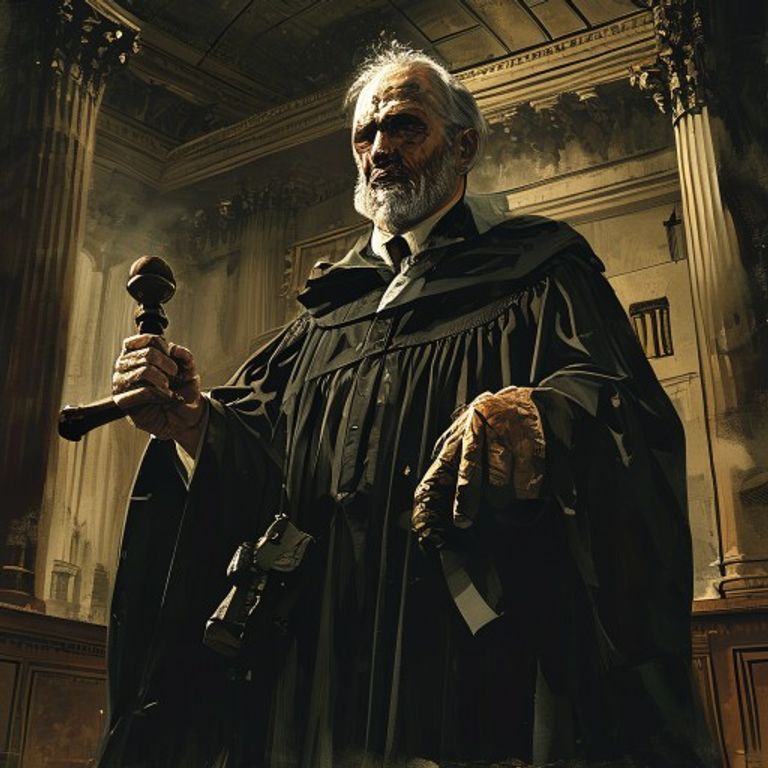
For over two decades, Senior United States District Judge Jack T. Camp Jr. was the terrifying face of federal authority in Atlanta. Appointed to the bench by President Ronald Reagan in 1988, Camp built a fearsome reputation as a strict constructionist and a merciless sentencer in drug cases. If you appeared in his courtroom on a narcotics charge, the gavel came down with crushing, unyielding force. He was the embodiment of the state’s righteous fury against the drug trade.
But while Judge Camp was locking young men in federal penitentiaries for decades, he was leading a shadow life that made a mockery of every sentence he pronounced. In 2010, the FBI arrested the 67-year-old federal judge after he bought cocaine, marijuana, and synthetic opiates from an exotic dancer he had been paying for sex. He even brought a loaded firearm to the drug deals to protect his supplier.
The scandal of Jack Camp is not merely one of personal hypocrisy. It is a devastating indictment of a defunct American judicial system that operates on two entirely different planes of reality: one for the citizens, and another for the "privileged corps" of the bench. It proves that the Founding Fathers’ most profound anxieties about an unaccountable judiciary were completely justified, and that the modern legal establishment has built a fortress of impunity that must be structurally reconstructed.
- Judge: Jack T. Camp Jr., Senior U.S. District Judge for the Northern District of Georgia.
- The Public Persona: A harsh sentencing judge known for his zero-tolerance approach to drug crimes.
- The Private Reality: Actively purchased and used cocaine, marijuana, and Roxicodone with an exotic dancer.
- The Arrest: Arrested in 2010 by the FBI after his supplier became an informant. Camp had a loaded gun in the front seat of his car during the sting.
- The Sentence: After pleading guilty to felony drug charges, this federal judge—who routinely handed down multi-year sentences to ordinary citizens—was sentenced to just 30 days in jail.
The Double Standard of the Gavel
To understand the systemic failure exposed by Jack Camp, one must look at the sentences he handed down compared to the sentence he received.
Camp presided over countless cases involving the exact same substances he was purchasing in parking lots. He destroyed families, locked away non-violent offenders, and rigidly applied mandatory minimums that robbed citizens of their liberty. Yet, when Camp himself was caught red-handed—buying narcotics and possessing a firearm during a drug transaction, a federal offense that usually triggers severe mandatory prison time—the legal establishment rallied to protect its own.
Camp’s defense team argued that brain damage from a cycling accident and a recent diagnosis of bipolar disorder were to blame for his sudden descent into criminality. It is a defense that a public defender might try for an impoverished addict in Camp’s own courtroom, only to have the judge scoff and issue a ten-year sentence. But because the defendant was an Article III judge, the federal prosecutors and the presiding judge treated him with a velvet glove. Camp received a mere 30 days in jail.
This is not justice. This is aristocracy.
The Collapse of Hamilton's "Integrity"
When the Founders debated the structure of the federal courts, Alexander Hamilton was the chief architect of the argument for lifetime judicial tenure. In Federalist No. 78, Hamilton argued that judges must be insulated from the political process to ensure they could rule without fear of reprisal. The judiciary, he wrote, would be the "least dangerous" branch because it possessed "neither force nor will, but merely judgment."
But Hamilton’s entire thesis rested on a fragile assumption: the character of the judges. He believed the prestige of the office would attract men of "integrity and moderation."
"The qualifications in the judges, which are essential to the impartial administration of the laws, are of such a nature as to demand long and laborious study," Hamilton wrote. He assumed the gravity of the bench would filter out the corrupt.
Jack Camp proves Hamilton fatally wrong. Lifetime tenure does not guarantee integrity; it guarantees impunity. When a judge is elevated to a position where he answers to almost no one, the isolation breeds an intoxicating arrogance. Camp believed he was the law in the courtroom, and above the law in the streets. The system Hamilton designed failed to account for the reality that giving a man unchecked power over the liberty of others frequently strips him of his own moral compass.
Jefferson's Warning: The Privilege of the Corps
Thomas Jefferson, unlike Hamilton, never trusted the legal establishment. He viewed the judiciary as a creeping threat to the republic, a group of unelected lawyers who would inevitably put their professional class above the Constitution.
In a letter written in 1820, Jefferson diagnosed the exact pathology that led to Jack Camp’s 30-day wrist-slap:
"Our judges are as honest as other men, and not more so. They have, with others, the same passions for party, for power, and the privilege of their corps."
That phrase—the privilege of their corps—is the defining feature of the American justice system today. When a citizen breaks the law, the system is a meat grinder. When a judge breaks the law, the system becomes a support group. The prosecutors, the defense attorneys, and the presiding judge in Camp's case were all part of the same elite legal corps. They looked at Jack Camp and saw a colleague who had fallen on hard times. They looked at the citizens Camp had sentenced and saw only criminals.
This two-tiered system violates the foundational premise of the Declaration of Independence: that all men are created equal, and that legitimate government derives its power from the consent of the governed. The American people never consented to a judicial oligarchy that exempts itself from the laws it brutally enforces against the poor.
A Call for Structural Reconstruction
The establishment views the Jack Camp case as an anomaly, a sad story of a sick man that was handled appropriately. But Camp is not an anomaly. He is the symptom of a defunct system that cannot be reformed with ethics pledges or slight procedural tweaks. We require a systemic reconstruction of the American judiciary.
1. Abolish Judicial Immunity for Criminal Sentences. If a judge is convicted of the same crimes for which he sentenced others, the law must mandate that the judge receive a sentence equal to the harshest penalty he ever imposed on a citizen for that offense. The elite must be forced to live under the maximum weight of the laws they apply to the public.
2. End Lifetime Tenure. Article III’s "good behavior" clause has been mutated into a shield for tyrants and hypocrites. We must institute mandatory term limits for all federal judges. The bench should be a temporary public service, not a lifelong lordship.
3. Civilian Sentencing Boards for Corrupt Officials. Judges and prosecutors cannot be trusted to sentence their own. When a judge or prosecutor is convicted of a crime, their sentence must be determined by an independent civilian board, stripping the "privilege of the corps" from the equation.
Jack Camp sat on a raised dais, dressed in a black robe, and destroyed lives with the strike of a gavel while high on the very drugs he condemned. He made a mockery of justice. But the true tragedy is not that Jack Camp existed. It is that the American judicial system is designed to protect men exactly like him. Until we reconstruct it, the gavel is nothing more than a weapon wielded by hypocrites.
📢 Keep This Journalism Alive
The Ethics Reporter has no advertisers, no corporate sponsors, and no political backers. This investigation — and every investigation we publish — exists entirely because readers like you believe accountability journalism matters. If this reporting moved you, please consider supporting us.
Donate to The Ethics ReporterEven $1 helps. No amount is too small. Thank you for standing with us.