On May 15, 2010, sixteen-year-old Kalief Browder was walking home from a party in the Bronx with a friend when a police car pulled up beside them. A man had reported his backpack stolen two weeks earlier, and the friend — or possibly Kalief; the accuser would change his story repeatedly, then leave the country — matched a description. The police searched the boys’ backpacks. They found nothing. They arrested Kalief anyway. He would spend the next three years of his life on Rikers Island — more than two of them in solitary confinement — awaiting a trial that never happened, accused of stealing a backpack that was never found, on the word of an accuser who was never cross-examined, because his family could not raise $3,000 for bail.
Kalief Browder never stood trial. He was never convicted of anything. At seventeen, he was offered a plea deal — plead guilty, go home with time served — and refused it, insisting he would not confess to a crime he had not committed, a decision that cost him the remainder of his adolescence. In 2013, the Bronx District Attorney’s office, its complaining witness in Mexico and unreachable, dismissed the case. Kalief walked out of Rikers after 1,111 days in custody. He came home with a GED, a shattered psyche, and a diagnosis of post-traumatic stress disorder. On June 6, 2015, at his mother’s house in the Bronx, Kalief Browder hanged himself. He was twenty-two years old.
Every clause of that story is a constitutional violation. Each clause corresponds, with terrible exactness, to a protection the Founders wrote into the Bill of Rights and America has since abandoned. The Sixth Amendment promises a speedy and public trial. Kalief got thirty-one court dates over three years and no trial. The Eighth Amendment forbids excessive bail. Kalief’s bail was set at an amount his working-class family could not pay, converting poverty into preventive detention. The Eighth Amendment forbids cruel and unusual punishment. Kalief spent roughly eight hundred days in solitary confinement — a practice the Founders’ generation invented, observed, and recoiled from as torture. The Fourteenth Amendment promises due process before the state deprives a citizen of liberty. Kalief’s deprivation of liberty rested on an arrest without evidence, a charge without a complainant, and a prosecution without a witness. He was, in the language of the Framers, held in answer to an infamous accusation without presentment, tried by no jury, and punished without conviction. The American penal system did not fail Kalief Browder. It performed, exactly as designed, a function the Constitution explicitly forbids.
The Arrest: No Backpack, No Witness, No Case
The facts of the arrest, as later established in depositions, investigative journalism, and the civil suit Kalief’s family brought against the city, are stark. On the night of the alleged robbery, a man named Roberto Bautista reported to police that two Black teenagers had robbed him at knifepoint, taking a backpack containing a camera, an iPod Touch, a credit card, and $700 in cash. Two weeks later — the timeline matters — police officers stopped Browder and his friend on the street because Bautista, driving in the area, spotted them and identified Browder’s friend as one of the robbers. The officers searched the boys. No knife. No backpack. No camera, no iPod, no cash, no credit card. The friend was released and never charged. Browder, who had a prior arrest record as a juvenile, was arrested. Bautista’s story would subsequently shift on the date of the robbery, the location, the details. By the time the case was scheduled for trial three years later, Bautista had moved to Mexico and the prosecution could not produce him. The entire case — the justification for three years of detention in one of the most violent jails in the Western Hemisphere — was a single, uncorroborated identification from a man whose account contradicted the physical evidence and who was never made to answer for it in court.
Under the law as it is supposed to operate, this case should have been dismissible at arraignment. Under the Sixth Amendment, the accused has the right “to be confronted with the witnesses against him.” Under the Fifth and Fourteenth Amendments, no person may be deprived of liberty “without due process of law.” Under the Eighth Amendment, bail — designed in the Founders’ scheme to secure the defendant’s appearance at trial, not to detain the poor — may not be excessive. Each protection was available to Kalief Browder in theory. None was available to him in fact, because the American criminal-justice system has spent half a century converting those parchment rights into procedural fictions. The confrontation right means nothing if the court never convenes the confrontation. Due process means nothing if the process takes three years and ends in dismissal. Excessive bail means nothing if courts routinely set bail calibrated to a schedule rather than to a defendant’s means. The rights are intact. The machinery to honor them has been deliberately dismantled.
Rikers: The Penal Colony Inside the City
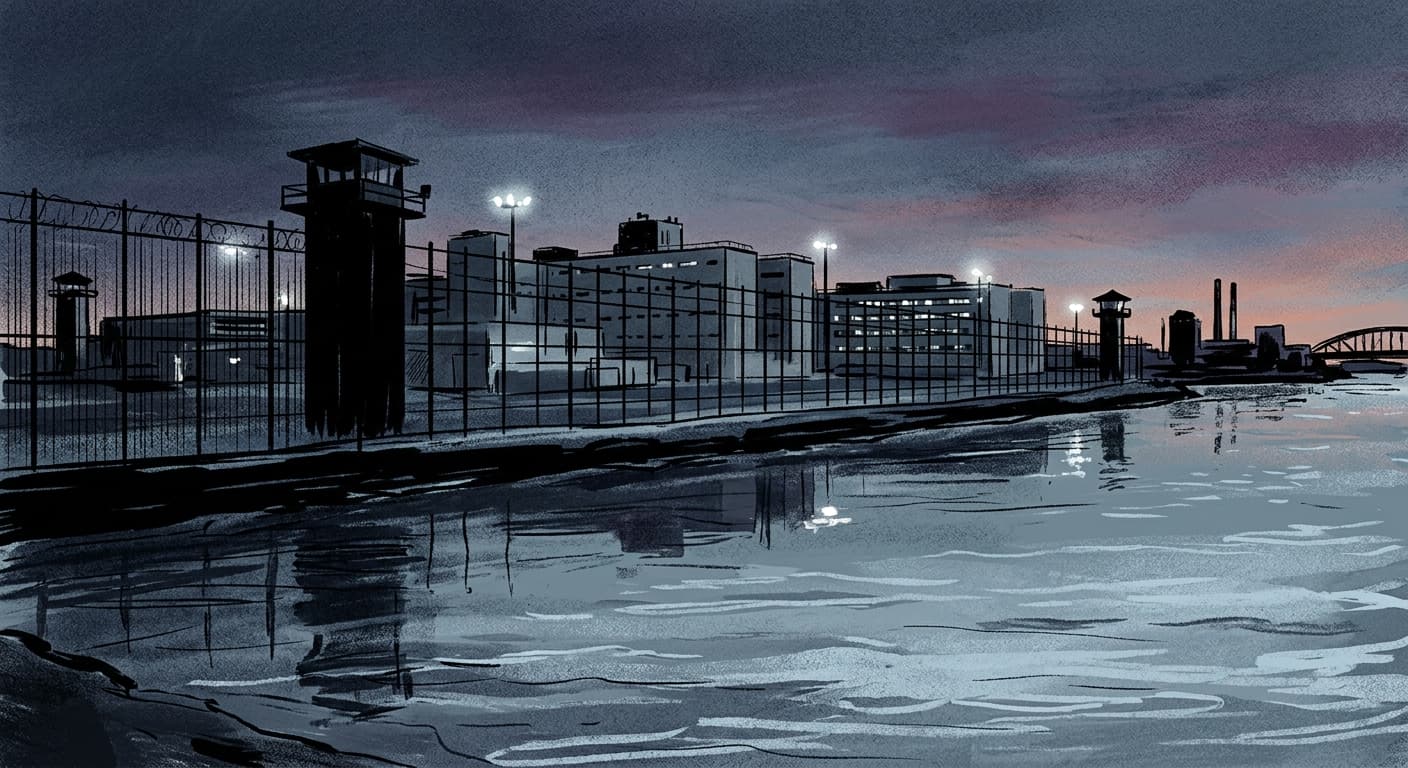
It is difficult to describe Rikers Island accurately without the description reading as advocacy rather than reportage. The jail complex sits on a 413-acre island in the East River between the Bronx and Queens, accessible by a single bridge, and houses — on any given day during the years Browder was held there — between ten and twelve thousand people, the overwhelming majority of them pretrial detainees who had not been convicted of any crime. The federal Department of Justice, in a blistering 2014 report on conditions for adolescent inmates, documented what it called a “deep-seated culture of violence” toward teenagers: guards using head strikes — blows to the face — as a routine first response to verbal defiance; officers taking inmates to isolated areas to beat them out of camera range; a disciplinary system whose maximum punishments were so frequently imposed as to be meaningless; and staff who, the report concluded, operated in a near-total absence of accountability or oversight. Adolescent inmates — sixteen- and seventeen-year-olds, charged and unconvicted — were beaten so regularly that the DOJ identified the pattern as systemic and unconstitutional.
Kalief Browder’s experience inside Rikers is documented not only by his family’s civil complaint and his later interviews but by surveillance video obtained and aired by The New Yorker and by the television documentary series Time: The Kalief Browder Story. In one video, Kalief is at the sink in a common area when an officer strikes him to the ground; a pack of inmates, apparently set upon him, then beat him while he lies defenseless. In another video, recorded months later, he is escorted, handcuffed and shackled, by a guard through a hallway; the guard suddenly slams him to the floor. This was the ordinary texture of his custody. In addition to the violence from guards and inmates, he was held for roughly eight hundred days in the jail’s Central Punitive Segregation Unit — solitary confinement — twenty-three hours a day in a cell measuring roughly twelve feet by seven, denied human contact, family visits, education, recreation, reading material, religious services. He was seventeen when the solitary began.
He attempted suicide at least six times while in custody. In one documented instance, in 2012, he hanged himself in his cell to the point of unconsciousness before officers cut him down — then, according to the family’s civil complaint, officers refused to take him to a hospital and returned him to the same cell. He was finally released to a hospital only after a second attempt. He told his mother, Venida Browder, that he believed the officers wanted him to die and that if he did not kill himself they would beat him to death. The Department of Justice’s own report corroborated the atmosphere he described: adolescent inmates in solitary, the DOJ found, were routinely subjected to violence, verbal abuse, and deliberate degradation designed to provoke and break them.
The Plea Deal as Plea Bargain Machinery
At some point in the spring of 2012 — after roughly two years in custody — the Bronx District Attorney’s office offered Kalief a deal. Plead guilty to the robbery. Accept a sentence of time served. Go home today. He refused. The offer came again. He refused again. His refusal is often described in terms of moral stubbornness, as though Kalief’s insistence on a trial were an eccentric personal choice. It was not. It was an assertion of the Sixth Amendment itself: the right of the accused to put the government to its proof before a jury of his neighbors. That he was punished for asserting this right — punished with continued confinement, continued violence, continued solitary — is not an aberration of the modern criminal process. It is its central operating principle. The Founders wrote the jury-trial guarantee as a structural check on prosecutorial power. The modern system has inverted the design: the trial is now the exception, the plea the rule, and the price of demanding the trial the Constitution guarantees is calibrated punishment designed to make the demand unbearable.
The numbers are stark. Nationally, roughly ninety-five percent of felony convictions are obtained by guilty plea. In the Bronx during Kalief’s years, felony cases regularly languished for years before trial, defendants held pretrial because they could not make bail. The Bronx’s court system was notorious — and was specifically sued in a 2011 class action, Trowbridge v. Cuomo, over unconstitutional trial delays — for failing to provide the speedy trials the Sixth Amendment and New York’s own statute required. The state statute, CPL § 30.30, nominally mandates dismissal if the prosecution is not ready for trial within six months of a felony charge. In practice, the statute’s clock is routinely gamed: prosecutors announce “ready,” the defense requests an adjournment, the clock is tolled, months pass, the prosecution announces not ready, the clock pauses again. Kalief’s thirty-one court appearances over three years did not violate the statute’s letter as interpreted by New York courts; they vaporized its spirit. The statute’s existence is documentary evidence that American law knows the right thing and has chosen not to do it.
What Solitary Confinement Is, in the Founders’ Vocabulary
Solitary confinement was invented in America. The Pennsylvania System, devised at Eastern State Penitentiary in the 1820s by Quaker reformers under a sincere belief that enforced isolation would produce penitence — hence “penitentiary” — was closely observed by the generation that had written the Constitution and by foreign visitors like Alexis de Tocqueville and Charles Dickens. Dickens toured Eastern State in 1842 and wrote, in American Notes, one of the great condemnations in the English language: “I hold this slow and daily tampering with the mysteries of the brain, to be immeasurably worse than any torture of the body.” The Pennsylvania System collapsed within a generation because its results — insanity, self-mutilation, suicide — made its barbarity undeniable even to the politicians who funded it. The United States Supreme Court, in In re Medley (1890), reviewed a case of solitary confinement and noted that the practice had been abandoned precisely because it produced inmates who became “of a semi-fatuous condition” or “violently insane,” while “others still committed suicide” — the words of a nineteenth-century court, recognizing a century before the rest of American law caught up that the practice was cruel within the meaning of the Eighth Amendment.
Kalief Browder was held for two years in a practice that the Supreme Court had recognized, in 1890, drove inmates insane and drove inmates to suicide. The practice was revived in American prisons in the 1980s and 1990s as a tool of prison management — less a punishment than a warehousing technique for the difficult, the mentally ill, and the inconvenient — and applied to pretrial detainees with a frequency no other Western democracy tolerates. The United Nations’ Special Rapporteur on Torture has concluded that prolonged solitary confinement beyond fifteen days constitutes torture or cruel, inhuman, or degrading treatment. Kalief was held in isolation for roughly eight hundred days — more than fifty times the threshold the international body defines as torture — as an unconvicted, presumptively innocent teenage defendant in a property case with no evidence.
The Founders knew what to call the deliberate infliction of mental destruction by the state upon an unconvicted person. The Eighth Amendment’s ban on cruel and unusual punishments derived directly from the English Bill of Rights of 1689, which itself responded to the Bloody Assizes and the crown’s use of imprisonment, mutilation, and psychological terror against political enemies. The Framers’ generation had watched Parliament and the Crown deploy the law’s forms — arrest, pretrial detention, endless continuances, procedural delays — as instruments of punishment in themselves. Patrick Henry, opposing ratification of the Constitution without a Bill of Rights, thundered against the prospect of federal officers who could “ruin you with impunity.” The entire project of the Bill of Rights was an effort to prevent the legalization of cruelty: to keep the American state from ever performing formally lawful punishments upon persons whom the law had not yet convicted. Rikers Island in 2010–2013 was a standing monument to the Framers’ foresight. Everything they feared, institutionalized.
The Speedy Trial Clause as Artifact
The Sixth Amendment reads, in its first clause, “In all criminal prosecutions, the accused shall enjoy the right to a speedy and public trial.” The word “speedy” is not decorative. It was inserted because the Framers had watched the English Crown use indefinite pretrial imprisonment as a substitute for conviction: hold a man long enough, and the holding becomes the punishment; the eventual trial is either never held or reduced to formality. The Supreme Court’s modern test for speedy-trial violations, articulated in Barker v. Wingo (1972), invites courts to balance four factors — length of delay, reason for delay, the defendant’s assertion of the right, and prejudice to the defendant — in a manner so deferential to prosecution delay that, as a practical matter, the clause has been read out of existence. In Kalief’s case, a three-year detention on a minor, unproven theft charge, in a jurisdiction that had been sued specifically for unconstitutional trial delay, produced no judicial remedy at all. The case was dismissed only because the prosecution lost its witness, not because any court held that three years without trial on a $3,000-bail property charge was a constitutional offense.
Consider what happened to the Sixth Amendment in Kalief Browder’s case, clause by clause. The “speedy” clause: three years. The “public trial” clause: no trial ever occurred. The “impartial jury” clause: no jury was ever seated. The “confronted with witnesses” clause: Kalief never confronted Bautista. The “compulsory process” clause and the “assistance of counsel” clause: he had counsel, and counsel’s efforts were consumed by thirty-one adjourned proceedings that produced no forward movement. Every individual clause of the Sixth Amendment was left notionally intact and operationally meaningless. The amendment stood as text, and failed as law. It is tempting to call this a New York problem, or a Bronx problem, or a Rikers problem. It is an American problem. The Sixth Amendment has been so thoroughly proceduralized — its guarantees translated into statutes, and the statutes riddled with loopholes, and the loopholes ratified by deferential courts — that an unconvicted teenager can spend three years in a violent jail waiting for a trial that never happens, and no court at any level will call it what the text calls it.
The Money Bail Machine
The Eighth Amendment’s first clause is the one Americans quote least: “Excessive bail shall not be required.” The Framers understood bail, plainly and functionally, as a mechanism to secure a defendant’s return to court — not as a mechanism to detain him. The alternative the Framers feared was preventive detention: the state holding, without conviction, anyone it accuses. That preventive detention regime — exactly what the Eighth Amendment was written to foreclose — is the de facto law of pretrial justice in most American jurisdictions, achieved not by statute but by the routine judicial practice of setting bail at amounts calibrated to institutional schedules rather than to the defendant’s financial means. The Supreme Court, in Stack v. Boyle (1951), said the obvious: “Bail set at a figure higher than an amount reasonably calculated to fulfill [the] purpose” of securing appearance “is ‘excessive’ under the Eighth Amendment.” Seventy years later, that holding is honored mostly in the breach. Thousands of unconvicted people are held in American jails every night not because they pose any established flight risk or danger but because they cannot pay.
Kalief Browder’s bail was initially set at $10,000 — the amount the judge reportedly imposed after the district attorney argued Browder was a flight risk because of a prior juvenile case. A bondsman would require roughly ten percent, or $3,000 by some accounts of the eventual bond figure. His mother, a working-class woman raising seven children, could not assemble the money. Later in the case, when the prosecution’s witness issues became apparent, a judge offered to release Kalief on his own recognizance — the system’s tacit concession that bail had been unnecessary all along. Kalief, by then, had been detained too long and damaged too deeply. The money-bail system had performed its function: it had converted a charge with no evidence into a de facto sentence of three years. It had done so constitutionally, in the view of every court that reviewed the case, because the Constitution’s text has been overridden by its practice.
The Aftermath: What Changed in His Name
Kalief Browder’s suicide on June 6, 2015, and Jennifer Gonnerman’s reporting for The New Yorker, made his case the emblem of a national scandal that had been hiding in plain sight. Mayor Bill de Blasio announced a plan to close Rikers Island within ten years. New York State enacted “Kalief’s Law” in 2017, amending New York’s speedy-trial statute to require courts to actually track and enforce trial readiness — a legislative admission that the existing statute’s promise had been empty. The state legislature, in a landmark 2019 reform, eliminated cash bail for most misdemeanors and nonviolent felonies — a statute passed explicitly in Kalief’s name and subsequently weakened by amendment after opposition from prosecutors and police unions. Governor Andrew Cuomo signed Executive Order 150 in 2015, requiring independent review of police killings. New York City banned solitary confinement for inmates under eighteen in 2015 and under twenty-one in 2016, and in 2021 the City Council passed legislation to end solitary confinement in city jails entirely — an action Mayor Eric Adams subsequently fought in court to block. The Supreme Court has never held that prolonged solitary confinement violates the Eighth Amendment.
Kalief’s mother, Venida Browder, who fought for her son through three years of detention and two years of broken homecoming, died on October 14, 2016, of what her family described as a broken heart, sixteen months after her son. The family’s civil suit against New York City settled in 2019 for $3.3 million — the standard mechanism by which American municipalities acknowledge wrongdoing without admitting it, paying from tax revenue so that no official need ever face personal consequence. The officers who beat Kalief on camera were not criminally charged. The prosecutors who demanded continuances for three years were not disciplined. The judges who set unreachable bail and granted delay after delay remained on the bench. The system that killed Kalief Browder paid a settlement, produced a law, and continued.
The Founder’s Question
The Founders wrote the Bill of Rights against the memory of exactly this kind of state: a state that could take a young man, hold him without trial, break him without conviction, and call the holding lawful because a magistrate had signed a paper. The Sixth Amendment’s speediness clause, the Eighth Amendment’s bail and cruelty clauses, the Fifth’s due-process clause, the Fourteenth’s extension of that due process to state action — taken together, they constitute the Framers’ complete architecture against the pretrial state. That architecture failed Kalief Browder at every element. It failed not because the words are ambiguous. It failed because a legal profession trained to treat law as paper has accepted, as the operating norm of American criminal justice, a set of practices that the Founders’ generation invented the Bill of Rights specifically to forbid.
Patrick Henry, again: “The Constitution is not an instrument for the government to restrain the people, it is an instrument for the people to restrain the government — lest it come to dominate our lives and interests.” In the Bronx, between 2010 and 2013, the government dominated and destroyed a seventeen-year-old’s life over a stolen backpack that never existed, on the word of a witness who vanished, for three years, without trial, in solitary confinement, under bail his mother could not pay. Every safeguard the Constitution promises was promised to Kalief Browder. None was delivered. When he came home, broken, he enrolled at Bronx Community College and earned a 3.5 GPA. He studied. He planned. Then he hanged himself from an air-conditioner cord, because what was done to him at Rikers Island could not be undone, and the country that had done it had decided, in effect, that no one had done it at all.
The right to a speedy and public trial by an impartial jury is not a technicality. It is the line between a republic and a carceral state. Kalief Browder was held, in America, on the wrong side of that line, for three years, as a boy. His name now adorns a state law. His suicide is taught in law schools. The structure that consumed him has outlasted the law named after him. If the Bill of Rights cannot protect a sixteen-year-old accused of stealing a backpack, it cannot protect anyone, and the entire edifice of American constitutional liberty is a performance staged for those who can afford their rights. The Founders would recognize the performance. They fought a revolution to end it.
Even $1 helps. No amount is too small. Thank you for standing with us.