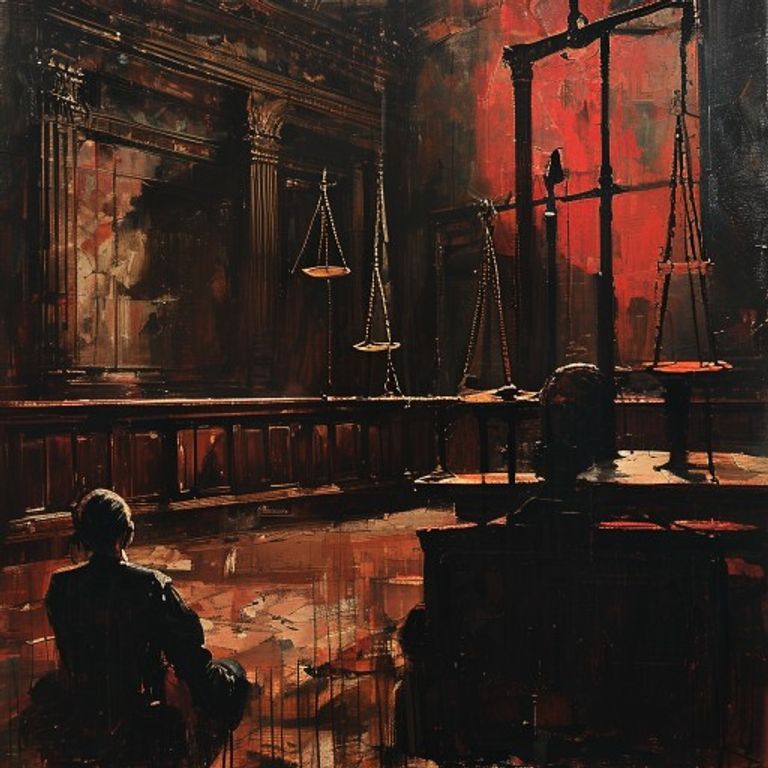
In the winter of 2003, a ten-year-old girl named Hillary Transue appeared before Luzerne County Judge Mark Ciavarella. Her offense: she had built a fake MySpace page mocking her school's assistant principal. She had no prior record. She appeared without an attorney. The hearing lasted less than two minutes. Judge Ciavarella sentenced her to three months in a private juvenile detention facility.
Her parents had been told not to bother hiring a lawyer. The judge, they were assured, was known for being lenient with first-time offenders.
They had no way of knowing that Judge Ciavarella had already accepted $2.8 million in illegal payments from the man who built that facility — and that their daughter was, in the coldest possible sense, a product being delivered to a paying customer.
What happened in Luzerne County between 2003 and 2008 is known today as the Kids for Cash scandal — the largest judicial corruption scheme in American history. More than 2,300 children were sentenced to private juvenile detention facilities by judges who were secretly on the payroll of those facilities' owner. The Pennsylvania Supreme Court ultimately vacated more than 4,000 juvenile convictions. Two judges went to federal prison. A civil jury ordered them to pay $200 million in damages to their victims.
And in December 2024, President Joe Biden commuted one of those judges' sentences.
This is not a story about two corrupt judges. This is a story about what happens when a judicial system operates without accountability, without transparency, and without the structural safeguards the Founders demanded — and what happens when that system, even after exposure, continues to protect its own.
- Judges: Mark Ciavarella Jr. and Michael Conahan, Luzerne County, Pennsylvania
- Scheme duration: 2003–2008
- Bribe total: $2.8 million from Robert Mericle, builder/co-owner of PA Child Care and Western PA Child Care facilities
- Children affected: More than 2,300 juveniles sentenced; 4,000+ convictions overturned
- Ages: Children as young as 8 years old
- Representation: Over 50% of children appeared without legal counsel
- Ciavarella sentence: 28 years federal prison (2011); currently incarcerated
- Conahan sentence: 17.5 years (2010); released 2020 (COVID); sentence commuted by Biden, December 2024
- Civil judgment: $200 million ordered against both judges (2022)
- Source: United States v. Ciavarella, No. 3:09-CR-0272 (M.D. Pa.); Juvenile Law Center records
The Machinery of the Scheme
To understand the full depth of what Ciavarella and Conahan did, you must understand what they systematically dismantled before they could profit from it.
In 2002, the judges took their first decisive step: they engineered the closure of the county-run juvenile detention facility. Conahan, who controlled the court's budget as president judge, simply cut off funding to the county facility and refused to send juveniles there. With no public option available, the stage was set.
Robert Mericle, a local contractor with political connections, then opened PA Child Care — a private, for-profit juvenile detention center. He paid Ciavarella and Conahan $2.1 million in what federal prosecutors would later describe as a finders' fee. The arrangement was simple: the judges would send children to Mericle's facility; Mericle would pay the judges. An additional $700,000 flowed through a related transaction involving a condominium in Florida.
What followed was a five-year assembly line of injustice. Ciavarella handled nearly every juvenile case in Luzerne County himself. Children appeared before him, often without attorneys — the judge was known to discourage legal representation, telling families it wasn't necessary. Hearings lasted minutes. Children were immediately shackled and handcuffed in open court, in front of their parents, and taken away.
The offenses that triggered these detentions were, in many cases, trivial. A teenager who shoplifted a $4 jar of nutmeg. A boy who threw a sandal at his mother during an argument. A girl who created a mock MySpace page. Children with no prior records, children who had never been in trouble before, found themselves imprisoned in facilities where abuse was later documented — all because two men in black robes had decided their liberty was worth a monthly payment.
The scheme was not secret because it was clever. It was secret because no one was looking. The judicial system had no meaningful external oversight. The county had no mechanism for tracking sentencing patterns. Defense attorneys who noticed that Ciavarella seemed unusually eager to incarcerate their clients had no forum to raise concerns. Parents who felt that something was wrong had no recourse. The self-policing nature of the judicial system — its insulation from accountability — was not a bug that allowed the scheme to operate. It was the operating system.
What the Founders Warned About
The men who designed the American republic in 1787 understood, with the hard-won wisdom of history, that power without accountability corrupts. They had studied the fall of republics. They had watched courts in England become instruments of royal tyranny. They had lived under a system where judges served at the pleasure of the Crown — where the independence of the judiciary meant independence from the people, not independence on behalf of the people.
Alexander Hamilton, writing in Federalist No. 78, made the foundational argument for lifetime judicial tenure. Judges needed independence, he argued, not to be free from accountability, but to be free from political pressure so they could do justice without fear. The court must possess, he wrote, "neither FORCE nor WILL, but merely judgment." The judiciary's power would come from the quality of its reasoning and the integrity of its character — nothing else.
"The complete independence of the courts of justice is peculiarly essential in a limited Constitution...the judiciary...must ultimately depend upon the aid of the executive arm even for the efficacy of its judgments. This simple view of the matter suggests several important consequences. It proves incontestably that the judiciary is beyond comparison the weakest of the three departments of power; that it can never attack with success either of the other two." — Alexander Hamilton, Federalist No. 78 (1788)
Hamilton's argument for judicial independence was grounded in a premise: that those who held judicial power would be men of "integrity and moderation" who exercised "merely judgment." He did not envision — or perhaps could not bring himself to envision publicly — what would happen when the judiciary was not staffed by such men. He did not design a system that could handle a Ciavarella, because he assumed the republic would not produce one.
Thomas Jefferson was less sanguine. Jefferson, who distrusted the legal profession with an intensity bordering on obsession, understood that institutional independence without institutional accountability was a recipe for tyranny by a different name. In a letter to William Jarvis in 1820, Jefferson put it plainly:
"You seem...to consider the judges as the ultimate arbiters of all constitutional questions; a very dangerous doctrine indeed, and one which would place us under the despotism of an oligarchy. Our judges are as honest as other men, and not more so. They have, with others, the same passions for party, for power, and the privilege of their corps." — Thomas Jefferson, Letter to William Jarvis, September 28, 1820
"The same passions for party, for power, and the privilege of their corps." Jefferson wrote those words two centuries before Mark Ciavarella sentenced Hillary Transue for a MySpace page. He might as well have been describing Luzerne County in 2005.
Madison, in Federalist No. 51, offered the structural solution: ambition must be made to counteract ambition. No institution could be trusted to police itself. External checks were not optional features of republican government — they were its essential mechanics. Yet the judicial system that emerged over the following two centuries built precisely the self-regulating structure Madison warned against: bar associations staffed by lawyers disciplining lawyers, judicial conduct commissions staffed by judges reviewing judges, appellate courts staffed by judges reviewing the decisions of judges.
The result was a system that could, on occasion, catch the most egregious corruption — when it was finally too visible to ignore. What it could not do was catch it early, prevent it, or hold accountable those who had allowed it to fester for years.
The Human Cost: A Reckoning in Numbers and Names
The statistics of the Kids for Cash scandal are staggering in the aggregate. They become unbearable when you attach names.
Sandy Fonzo's son, Edward Kenzakoski, was seventeen years old when he appeared before Ciavarella on a minor drug charge. He was sent to detention. He never recovered. After years of struggling with the trauma of his incarceration, Edward Kenzakoski died of a drug overdose at the age of 23. At a public rally after Ciavarella's sentencing, his mother confronted the judge on camera. "You ruined my son's life," she told him, her voice breaking. "You destroyed my son's life."
When President Biden commuted Michael Conahan's sentence in December 2024 — lumping the judge in among roughly 1,500 routine commutations — Sandy Fonzo was still alive to hear about it. "What about all of us?" she asked reporters. The question was not rhetorical.
The Juvenile Law Center, which brought the original legal challenge that ultimately unraveled the scheme, documented pattern after pattern of procedural violation. Over 50% of the children who appeared before Ciavarella lacked any legal representation. The judge routinely pressured families not to retain attorneys. Children were adjudicated delinquent, handcuffed, and removed from courtrooms before their parents could process what had happened. Sixty percent of the children removed from their homes were sent to the for-profit facilities at the center of the scheme.
For the builder, Robert Mericle, the financial arrangement was straightforward — juvenile justice, monetized. For every child Ciavarella sent to his facilities, Mericle received a per-diem payment from the county and state. The judges were, in effect, a guaranteed revenue stream. The children were inventory.
Mericle ultimately cooperated with prosecutors, pleaded guilty to failing to report the payments to a grand jury, and served one year in federal prison. He was ordered to pay $2.15 million to fund children's health programs — a sum that represented a modest premium on the $2.8 million he had paid to corrupt the system in the first place. The man who paid for children's liberty served twelve months. The children he purchased served months and years.
The System That Protected the System
Ciavarella and Conahan were ultimately caught — but not by the judicial oversight system. They were caught because a juvenile defendant filed a federal habeas petition that made its way to a federal judge outside Luzerne County. The Juvenile Law Center then filed a complaint with the Pennsylvania Supreme Court, triggering a broader investigation. The Pennsylvania Supreme Court, to its credit, acted swiftly once it was seized of the matter — vacating thousands of convictions and referring the case for criminal prosecution.
But the scheme had operated for five years before anyone outside the county's judicial system forced the issue. During those five years:
- The Luzerne County Bar Association received no formal complaints that triggered investigation
- The Pennsylvania Judicial Conduct Board received complaints about Ciavarella but took no public action
- Defense attorneys who expressed concerns to colleagues were dismissed
- Parents who sought to appeal their children's sentences encountered a system that presumed its own legitimacy
This is not a story of a broken watchdog that simply failed to bark. It is a story of a watchdog that was never designed to bark at other dogs.
The judicial conduct system in Pennsylvania, like its counterparts across the nation, operates with a structural presumption in favor of judges. Complaints are filed with a board; the board investigates in secret; the vast majority of complaints are dismissed before reaching public proceedings. In Pennsylvania's case, the Judicial Conduct Board received a complaint about Ciavarella's unusually high detention rates before the scheme was publicly exposed. The board dismissed the complaint. It never became public. The scheme continued.
After the scandal broke, Pennsylvania undertook significant reforms — including changes to juvenile court procedures, mandatory representation requirements, and revised conduct board procedures. These were meaningful improvements. But they were reforms imposed by external pressure after catastrophic failure, not products of a self-correcting system. The structure that allowed the scheme remains intact in most of the country. The Luzerne County scandal was exposed; the next Luzerne County has not been.
The Biden Commutation: One Final Insult
On December 12, 2024, in the final weeks of his presidency, Joe Biden issued approximately 1,500 sentence commutations and 39 pardons. Among the commutations was Michael Conahan, who had been released from federal custody in 2020 due to COVID-19 concerns and placed on house arrest through 2026. Biden's commutation wiped out the remainder of that supervision.
The White House offered no specific justification for including Conahan among the commutations. His name appeared in a list with no individualized explanation — a bureaucratic efficiency applied to a case that cried out for deliberation.
The victims' community was not consulted. They found out when reporters called.
Sandy Fonzo, whose son died, spoke to media outlets from Pennsylvania to the United Kingdom. The Guardian quoted her directly: "What about all of us?" The question encapsulates something the legal system has never adequately answered: when judges use their power to destroy children's lives for money, what does justice actually look like?
Ciavarella, for his part, remains in federal prison serving his 28-year sentence. He has consistently maintained, in public statements and court filings, that the payments he received were legitimate consulting fees — a position that 12 of the 39 counts against him thoroughly refuted at trial.
The $200 million civil judgment entered against both judges in 2022 has, as a practical matter, never been paid. Judgments are only meaningful when they can be collected from defendants with assets. Two former judges who accepted bribes and then spent years in litigation and incarceration do not, as a rule, have $200 million.
The children they sentenced have nothing but their scars.
A System Built to Protect Itself
The Kids for Cash scandal is extreme in its specifics but not anomalous in its structure. Across the country, judicial and attorney misconduct is systematically under-detected, under-prosecuted, and under-disciplined — not because of isolated failures but because of institutional design.
The Reuters investigative series on judicial misconduct, published in 2020, identified thousands of judges who had broken laws or violated their oaths and remained on the bench. Judges with DUI convictions. Judges who had committed domestic violence. Judges who had engaged in serial harassment of court staff. In case after case, the judicial conduct system had imposed private admonishments — secret rebukes that appeared nowhere in the public record — while the judges continued to adjudicate the lives of ordinary Americans.
The American Bar Association's own data on attorney discipline tells a similar story. Fewer than 3% of complaints against attorneys result in any public discipline. Disbarment — the ultimate sanction — is so rarely imposed that it functions more as a theoretical backstop than a practical deterrent. Attorneys who defraud clients, who steal from estates, who lie to courts face a disciplinary system run by the same professional guild they are members of.
Thomas Jefferson understood this problem viscerally. He wrote to John Adams in 1816 that law had become "the most lucrative, the most licentious and the least successful profession" — and that the legal profession's control over the courts had made it effectively ungovernable by anyone outside it. "The lawyers themselves," he wrote, "form an organized body to resist every encroachment on their privileges."
He was describing the 18th century bar. He might as well be describing the present one.
The Reconstruction We Need
The Founders gave us both the diagnosis and the cure. The cure requires will, not invention.
1. Independent civilian oversight of the judiciary. Judicial conduct commissions must be restructured to include substantial civilian representation — not token appointments, but genuine civilian majorities with real investigative authority. The premise that only judges can evaluate judicial conduct is precisely the self-dealing logic that allowed Luzerne County to operate for five years undetected.
2. Mandatory public disclosure of all judicial conduct proceedings. The current system of private admonishments — secret rebukes that never reach the public record — is incompatible with republican government. Article II, Section 4 of the Constitution provides for impeachment for "high crimes and misdemeanors." The Founders did not envision a system where judicial misconduct was quietly managed in confidential proceedings. Sunshine is the original disinfectant.
3. Federal minimum standards for juvenile representation. The Kids for Cash scheme operated in part because children appeared before a corrupt judge without counsel. The Sixth Amendment's guarantee of counsel has never been fully extended to juvenile proceedings. It must be. Congress has the authority. The will has been absent.
4. Prohibition on judicial financial relationships with entities appearing before their courts. Federal ethics rules require recusal when judges have financial interests in cases — but enforcement is judge-driven, complaint-based, and systematically under-enforced. The solution is structural: automatic disclosure requirements, third-party auditing of judicial financial relationships, and criminal penalties for undisclosed conflicts. Not rules. Structure.
5. Revisit clemency processes for serious judicial corruption cases. The Biden administration's inclusion of Michael Conahan in a mass clemency action — without individualized review, without victim consultation, without public explanation — illustrates that even after the system catches judicial predators, political processes can quietly undo the accountability that victims spent years fighting for. Any meaningful reform must address not just the front end of the system but its back end: when judicial predators are finally sentenced, those sentences must mean something.
6. Congressional use of jurisdiction and impeachment powers. Article III judges serve "during good behavior" — a standard that was always intended as a condition, not a guarantee. Congress's power to define and limit federal court jurisdiction, combined with the impeachment power, gives the legislative branch meaningful tools to hold an unaccountable judiciary accountable. These tools have atrophied from disuse. The Founders built them. We must use them.
What happened to more than 2,300 children in Luzerne County was not an aberration. It was the logical endpoint of a system that had spent two centuries perfecting its own unaccountability. The Founders warned us. Jefferson warned us. Madison warned us. Hamilton warned us — even Hamilton, who loved the judiciary best.
The children of Luzerne County paid the price for our failure to listen.
It is past time to rebuild what we should have built correctly the first time.
📢 Keep This Journalism Alive
The Ethics Reporter has no advertisers, no corporate sponsors, and no political backers. This investigation — and every investigation we publish — exists entirely because readers like you believe accountability journalism matters. If this reporting moved you, please consider supporting us.
Donate to The Ethics ReporterEven $1 helps. No amount is too small. Thank you for standing with us.