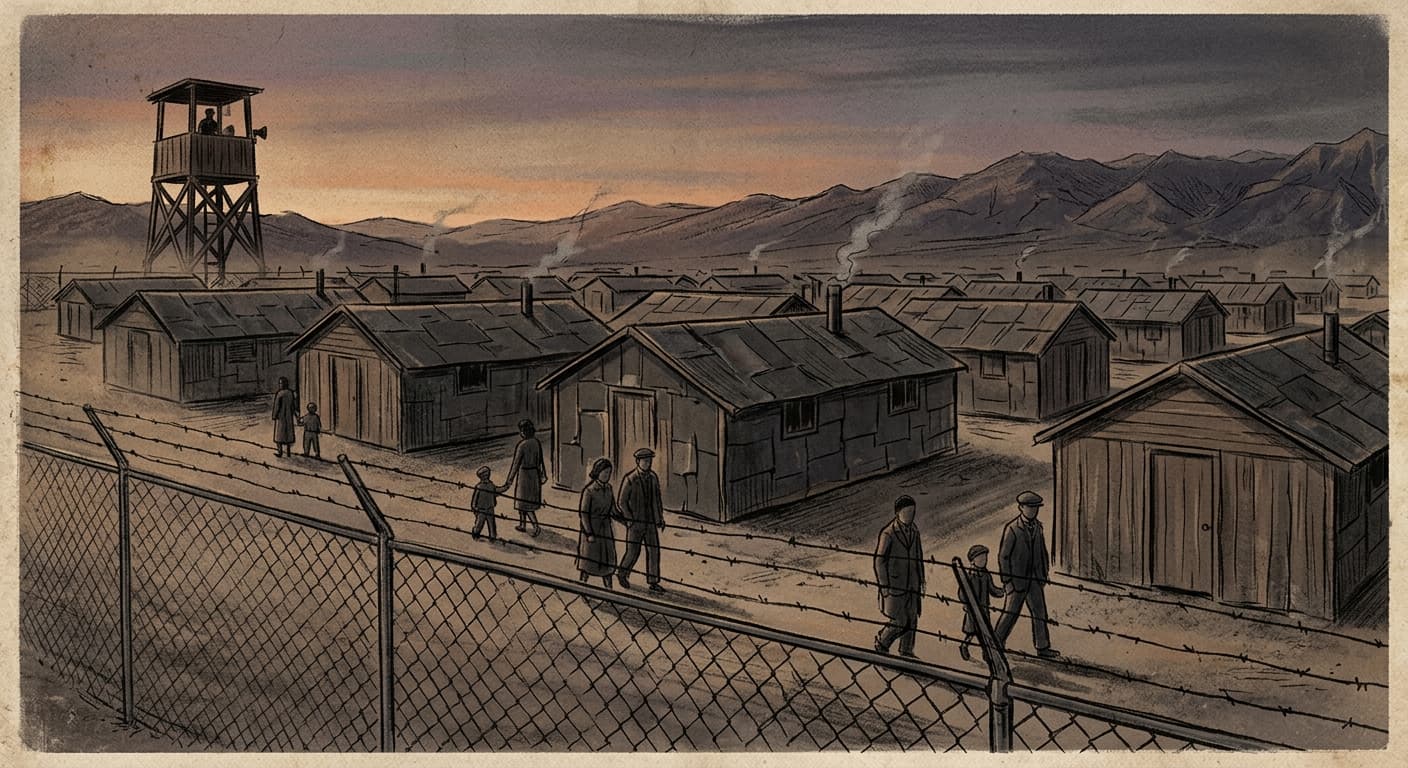
Fred Korematsu was twenty-three years old when he refused to report to a relocation center in the spring of 1942. He was a welder, born in Oakland, California, an American citizen. He had tried to enlist in the Navy and had been rejected for medical reasons — a perforated eardrum — or so he was told; the Navy's rejection letter did not mention that it was not accepting Japanese Americans. He had tried to enlist in the Coast Guard and had been rejected again. He had tried to volunteer for the Army. His government's response to his patriotism was to order him to pack what he could carry, report to a racetrack converted into a temporary detention camp, and submit to indefinite imprisonment in a barracks built by the Army Corps of Engineers in the Utah desert. Korematsu refused. He changed his name, had plastic surgery on his eyes, tried to disappear into the anonymity of the Bay Area. He was arrested on a street corner in San Leandro in May 1942, identified despite his alterations, and prosecuted for violating Civilian Exclusion Order No. 34, issued under the authority of Executive Order 9066. He was convicted in federal court. He appealed. His case reached the Supreme Court of the United States in 1944, and on December 18 of that year, by a vote of six to three, the Court upheld his conviction. Justice Hugo Black's majority opinion declared that “the military urgency of the situation demanded that all citizens of Japanese ancestry be segregated from the West Coast temporarily.” It was, by the standards of constitutional law, a catastrophe. It was also, as we now know incontrovertibly, built on a lie that the government told to the Court — a lie the government knew was a lie at the time it told it.
The Korematsu decision is not simply a bad ruling from a frightened era. It is a case study in how the constitutional balance can collapse when the executive branch manufactures a threat, the legislature acquiesces, the judiciary defers, and the courts are fed false evidence by their own government. The Founders designed a system in which ambition would counteract ambition, in which power would check power, in which the people's rights would be protected not by parchment but by the structure of separated institutions guarding their own prerogatives. In 1942-1944, every one of those institutions failed to guard theirs. The Army lied. The Justice Department suppressed the truth. The Supreme Court, in deference to “military necessity,” accepted the lie and wrote it into constitutional doctrine. It took thirty-nine years for the lie to be exposed, forty years for the conviction to be vacated, and seventy-four years for the Supreme Court to formally disavow the precedent. The damage — 120,000 people interned, two-thirds of them American citizens, their homes and businesses lost, their families shattered — could never be undone. The constitutional lessons, however, are more urgent now than they have ever been, because the formula tested in Korematsu — emergency plus executive authority plus judicial deference equals the suspension of rights — is a formula that remains available to any future administration, and the Court's 2018 repudiation in Trump v. Hawaii was, in substance, less a repudiation than a polite retraction.
Executive Order 9066
The bombing of Pearl Harbor on December 7, 1941, was the trigger, but the machinery was ready before the trigger was pulled. On the West Coast, anti-Japanese sentiment was not a wartime invention; it was a half-century-old political tradition, rooted in California's Alien Land Laws, the exclusion acts, the “yellow peril” rhetoric of the Hearst press, and the systematic discrimination that had already stripped Japanese immigrants of the right to naturalize, to own land, to marry whites. When General John DeWitt, commanding the Western Defense Command, began agitating for mass removal in early 1942, he was not responding to a new military fact. He was responding to political pressure from California Governor Culbert Olson, from the attorney general Earl Warren (whose later liberalism would make his wartime role a subject of lifelong regret), from the Western Growers Protective Association and other agricultural interests that stood to profit from the confiscation of Japanese American farmland, and from native American Legion chapters and chambers of commerce.
The intelligence assessments told a different story. The Office of Naval Intelligence had conducted a secret investigation of the Japanese American community in the fall of 1941, directed by Lieutenant Commander Kenneth D. Ringle. The Ringle Report, submitted in January 1942 and shared with Army intelligence, concluded unequivocally that the “Japanese problem” had been “magnified out of all proportion to the actualities” and that a small number of dangerous individuals — perhaps three hundred — were known and surveilled. The FBI, under J. Edgar Hoover, had already arrested the individuals it considered threats in the days after Pearl Harbor. Hoover himself opposed mass evacuation, calling it “primarily political” and writing to the Attorney General that “the necessity for mass evacuation is based primarily upon public and political pressure rather than on factual data.” The Army's own intelligence chief, Brigadier General Sherman Miles, told DeWitt that there was no military justification for mass removal.
None of this mattered. On February 19, 1942, President Franklin D. Roosevelt signed Executive Order 9066, authorizing the Secretary of War and military commanders to prescribe “military areas” from which any or all persons could be excluded, and providing for the “right of any person to enter, remain in, or leave” such areas to be under military control. The order was deliberately vague; it did not mention Japanese Americans by name, and its language was drawn from a draft that had been prepared in advance by the Justice Department. The constitutional authority claimed was the President’s power as Commander in Chief, plus the implied war powers of Congress. Within weeks, General DeWitt had designated the entire West Coast as a military area and issued civilian exclusion orders requiring all persons of Japanese ancestry — citizen and alien alike — to report to “assembly centers.” From there they were shipped to ten permanent “relocation centers” — the government's own euphemism — in deserts and swamps from California to Arkansas: Manzanar, Tule Lake, Poston, Gila River, Heart Mountain, Granada, Topaz, Minidoka, Jerome, Rohwer. They were surrounded by barbed wire, guarded by soldiers in watchtowers with machine guns pointed inward. The government called them “evacuees.” They were prisoners.
The Human Machinery
What “evacuation” meant in practice deserves precision, because the euphemisms did real constitutional work. Families received as little as forty-eight hours' notice on posted exclusion orders. They could bring only what they could carry. Businesses were sold for fractions of their value; farmland was abandoned at planting time; household goods were stored in warehouses that were often looted or whose fees the owners, impoverished by imprisonment, could not pay. The Federal Reserve Bank of San Francisco, which administered the Farm Security Administration's property custody program, estimated the internees' direct property losses in the hundreds of millions of 1942 dollars — a figure later assessed by the Commission on Wartime Relocation and Internment of Civilians, in its 1983 report Personal Justice Denied, as part of a total economic loss that reached into the billions. Assembly centers were hastily converted racetracks and fairgrounds — Santa Anita, Tanforan, Puyallup — where families slept in horse stalls still smelling of manure. The permanent camps were worse: tarpaper barracks in the Utah desert at Topaz, where winter temperatures dropped below zero; the alkaline flats of Tule Lake, ringed by a “segregation center” for internees who refused to sign loyalty oaths; Heart Mountain, Wyoming, where the ground froze and the wind did not stop. Behind the wire, the internees built schools, newspapers, gardens, and self-government — and the government drafted young men out of the camps into the 442nd Regimental Combat Team, which became the most decorated unit of its size in American military history while many of its soldiers' families remained imprisoned.
The Constitutional Architecture of the Fraud
The legal framework erected to justify this was, on paper, plausible enough to fool a deferential court. The government's theory, as presented to the Supreme Court in Hirabayashi v. United States (1943) and then in Korematsu, rested on a chain of delegated authority: Congress had ratified Executive Order 9066 by statute in March 1942, making violation of exclusion orders a federal misdemeanor; the President had acted under his war powers; the military had made a judgment of necessity. The Court in Hirabayashi, upholding a curfew order against Gordon Hirabayashi, a University of Washington student, had already accepted the premise that “the war power of the national government is ‘the power to wage war successfully’” — a phrase from Hughes v. Superior Court that Chief Justice Stone quoted — and that the military’s judgment of what was necessary was entitled to great weight. In Korematsu, Justice Black took the same framework and applied it to exclusion and detention, adding only the famous sentence that “compulsory exclusion, though constitutionally suspect, is justified during circumstances of ‘emergency and peril.’”
The dissenters saw what was happening. Justice Frank Murphy, a former Attorney General who had sat on the Court for only four years, wrote a dissent that is one of the great documents in American constitutional history. He called the decision “the legalization of racism” and wrote: “I dissent, therefore, from this legalization of racism. Racial discrimination in any form and in any degree has no justifiable part whatever in our democratic way of life. It is unattractive in any setting, but it is utterly revolting among a free people who have embraced the principles set forth in the Constitution of the United States. All residents of this nation are kin in some way by blood or culture to a foreign land. Yet they are primarily and necessarily a part of the new and distinct civilization of the United States. They must accordingly be treated at all times as the heirs of the American experiment, and as entitled to all the rights and freedoms guaranteed by the Constitution.”
Justice Robert Jackson, who would soon serve as chief prosecutor at Nuremberg, wrote the other great dissent, and it is Jackson's dissent that has proven most prophetic. He warned that the Court was doing something far worse than upholding an individual order: it was writing a principle into constitutional law. “Once a judicial opinion rationalizes such an order to show that it conforms to the Constitution,” he wrote, “or rather rationalizes the Constitution to show that the Constitution sanctions such an order, the Court for all time has validated the principle of racial discrimination in criminal procedure and of transplanting American citizens. The principle then lies about like a loaded weapon ready for the hand of any authority that can bring forward a plausible claim of an urgent need. Every repetition imbeds that principle more deeply in our law and thinking and expands it to new purposes.”
What neither Murphy nor Jackson knew — what the Court majority did not know, or chose not to know — was that the military's claims of necessity were fabricated. The Justice Department had in its files the FBI reports, the ONI Ringle Report, and the Army's own intelligence assessments, all of which contradicted DeWitt's public claims of espionage, sabotage, and imminent invasion. The Department's own attorneys, led by Edward Ennis, the Assistant Solicitor General who supervised the case, knew that the evidence did not support DeWitt's allegations. Ennis discovered, in the course of preparing the Korematsu brief, that the War Department had included in its record a false claim that Japanese Americans had been arrested for espionage and sabotage — a claim the FBI could find no evidence for. Ennis wrote a memo to the Solicitor General, Charles Fahy, warning that the Court was being asked to rely on “statements of fact that are not true” and that the Department had an obligation to correct the record. The memo was suppressed. The footnote that Ennis drafted, acknowledging the discrepancies, was watered down to near-invisibility by Fahy's office. The Court was never told.
Endo: The Decision Nobody Remembered
On the same day the Court decided Korematsu — December 18, 1944 — it also decided Ex parte Endo, and the juxtaposition exposes the doctrinal incoherence at the heart of the internment cases. Mitsuye Endo was a twenty-two-year-old Nisei clerical worker for the State of California whose loyalty the government itself conceded: she had answered the loyalty questionnaire affirmatively, her brother was serving in the United States Army, and the War Relocation Authority admitted she posed no threat. She had been detained nonetheless, first at Tule Lake and then at Topaz, and she petitioned for habeas corpus. Justice William O. Douglas, writing for a unanimous Court, held that the government had no statutory authority to detain a concededly loyal citizen. The Court dodged the constitutional question — Douglas rested on statutory interpretation — but the holding's implication was unmistakable: if the government could not detain a loyal citizen, the entire premise of indefinite mass detention collapsed. The Roosevelt administration had read the writing on the wall; the day before the decisions were announced, the War Department declared the exclusion orders rescinded, and the camps began emptying. The sequence tells everything about the Court's institutional posture: Korematsu's ratification came only when the policy was already being dismantled. The Court's “loaded weapon” was validated at the very moment the executive was holstering it.
The Hirabayashi and Yasui decisions of 1943 complete the doctrinal picture. Minoru Yasui, a lawyer and Army reservist in Portland, deliberately violated the curfew to test it; Gordon Hirabayashi, a Quaker student, refused both curfew and exclusion. The Court upheld the curfew in both cases, unanimously, and — crucially — ducked the exclusion question on technical grounds. Chief Justice Stone's opinions leaned on the wartime emergency and, remarkably, on a citation-laden deference to military judgment that cited no underlying record at all, because there was none. The Court had accepted General DeWitt's Final Report — a public-relations document submitted after the fact, which contained the fabricated claims of radio signaling and shore-to-ship communications that the FCC had investigated and debunked — as the factual basis for its review. The lie had entered the record years before the Justice Department's suppression was complete; the suppression merely ensured the Court never learned it had been lied to.
Coram Nobis and the Long Exposure
The exposure began in 1981, when Peter Irons, a political scientist and constitutional historian at the University of California, San Diego, was researching a book on the internment cases. He obtained, under the Freedom of Information Act, the Justice Department's files on Korematsu and the related cases. What he found was Ennis's suppressed memo and the documentation of the Ringle Report's suppression. Irons, aided by a young lawyer named Dale Minami, assembled a team of Japanese American attorneys and scholars, and they devised a legal strategy: file petitions for writ of error coram nobis — an ancient common-law remedy for correcting factual errors in criminal proceedings — in the federal courts where Korematsu, Hirabayashi, and Yasui had been convicted.
The coram nobis petitions were filed in 1983. In the Northern District of California, Judge Marilyn Hall Patel heard Korematsu's case. The government, represented by the Reagan administration's Justice Department, conceded that the original record had been tainted — it could hardly do otherwise once Irons's documents were public — but argued that the convictions should stand because the plaintiffs had been “guilty” of violating the orders. Patel rejected that argument. On April 19, 1984, she granted the writ, vacating Korematsu's forty-year-old conviction. Her opinion was a masterwork of judicial candor: she found that the government had “deliberately omitted relevant information and provided misleading information” to the Supreme Court, that the exclusion orders were based on “unsubstantiated facts, distortions and misrepresentations,” and that the record demonstrated “a manifest injustice.” She did not find Korematsu innocent — the remedy was vacatur, not acquittal — but she destroyed the factual foundation on which the Supreme Court's decision rested. Similar relief was granted to Hirabayashi in 1987 and to Yasui in 1986.
The legal and political fallout culminated in the Civil Liberties Act of 1988, signed by President Reagan. The Act provided a formal apology — “a grave injustice was done” — and reparations of $20,000 to each surviving internee, approximately 82,000 people. It was, in constitutional terms, legislative acknowledgment of judicial failure. Congress, the same institution that had ratified Executive Order 9066 in 1942, now formally repudiated the policy it had enabled. The Supreme Court, however, remained silent. The Korematsu decision was still “good law,” never overruled, sitting in the United States Reports like Jackson's loaded weapon.
Trump v. Hawaii and the Repudiation That Wasn't
The disavowal came on June 26, 2018, in Trump v. Hawaii, the travel ban case. Chief Justice John Roberts, writing for a five-justice majority, upheld President Trump's executive order restricting entry from several Muslim-majority countries. In doing so, Roberts took the opportunity to write what he called a “dictum” about Korematsu: “The dissent’s reference to Korematsu… affords this Court the opportunity to make express what is already obvious: Korematsu was gravely wrong the day it was decided, has been overruled in the court of history, and — to be clear — ‘has no place in law under the Constitution.’” The quoted phrase was from Jackson’s dissent. It was the first time the Court had said those words in a majority opinion. It was also, in context, deeply problematic: Roberts issued his condemnation of Korematsu in the course of upholding another executive order, issued under another claim of national security necessity, that used racial and religious classifications to exclude and detain outsiders. The dissenters, led by Justice Sotomayor, pointed out the irony: the majority condemned Korematsu while applying the same deferential standard to a policy whose origins lay in explicit anti-Muslim campaign rhetoric. “History will not look kindly on the Court’s misguided decision today,” Sotomayor wrote, “nor should it.”
The formal repudiation was significant. But the substantive doctrine that produced Korematsu — extreme judicial deference to executive claims of national security necessity — was arguably strengthened, not weakened, by Trump v. Hawaii. The Court's standard in the travel ban case was that it would look only at the face of the order, not at the statements of the President or his advisers, and that it would uphold the order if it could plausibly be grounded in national security. That is a higher level of deference than the Court applied in Korematsu itself, where at least the government had to invent a factual record of military threat. In Trump v. Hawaii, the Court invented its own justification: the government’s “vetting” rationale, despite having been disclaimed by the order’s own drafters. The principle remains available: the executive asserts an emergency, the judiciary defers, the rights of the disfavored group are extinguished, and the Constitution is amended by deference rather than by Article V.
What the Founders Built Against This — and What Broke
The constitutional design rejected in Korematsu was explicit. The Fifth Amendment’s Due Process Clause was not limited to criminal prosecutions; it was the guarantee that no person would be deprived of life, liberty, or property without lawful judgment. The Fourth Amendment’s ban on unreasonable seizures of persons applied to the mass roundup. The Equal Protection principles embedded in the Fourteenth Amendment — though not yet extended to the federal government by reverse incorporation — expressed the same commitment to equal citizenship that the Radical Republicans had fought for in the aftermath of slavery. The separation of powers, Madison’s “auxiliary precautions,” was supposed to prevent any single branch from accumulating the unchecked power to make, execute, and judge its own emergency decrees.
What broke was not the text but the institutions. The executive manufactured a threat and suppressed contradictory evidence. Congress ratified the decree without deliberation. The judiciary, instead of exercising the checking function that Hamilton in Federalist No. 78 had identified as its essential role, deferred. The press, with honorable exceptions, amplified the fear rather than investigating the claims. The result was a system in which the rights of 120,000 people could be extinguished by a single signature, ratified by a compliant legislature, and blessed by a court that did not inquire into the facts. The Founders’ design assumed that each branch would guard its own power jealously. In 1942-1944, each branch eagerly surrendered it.
The lesson is not that we should never trust the executive in wartime. It is that we should never trust the executive’s unverified claims of necessity, and that courts exist precisely to verify them. The Ringle Report existed. The FBI reports existed. The truth was available. The failure was not one of information but of institutional courage. That failure is repeatable in any era, under any administration, whenever fear is manufactured and deference is demanded. Korematsu is not ancient history. It is a template. The question is whether the judiciary has learned to recognize the template before the barbed wire goes up, or only after the apology is issued, the reparations are paid, and the loaded weapon is passed to the next hand.