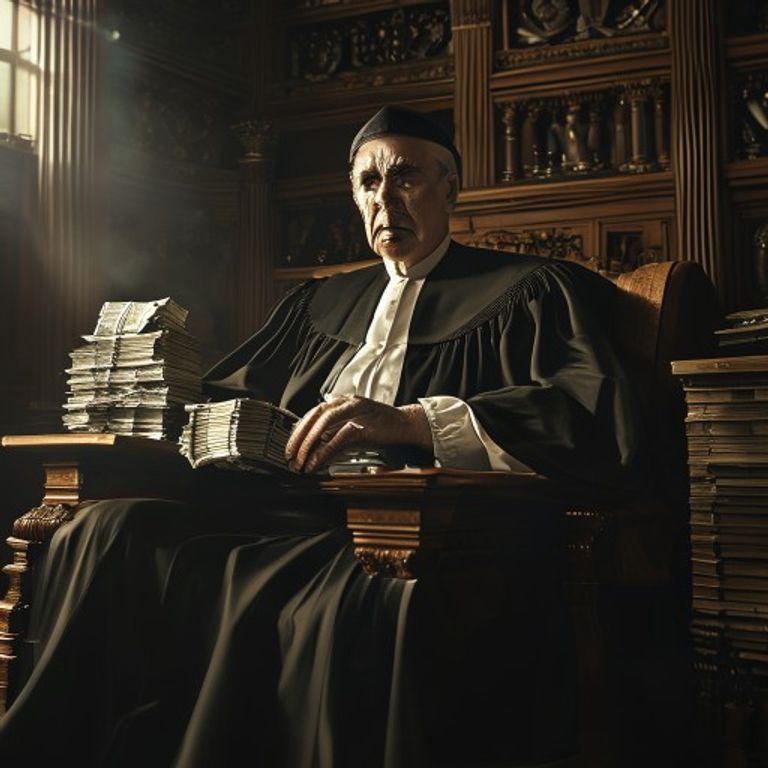
Before there was Operation Greylord, and long before the "Kids for Cash" scandal, there was Martin Manton. In the 1930s, Manton was the Senior Circuit Judge of the United States Court of Appeals for the Second Circuit. He was, by institutional rank, the second-highest judicial officer in the United States, outranked only by the Chief Justice of the Supreme Court. He was also a prolific and unapologetic criminal.
Manton did not merely bend the rules; he sold the entire concept of appellate justice to the highest bidder. Over the course of his tenure, he accepted over $400,000 in bribes (equivalent to millions today) from litigants, patent holders, and corporate tycoons. If a major corporation needed a patent upheld or an antitrust suit dismissed in the Second Circuit, they knew who to pay. Manton effectively ran the federal appellate court in New York like a Mafia protection racket.
The Martin Manton scandal of 1939 is not just a piece of historical trivia. It is a catastrophic indictment of the American judicial framework. It demonstrated that the Founders’ deepest anxieties about an unaccountable legal elite were not theoretical. They were prophecies.
The Machinery of Appellate Extortion
Manton was appointed to the federal bench by Woodrow Wilson. By the 1930s, his power was absolute. He sat on the Second Circuit, which handled the most lucrative commercial and financial litigation in the world. He established a network of "fixers"—corrupt attorneys and bagmen who would approach litigants with a simple proposition: pay a "loan" or a "consulting fee," and Judge Manton would ensure the ruling went your way.
In one infamous case, a matchbook company paid Manton thousands of dollars to secure a monopoly on the striking friction strip. In another, an electric company paid $50,000 to win a patent dispute. The Second Circuit, which was supposed to be a bastion of federal law, became a clearinghouse for corporate bribery.
The Federalist Illusion and Madison’s Warning
When Alexander Hamilton defended the lifetime tenure of federal judges in Federalist No. 78, he argued that the judiciary would be the "least dangerous" branch because it had "neither force nor will, but merely judgment." Hamilton presumed that the prestige of the office would attract men of "integrity and moderation."
Manton exposed the lethal flaw in Hamilton’s optimism. When judgment can be bought, the judiciary ceases to be the "least dangerous" branch. It becomes the most dangerous monopoly in the republic. A corrupt legislature can be voted out. A corrupt executive can be replaced. But a corrupt appellate judge, shielded by lifetime tenure and the secrecy of judicial chambers, wields tyrannical power.
James Madison warned in Federalist No. 51 that "if men were angels, no government would be necessary." He insisted that ambition must be made to counteract ambition. But the judicial system the Founders inadvertently permitted—and which the legal profession subsequently built—insulated judges from those very counteracting forces. Manton thrived precisely because the legal "guild" refused to police its own elite.
Jefferson’s "Sappers and Miners"
Thomas Jefferson warned that the federal judiciary was "like gravity by night and by day, gaining a little today and a little tomorrow, and advancing its noiseless step like a thief over the field of jurisdiction." He viewed the legal profession as an organized body dedicated to protecting "the privilege of their corps."
Manton was the ultimate thief in the night. He was eventually exposed not by a rigorous system of judicial ethics, but by a combination of investigative journalism and a politically motivated district attorney (Thomas E. Dewey). The judicial conduct system did not catch him. The bar associations did not expose him. The "corps" protected him until the public scandal became too overwhelming to ignore.
The Systemic Reconstruction We Need
Manton resigned in 1939, was convicted of conspiracy, and served 17 months in federal prison. The legal establishment patted itself on the back, declared the system had worked, and went back to business as usual. They did not reconstruct the system; they simply removed one glaring liability.
We are still living under the architecture that produced Martin Manton. A system that requires a media circus and an ambitious prosecutor to stop a judge from selling the law is a defunct system. We need complete, structural rebuilding:
1. Eradicate Lifetime Tenure. Article III’s "good behavior" clause has been warped into an absolute shield. Term limits and mandatory retention elections must be instituted. The people must have the ability to recall judges who betray the public trust.
2. Financial Panopticon for the Judiciary. Judges must be subjected to invasive, mandatory, and continuous financial auditing by independent civilian boards. Privacy is a right of the citizen; absolute transparency is the obligation of the jurist.
3. Decimate the "Privilege of the Corps." The self-policing monopoly of the bar association must be broken. Misconduct investigations must be handled by grand juries comprised entirely of non-lawyers.
The Founders gave us a republic. The legal profession gave us an oligarchy where justice is sold by the pound. Until we structurally reconstruct the American judiciary, we will always be at the mercy of the next Martin Manton.
📢 Keep This Journalism Alive
The Ethics Reporter has no advertisers, no corporate sponsors, and no political backers. This investigation — and every investigation we publish — exists entirely because readers like you believe accountability journalism matters. If this reporting moved you, please consider supporting us.
Donate to The Ethics ReporterEven $1 helps. No amount is too small. Thank you for standing with us.