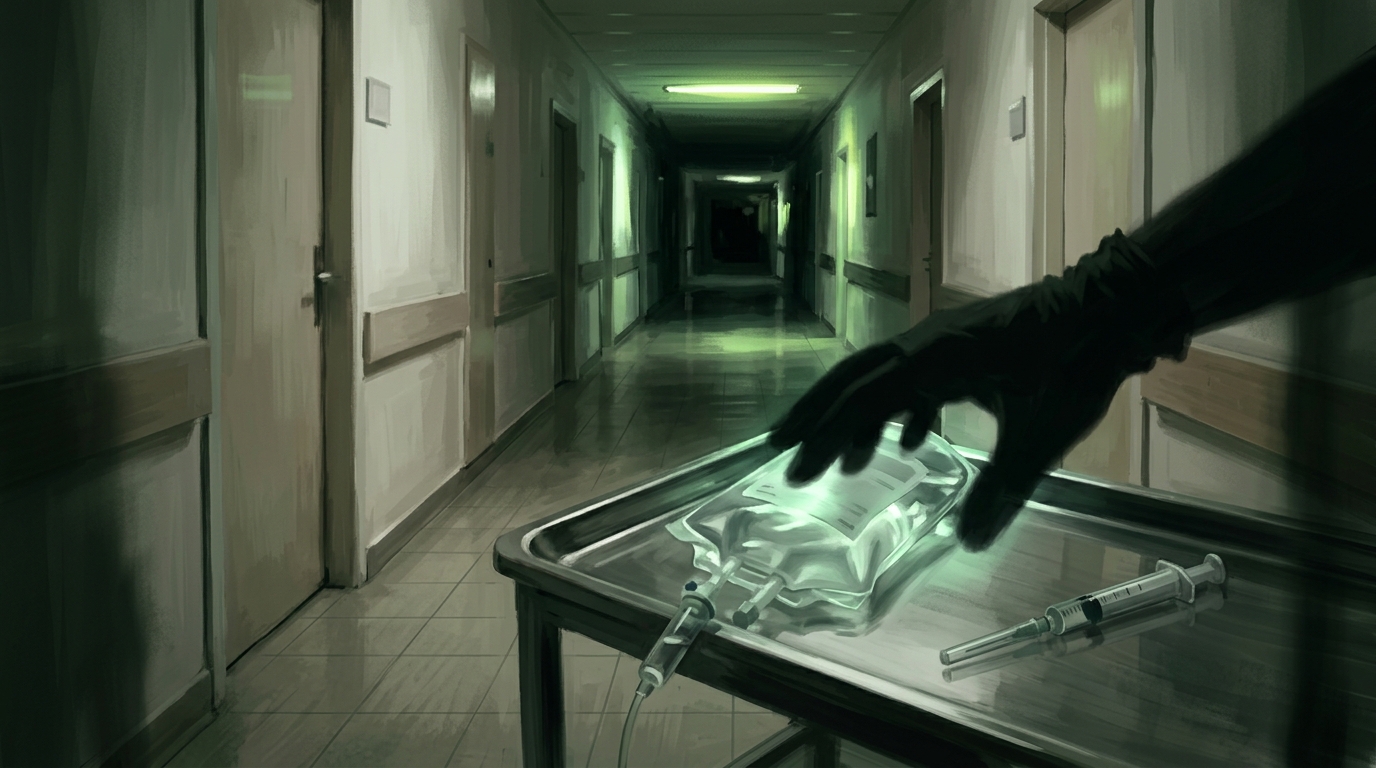
On June 27, 1997, federal agents arrested a passenger at Chicago’s O’Hare International Airport during a layover. He was traveling on a one-way itinerary toward Saudi Arabia, where a hospital job was waiting for him. The traveler was a forty-two-year-old American physician named Michael Swango, and the warrant that stopped him was, on its face, almost laughably small: he was charged with lying on a government form. Years earlier, applying for a residency that placed him inside a Veterans Affairs hospital on Long Island, he had concealed a criminal conviction. That was the crime the government could prove that day. The crime the government believed — the reason agents had tracked his movements across two continents — was that Michael Swango had spent the better part of fourteen years poisoning the people around him, and that an unknown number of his patients, on three continents, were dead because of it.
When the full accounting was attempted, after his guilty pleas in 2000, the FBI’s estimate of Swango’s victims ran as high as sixty. The number will never be fixed with certainty, because the story of Michael Swango is not primarily a story about a murderer’s cunning. He was, by most accounts, a careless liar whose fabrications collapsed under the gentlest scrutiny. It is a story about the institutions that declined to scrutinize — the medical schools, teaching hospitals, and credentialing bodies that passed him from one ward full of vulnerable patients to the next, each one satisfied with a photocopied license and a cheerful interview, each one relieved when he became someone else’s problem. The journalist James B. Stewart, whose 1999 book on the case supplied its enduring title, called the phenomenon a “blind eye.” The phrase is almost too kind. Eyes that are blind cannot see. These chose not to.
The Golden Boy
Swango’s early biography reads like the setup for an entirely different life. He was the valedictorian of his high school class in Quincy, Illinois, a gifted musician, the son of an Army officer who served in Vietnam. He enlisted in the Marines and received an honorable discharge. He entered Southern Illinois University’s medical school, where the first shadows appeared — not violence, but fraud. Classmates noticed that he faked patient histories and skipped work he claimed to have done; he was nearly prevented from graduating after a review of his conduct, and was permitted to finish only after protest and delay. Fellow students, with the black humor of medical training, had already registered something unsettling about his fascination with dying patients. The school graduated him anyway, in 1983, with a dean’s letter that did not tell the next institution what the last one knew. It was the first handoff, and it set the pattern for every one that followed.
The next institution was Ohio State University, where Swango began a surgical internship in 1983. Within months, nurses on the neurosurgery ward began reporting a chilling coincidence: patients who had been stable were suddenly dying, or nearly dying, when the new intern was on the floor. In February 1984, a patient named Rena Cooper survived an episode of sudden paralysis and respiratory failure and told the staff, in writing, that a blond resident had injected something into her intravenous line. Nurses identified Swango. What followed was not an investigation so much as the performance of one. The university conducted an internal review, run by physicians and administrators with no forensic training and every institutional incentive to find nothing. It found nothing. Swango completed his internship year; the university simply declined to renew him. No report went to the police. No meaningful report went to the state medical board. A young gymnastics enthusiast named Cynthia Ann McGee, nineteen years old, recovering from a traffic accident, had died on his watch in January 1984. Sixteen years later, Swango would stand in a Columbus courtroom and admit he had killed her with an injection of potassium. In 1984, Ohio State wrote him a letter of reference.
Arsenic in Quincy
Unable to continue in medicine immediately, Swango went home to Illinois and took a job as an emergency medical technician with an ambulance service in Adams County. In the fall of 1984, his co-workers began getting violently ill — nausea, vomiting, dizziness — in clusters that followed a pattern: they got sick after eating the doughnuts Swango brought in, after drinking the sodas he handed them, after sharing the iced tea he had touched. Paramedics are not epidemiologists, but they are professionally suspicious people, and they did what Ohio State’s credentialed reviewers had not: they ran an experiment. They set out a pitcher of tea, left Swango alone with it, and had it tested. It contained arsenic. A search turned up ant poison and an assortment of other toxins in his possession, along with recipes and notes on poisoning. In August 1985, a jury convicted him of aggravated battery for poisoning six co-workers. A judge sentenced him to five years, telling him he was a danger to others. The conviction was public. It was covered in the press. It was, from that day forward, a matter of record available to any hospital that looked.
Swango served roughly two years. What he did next is the hinge of the entire story, the part that moves it from the biography of one aberrant man to an indictment of a profession. He decided to return to medicine. And medicine let him.
The Long Readmission
The mechanics were almost insultingly simple. Swango altered documents. He explained away his conviction, when he acknowledged it at all, as a barroom brawl, a misunderstanding, a wrongful charge arising from a workplace dispute. He applied broadly, knowing that somewhere a residency program with an unfilled slot would want to believe him. In 1992, the University of South Dakota’s internal medicine program took him. He was personable, hardworking, well liked — the reviews were glowing right up until the day a television program about his poisoning conviction reached Sioux Falls, and the program, facing publicity rather than any new fact, dismissed him. Every fact it acted on had been available before it hired him.
Remarkably, the exposure did not end his career. It barely paused it. In 1993, Swango was accepted into a psychiatric residency at the State University of New York at Stony Brook, a program whose rotations placed him at the Veterans Affairs Medical Center in Northport, on the North Shore of Long Island — a federal hospital, full of elderly veterans, staffed in part by residents with unsupervised access to intravenous lines. He got the position by lying again, and again the lie was checkable: he told the program his Illinois conviction stemmed from a fistfight. No one called Illinois. No one pulled the court file. At Northport, in the summer and early fall of 1993, patients under his care began to die: Thomas Sammarco, aged seventy-three; George Siano, sixty; Aldo Serini, sixty-two. Each death was attributed at the time to natural causes. Each man, the government would later establish, had been poisoned by his doctor.
Swango was fired in October 1993 — not because anyone connected him to the deaths, but because the dean at South Dakota happened to warn a colleague, and word reached Stony Brook that its polite young resident was the poisoner from the news. The scandal cost the medical school’s dean his position and prompted an extraordinary letter of apology to more than a hundred other medical schools. It did not prompt a homicide investigation with any urgency. Swango, unemployed but still holding credentials and copies of his own glowing evaluations, did what he had always done. He moved to where the checking would be weaker. This time that meant another continent.
Mnene
In 1994, Swango arrived in Zimbabwe and secured a position at Mnene Hospital, a Lutheran mission facility in the country’s rural south. The pattern resumed with terrible fidelity: patients who were recovering suddenly declined; injections no one had ordered; deaths that made no clinical sense. But the mission doctors and nurses at Mnene did what two American teaching hospitals had not — they formally accused him. Zimbabwean authorities investigated, and Swango, facing poisoning charges, fled the country. He drifted through southern Africa, at one point working again as a physician, and eventually secured the job in Saudi Arabia that put him on the itinerary through O’Hare in June 1997, where the FBI — alerted, at last, and armed with the only charge readily provable, fraud — was waiting.
In March 1998, Swango pleaded guilty to defrauding the government by lying his way into the VA position, and that July he was sentenced to three and a half years in federal prison. The fraud case was a placeholder, and everyone involved knew it. Federal prosecutors in the Eastern District of New York, working with the FBI and VA investigators, spent the next two years building the case the system had declined to build for fifteen: exhuming bodies, running toxicology on decade-old tissue, assembling evidence from Ohio, New York, and Zimbabwe. In July 2000, days before Swango’s scheduled release — he had, incredibly, been preparing for another overseas medical job — a federal grand jury indicted him for the murders of the three Northport veterans, charges that carried the possibility of the death penalty.
The Plea
On September 6, 2000, in the federal courthouse in Uniondale, New York, Swango pleaded guilty to three murders and to fraud, in exchange for a sentence of three consecutive terms of life imprisonment without the possibility of parole — and, crucially, an agreement that spared him extradition to Zimbabwe and the death penalty in the United States. The plea allocution was clinical. He admitted injecting his patients with substances he knew would kill them. Relatives of the dead veterans sat in the gallery and listened to a physician describe, in the flat language of a plea colloquy, the murder of the men who had trusted him. The following month, Swango was brought to Columbus, where he pleaded guilty to the 1984 murder of Cynthia McGee and received a fourth life term — a resolution Ohio prosecutors described as an act of closure for a family that had waited sixteen years to learn that their daughter’s death in a university hospital had been a homicide. He remains in the federal supermax facility in Florence, Colorado.
The Count
How many people did Michael Swango kill? The four murders to which he pleaded guilty are the legal answer, and everyone who worked the case considered it a floor. Federal investigators, working backward through the wards he had staffed in Ohio, New York, and southern Africa — matching his shifts against unexplained deaths — produced estimates that ranged from the thirties to as high as sixty. The Zimbabwe cases alone, documented well enough that Harare filed poisoning charges before he fled, would place him among the most prolific medical killers on record; the plea agreement that spared him the death penalty also, by design, spared the system a full accounting, since it extinguished any American proceeding at which the wider evidence would have been aired. Ohio State, for its part, eventually commissioned an outside review of its 1984 investigation; the resulting report was blunt about the university’s failures — an inquiry run to reassure rather than to find, conducted without police, without forensic rigor, and without any apparent institutional memory that patients, not reputations, were the parties at risk. Three years after Swango’s plea, the arrest of the New Jersey nurse Charles Cullen — who confessed to killing patients across nine hospitals over sixteen years, each institution quietly passing him to the next — demonstrated that the pattern was not one man’s anomaly but the industry’s default. New Jersey and other states responded with statutes requiring health-care employers to report and disclose — laws that exist, in a real sense, because the handoff had by then killed for three decades under two different names.
The Ethics of the Handoff
It is tempting to file Swango under the true-crime rubric of the medical serial killer, alongside Harold Shipman in England or, later, Charles Cullen in New Jersey — a monster whose pathology explains everything. But the pathology explains only the killing. It does not explain the career. The career was built by others, in increments, each one small enough to feel defensible. A medical school that graduated a student its own faculty distrusted, because failing him was administratively painful. A teaching hospital that investigated a poisoning allegation with the tools of a personnel dispute, because the alternative — calling the police on its own intern — was institutionally unthinkable. A residency program that accepted a felon’s account of his own felony, because verifying it would have taken a phone call someone might have had to explain. A federal hospital system that credentialed him on paper he had forged. At every stage, the professionals involved had duties — ethical duties, codified duties, in some cases legal duties — to report, to verify, to warn. At every stage, the duty lost out to the path of least resistance.
The case became a standard citation in the movement to reform physician credentialing, and it is fair to say the machinery improved because of it. The National Practitioner Data Bank, created by Congress in the late 1980s, was meant to prevent exactly this kind of state-hopping, but it worked only when hospitals both reported to it and queried it honestly; Swango’s case demonstrated how much discretion remained. The Federation of State Medical Boards pressed for centralized verification of credentials. The VA tightened its own screening after congressional scrutiny of how a convicted poisoner obtained privileges in a federal hospital. Residency programs today routinely require primary-source verification — the court record itself, not the applicant’s summary of it.
But the deeper lesson of the Swango case is one no database can encode, and it recurs in every profession this publication covers. Institutions protect themselves first. The impulse that moved Ohio State to conduct a quiet internal review rather than call a homicide detective is the same impulse that moves a law firm to ease out a partner who stole from a client trust account rather than report him, the same impulse that lets a bank quietly separate from a trader rather than refer him to regulators. The problem passes downstream, to the next employer, the next set of clients, the next ward of patients — people who never get a vote, because the information that would have protected them was treated as a reputational liability to be managed rather than a warning to be delivered.
Swango’s victims at Northport were veterans in their sixties and seventies, men who had survived wars and trusted the white coat at their bedside. Their deaths were preventable not once but half a dozen times — in 1983, when a dean’s letter could have told the truth; in 1984, when a nurse’s report could have gone to the police; in 1985, when a felony conviction could have ended a medical career for good; in 1992 and 1993, when a single primary-source check could have stopped the last hiring. The blind eye was not one eye. It was a relay of them, each institution closing its own in turn and handing the man along. The lesson is written on four consecutive life sentences: in the professions, the failure to verify is not a clerical lapse. It is the mechanism by which the worst people in a licensed field do their work.