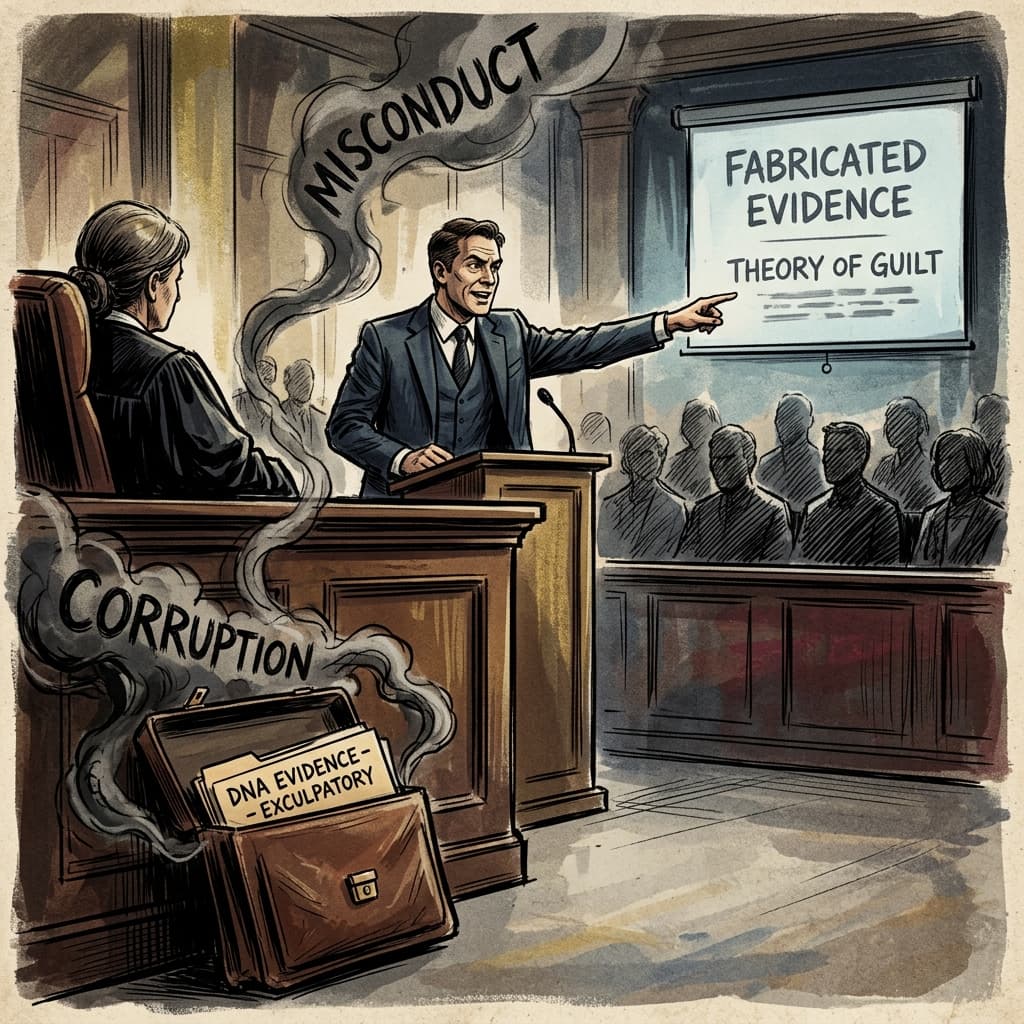
When a prosecutor stands before a jury, he is no longer acting in his individual capacity. He is the state. He wields the power to strip a citizen of his liberty, destroy his reputation, and incarcerate him in a steel cage. The Founding Fathers understood the terrible gravity of this power. They therefore enshrined the Fifth Amendment right to due process, the Sixth Amendment right to confront witnesses, and a host of constitutional protections designed to ensure that the machinery of the state could not be weaponized against the innocent.
Yet, when those protections are stripped away by a prosecutor drunk on ambition and the intoxication of political power, the result is catastrophic. In March 2006, three young men—all lacrosse players at Duke University—were accused of participating in a brutal gang rape. The accusation came from a woman whose credibility was paper-thin. The physical evidence contradicted her narrative. And the DNA evidence explicitly excluded the three accused men. Yet the District Attorney for Durham County, North Carolina—a man named Mike Nifong—pursued the case with the ferocity of a zealot, knowingly withheld exculpatory evidence from the defense, suppressed DNA findings, and presented lies to the grand jury.
The Duke lacrosse case is not a tragedy about three privileged young men. It is a harrowing indictment of the American prosecutorial system. It proves that the constitutional protections enshrined in the Fifth and Sixth Amendments are merely theoretical unless they are backed by meaningful consequences for prosecutors who deliberately violate them. It exposes the absolute contempt with which the legal establishment treats the rights of the accused, and it demonstrates that the Founders' greatest fears—that an unaccountable executive power would weaponize the courts—have been entirely realized.
- The Accusation: On March 13, 2006, a 28-year-old African American woman alleged she had been raped by three white Duke University lacrosse players at a party in Durham, North Carolina.
- The Accused: Colin Finnerty, Reade Seligmann, and David Evans—all young men from affluent families with no prior criminal records.
- The Exonerating Evidence: DNA testing excluded all three accused men. No biological material from the accused was found on the victim. A lab report indicated multiple male DNA profiles that did not match any of the accused.
- The Suppression: Mike Nifong received the DNA results showing the men were innocent. He ordered the lab to "not report" the full results and withheld the evidence from the defense for months.
- The Consequences: After three years, charges were dropped. The state Attorney General declared the men innocent. Nifong was disbarred and served one day in jail. The three men settled for $30 million.
The Accusation and the Machinery of State Violence
On the evening of March 13, 2006, the Duke University lacrosse team hired exotic dancers for a party at a rental house. During the party, a 28-year-old Black woman alleged that she had been violently raped by three of the players. The accusation immediately exploded into national outrage. A Black woman, in the American South, accusing three white men of sexual violence carried immense emotional and political weight.
The Durham Police Department, under pressure from the Black community and national media attention, moved with extraordinary speed. Within days, photographs of the lacrosse team were shown to the accuser in a deliberately suggestive manner—a procedure known as a "show-up," which is notorious for generating false identifications. Initially unable to identify her alleged attackers, she was then shown a photographic array of exclusively Duke lacrosse players and induced to select three men: Colin Finnerty, Reade Seligmann, and David Evans.
The three men were arrested and charged with rape and kidnapping. The case seemed straightforward: a wealthy, predominantly white sports team preying on a vulnerable Black woman. The national media seized upon the narrative with voracious intensity. The players were portrayed as violent rapists. Duke's president denounced them. The 88 Duke University faculty members signed a public letter declaring support for the accuser without knowing a single fact of the case.
But the simplicity of the narrative was a fiction. Every element of the prosecution's case was constructed on a foundation of lies.
The Exculpatory Evidence and the Suppression
From the very first moments of the investigation, the physical evidence contradicted the accuser's account. When medically examined at Duke Hospital on the morning of March 14—approximately twelve hours after the alleged rape—the emergency room physician documented that she displayed no evidence of traumatic sexual abuse. There were no tears, no abrasions, no vaginal injuries. Her state of intoxication was so severe that questions were raised about her ability to consent to the medical examination itself.
When forensic tests were performed on swabs taken from her body, the results were explosive in their exculpatory nature. DNA from male contributors was found—but none of it matched any of the three accused men. The lab results indicated that biological material from multiple men was present, suggesting either consensual sexual activity or contact with other individuals.
The DNA report was unambiguous: Colin Finnerty, Reade Seligmann, and David Evans could not be the source of the DNA evidence recovered.
Under Brady v. Maryland, a Supreme Court precedent of sixty years, a prosecutor is constitutionally obligated to disclose exculpatory evidence to the defense. This is not a suggestion; it is a constitutional mandate. A prosecutor who withholds exculpatory evidence is violating the Fifth Amendment right to due process.
Mike Nifong received the DNA results and understood immediately that they destroyed the state's case. Rather than honor his constitutional obligations, Nifong ordered the lab director to exclude the full results from the official DNA report. He instructed the lab to produce a report that stated DNA was found but omitted the critical fact that none of it matched the accused men.
For months, Nifong concealed the complete DNA results from the defense attorneys. The three young men and their lawyers were operating in the dark, unaware that the government possessed definitive proof of their innocence. Meanwhile, Nifong presented the case to a grand jury, arguing for indictment, without disclosing the exculpatory evidence.
Jefferson and the Ambition of the Prosecutorial Class
Thomas Jefferson understood that unchecked executive power inevitably becomes tyranny. In his writings on the Constitution, Jefferson warned repeatedly that the power to prosecute was the most dangerous power in any government. Without meaningful constraints, a prosecutor becomes a tool of arbitrary state violence.
In an 1820 letter, Jefferson issued a prophetic warning:
"Our judges are as honest as other men, and not more so. They have, with others, the same passions for party, for power, and the privilege of their corps."
The Duke lacrosse case is a perfect illustration of Jefferson's warning. Mike Nifong was not motivated by a sincere belief in the guilt of the three young men. He was motivated by the intoxicating allure of political power. Durham County was approximately 40% Black, and the Black community was demanding justice for a sexual assault. By aggressively prosecuting the case, Nifong positioned himself as a champion of racial justice. He won re-election on the back of the Duke case. He transformed himself from an obscure small-town prosecutor into a figure of national prominence.
Nifong's ambition and the "privilege of his corps" blinded him to the truth. Even as the evidence mounted that the three men were innocent, he pressed forward. He was no longer interested in justice; he was interested in victory. The careers of three innocent men were mere collateral damage in his quest for political power.
Madison and the Catastrophic Failure of Checks and Balances
James Madison designed the Constitution around the principle that power must be checked by competing institutions. In Federalist No. 51, Madison wrote:
"Ambition must be made to counteract ambition. If men were angels, no government would be necessary... In framing a government which is to be administered by men over men, the great difficulty lies in this: you must first enable the government to control the governed; and in the next place oblige it to control itself."
The American prosecutorial system has no meaningful check on prosecutorial abuse. Grand juries, designed to serve as a check on prosecutorial power, have become rubber stamps for the state. Over 99% of cases presented to grand juries result in indictment. Defense attorneys do not have the opportunity to cross-examine witnesses before the grand jury. The prosecutor controls the narrative entirely.
In the Duke case, Nifong presented a one-sided, dishonest narrative to the grand jury, withholding exculpatory evidence. The grand jury had no way to know they were being lied to. The constitutional check on prosecutorial power was utterly useless.
The Illusion of Professional Consequences
When the truth finally emerged and the three men were exonerated, the question of accountability arose. The State Bar of North Carolina concluded that Nifong had violated his ethical obligations. They disbarred him—permanently revoking his law license. Additionally, he was convicted of criminal contempt and sentenced to a single day in jail.
One day.
Colin Finnerty, Reade Seligmann, and David Evans spent three years in legal limbo, facing potential decades in prison. Their lives were destroyed. And the man who orchestrated their persecution was sentenced to one day in jail.
The math of American justice is always the same: a brutal, crushing calculation for the ordinary citizen, and an administrative slap on the wrist for the member of the legal elite.
A Blueprint for Prosecutorial Accountability
The Founding Fathers believed that the power to prosecute was so dangerous that it had to be constrained by multiple layers of democratic accountability. The Duke lacrosse case proves that those layers have entirely failed.
1. Abolish Prosecutorial Immunity
The Supreme Court's doctrine of absolute prosecutorial immunity, established in Imbler v. Pachtman, must be legislatively abolished. Prosecutors who intentionally suppress exculpatory evidence, suborn perjury, or present false evidence must face personal civil liability. If the victim of prosecutorial misconduct can sue the prosecutor personally and drain his personal wealth, the prosecutor will be far less likely to abuse his power.
2. Mandatory Video Recording of Grand Jury Proceedings
All grand jury proceedings must be videotaped and made available to the defense upon indictment. The prosecutor cannot be permitted to present a one-sided, dishonest narrative to a secret body.
3. Discovery Before Indictment
The Brady requirement to disclose exculpatory evidence currently applies after indictment. The law must be changed to require prosecutors to disclose all exculpatory evidence before presenting to the grand jury. No indictment should issue without full disclosure.
4. Automatic Reversals for Brady Violations
If a prosecutor violates Brady, the conviction must be automatically reversed. The consequence must be so severe that no prosecutor will risk it.
Conclusion: The Weaponization of the Law
Mike Nifong did not become a criminal because of personal malice toward three lacrosse players he had never met. He became a criminal because the American prosecutorial system is structurally designed to allow such abuse. There is no meaningful accountability. There is no check on his power. There is no consequence severe enough to deter misconduct.
The three young men of the Duke lacrosse case survived because they had excellent attorneys, because a lab director told the truth despite pressure from the prosecutor, and because national media attention forced an investigation. Thousands of others accused of crimes do not have those advantages. They are destroyed by prosecutors drunk on power, operating under a doctrine of absolute immunity.
The Founding Fathers warned us that an unaccountable executive power would inevitably become tyranny. The Duke lacrosse case proves they were right. Until we impose catastrophic personal consequences on prosecutors who abuse their power, the state will continue to weaponize the law against the innocent.
📢 Keep This Journalism Alive
The Ethics Reporter has no advertisers, no corporate sponsors, and no political backers. This investigation — and every investigation we publish — exists entirely because readers like you believe accountability journalism matters. If this reporting moved you, please consider supporting us.
Donate to The Ethics ReporterEven $1 helps. No amount is too small. Thank you for standing with us.