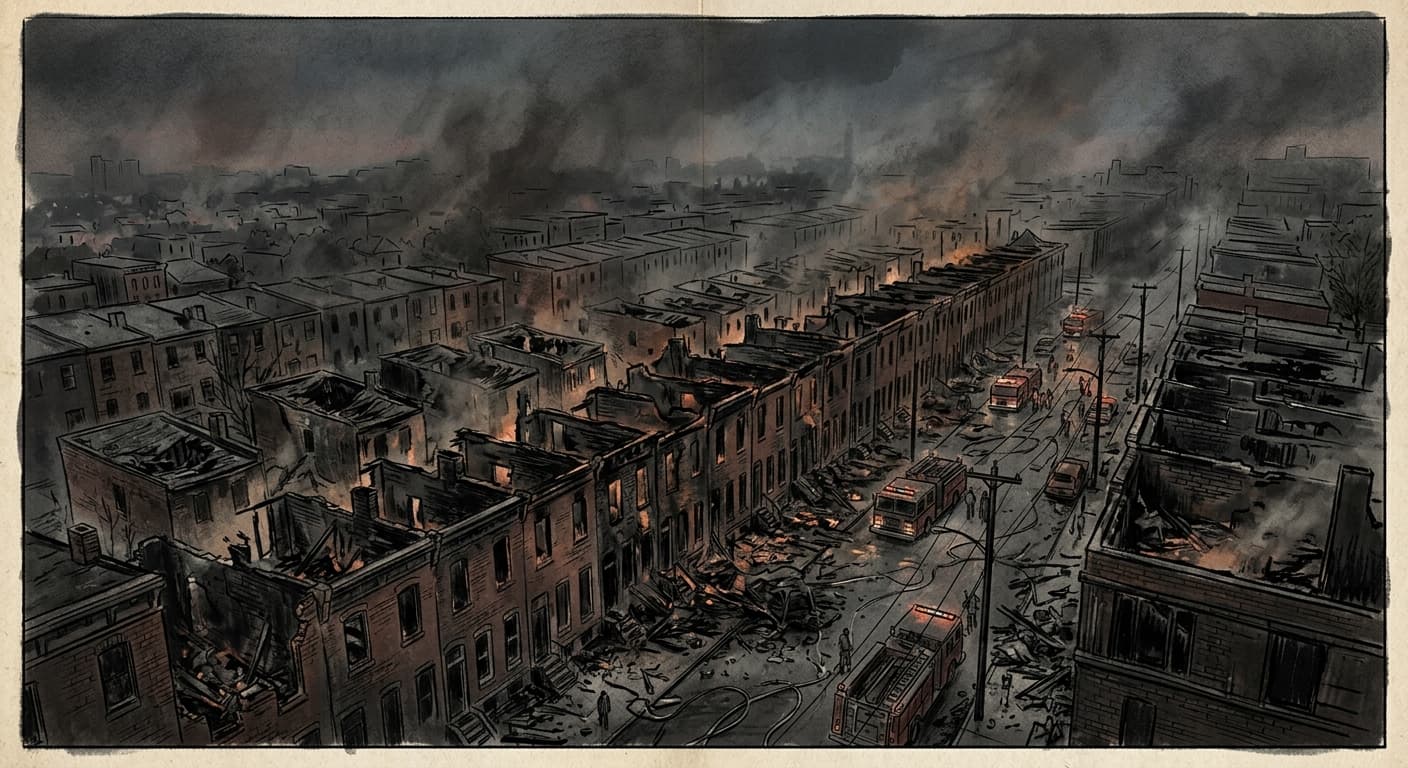
On the evening of May 13, 1985, a Pennsylvania State Police helicopter rose into the sky over West Philadelphia carrying a canvas bag containing two one-pound sticks of Tovex, an industrial explosive, atop C-4 plastic explosive — a satchel charge assembled by the Philadelphia Police Department's bomb squad. The helicopter hovered over 6221 Osage Avenue, a two-story brick row house in a working-class Black neighborhood, the home of the radical back-to-nature communal group known as MOVE. At 5:28 p.m., Lieutenant Frank Powell, the head of the bomb squad, leaned out of the helicopter and dropped the satchel onto a fortified bunker the group had built on the roof. The explosion that followed ignited a fire. The city's police commissioner and fire commissioner then made a decision nearly beyond comprehension: they let it burn. By the time the fire was finally brought under control hours later, eleven members of MOVE — including five children — were dead in that house, and the fire had spread to consume sixty-one homes on the block, leaving some two hundred and fifty men, women, and children homeless. A city had bombed its own citizens from the air, on American soil, in a residential neighborhood, in the name of law enforcement.
The Philadelphia Special Investigation Commission, empaneled by Mayor W. Wilson Goode in the aftermath and chaired by William H. Brown III, would spend months hearing testimony before issuing findings that remain, four decades later, among the most damning official verdicts ever rendered against a municipal government: the dropping of the bomb on an occupied row house was, in the Commission's word, unconscionable. The decision to let the fire burn was unconscionable. The use of high-powered automatic weapons against a house containing children was wrong. And yet — and here is the pattern that should be burned into the conscience of every American who believes the law applies equally to the powerful and the powerless — almost no one was ever held meaningfully accountable. No city official went to prison for the eleven dead on Osage Avenue. The only MOVE member to survive the fire, Ramona Africa, was convicted of riot and conspiracy and sent to prison. The city paid civil settlements and, decades later, rebuilt the block it had burned. The officials who ordered, assembled, and dropped the bomb retired on pensions.
The MOVE bombing is the single most extreme instance of American municipal violence against American citizens since the mid-twentieth century — a moment when the boundary between police force and military force dissolved entirely, when a city government used aerial bombardment to resolve a neighborhood dispute, and when the justice system demonstrated, with terrible clarity, that the state's agents may kill with weapons of war and face no reckoning under law. Against this event, the Founders' warnings stand in stark relief: their terror of standing armies turned inward, their Fourth Amendment command that the people's homes be inviolable, their insistence in the Eighth Amendment that governmental punishment be bounded and deliberate, the Due Process Clause's demand that no person be deprived of life except by law's judgment. On Osage Avenue, none of it held. Eleven people, five of them children who had committed no crime at all, were executed by fire on the decision of officials who were never tried for it. This is the story of how that happened, why the law let it happen, and what it reveals about a judicial system that has never known what to do when the criminals wear uniforms.
Who Was MOVE — And Why That Question Is a Trap
Any honest account of May 13, 1985, must begin with the truth that MOVE was, by the standards of ordinary civic life, an extraordinarily difficult neighbor. Founded in Philadelphia in the early 1970s by a man who took the name John Africa — born Vincent Leaphart — MOVE was a Black liberation and back-to-nature movement whose members adopted the surname Africa, rejected modern technology and consumer society, ate raw food, composted their waste in their yard, and lived communally. Their philosophy was opaque; their rhetoric could be apocalyptic. They kept dogs and other animals. On Osage Avenue, where the group relocated after a catastrophic earlier confrontation with the city in 1978, neighbors' complaints accumulated over years: the group's loudspeaker harangues blasted profane denunciations of the system at all hours; the property harbored vermin; the neighbors — themselves Black working-class homeowners on a tidy block — felt besieged, and they begged the city to act.
And the city had history with MOVE. On August 8, 1978, police had moved in force to evict the group from its earlier headquarters in the Powelton Village section of the city. Gunfire erupted — MOVE said it came from police; police said it came from MOVE — and Philadelphia Police Officer James Ramp was killed. Nine MOVE members, the MOVE Nine, were convicted of his murder and sentenced to long prison terms, in a prosecution the group maintained was a frame-up and whose physical evidence — the ballistics and trajectories — critics argued for decades was inconsistent with the prosecution's theory. That 1978 confrontation defined the relationship: to MOVE, the city was an occupying army that had imprisoned its family; to the Philadelphia Police Department, MOVE was the group that had killed one of theirs. When the standoff built again on Osage Avenue in 1984 and 1985, it was a collision already freighted with blood and grievance.
But here is the trap, and it must be identified plainly, because every official apologia for May 13 begins with the recitation of MOVE's offenses: the question is not whether MOVE was a good neighbor. The question is not even whether MOVE had broken laws — they plainly had, and warrants for several adult members' arrest on parole violations, weapons offenses, and terroristic threat charges were the legal predicate for the police action. The question is what the law permitted the city to do about it, and the law's answer is not, was not, and can never be: drop a bomb from a helicopter on a house known to contain children, and then hold the fire department back while it burns. A constitutional republic polices difficult citizens with warrants, arrests, and due process. It does not bomb them. The moment the analysis is allowed to drift from the city's conduct to the victims' character, the argument has already been lost — or, more precisely, deliberately ceded. The five children who died in that house — Tomaso, Phil, Delisha, Netta, and Tree Africa, ranging in age from nine to fourteen — had committed no offense against anyone. They died in a fire their own city set and refused to fight. Their neighbors, who had begged for help, watched their own homes burn instead.
The Buildup: A Neighborhood Held Hostage and a City That Planned a Siege
By the spring of 1985, the Osage Avenue situation had reached its breaking point. Mayor W. Wilson Goode — Philadelphia's first Black mayor, a fact that would prove both significant and utterly unprotective — faced intractable pressure from the 6200 block's residents, who felt abandoned, and from his police department, which regarded MOVE with institutional hatred. The decision was made to execute the outstanding arrest warrants and evict the group from 6221 Osage. What followed was not the planning of an arrest. It was the planning of a siege, and later a battle, prosecuted against a fortified position — the phrase the police themselves used — in the middle of a residential block.
The operational planning, as later reconstructed by the Special Investigation Commission, involved hundreds of police officers, staged over a weekend, with a show of force designed, in the words of the commission's findings, to overwhelm. On the night before the assault, police evacuated the block's residents — telling them, by most accounts, that they would be able to return within about twenty-four hours. Many left with nothing. At first light on May 13, police used water cannons against the house and called over bullhorns for the occupants to emerge. MOVE did not surrender. By mid-morning, gunfire had been exchanged — the Commission would find that MOVE fired at police, though the scale of MOVE's fire was dwarfed by what followed — and the police response escalated into an hours-long fusillade.
The numbers recorded by the Commission stagger belief. Over the course of the day, the Philadelphia Police Department fired approximately ten thousand rounds into a single row house. Officers used automatic weapons, shotguns, carbines, handguns, M-16s, Uzis, and a .50-caliber machine gun, according to the testimony and inventories the Commission reviewed. Tear gas was pumped into the building. Explosive charges were used to blast holes in the party walls of adjoining houses so that police could move through the row's interiors — demolitions that structurally undermined the neighboring homes before the fire ever reached them. All of this ordnance was directed at a structure the police knew — knew with certainty, through surveillance, intelligence, and the sheer intimacy of a years-long standoff — contained children. The Commission would later find that the police knew, at the time of the final assault planning, that there were at least six adults and several children inside the house. The bombardment continued anyway. Ten thousand rounds at a house full of children: if any single fact of May 13 deserves to be repeated in every civics classroom in America, it is that one.
Five Twenty-Eight P.M.: The Bomb
And still it was not enough. As afternoon wore on with MOVE unreleased — as the Commission dryly noted, the group's fortified rooftop bunker, from which police believed gunfire had come, remained intact — the decision was made at the highest levels to destroy the bunker with an aerial bomb. The chain of decision, as the Commission reconstructed it, ran through Managing Director Leo Brooks and Police Commissioner Gregore Sambor to Mayor Goode, who approved a plan he later testified he did not fully understand — a failure of command the Commission found staggering. Brooks conveyed the approval. The bomb squad under Lieutenant Powell assembled the device: Tovex gel provided, astonishingly, with the involvement of a federal agent — the FBI, the Commission found, had facilitated the police department's acquisition of military-grade explosives including C-4, without asking sufficient questions about its intended use — and C-4 from federal stocks.
At 5:28 p.m., the helicopter hovered over the house and Powell dropped the satchel charge. The device exploded against or beside the rooftop bunker. It destroyed the bunker. It also started a fire on the roof of a wood-framed, tar-roofed row house in a block of contiguous wood-framed, tar-roofed row houses — a fire in a dense urban row where, as every Philadelphia firefighter knows in their marrow, an unattended roof fire near party walls is an existential threat to the entire block. This consequence was not merely foreseeable; it was foreseen. Testimony before the Commission established that the risk of fire spread had been raised in the planning and dismissed.
What happened next transformed a catastrophe into a crime scene. The fire on the roof was initially small. Fire Commissioner William Richmond, with Commissioner Sambor, made the decision not to immediately fight it. The stated rationale, offered in later testimony, was tactical: the fire might burn off the bunker or drive MOVE from the house, and firefighters could not be risked while gunfire might come from the building. Sambor had stated, in a remark recorded in the contemporaneous record and quoted in the Commission's findings, that he wanted to let the bunker burn — to let the fire eliminate the tactical problem the bomb had been dropped to solve. For approximately forty-five critical minutes, as the fire grew, the ladder companies and engine companies of the Philadelphia Fire Department — the finest urban firefighting agency of a great American city, stationed in force at the scene — stood by and watched.
By the time the order to fight the fire came, it was far too late. The blaze, fed by the wood joists and tar roofs of the Osage Avenue row, leapt from house to house. It roared down the block and jumped the street. Firefighters, finally unleashed, could not stop it. The fire consumed sixty-one homes on Osage Avenue and the adjacent Pine Street block. It was, by every account the Commission assembled, the worst residential fire in the history of the City of Philadelphia — a fire set by a police bomb and sustained by police order. Some two hundred fifty residents, who had been evacuated the night before with assurances of a quick return, lost everything: their homes, their photographs, their neighbors' houses, the block itself.
Eleven Dead, Including the Children
Inside 6221 Osage, as the fire took hold, the occupants faced an inferno. What the record establishes — through the Commission's findings, the testimony of the sole surviving MOVE adult at the scene, Ramona Africa, and the physical evidence — is that some of the MOVE adults attempted to escape through the rear of the house, moving or carrying children toward the alley, and that police gunfire prevented some of the occupants from escaping the burning building. That finding is not activist legend; it is Finding 28 of the city's own Special Investigation Commission: police gunfire prevented some occupants of 6221 Osage Avenue from escaping from the burning house to the rear alley. Only two people made it out alive: Ramona Africa, badly burned, who was arrested at the scene, and thirteen-year-old Birdie Africa, who fled the fire with her. Everyone else died inside.
The dead of 6221 Osage Avenue were: John Africa, the group's founder, and five other adults — Rhonda, Theresa, Frank, Raymond, and Conrad Africa. And the five children — the innocents — Tomaso, age nine; Phil, called Little Phil, eleven or twelve; Delisha, twelve or thirteen; Netta, twelve or thirteen; and Tree, age fourteen. Eleven human beings. Their bodies were recovered from the charred interior over the following days. The coroner's office attributed the deaths to the fire — to burns and smoke. Five of the dead were children, executed by their municipal government's fire for the offense of being born into a despised family.
Let the constitutional arithmetic be done precisely, because it is the arithmetic of this entire series. The Fourth Amendment protects houses — the Founders placed the house at the center of the text, having watched British troops quartered in and turned out of colonists' homes. The house at 6221 Osage was seized not by warrant executed at the door but by aerial bombardment, and then destroyed, with its child occupants, by deliberate governmental decision. The Fifth and Fourteenth Amendments forbid the deprivation of life without due process of law; eleven persons, none of them ever charged with — let alone tried for — any capital offense, were deprived of life by executive fiat in real time. The Eighth Amendment forbids cruel and unusual punishments even after conviction by a jury; burning alive is the ancient emblem of cruel punishment, and it was administered here wholesale and without conviction to children. The Founders wrote every one of these protections with the abuses of standing armies in view. On Osage Avenue, the standing army wore police patches, and the law's protections stood mute while the block burned.
The Commission's Verdict: Unconscionable
Mayor Goode, whatever else may be said of his role, did one thing that the pattern of these cases makes remarkable: he empaneled a real investigation. The Philadelphia Special Investigation Commission, eleven members chaired by attorney William Brown, held weeks of public televised hearings through late 1985 and early 1986, subpoenaed the principals, and compelled testimony from Goode, Sambor, Richmond, Brooks, Powell, the bomb technicians, the firefighters, and the surviving MOVE member. The hearings were an ordeal for the city. Goode testified that he had approved a plan without understanding it — that he did not know a bomb would be dropped, a claim the Commission received with open incredulity given his testimony elsewhere that he had been told of plans involving explosives. The contradictions accumulated under oath.
On March 6, 1986, the Commission issued its report. Its findings, in the measured language of official reports, were annihilating. The Commission found that the use of an explosive device dropped from a helicopter onto an occupied house in a residential neighborhood was unconscionable. It found that the decision to let the fire burn was unconscionable. It found that the city's failure to plan for fire suppression before dropping explosives near a tar-roofed row was recklessly negligent. It found that the firing of some ten thousand rounds into a house containing children was excessive and unjustifiable. It found that city officials at the highest levels had failed in their responsibilities. And it recommended, among other things, investigation of individual responsibility — the referral, in substance, of the question whether crimes had been committed by named officials.
Here the story rejoins the pattern, and the pattern is the point. A Philadelphia County grand jury was convened. It investigated. And it declined to indict any city official for the deaths on Osage Avenue. No police commissioner, no fire commissioner, no managing director, no bomb squad commander, no mayor — not one charged with manslaughter, not one with reckless endangerment, not one with any crime arising from the killing of eleven people, five of them children, by bomb and fire. The legal architecture that protects police officers in the Diallo pattern here protected an entire chain of command that had dropped a bomb on a neighborhood. The grand jury's declination, in the face of a commission report using the word unconscionable about the government's own conduct, stands among the most thorough exonerations of indefensible state violence in the American record — a demonstration that when the state's agents kill through official channels, the criminal law dissolves.
One Prisoner: The Survivor Goes to Jail
There was, however, a trial arising from Osage Avenue, and a defendant, and a prison sentence — a single one. Ramona Africa, who had crawled, burning, from the house as police arrested her, was prosecuted for riot and conspiracy. She was convicted by a Philadelphia jury in 1986 and sentenced to sixteen months to seven years in state prison; she served the full seven years, refusing parole terms she said would dishonor her family. Her defense — that the city had murdered her family and burned a neighborhood to evict them — was not a defense the law recognized. The sole person physically injured in the fire whom the Commonwealth successfully sent to prison was the person the fire was set to kill. The officials who planned the siege, assembled the bomb, dropped it, and held back the fire trucks faced no criminal judgment whatever.
Consider what this inversion means as a matter of legal structure, because it is the deepest lesson of the MOVE case. The criminal law in a constitutional republic exists to answer private violence with public judgment. When the violence is public — when it is the state itself that bombs and burns — the criminal law, in the American pattern, has no answer, because every instrument of the answer (prosecutors, grand juries, the doctrines of immunity and deference) is owned, staffed, or intellectually captured by the same state that did the violence. The Founders understood this danger in its military form — the Declaration of Independence's bill of particulars against George III is substantially a catalog of armies unaccountable to law, of mock trials, of the quartering of troops, of the burning of towns. They built constitutional structures against it. On Osage Avenue, each structure was tested, and each failed. The grand jury declined. The jury system tried only the survivor. The civil courts paid money, of which more shortly. And the officials drew pensions. A republic's law that cannot reach its own bombardiers is not law; it is courtesy that the state extends to itself.
What the Courts Could Do: Money, Decades Late
The civil law did what the criminal law would not — which is to say, it moved money, slowly, to some of the injured, while establishing almost nothing by way of institutional accountability. In 1996, eleven years after the bombing, a federal jury in the civil suit brought by Ramona Africa and relatives of two of the MOVE members killed in the fire rendered a verdict finding that the City of Philadelphia had used excessive force and violated the constitutional protection against unreasonable seizure, awarding a total of $1.5 million in damages — a fraction of which the presiding federal judge later reduced. A federal judge, in upholding the core verdict, used language strikingly parallel to the commission's: the dropping of the bomb was, the court observed, unconscionable conduct. The city also settled, for substantial sums totaling in the millions across the mid-1980s, many of the claims of the block's evacuated residents, and ultimately rebuilt the destroyed homes — the infamous rebuilt row whose defective construction would become a scandal of its own within a decade, the city having burned the neighborhood and then, in a coda of pure institutional contempt, rebuilt it badly. By the early 2000s, many of the rebuilt houses stood vacant and deteriorating; the city eventually pursued buyouts. The block that Philadelphia bombed, it also ruined twice.
The civil architecture deserves the same skeptical eye this series applied to the Diallo settlement, because it is the same architecture. When a municipality's agents kill, the municipality pays out of the public fisc; the individual decision-makers are shielded by doctrines of immunity for discretionary governmental acts; the payments are budgeted; and the law produces what scholars have come to call judgment without accountability — compensation without consequence. For the families of the eleven dead, divided as they were, the 1996 verdict stood as the sole official determination that the Constitution had been violated on Osage Avenue — eleven years on, in a money case, against a municipal treasury, with no individual held to account. And even then, in an epilogue perfectly emblematic of the pattern, the city initially refused to pay Ramona Africa's portion of the judgment, litigating over it further. Justice delayed, diluted, and denominated in dollars.
In 2020 — thirty-five years after the bombing — the Philadelphia City Council finally passed a resolution formally apologizing for what it called a horrific event and acknowledging the city's role. Apologies from city councils are not accountability either, but they are evidence: evidence that the official verdict of history on May 13, 1985, is settled, that everyone now concedes the unconscionability, and that this concession has cost the conceders nothing. In those same years, the remains of the children killed in the bombing were discovered to have been retained — used, in fact, in University of Pennsylvania forensic anthropology teaching, via the Penn Museum and partners, without the family's full knowledge or consent — a revelation in 2021 that produced another round of horror and another round of apologies. Even in death, the children of Osage Avenue could not be returned to rest by the institutions that had burned them. Every layer of the story, from 1985 to 2021, tells the same truth about how little the system values the victims of state violence.
The Militarization Before the Word
It has become commonplace, in the years since the 1033 program's revelations and the armored vehicles of Ferguson, to speak of the militarization of American policing — of the pipeline by which battlefield weaponry flows to municipal departments, of the warrior mind-set, of the occupation style of policing in poor and Black neighborhoods. The MOVE bombing predates the vocabulary. It is, in a sense, the founding atrocity of the modern recognition: the moment in which an American city openly used military means — aerial delivery, explosives, automatic suppression fire, anti-personnel volume of rounds in the thousands — against its own residents at home, and in which the legal system responded not by drawing a line but by shrugging.
The Founders' fear of standing armies was not an abstraction and not merely anti-British. It was a structural insight: that a government with an army turned inward will use it, that force begets escalation, that the logic of the battlefield once admitted into civil government consumes due process entirely. The Third Amendment's quaint protection against quartered soldiers, the Fourth's protection of the house, the Fifth's demand for presentment before deprivation — these were the war-generation's engineering against exactly May 13, 1985. Philadelphia's police department did not need a standing army. It made itself one for a day, against a single row house, with federal complicity in the supplying of C-4, and it killed children from the sky. If the Founders' constitutional design could be relied upon to restrain such an event, the MOVE bombing would have produced trials of officials, convictions, and a doctrinal reckoning. Instead it produced settlements, a survivor's imprisonment, a rebuilt-then-ruined block, and, thirty-five years later, an apology.
The Verdict This Series Renders
Take America Back renders the verdict the law withheld. The bombing of 6221 Osage Avenue was a crime against the Constitution's every relevant guarantee: against the inviolability of the house, against life under due process, against the prohibition of cruel punishment, against the equal protection of the children who died. It was a crime whose perpetrators were named in a commission report and shielded by a grand jury's silence. It was paid for, years late, with the public's money and the survivors' patience, while the chain of command retired intact. And it stands as proof — perhaps the single strongest proof in the modern record — that the American justice system, as currently constituted, cannot process state violence against the powerless except by converting it into checks, which it then litigates for years.
The reconstruction this series argues for must therefore include, at minimum: the end of the doctrines — official immunity, governmental-function protections, the procedural ownership of accountability by the accused institution — that let a city drop a bomb on children and send no one to judgment. It must restore the Fourth Amendment's house to the center of the law's protection, with remedies that reach decision-makers personally when they order the unthinkable. And it must insist, at every step, on the principle the Commission's great report implied but the criminal law would not enforce: that a free republic does not bomb its own citizens, and that when it does, the first question is never what the dead were guilty of. The first question — the only question — is what the law will do to the officials who did the killing. On Osage Avenue, the answer was nothing. Until that answer changes, every block in every poor neighborhood in America is, as a matter of demonstrated fact, bombable. The children of Osage Avenue — Tomaso, nine; Little Phil; Delisha; Netta; Tree Africa, fourteen — deserve better than the law that orphaned them of justice. America owes them a rebuilt Constitution to match the street it rebuilt so badly, and this series intends, article by article, to keep demanding it.