On July 8, 1997, Danial Williams came home to his Norfolk, Virginia apartment and found his wife Michelle Moore-Bosko dead. She had been raped and stabbed to death. Williams, a Navy seaman, called 911. He was devastated. Within days, however, the Norfolk Police Department had turned its attention away from the grieving husband and toward William's neighbor and friend, Joe Dick, a fellow sailor. Over the next several days, Detective Robert Glenn Ford would interrogate Dick, and then Williams, and then two other Norfolk-based sailors—Eric Wilson and Derek Tice—extracting from each man detailed confessions to a crime that the forensic evidence said they did not commit. Four young men, four sailors, all innocent, would confess to raping and murdering a woman, and the Commonwealth of Virginia would convict them all on the basis of those confessions, even though DNA evidence collected from the victim's body excluded every single one of them.
The Norfolk Four case is one of the most exhaustively documented examples of a specific and terrifying form of American law enforcement failure: the manufacture of false confessions by trained interrogators who know, or should know, that they are manufacturing them, and the willingness of prosecutors and judges to accept confession as evidence that overrides every other kind of proof. It is the case examined at length in The Wrong Guys, the definitive account by criminologist Tom Wells and false-confession scholar Richard Leo — a case they present as a landmark of American confession-driven injustice. It is also, like the Central Park Five, a case in which the truth only came out because the actual murderer—still free, still violent—finally confessed.
Between those two facts lies a story about what happens when a detective is certain, when a prosecutor is ambitious, and when the legal system decides that the presumption of innocence is an obstacle to be managed rather than a principle to be honored.
The Detective with a History
Ford's conduct in the Norfolk Four investigation was not an isolated failure of judgment under pressure. Internal affairs files and court records developed later showed a pattern of complaints about his methods stretching back years, and defense lawyers in Norfolk knew what taking a Ford confession case to trial entailed: the confession would come in, and everything else — DNA, alibis, impossibility — would be argued around it. The Norfolk Police Department kept him on homicide anyway, and gave him new suspects. The institution knew what it had in Ford and used him precisely for what he was known to be: a detective who could finish cases with confessions. That is the institutional lesson before the individual one. Ford did not slip through the safeguards; he was the safeguards' product, repeatedly validated by results in a department that measured results in closed cases and convictions obtained.
The Widening Net: Seven Men, Then Four
The case did not begin with four suspects; it began, as these cases often do, with a confession looking for accomplices. Williams was arrested first — the grieving husband, interrogated for hours in the days after finding his wife's body, who came to 'confess' under Ford's administration that he had killed her. Only when Williams named others under prompting, and those others proved the crime could not fit the account Ford had extracted, did the script change: Williams was recast from lone killer to participant in a group assault. Dick followed, then others. In the end, Ford's rolling interrogations produced accusations against as many as seven men — a group the press briefly called the Norfolk Seven before reality intervened. Charges against some were dropped when their alibis proved unbreakable; one sailor was at sea when the murder occurred. A rational system would have read the proliferation of contradictory 'accomplice' confessions as a five-alarm warning about the interrogation method itself. Virginia instead prosecuted the four whom the contradictions had not yet exonerated.
The arithmetic deserves a second look. Each confession added a defendant, and the physical evidence — which excluded every defendant — stayed the same. At no point did the accumulation of exclusionary DNA cause the Commonwealth to step back and ask whether the confessions were the problem. The confessions were the proof; the DNA, in the prosecution's framing, was the anomaly. That inversion — testimony over physics, statement over science — is the formal signature of the wrongful-conviction system, and the Norfolk case is its textbook.
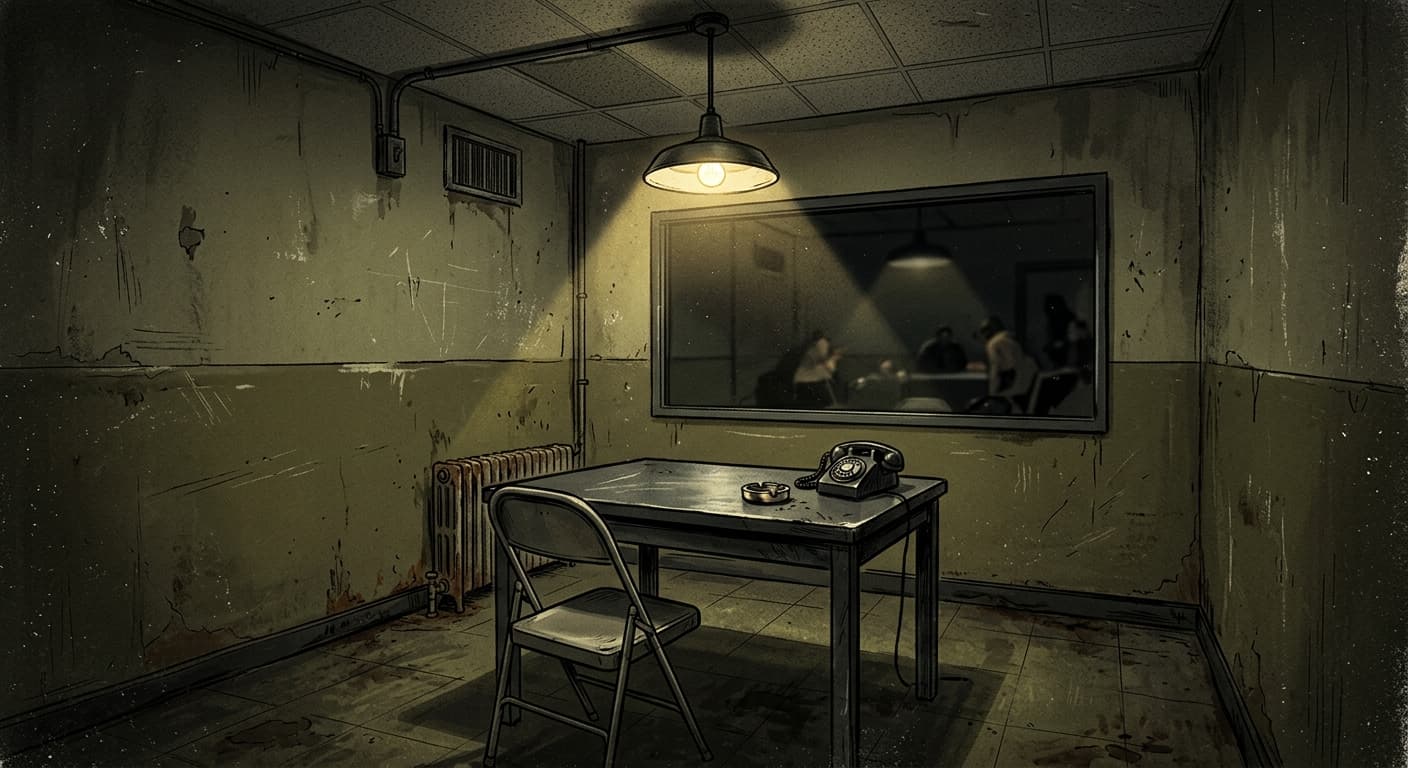
The Interrogation Rooms at Norfolk Police Department
Detective Robert Glenn Ford was the lead investigator in the Norfolk Four case. He had a reputation in the department for being able to get confessions. He had a history, documented after the fact, of using interrogation techniques that were specifically designed to break down resistance: he would lie about the evidence, he would minimize the crime, he would tell suspects that others had already confessed and named them, he would isolate them for hours or days at a time.
Joe Dick was interrogated by Ford for approximately 10 hours. Williams was interrogated for similar periods. Tice and Wilson also faced hours of questioning. In each instance, Ford began by telling the suspect that the police already knew what happened, that the physical evidence proved it, that the victim had been raped, that the suspect's DNA was found at the scene—these claims were, as a matter of objective fact, false. The DNA found at the scene did not match any of the four sailors. But the detectives assured them that it did.
The psychological mechanism of the false confession has been the subject of extensive academic research. Interrogation experts like Kassin, Richard Leo, and others have demonstrated that when a suspect is told that the evidence against them is overwhelming, that the crime is less serious than it appears, that the suspect will be released if they cooperate, and that others have already implicated them, the suspect—particularly a young, intellectually vulnerable, or sleep-deprived suspect—will often begin to internalize the story. The suspect comes to believe that they must have committed the crime, because why would police lie? Why would others name them if they were innocent?
Joe Dick, in his confession, described the rape and murder in detail. Williams did the same. So did Tice. So did Wilson. None of them had actually been there. But the confessions were so detailed, so specific, that prosecutors, juries, and even the men's own defense attorneys found them credible. The confessions contained information about the layout of the apartment, the position of the body, the nature of the wounds—information that detectives had provided to the suspects during interrogation, but which appeared in the confessions as if it were the suspect's own knowledge.
Confession Culture and the Machinery of Credence
Why does the legal system cling so stubbornly to confessions, even against DNA? Part of the answer is doctrinal. Confession jurisprudence in America is built on the voluntariness test of the Fifth and Fourteenth Amendments — a confession is admissible unless police conduct 'overbore the will' of the suspect, a standard so forgiving that lying about evidence, implying leniency, isolating suspects for many hours, and exploiting youth or intellectual limitation have all been held, again and again, to fall within bounds. Courts review the tape of the confession, not the hours that produced the tape, and the appellate record flattens a two-day psychological siege into a few pages of transcript. Part of the answer is institutional. Confessions close cases, clear dockets, and generate conviction statistics; a detective who is good at producing them is, by the metrics of the bureaucracy, a good detective. And part of the answer is human. Jurors cannot imagine confessing to a rape-murder they did not commit, and no instruction from a judge can fully displace that intuition — which is why the only effective protection is keeping contaminated confessions out of the courtroom in the first place, and why the system's refusal to do so is a choice with a body count.
The Norfolk Four case shows the whole edifice at work: voluntariness found despite hours of deception and feed; appellate deference paid to trial-court crediting of police testimony; and a presumption, all the way up the chain, that a man who confessed must have done it. Every level of the review architecture examined the case and let it stand, until the architecture was bypassed entirely by a letter from a prison cell.
The DNA That Nobody Wanted to Hear
Before any trial took place, the Norfolk Police Department conducted a forensic examination of the crime scene and recovered semen from the victim's body. The semen did not match any of the four accused sailors. This information was known to the prosecution. It was known to the defense. And it was presented to the jury. But the confessions were so powerful, so detailed, so apparently impossible to explain except by actual guilt, that the prosecutors argued that the DNA evidence was somehow mistaken, confused, or that a fifth unknown assailant must have been involved.
The theory was absurd on its face. Four men allegedly raped a woman, murdered her, and left DNA—except that no DNA matching any of them was found. The prosecutors argued that the four men must have worn condoms, or that the DNA evidence was somehow contaminated. The jury was asked to believe that four men confessed to a crime that the physical evidence said they did not commit, and that the physical evidence was somehow misleading.
Each of the four men was convicted. They each received sentences ranging from 30 years to life. All went to prison. All maintained their innocence. All told anyone who would listen—lawyers, legal aid organizations, even eventually journalists and activists—that they had not committed the crime, that they had been coerced into confessing, that Detective Ford had fed them the details.
For years, nobody believed them.
The Widow Who Waited
There is one more figure in this story whose patience deserves the record. Michelle Moore-Bosko's mother, Carol Moore, spent years believing the four sailors had killed her daughter — because the Commonwealth of Virginia told her so, with confessions as proof. When the Ballard confession surfaced, the Moore family did not do the easy thing, which would have been to cling to the old verdicts. They asked questions. They read the file. And they concluded, as the evidence had concluded a decade before anyone would listen, that the men who confessed were innocent and the man who stayed silent was guilty. Carol Moore's public support for the sailors' pardons — a mother saying, in effect, the state lied to me about my daughter's murder — carried a moral authority no advocate could match. The system had not merely failed four sailors; it had failed the victim's family too, using their grief as set-dressing for convictions its own contradictions had already hollowed out. It is a failure worth naming, because it recurs: families of victims are almost never told that the case against the convicted rests on a technique, not a fact. They find out, when they find out, the way everyone else does — by accident, years late.
The Fight for the Governors
Getting Virginia to act took years of organized pressure. The Innocence Project of the National Capital Region and volunteer lawyers from major firms filed clemency petitions and laid the record before a succession of governors. Retired FBI agents, reviewing the file independently, concluded the confessions were coerced and unreliable, and said so publicly. Interrogation experts — including men whose careers were spent extracting real confessions from real killers — examined the transcripts and testified that the Norfolk confessions bore every signature of contamination: the suspects' factual 'knowledge' tracking exactly the details detectives had fed, and matching nothing the police did not already know. In 2006, the Virginia Supreme Court declined relief; direct appeals had been exhausted years earlier on the fiction that a confession is self-validating.
The Truth Comes to Light
In 2005, attorneys working with the Innocence Project and the law firm of WilmerHale took up the sailors' case. Even before then — as early as 1999 — DNA testing of crime-scene evidence had identified a single male contributor who matched none of the four. That profile was run through Virginia's DNA databank, and in 2000 it produced a cold hit: Omar Ballard, a convicted rapist serving a long sentence for another attack. Ballard admitted his guilt to investigators in correspondence from prison — in a March 2005 letter he stated flatly that he alone had raped and killed Michelle Moore-Bosko, and he demanded to be heard when authorities seemed slow to follow up. His account matched the crime scene evidence in ways the sailors' confessions never had. He had done it alone. He had never met any of the four sailors.
When confronted with the DNA evidence, Omar Ballard confessed. His confession was detailed and consistent with the physical evidence at the scene in ways that the boys' confessions never had been. He described the victim's clothing, the position of her body, the nature of the wounds, the items he took from the apartment. He knew things that only the actual killer would know, because he was the actual killer.
With the truth finally undeniable, the Commonwealth of Virginia was forced to confront what had happened. In 2009, Governor Tim Kaine issued conditional pardons to all four men. The pardons were based on the evidence of their innocence, and they freed the men from prison, but they did not expunge their records or declare them not guilty. That required further legal action. In 2011, the Virginia Court of Appeals formally overturned the convictions. In 2013, the men reached a settlement with the city of Norfolk and the police department for approximately $4.7 million.
Detective Glenn Ford, the man who had extracted the false confessions, never faced any discipline for his conduct in the Norfolk Four investigation. He retired from the Norfolk Police Department in 2008 with full honors. In 2010 and 2011, he was convicted in federal court of extortion and wire fraud — for taking hundreds of thousands of dollars in bribes from drug dealers and others in exchange for leniency and information, an unrelated pattern of corruption — and sentenced to twelve and a half years in prison. The criminal justice system caught Glenn Ford for selling his badge, but never for the confessions he manufactured. For those, he has never answered. And no Virginia court has ever held that his interrogations violated the Constitution; the law that failed the four sailors remains, in its essentials, the law today.
The Architecture of the False Confession
What is important to understand about the Norfolk Four case is that it was not an aberration. Detective Ford was not uniquely evil. The prosecutors were not uniquely corrupt. The system functioned exactly as it was designed to function: interrogators were trained to extract confessions, prosecutors were rewarded for securing convictions, judges were reluctant to exclude confession evidence, and juries were inclined to believe that confessions were truthful. Each part of the system worked according to its own logic, and the logic of the system produced the convictions of four innocent men.
The confession is the most powerful evidence in the American courtroom. Jurors are more likely to convict based on a confession than on any other form of evidence, including DNA. This makes intuitive sense—after all, people do not usually confess to crimes they did not commit. But the empirical reality is that false confessions contribute to approximately 25-30% of wrongful convictions. And they are most common when a suspect is young, vulnerable, sleep-deprived, and subjected to interrogation techniques designed to overcome resistance.
The Founders did not anticipate the modern police interrogation. They could not have imagined the psychological pressure techniques that are now standard in American police departments. But they did understand, from their own experience with the Crown's legal system, that a system based on confession was a system designed for abuse. The Fifth Amendment's protection against compelled self-incrimination was a direct response to that understanding. It was meant to protect individuals from being forced to condemn themselves under pressure.
In the Norfolk Four case, the Fifth Amendment's protection was a legal formality. The confessions were technically voluntary—the suspects were Mirandized, they waived their right to counsel, they confessed on video. But they were actually coerced, in the truest sense: men who were told that the evidence proved their guilt, who were isolated and questioned for hours, who were offered the hope of release if they simply told the detectives what they wanted to hear, came to believe that they had no choice but to confess. The law called it voluntary. The reality was compulsion.
What the Founders Knew About Power
The Founders understood something about government that is easy to forget in a time of relative institutional stability: that when the state is given the power to investigate, interrogate, and punish, that power will be abused. Not sometimes. Not in exceptional cases. Consistently, predictably, inevitably. The only question is whether the abuse will be discovered and punished, or whether it will be successful and invisible.
This is why the Constitution is structured the way it is. The protection against self-incrimination. The presumption of innocence. The right to counsel. The right to confront witnesses. The requirement of proof beyond a reasonable doubt. These are not technicalities. They are structural responses to the human capacity for abuse of power. They are attempts to place obstacles in the way of the state's natural tendency toward tyranny.
The Norfolk Four case is a perfect illustration of what happens when those obstacles fail. The men had attorneys. They were read their rights. They were tried before juries. They had a theoretically fair system. And yet, they were convicted based on evidence that the physical evidence flatly contradicted. They were convicted based on confessions that were the product of systematic psychological coercion. They were convicted because the system was designed to produce convictions, not to discover truth.
It is worth noting that the truth only came out because the actual murderer confessed. If Omar Ballard had never been identified, never been caught, never confessed, the four sailors would still be in prison today. The system would have continued to function perfectly well, and the four men would have remained innocent people convicted by lies and psychology. The system's own mechanisms would never have found them.
The Reckoning
In the years since the Norfolk Four case was revealed, some reforms have been attempted. Some police departments have begun to require electronic recording of all interrogations. Some prosecutors' offices have begun to take confession evidence with more skepticism. Some juries have been educated about the phenomenon of false confessions.
But these reforms are piecemeal and insufficient. The interrogation techniques that produced the Norfolk Four confessions are still legal in most jurisdictions. Police officers can still lie about evidence. They can still use isolation and minimization. They can still feed details to suspects. And juries can still convict based on confessions, even when DNA evidence contradicts them. Virginia now records some interrogations; the doctrine that blessed the Norfolk confessions at trial has not been revisited. The next Omar Ballard letter could land tomorrow in a case file where no one is required to read it.
Danial Williams, Joe Dick, Derek Tice, and Eric Wilson spent years in prison—five years, eight years, ten years, longer—before they were released. Williams spent the longest: nearly 12 years. They were released not because the system discovered its own error, but because the actual killer confessed. That is the system's confession: the state had to wait for the real criminal to be caught to discover that it had been wrong.
This should be a source of profound shame for the American legal system. Instead, it is mostly unknown. The Norfolk Four case is studied by wrongful conviction experts and interrogation scholars, but it has not become a household name the way that Central Park Five has. The men are free now, but they carry the stigma of their conviction with them—they were, after all, convicted rapists and murderers in the public record, even if that record is now overturned. They spent their twenties in prison. They will never get those years back.
Twelve Years, and What Was Taken
Danial Williams, Joe Dick, Derek Tice, and Eric Wilson spent between roughly eight and nearly twelve years in prison — Williams the longest. They were released not because the system discovered its own error, but because the actual killer confessed, and because years of lawyers, journalists, and exoneree advocates finally made denial untenable. That is the system's confession: the state had to wait for the real criminal, and then for an army of volunteers, to discover that it had been wrong.
And even then, the liberation was incomplete for years more. The conditional pardons of 2009 freed the bodies and kept the brand: three men walked out with sex-offender registration obligations and felony records for a crime committed by a man the state had identified in its own databank in 2000. Wilson, already out, lived under registration rules for a rape Omar Ballard committed. The absolute pardons of 2017 finally closed the legal file. The file had been open for twenty years.
This case should serve as a warning. Confession evidence is not reliable. Interrogation techniques designed to overcome resistance produce false confessions. The presumption of innocence is not a technicality — it is the only protection against the state's power to condemn the innocent. And the system, as currently designed, is not capable of discovering its own mistakes. It requires outside intervention, luck, and the conscience of the actual criminal to set men free. That is not justice. That is tragedy.
The Founders understood that unchecked government power was the greatest threat to liberty. The Norfolk Four case is proof that they were right. When the state is given the power to investigate, interrogate, and condemn, and when the people are told that they have a right to a fair trial but the trial is conducted within a system designed to produce convictions, the result is exactly what happened to four sailors in Norfolk: innocent men in prison, a guilty man free, and a legal system that performed exactly as it was designed to perform, to the eternal detriment of justice.