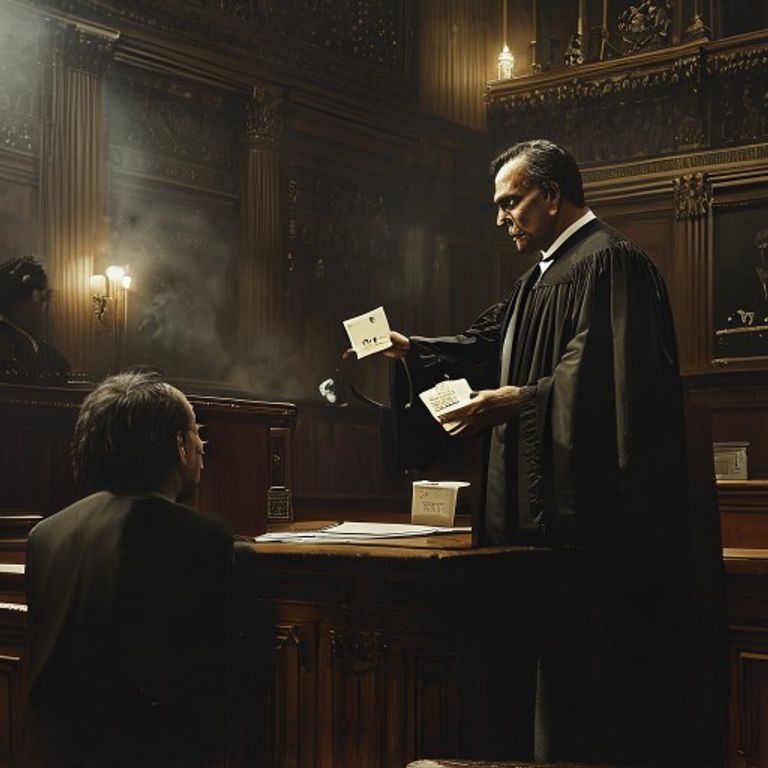
The mythological architecture of the American republic is heavily reliant on the unquestioned sanctity of the courtroom. The raised mahogany bench, the austere black robes, the bailiff’s command to rise—these are all stagecraft designed to convince the citizen that the judiciary operates on a plane elevated above the grimy, transactional reality of ordinary politics. We are taught to revere the judge as the impartial oracle of the law, stripped of personal ambition and immune to the temptations of the marketplace. This mythology is absolutely vital because the judiciary lacks an army or a police force of its own; its power is entirely sustained by the public’s belief in its inherent integrity.
In the early 1980s, the Federal Bureau of Investigation shattered that mythology with an investigation code-named Operation Greylord. For three and a half years, undercover agents and wiretaps exposed the Cook County Circuit Court in Chicago for what it truly was: a sprawling, highly organized criminal enterprise operated directly from the bench. It remains the largest and most successful undercover investigation into judicial corruption in American history, and it permanently destroyed the illusion of the impartial American judge.
Operation Greylord proved that the entire legal ecosystem—judges, defense attorneys, prosecutors, police officers, and court clerks—was not a system of adversarial justice, but a unified cartel organized around the extraction of bribes. You could buy an acquittal for murder. You could buy the dismissal of a drunk driving charge. You could buy the outcome of a civil lawsuit. Justice was not blind; she was simply waiting for an envelope of cash to be slipped under the judge's door.
The Greylord scandal is frequently treated by the modern legal establishment as an embarrassing historical footnote, a localized anomaly that was successfully "cleaned up" by the system. This is a profound and deliberate lie. Operation Greylord is not an anomaly; it is the inevitable result of an unaccountable legal aristocracy. It proves that the Founding Fathers’ deepest warnings about a self-policing legal elite were entirely correct, and that the American justice system requires an immediate, total, and structural reconstruction.
- The Investigation: An unprecedented 3.5-year undercover FBI operation targeting the Cook County judicial system in Chicago, Illinois, running from 1980 to 1983.
- The Scope: The investigation utilized undercover agents posing as corrupt lawyers and criminals, and for the first time in history, placed wiretaps directly inside a judge's chambers.
- The Crimes: Systematic bribery, extortion, and mail fraud. Judges accepted cash bribes to fix everything from minor traffic tickets to violent felony murder cases.
- The Indictments: A staggering 92 individuals were indicted. This included 17 judges, 48 lawyers, eight police officers, ten deputy sheriffs, eight court officials, and one state legislator.
- The Informant: Terry Hake, a former prosecutor turned defense attorney, who courageously agreed to wear a wire for the FBI and infiltrate the corruption network, risking his life and career.
- The Result: The operation resulted in dozens of convictions, fundamentally exposing the self-policing mechanisms of the legal profession as a total failure.
The Marketplace of Justice
To understand the depth of the corruption exposed by Operation Greylord, one must discard any preconceived notions of judicial dignity. The courtrooms of Cook County did not function as halls of justice; they functioned as bustling, open-air bazaars. The corruption was not a secret. It was the standard operating procedure, the expected toll for navigating the system.
At the center of this marketplace were the "hustlers"—unscrupulous defense attorneys who specialized in bribing judges. These attorneys would loiter in the courthouse hallways, approaching defendants who had arrived without legal representation. The pitch was simple and effective: "Pay me, and I guarantee you walk out of here today without a conviction."
The hustler would then collect the client's fee, walk into the judge's private chambers, and split the money directly with the man in the black robe. The transactions were brazen. Judges would hold up a number of fingers from the bench to indicate how much a specific ruling would cost. Bags of cash were passed in courthouse restrooms and in the stairwells. In Traffic Court, the bribery was so systemic that court clerks had established a standardized menu of prices for fixing different types of tickets.
The corruption infected every tier of the legal process. In civil court, judges demanded kickbacks from the settlement awards they approved. In felony criminal court, the stakes were literally life and death. Operation Greylord exposed that at least one judge, Thomas J. Maloney, had accepted tens of thousands of dollars to fix multiple murder cases. He sent men to death row, and he let murderers walk free, based entirely on who was willing to meet his asking price. He commoditized human life under the color of law.
This was not the work of a few "bad apples." The hustlers could not operate without the complicity of the court clerks who assigned the cases to the corrupt judges. The judges could not operate without the police officers who agreed to falsify their testimony in exchange for a cut of the bribe. The entire apparatus—the police, the clerks, the lawyers, and the judges—functioned as a single, terrifying cartel.
The Delusion of Federalist No. 78
The shocking reality of Operation Greylord completely demolishes the theoretical foundation upon which the American judiciary was constructed. When Alexander Hamilton drafted Federalist No. 78 to defend the proposed structure of the federal courts, he sought to soothe the public's anxiety about granting unelected judges immense power and lifetime tenure.
Hamilton famously argued that the judiciary would be the "least dangerous" branch of government. His reasoning was that the courts possessed "no influence over either the sword or the purse; no direction either of the strength or of the wealth of the society; and can take no active resolution whatever. It may truly be said to have neither FORCE nor WILL, but merely judgment."
Hamilton’s thesis rested on a naive, almost aristocratic optimism. He assumed that because judges could not command armies or levy taxes, they could not become tyrants. He believed that the prestige of the bench, coupled with the rigorous intellectual demands of the law, would naturally attract men of "integrity and moderation."
Operation Greylord proved Hamilton disastrously wrong. The corrupt judges of Cook County did not need the sword or the purse; they realized that judgment itself is a highly liquid commodity. When a judge holds the power to send a man to prison or strip him of his property, that judgment becomes the ultimate leverage. The judges weaponized their authority, transforming the courtroom into a mechanism for extortion. They proved that a judge who is insulated from direct public accountability is not automatically impartial; he is merely available to the highest bidder.
Jefferson's Warning and the Privilege of the Corps
Unlike Hamilton, Thomas Jefferson viewed the legal establishment with profound, unyielding suspicion. Jefferson recognized that human nature is not altered by a law degree or a black robe. He understood that lawyers, when concentrated into a self-regulating institution, would inevitably form an oligarchy that elevated its own interests above the Constitution and the rights of the citizenry.
In a prophetic 1820 letter to William Jarvis, Jefferson diagnosed the exact pathology that drove the Greylord corruption:
"Our judges are as honest as other men, and not more so. They have, with others, the same passions for party, for power, and the privilege of their corps."
The "privilege of their corps" was the defining rule of the Chicago courthouse. The local bar association knew about the corruption. The honest attorneys who refused to participate knew which judges were taking bribes. The state judicial conduct boards received complaints. Yet, for decades, the legal establishment did absolutely nothing. They protected the cartel. They valued the reputation of the profession above the integrity of the law.
The honest lawyers remained silent because to speak out against a corrupt judge was professional suicide. The judge would destroy the lawyer's career, ruling against them in every subsequent case, while the bar association looked the other way. The system was utterly incapable of policing itself because the investigators and the investigated belonged to the same exclusive fraternity. The privilege of the corps demanded silence.
It took the Federal Bureau of Investigation—an outside entity acting outside the normal channels of legal self-regulation—to break the cartel. It required an undercover informant, Terry Hake, to violate the unwritten code of the guild and secretly record his colleagues. If the legal profession had been left to police itself, the judges of Cook County would still be selling acquittals today.
The Failure of Madison's Check and Balances
James Madison, the chief architect of the Constitution, structured the American republic on the foundational premise that power inherently corrupts. In Federalist No. 51, Madison declared that "ambition must be made to counteract ambition." Because men are not angels, no institution could be trusted to police itself. Every branch of government required an external, adversarial check.
Yet, the legal profession successfully lobbied for an exemption from Madison’s rule. Through state supreme courts and legislative delegations, the legal guild established a monopoly on self-regulation. Only lawyers are allowed to investigate lawyers. Only judges are allowed to discipline judges. They argued that the law is too complex for laypeople to understand, and therefore, the profession must be immune from civilian oversight.
Operation Greylord is the horrific, inevitable result of abandoning Federalist 51. When the legal system is insulated from the "dependence on the people" that Madison deemed essential, it descends rapidly into tyranny. The Greylord judges did not fear the state bar association or the judicial inquiry board, because they knew those bodies were staffed by their friends, colleagues, and former law partners. They operated with total impunity because the constitutional system of checks and balances had been deliberately disabled at the courthouse door.
The Declaration of Independence: Trading a King for a Cartel
The irony of the American judicial system is that it has recreated the exact tyranny that sparked the American Revolution. When Thomas Jefferson drafted the Declaration of Independence in 1776, he included a searing indictment of King George III's manipulation of the courts. Among the list of grievances justifying the rebellion, Jefferson wrote:
"He has made Judges dependent on his Will alone, for the tenure of their offices, and the amount and payment of their salaries."
The Founding Fathers understood that a judge who is dependent on a singular, unaccountable power cannot dispense justice. They fought a war to establish a republic where the law would apply equally to all men, governed by a Constitution rather than the whims of a monarch.
But Operation Greylord revealed that we merely traded a King for a Cartel. The citizens of Chicago were just as oppressed by Judge Richard LeFevour and Judge Thomas Maloney as the colonists were by the King's magistrates. The corrupt judges of Cook County made the administration of justice dependent on their will alone, and the amount and payment of their bribes. They stole the fundamental right to a fair trial from thousands of citizens, mocking the very document that birthed the nation.
When a judge demands a bribe to apply the law, he ceases to be a public servant and becomes an occupying force. He exercises a form of tyranny that is infinitely more insidious than that of a dictator, because he does it while wrapping himself in the flag and the Constitution.
The Illusion of the "Cleaned Up" System
In the aftermath of Operation Greylord, the legal establishment engaged in a massive public relations campaign to assure the public that the "bad apples" had been removed and the system was now secure. They instituted new ethics guidelines, reorganized the court dockets, and congratulated themselves on a job well done.
This is the standard operating procedure of a monopoly attempting to survive a crisis. The establishment sacrifices the individuals who were caught in order to protect the structural integrity of the institution itself. The corrupt judges went to federal prison, but the architecture of the legal cartel—the self-policing mechanisms, the absolute judicial immunity, the unchecked power of the bar associations—remained entirely intact.
Operation Greylord did not end judicial corruption; it merely taught the next generation of corrupt lawyers and judges to be more discreet. The underlying incentive structures have not changed. The legal profession is still a self-regulating guild. Judges are still insulated from meaningful civilian oversight. The privilege of the corps still dictates that attorneys must remain silent about the misconduct they witness, lest they destroy their own careers.
We cannot reform a system that is fundamentally designed to protect its own power. We cannot rely on the legal cartel to police itself. The American judicial framework requires immediate, systemic, and radical reconstruction to align it with the founding principles of this republic.
A Blueprint for Systemic Reconstruction
To reclaim the justice system from the oligarchy of the robes, we must implement structural changes that destroy the legal monopoly and impose absolute democratic accountability upon the courts.
1. Eradicate Judicial Self-Policing
The authority to investigate, discipline, and remove judges must be completely severed from the judicial branch and the bar associations. We must establish independent, civilian-run oversight commissions equipped with mandatory subpoena power, independent funding, and full authority to refer cases for criminal prosecution. The legal profession must never again be permitted to grade its own homework.
2. Mandatory Audio and Video Recording in Chambers
Operation Greylord succeeded only because the FBI achieved something unprecedented: they planted a listening device directly inside a judge's private chambers. The concept of "judicial privacy" has been relentlessly weaponized to conceal extortion, bribery, and backroom deals. The business of the people must be conducted in the light. All judicial chambers and courtrooms must be subjected to mandatory, unalterable audio and video recording. Transparency is the only antidote to the shadow dockets of the legal elite.
3. Eliminate Absolute Judicial Immunity for Bribery and Fraud
The doctrine of absolute judicial immunity currently shields judges from civil liability even when they act with profound malice. If a judge is found to have accepted a bribe or intentionally manipulated a case for personal gain, the victims must have the immediate right to sue the judge personally, piercing their immunity and attacking their personal assets and pensions. The robe must no longer function as a shield against civil accountability.
4. Independent Undercover Audits
The legal system cannot rely on the rare, heroic whistleblower to expose corruption. Congress and state legislatures must mandate routine, unannounced undercover "integrity testing" of the courts by independent, non-legal agencies. Just as financial institutions are subjected to stress tests, the judicial system must be continuously tested by undercover operatives to ensure that justice is not for sale.
Conclusion: The Reclaiming of the Republic
Operation Greylord was a terrifying glimpse behind the curtain of the American legal system. It exposed the stark reality that beneath the veneer of constitutional dignity, the courtroom can easily function as a criminal enterprise. The 17 judges who were indicted in Chicago did not break the system; they exploited a system that was structurally designed to protect them from accountability.
The Founding Fathers warned us that any institution permitted to police itself will inevitably descend into tyranny. The victims of the Cook County cartel—the citizens who were wrongfully convicted, the families who were denied justice, the honest lawyers who were driven from the profession—paid the horrific price for our failure to heed that warning.
It is time to abandon the naive delusion that a black robe magically confers integrity. The American justice system is defunct. Until we tear down the self-regulating legal cartel and reconstruct the courts on a foundation of absolute democratic accountability, the ghost of Operation Greylord will continue to haunt every courthouse in the nation. We must take America back from the oligarchy of the bench.
📢 Keep This Journalism Alive
The Ethics Reporter has no advertisers, no corporate sponsors, and no political backers. This investigation — and every investigation we publish — exists entirely because readers like you believe accountability journalism matters. If this reporting moved you, please consider supporting us.
Donate to The Ethics ReporterEven $1 helps. No amount is too small. Thank you for standing with us.