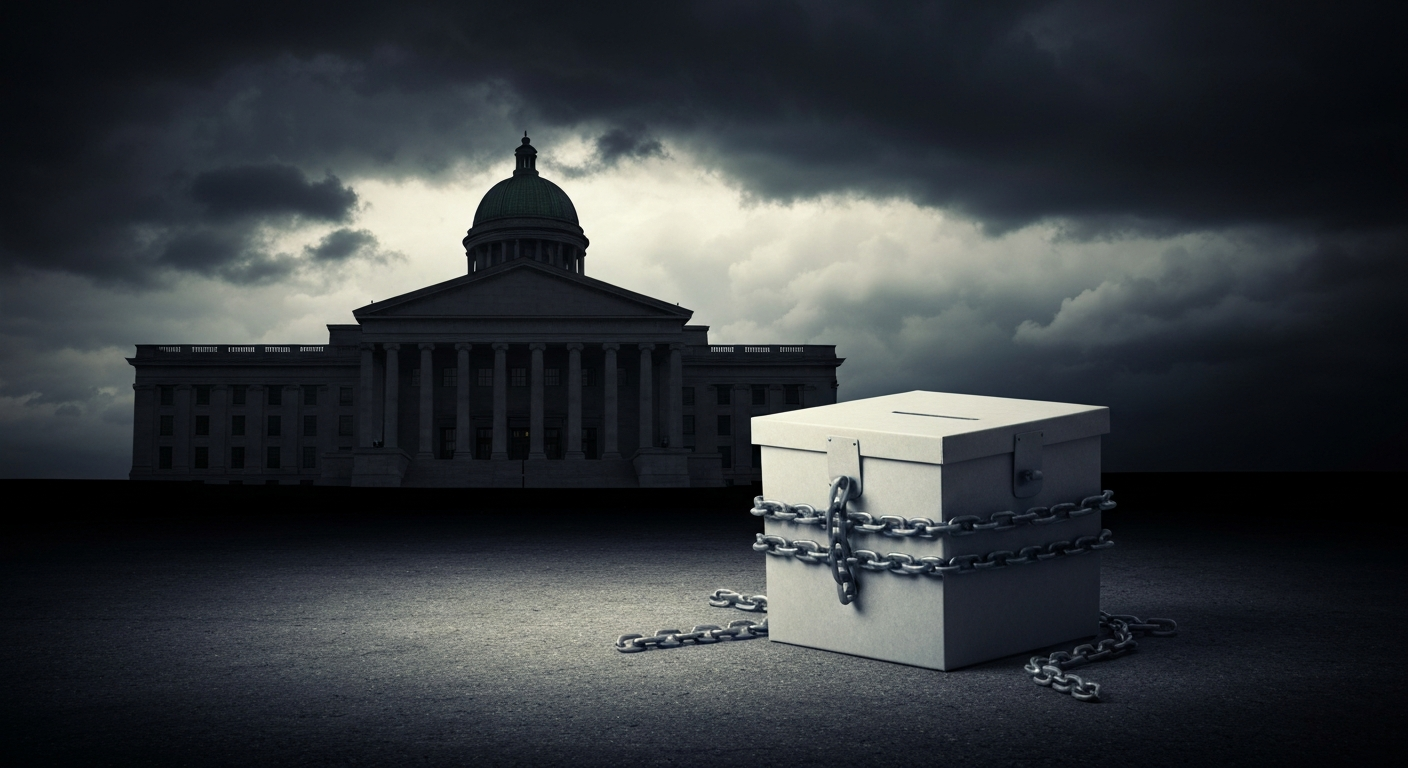
On January 7, 2022, a Shelby County, Tennessee judge sentenced a Black woman named Pamela Moses to six years, one month, and fifteen days in prison — a sentence far exceeding the punishment for many violent felonies — for the act of filling out a voter registration form. Moses, a community activist and outspoken critic of the Memphis Police Department, had not cast a fraudulent ballot. She had not organized a conspiracy to undermine an election. She had not defrauded anyone of anything. She had made an administrative error: she registered to vote while still technically on felony probation, a status she had every reason to believe had already expired. For this clerical mistake, Amy Weirich — the Shelby County District Attorney, a prosecutor who had already been publicly censured by the Tennessee Supreme Court for misconduct in a separate capital case — pursued Pamela Moses with the full, grinding machinery of state power.
The Pamela Moses case is not an anomaly in the American criminal justice landscape. It is an emblem. It represents the precise, lethal convergence of forces that destroy lives in the United States every single day: a prosecutor whose ambitions and personal animosities override their constitutional duty; a system that provides the apparatus of the state as a weapon against political dissidents and community activists; a culture of absolute prosecutorial immunity that renders misconduct effectively risk-free; and a national media apparatus that initially treated the grotesque sentence as a three-day news cycle rather than the institutional catastrophe it was. What happened to Pamela Moses in Shelby County is what happens when the justice system works exactly as it was designed to work for the people it was designed to work against.
Quick Facts: The Prosecution of Pamela Moses
- The Defendant: Pamela Moses, a Memphis, Tennessee community activist and vocal critic of the Memphis Police Department.
- The Charge: Fraudulent voter registration — a Class E felony in Tennessee — after Moses registered to vote while allegedly still on felony probation for a 2015 assault conviction.
- The Sentence: Six years, one month, and fifteen days in state prison — more time than many violent felons receive.
- The Prosecutor: Amy Weirich, Shelby County District Attorney, who had previously been publicly reprimanded by the Tennessee Supreme Court for Brady violations in the capital case of State v. Noura Jackson.
- The Key Evidence Problem: A probation officer falsified or manipulated documents central to the prosecution's case, rendering the entire proceedings constitutionally defective.
- The Outcome: In February 2022, just weeks after the jaw-dropping sentence landed, Judge Jennifer Mitchell vacated the conviction and ordered a new trial. Moses had already spent months in jail.
- Accountability for Weirich: None. Zero. She continues to serve as Shelby County DA with her prosecutorial immunity fully intact.
Who Is Pamela Moses, and Why Did the State Want Her Silenced?
To understand the prosecution of Pamela Moses, you must first understand who Pamela Moses is — because context matters enormously when examining why a DA's office devotes the resources necessary to pursue a six-year prison sentence over a voter registration form. Moses is not a career criminal. She is not a violent offender. She is not someone who had preyed upon her community or who presented a danger that required decades of incarceration to neutralize. She is an activist. A loud, unapologetic, frequently inconvenient activist who had the audacity to stand on street corners in Memphis, Tennessee and demand that the government be held accountable for its treatment of Black citizens.
Moses had been involved in local politics and community organizing for years. She was a visible presence at city council meetings, police accountability forums, and public demonstrations. She had run for public office multiple times — including a 2018 campaign for mayor. She used social media, public appearances, and her sheer force of personality to draw attention to police violence, mass incarceration, and the disparate treatment of Black Memphians by the very legal system that would eventually be turned upon her. In 2015, Moses had pleaded guilty to aggravated assault charges stemming from a domestic dispute. She received a suspended sentence and was placed on probation — a period of supervision that carries with it a suspension of voting rights under Tennessee law.
The critical question at the heart of the Moses prosecution is deceptively simple: Was she still on probation when she registered to vote? Moses maintained, with compelling supporting evidence, that she had every reason to believe her probation had been discharged. She had received documentation suggesting her probationary period was over. She had, by her own account, sought clarification from the probation office and was given paperwork — paperwork that she understood to indicate that her supervision had ended. Acting on this understanding, she registered to vote. This is not the behavior of a woman engaged in an audacious conspiracy to subvert democratic elections. This is the behavior of a woman navigating an incomprehensible bureaucratic maze and trying to exercise the most fundamental right of citizenship.
The Amy Weirich Pattern: A Career Built on Misconduct
Amy Weirich did not arrive at the Pamela Moses prosecution with clean hands. She arrived as a prosecutor who had already been publicly called out — by the highest court in the state of Tennessee — for serious misconduct in a separate, high-profile case. To understand the Moses prosecution, one must understand the Noura Jackson case and what it reveals about Weirich's prosecutorial character.
Noura Jackson was convicted in 2009 for the 2005 stabbing death of her mother, Jennifer Jackson, in Memphis. It was a deeply contested case built substantially on circumstantial evidence. During the trial, Weirich — then a prosecutor, not yet DA — committed a stunning violation that the Tennessee Supreme Court would later address directly. In her closing argument, Weirich pointed to Jackson and demanded, "Tell me, why? Just tell me why." This was a direct comment on Jackson's decision not to testify — a gross and unconstitutional violation of the defendant's Fifth Amendment right against self-incrimination. The Tennessee Supreme Court later found that Weirich's remarks were constitutionally improper.
But the court's finding on the closing argument was not even the most serious issue in the Jackson case. Weirich's office had also failed to disclose a key piece of exculpatory evidence: a statement from a friend of Noura Jackson who had reportedly informed investigators about statements Jackson made near the time of the murder. The suppression of this material constituted a textbook Brady v. Maryland violation. In 2014, the Tennessee Supreme Court vacated Jackson's conviction and granted a new trial. Weirich, rather than being sanctioned or facing any meaningful professional consequences, was later formally reprimanded by the Tennessee Supreme Court — a reprimand that functioned, in the practical world of political legal culture, as little more than a speeding ticket. Jackson ultimately pleaded guilty to a reduced charge in 2016 and was released.
This is the context in which Amy Weirich's office prosecuted Pamela Moses. A prosecutor publicly censured by her state's highest court for constitutional violations, who went on to be repeatedly re-elected as District Attorney, and who now wielded the power to pursue a six-year sentence against a Black activist for a clerical error on a voter registration form. The Tennessee Supreme Court's reprimand proved to be not a deterrent, but an irrelevance.
"Power naturally grows. Why? Because human passions are insatiable. But that power alone can grow which already is too great; that which is unchecked; that which has no equal power to control it."
— John Adams, Letter to Thomas Jefferson (1787)
The Fabricated Evidence: A Probation Officer in the Heart of the Case
The prosecution of Pamela Moses collapsed not because the defense mounted an overwhelmingly compelling factual case at trial — though the factual case was always deeply problematic — but because the evidence used to secure her conviction was itself corrupted at the source. The central issue that led Judge Jennifer Mitchell to vacate Moses' conviction involved a probation officer who had allegedly manipulated or fabricated documents that the prosecution relied upon to establish that Moses knew she was still on active probation when she registered to vote.
The mechanics of this manipulation were this: Moses' defense rested heavily on her claim that she had been given documentation indicating her probation had ended, or at minimum, that she was operating under a sincere and reasonable belief that it had ended. The prosecution's ability to counter this narrative — to prove that Moses knew she remained on active probation — was therefore critical. The probation records that established the continuity of her supervision became the linchpin of the entire case.
After the initial sentencing, it emerged that the probation officer associated with Moses' case had signed off on documentation in a manner that was potentially fraudulent. Specifically, concerns arose about whether the officer had backdated or otherwise manipulated records in a way that falsely bolstered the prosecution's theory that Moses had been continuously on active probation at the time of her voter registration. When these concerns came to light, the integrity of the entire evidentiary foundation of the prosecution crumbled. On February 18, 2022 — less than six weeks after handing down her bombshell sentence — Judge Jennifer Mitchell vacated the conviction and ordered a new trial, finding that the prosecution had presented false evidence to the jury, and that this rendered the trial so fundamentally unfair as to require a new proceeding.
Let that sequence of events sink in. The Shelby County District Attorney's office, led by a prosecutor already publicly censured for misconduct, had secured a six-year prison sentence for a Black activist by relying on evidence that a judge subsequently found was tainted by fraud. Moses had already spent months in jail awaiting trial and incarcerated post-sentencing. The state had already destroyed significant portions of her life: her ability to care for her family, to pursue her activist work, to maintain her employment, to live in freedom. And when the fabricated nature of the central evidence came to light, Amy Weirich's office faced no criminal prosecution for presenting false evidence. No one was disbarred. The DA's office issued no public apology to Pamela Moses.
The Criminalization of Voter Registration: A Historic Weapon
To fully appreciate the depravity of the Moses prosecution, it is necessary to step back and examine it within the long, brutal history of the criminalization of Black voting in the American South. The specific mechanism used against Moses — the use of felony disenfranchisement to strip voting rights, and then the criminal prosecution for attempting to exercise those rights — is not a modern innovation. It is a direct descendant of the post-Reconstruction legal architecture specifically designed to prevent Black Americans from participating in democracy.
Following the Civil War and the ratification of the Fifteenth Amendment in 1870, the former Confederate states faced a constitutional prohibition on using race as an explicit disqualification from voting. Their response was elegant in its cruelty: they built a comprehensive system of laws designed to criminalize the ordinary behavior of Black citizens and then use those convictions as the pretext for disenfranchisement. Vagrancy laws, "black codes," poll taxes, literacy tests, and the mass incarceration of Black men for minor or manufactured offenses all fed directly into the felony disenfranchisement machine. By the late nineteenth and early twentieth centuries, the laws were not explicitly racial, but their application was. Black men were arrested, convicted of felonies at rates wildly disproportionate to their white counterparts, stripped of their voting rights, and then prosecuted again if they attempted to reclaim those rights.
Tennessee's felony disenfranchisement laws, like those of many southern states, maintain this legacy. A state with a history of aggressive criminalization of its Black population maintains aggressive rules about when and how those criminal convictions are purged from the voting rolls. The bureaucratic maze that Pamela Moses was navigating — the confusion about whether her probation had ended, the paperwork she believed discharged her supervision, the voter registration she filled out in good faith — exists precisely because Tennessee's system is deliberately complicated. A system that is easy to navigate is a system that is easy to use. A system riddled with traps is a system that can be used to prosecute people like Pamela Moses.
This historical context does not mean that Amy Weirich sat in her office consciously channeling the spirit of nineteenth-century voter suppression architects. It means that she prosecuted Moses within a system that was built for this purpose, using tools that were designed for this purpose, producing an outcome that the system was designed to produce. Institutional racism does not require individual racists actively plotting to disenfranchise. It requires institutions built to disenfranchise, operated by individuals who do not question the purpose or effect of those institutions.
The Magnitude of the Sentence: Proportionality as Constitutional Promise and Political Fiction
The Eighth Amendment to the United States Constitution prohibits cruel and unusual punishment. The prohibition on punishment disproportionate to the offense is a foundational principle of the Anglo-American legal tradition, tracing back to the Magna Carta of 1215. The Supreme Court has repeatedly, if inconsistently, affirmed that grossly disproportionate sentences can constitute Eighth Amendment violations. And yet, across the American criminal justice landscape, sentences of breathtaking severity are routinely imposed for offenses that cause minimal social harm, while violent actors who possess the right connections, the right skin tone, and the right economic resources receive comparative leniency.
The sentence of six years, one month, and fifteen days handed down to Pamela Moses exists in a universe of its own grotesque logic. Under Tennessee law, Class E felonies — the category into which fraudulent voter registration falls — carry a sentence range of one to six years. Weirich's prosecution had pushed for the maximum. The sentencing judge, following the jury's guilty verdict, obliged with the kind of thoroughness one generally reserves for violent predators. Six years for filling out a form. Six years for attempting to exercise the franchise.
Consider what six years in Tennessee state prison means for a human being. It means separation from children, if any exist. It means the destruction of employment, career, and professional relationships. It means submitting to the physical and psychological violence of mass incarceration — the strip searches, the constant surveillance, the loss of autonomy over every aspect of daily life. It means emerging from prison as a convicted felon, with all the collateral consequences that designation carries: difficulty finding employment, housing, and education; the loss of civil rights; the social stigma that functions as a permanent, informal sentence running concurrently with the formal one. And in Moses' case, it would have meant the silencing of one of the most vocal critics of the Memphis legal establishment.
Meanwhile, white-collar criminals who steal millions from the public treasury receive probation. Police officers who beat unarmed citizens receive suspensions. Prosecutors who suppress exculpatory evidence receive reprimands. The Eighth Amendment's promise of proportionality is, in practice, applied with a thumb firmly on the scale — and the thumb always presses down on the same side.
"I know no safe depository of the ultimate powers of the society but the people themselves; and if we think them not enlightened enough to exercise their control with a wholesome discretion, the remedy is not to take it from them, but to inform their discretion by education."
— Thomas Jefferson, Letter to William Charles Jarvis (1820)
National Reaction and the Media's Failure of Proportionality
When the sentence was announced in January 2022, it briefly penetrated the national consciousness. The story had obvious gravity: a Black woman activist sentenced to more than six years in prison for a voter registration form. Civil rights organizations condemned the sentence immediately and forcefully. The NAACP Legal Defense Fund called it a gross miscarriage of justice. Social media exploded with outrage. For approximately seventy-two hours, Pamela Moses was the face of a systemic crisis.
And then the cycle moved on. When the conviction was vacated six weeks later, many outlets treated the vacatur as a resolution — the system corrected itself, the crisis is over, nothing to see here. This framing is precisely the kind of institutional gaslighting that allows systemic prosecutorial misconduct to persist across decades. The system did not correct itself. A judge, responding to evidence that the prosecution had used fraudulent documents, had no choice but to vacate the conviction. That is not the system working as intended; that is the system being caught in the act and being forced to retreat. The system had already inflicted the months of pre-trial detention, the psychological trauma of the trial, the horror of a six-year sentence, and the destruction of Moses' public life as an activist. The vacatur undid the formal conviction; it could not undo any of the actual harm.
Furthermore, the vacatur was not a finding of innocence. It was a finding that the trial was fundamentally unfair because of tainted evidence. The state retained the option — and for a period exercised it — of retrying Moses on the original charges. The specter of re-prosecution hung over Moses even after she walked out of jail. The DA's office ultimately dropped the charges in 2023, but only after years of legal proceedings, public pressure, and the sustained advocacy of civil rights organizations. Moses spent years of her life fighting for the right to exist in freedom over a voter registration form.
Amy Weirich: The Mechanics of Prosecutorial Impunity
Amy Weirich's career is a case study in how prosecutorial impunity functions in the modern American legal system. She was publicly reprimanded by the Tennessee Supreme Court for unconstitutional misconduct. Rather than facing professional sanctions, she was subsequently re-elected as District Attorney by the voters of Shelby County. Her office then prosecuted Pamela Moses with evidence later found to be tainted by fraud. No charges were brought against Weirich or her prosecutors for presenting false evidence. No civil rights lawsuit could succeed against her, because absolute prosecutorial immunity — the same judicially fabricated doctrine that protected Kevin Crane in Missouri and Harry Connick Sr. in Louisiana — shields her from personal financial liability for her conduct in court.
This is the architecture of impunity in its most naked form. The Tennessee Supreme Court's formal reprimand in the Jackson case served not as a professional death sentence but as a credential — evidence, to Weirich's supporters, that she was willing to fight hard for convictions, perhaps too hard sometimes, but always with a fierce commitment to "justice." The political culture of elected district attorneys in Tennessee, as in so much of the American South, rewards aggressiveness and punishes restraint. Being censured by the Supreme Court for pushing too hard against a defendant is, within this culture, not a disqualifying mark. It is a war wound.
The Weirich pattern illustrates why the existing mechanisms of prosecutorial accountability — bar association oversight, judicial conduct reprimands, the theoretical availability of federal civil rights prosecutions under 18 U.S.C. § 242 — have proven completely inadequate as safeguards against repeat misconduct. State bars are club institutions. They discipline errant members with a reluctance born of professional solidarity and institutional self-interest. The Supreme Court reprimands prosecutors who commit constitutional violations; the reprimands rarely, if ever, result in the termination of a prosecutorial career. Federal civil rights prosecutions of state prosecutors are extraordinarily rare and nearly impossible to sustain, given the demanding intent requirements under Screws v. United States (1945) and its progeny. The net result is that a prosecutor can commit misconduct in one major case, receive a public censure, and then proceed to orchestrate a prosecution saturated with fabricated evidence against an activist in the very next chapter of their career — all without facing a single day in court, a single dollar in personal liability, or a single year without a government paycheck.
Felony Disenfranchisement as a Tool of Political Suppression
The Moses case crystallizes, with terrible clarity, how felony disenfranchisement statutes function not merely as civil-disability laws, but as active instruments of political suppression when wielded by prosecutors with the will and discretion to use them. The criminal prosecution of an individual for attempting to vote — even if that prosecution is legally premised on a genuine violation of disenfranchisement law — must be examined with intense scrutiny when the individual targeted is a vocal political critic of the prosecuting office.
It is not paranoid to observe that Pamela Moses had repeatedly made herself an adversary of the Memphis law enforcement establishment. She had campaigned publicly against the police department. She had run for public office on a platform that directly challenged the interests and priorities of incumbents in Shelby County's legal community. She had a significant, if not enormous, public following. In this context, the decision to pursue the maximum available sentence for a voter registration error is not merely a prosecutorial decision about the facts of a case; it is a political act. It is an exercise of institutional power against a political enemy, dressed in the neutral language of the law.
This is precisely the kind of prosecutorial power that the Founding Fathers feared above all others. They had lived under a system where the Crown's prosecutorial apparatus was deployed selectively against political dissidents — where critics of the government were charged with seditious libel, where patriots were imprisoned on pretextual grounds, where the law was applied not as a neutral standard but as a political cudgel. The Fourth Amendment, the Fifth Amendment, the Sixth Amendment — the entire criminal procedure apparatus of the Bill of Rights — was erected specifically to prevent this kind of weaponized prosecution. And yet, two and a half centuries after the Founders embedded these protections in the Constitution, the prosecutors of Shelby County, Tennessee could march Pamela Moses into a courtroom, present evidence that a judge would subsequently find was tainted by fraud, and secure a six-year sentence — all without any meaningful check on the exercise of their power.
The Absence of Federal Intervention
One of the most striking aspects of the Moses case is what did not happen at the federal level. The U.S. Department of Justice has both the authority and the mandate to prosecute state officials who deprive citizens of their constitutional rights under color of law. 18 U.S.C. § 242, the criminal civil rights statute, provides for federal prosecution when a person acting under color of law willfully deprives another of their constitutional rights. The willful presentation of false or fabricated evidence in a criminal proceeding, resulting in the unlawful imprisonment of a citizen, is exactly the kind of conduct this statute was designed to reach.
The DOJ did not investigate. The Civil Rights Division did not act. The U.S. Attorney for the Western District of Tennessee did not convene a grand jury. The federal government, which possesses unique power to deter prosecutorial misconduct by criminalizing it, elected to watch from the sidelines. This federal inaction is itself a policy choice, and it is a policy choice with profound consequences. It communicates to state prosecutors that the use of fabricated evidence, the pursuit of politically motivated prosecutions, and the systematic abuse of disenfranchised communities will not be met with federal sanction. It communicates that the people who can be most easily destroyed by the justice system — Black women, community activists, people with prior records — are the least likely to receive federal protection from that system's excesses.
The contrast with the federal government's historical appetite for investigating and prosecuting civil rights violations against more politically sympathetic targets is instructive. When prosecutors in Alabama were found to have engaged in politically motivated prosecutions of Republican targets in the Don Siegelman case, the case generated congressional hearings, media scrutiny, and sustained federal attention. When a Black woman activist in Memphis is sentenced to six years on the basis of fabricated evidence, the federal response is silence. The differential application of federal civil rights enforcement is not merely a moral failure; it is itself a form of systemic racial discrimination embedded in the executive branch.
The Collateral Destruction: What Months Behind Bars Actually Means
The vacatur of Pamela Moses' conviction is routinely cited as evidence that the system ultimately worked. This is a comforting lie. It ignores the vast, irreversible damage inflicted on Moses during the period between her arrest and the eventual dismissal of charges. Consider the timeline: Moses was arrested, subjected to pre-trial detention, put through a trial in which false evidence was presented to a jury, sentenced to more than six years in prison, and spent time incarcerated before the conviction was vacated. The formal legal resolution — no conviction, charges eventually dropped — does nothing to restore the months of her life spent in a jail cell.
The collateral consequences of incarceration do not pause while appeals are pending. Employment does not wait. Relationships do not freeze in place. Children do not stop needing their parent. Housing situations do not remain stable. The psychological toll of arrest, prosecution, trial, and imprisonment does not simply evaporate when a judge vacates a conviction. The violence of incarceration — and it is violence, whether or not the criminal justice establishment is willing to use that word — is inflicted in real time, on real bodies, with permanent effects that no subsequent court order can undo.
This is the hidden cost of prosecutorial misconduct that never appears in the official reckoning. The only number the system measures is convictions. The convictions overturned, the cases eventually dismissed, the defendants ultimately vindicated — these are treated as evidence that the system self-corrects. But self-correction after the fact is not justice. It is damage control. It is the fire department arriving after the house has burned down and declaring the emergency resolved because the flames have been extinguished. Pamela Moses' house burned down. Amy Weirich drove away from the smoldering wreckage with her career, her salary, her prosecutorial immunity, and her professional reputation entirely intact.
A Blueprint for Reform: Ending the Culture of Prosecutorial Weaponization
The Pamela Moses case, taken together with the prosecutorial abuses documented across the American legal system, demands not incremental tinkering but structural overhaul. The tools that allowed Amy Weirich to pursue Moses — absolute prosecutorial immunity, weak bar association oversight, the political incentive structure of elected DAs, and the weaponization of felony disenfranchisement — must be dismantled and replaced with a framework that centers accountability. Herewith, a blueprint:
The Reform Blueprint: Ending Prosecutorial Weaponization
- Abolish Absolute Prosecutorial Immunity for Proven Fabrication: Congress must amend 42 U.S.C. § 1983 to eliminate absolute immunity in cases where a prosecutor knowingly presents false or fabricated evidence. This is not a radical proposition. When a private citizen commits fraud to deprive another of their rights, they face criminal prosecution and civil liability. A prosecutor who does the same must face identical consequences. "Qualified immunity" — the standard applied to police officers — should be the maximum protection available to prosecutors, and only in cases of genuine good-faith errors.
- Mandatory Federal Investigation of Post-Vacatur Cases: When a conviction is vacated specifically because of prosecutorial use of false evidence, the DOJ Civil Rights Division must be statutorily required to open an investigation under 18 U.S.C. § 242. The current regime of discretionary non-investigation sends a clear message that state prosecutors can present fabricated evidence with federal impunity. Mandatory investigation eliminates prosecutorial confidence in federal non-intervention.
- Independent Special Prosecutors for Misconduct Allegations: Bar associations cannot continue to serve as the primary disciplinary body for prosecutorial misconduct. Every state must establish an independent office of prosecutorial accountability, staffed by lawyers with no ties to the local DA's office, with full investigative authority and the power to seek criminal indictments against prosecutors who commit civil rights violations. Complaints of fabricated evidence must trigger automatic referral to this office.
- Reform Felony Disenfranchisement Statutes and Create a Safe Harbor: States must dramatically simplify their voter restoration processes and create an explicit statutory safe harbor: no person shall be criminally prosecuted for voter registration if they acted in reliance on written documentation from a government agency indicating their civil rights had been restored. The government created the confusion; the government must bear the legal responsibility for that confusion.
- Proportionality Review Boards for Maximum Sentences on Non-Violent Offenses: States must establish independent review panels to examine any maximum-range sentence imposed for a non-violent, non-person offense. These panels must have the authority to recommend sentence reduction when the sentence is grossly disproportionate to the harm caused and when the prosecutorial record of the office indicates a pattern of selective enforcement.
- Civil Damages from Prosecutorial Misconduct Funds: Because eliminating immunity entirely may face constitutional challenge, states must create mandatory compensatory funds — financed by surcharges on DA office budgets and individual prosecutor bond requirements — from which individuals who are wrongfully prosecuted or imprisoned due to prosecutorial misconduct can be compensated, without needing to pierce personal immunity. When misconduct drains the fund, it creates direct institutional pressure on DA offices to police their own practices.
Conclusion: The Republic Cannot Survive a Weaponized Prosecution
The story of Pamela Moses is, at its core, a story about what happens when the machinery of the state is deliberately aimed at an individual for political reasons and then protected by institutional impunity when it malfunctions. It is a story about the collision between the constitutional promise of equal protection under the law and the social reality of a justice system that applies its full fury selectively, predictably, and along racial and political lines.
Amy Weirich did not invent prosecutorial weaponization. She inherited it, refined it, and deployed it with the confidence of someone who knew that the institutional backstop of absolute immunity and professional solidarity would protect her from any serious consequence. The Tennessee Supreme Court had already told her that her constitutional violations were serious enough to merit formal reprimand. The electorate of Shelby County had told her that her constitutional violations were not serious enough to end her career. She drew the obvious conclusion. And Pamela Moses paid for it.
A constitutional republic cannot coexist with a prosecution machine that can be wielded against political dissidents without consequence. The Founders knew this. James Madison wrote in Federalist No. 51 that the entire constitutional project depended on giving "to those who administer each department the necessary constitutional means and personal motives to resist encroachments of the others." The vision was a system of institutional friction — of checks that actually checked, of balances that actually balanced. What we have instead, in the DA's offices of America, is a concentration of power that the Founders would have recognized immediately as a species of tyranny: unilateral, largely unreviewable, and clothed in the legitimizing language of law.
Pamela Moses is free. The charges against her have been dropped. She continues her activist work in Memphis. But the six-year sentence still exists in the historical record as a monument to what the American justice system is capable of when it is not adequately constrained. It is not enough that she is free. Justice demands that the people who put her in chains face the same system they used against her. Until they do, the promise of equal justice under law remains exactly that: a promise. Undelivered. Unpaid. Written in ink on a courthouse wall while the machinery of selective prosecution grinds on beneath it.
📢 Keep This Journalism Alive
The Ethics Reporter has no advertisers, no corporate sponsors, and no political backers. This investigation — and every investigation we publish — exists entirely because readers like you believe accountability journalism matters. If this reporting moved you, please consider supporting us.
Donate to The Ethics ReporterEven $1 helps. No amount is too small. Thank you for standing with us.