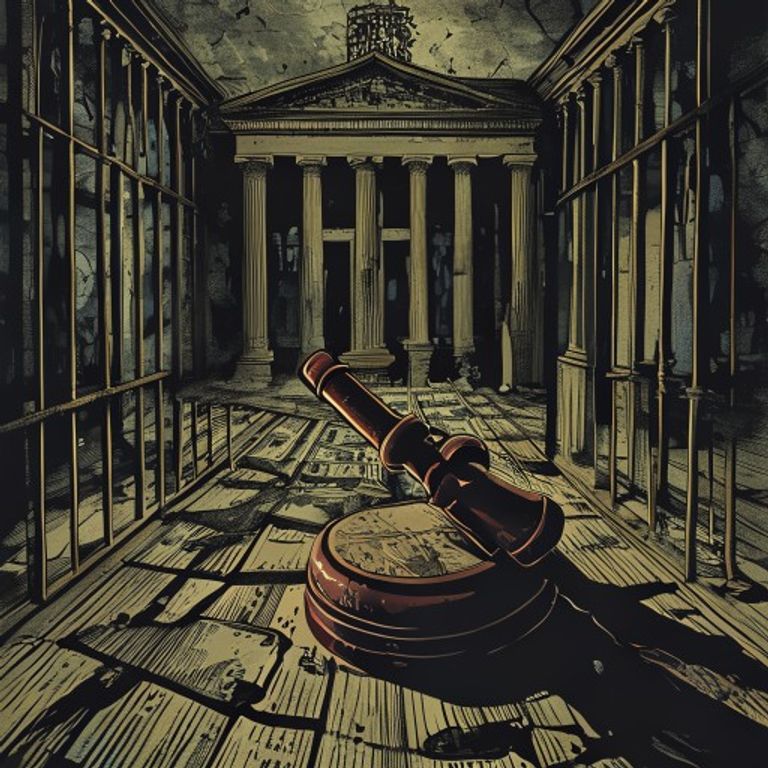
The highest court in Pennsylvania, the oldest appellate court in the nation, was fundamentally compromised not by external threats, but by the very men entrusted to uphold its integrity. In the mid-2010s, a scandal erupted that exposed the deep rot within the Pennsylvania Supreme Court—a rot characterized by the exchange of bigoted, pornographic emails using government servers, self-dealing, and an overarching culture of untouchability. This was not a mere lapse in judgment by a few; it was a systemic failure of a self-regulating judiciary that prioritized the protection of its own over the administration of justice.
Justice Seamus McCaffery and Justice J. Michael Eakin were forced off the bench after the "Porngate" email scandal revealed they had participated in the exchange of highly offensive materials with prosecutors and other members of the legal establishment. The scandal laid bare a terrifying reality: the supposedly impartial arbiters of justice were engaging in frat-boy behavior with the very prosecutors who argued cases before them. This was an incestuous, closed-loop system where justice was an inside joke, and the public was the punchline.
The Founders of the American Republic would have recognized this immediately not as a modern aberration, but as the inevitable consequence of unchecked power. When they debated the structure of the judiciary, their greatest fear was the creation of an unaccountable oligarchy.
The Betrayal of Founding Principles
Thomas Jefferson, a fierce critic of judicial overreach, warned repeatedly of the dangers posed by a judiciary insulated from democratic accountability. He understood that judges, stripped of the veneer of their robes, were merely men susceptible to the same vices and corruptions as any other.
"Our judges are as honest as other men, and not more so. They have, with others, the same passions for party, for power, and the privilege of their corps." — Thomas Jefferson, Letter to William Jarvis, 1820
The "privilege of their corps" is exactly what protected the Pennsylvania justices for so long. The legal establishment in Pennsylvania—the bar associations, the judicial conduct boards—operated as a shield, ensuring that misconduct was handled quietly, if at all. It took an external investigation by the state's Attorney General to bring the email scandal to light. The system could not police itself.
Hamilton's Warning Ignored
Alexander Hamilton, in Federalist No. 78, argued that the judiciary would be the "least dangerous" branch because it possessed "neither force nor will, but merely judgment." However, Hamilton predicated this entirely on the assumption that judges would possess "integrity and moderation."
When the judgment of the highest court is corrupted by bias, fraternization with prosecutors, and an arrogant belief in its own invulnerability, the judiciary becomes extraordinarily dangerous. It ceases to be a court of law and becomes an instrument of power for a privileged elite. The Pennsylvania Supreme Court scandal demonstrated that when the prerequisite of "integrity" is absent, the structural protections designed to ensure judicial independence instead guarantee judicial impunity.
The Necessity of Systemic Reconstruction
The solution to such entrenched corruption cannot be found in mere reforms or updated ethics seminars. The structure of a self-policing legal guild is fundamentally incompatible with the principles of a democratic republic. We require systemic reconstruction.
1. Abolish Self-Policing. Judicial conduct boards must be entirely removed from the control of the legal profession and staffed by a supermajority of civilian members. The public must have the power to investigate and discipline the judges who serve them.
2. End the Secrecy. All complaints and investigations into judicial misconduct must be public. The secrecy that currently shrouds these processes serves only to protect corrupt judges from public scrutiny.
3. Revive Legislative Oversight. State legislatures and Congress must aggressively utilize their powers of investigation and impeachment. The impeachment power was designed to remove officers who violate the public trust; it must be wielded as a routine tool of accountability, not a historical rarity.
The American judicial system is defunct. The Pennsylvania Supreme Court scandal is just one symptom of a disease that infects courts nationwide. Until we strip away the "privilege of their corps" and rebuild the system on a foundation of genuine accountability, the promise of equal justice under law will remain a hollow lie.
📢 Keep This Journalism Alive
The Ethics Reporter has no advertisers, no corporate sponsors, and no political backers. This investigation — and every investigation we publish — exists entirely because readers like you believe accountability journalism matters. If this reporting moved you, please consider supporting us.
Donate to The Ethics ReporterEven $1 helps. No amount is too small. Thank you for standing with us.