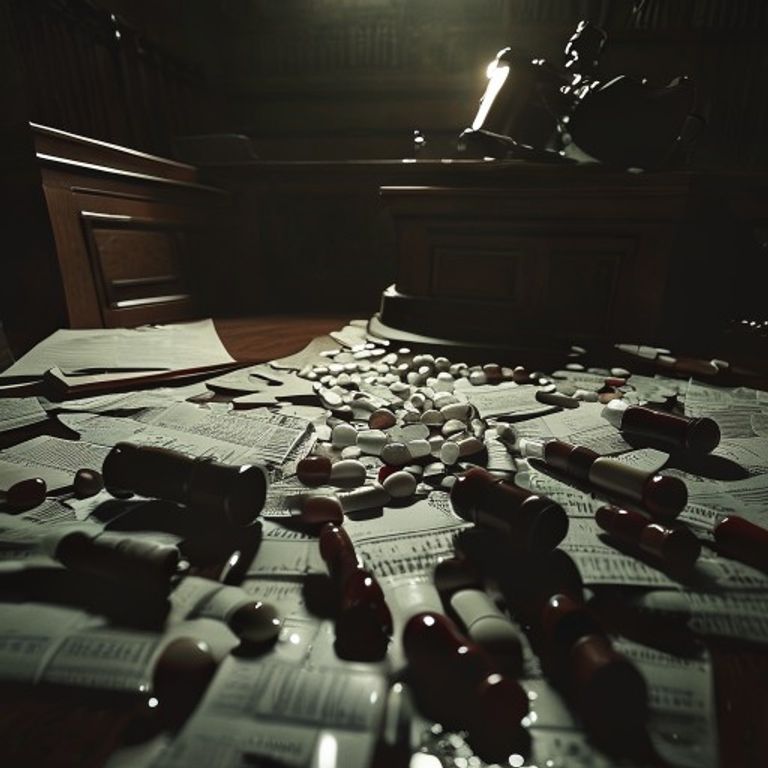
The American courtroom is designed to project an aura of infallible authority. The raised dais, the black robe, the bailiff demanding all to rise—these are architectural and psychological tools meant to reinforce the supremacy of the law. But what happens when the man wearing the robe is completely incapacitated, actively committing felonies from the bench, and exploiting the power of the state to feed his own addictions?
In Knox County, Tennessee, the answer was silence. For years, Criminal Court Judge Richard Baumgartner presided over some of the most complex, violent, and highly publicized murder trials in the state's history while heavily intoxicated on prescription painkillers. He was not merely a functional addict; he was a judicial predator who bought drugs from a convicted felon serving probation in his very own court, engaged in sexual acts with his supplier in his chambers, and manipulated the justice system to protect her from arrest.
The Richard Baumgartner scandal is not a tragedy of personal demons. It is a catastrophic indictment of the American judicial framework. It demonstrates how the self-regulating mechanisms of the legal profession actively cover for compromised judges, placing the "privilege of the corps" above the constitutional rights of the citizens. It proves that the Founding Fathers’ deepest anxieties about an unaccountable legal elite were not theoretical. They were warnings we failed to heed.
- Judge: Richard Baumgartner, Knox County Criminal Court, Tennessee.
- The Misconduct: Presided over high-profile murder trials (including the Christian-Newsom murders) while addicted to prescription pills.
- The Crimes: Bought hundreds of pills from a felon on probation in his court; coerced sex in his chambers; used his official position to shield his supplier from law enforcement.
- The Fallout: His incapacitation led to the overturning of multiple convictions, forcing the state to retry violent offenders and forcing victims' families to relive the trauma.
- The Conviction: Convicted in federal court of misprision of a felony (concealing a crime) and sentenced to 6 months in prison.
Justice Intoxicated: The Christian-Newsom Trials
The depravity of Baumgartner's conduct is best understood through the lens of the cases he oversaw. In 2007, Knoxville was rocked by the horrific carjacking, torture, and murder of Channon Christian and Christopher Newsom. The subsequent trials of the perpetrators were emotionally charged, legally complex, and demanded the utmost judicial competence.
Baumgartner was the presiding judge. During these capital murder trials, Baumgartner was frequently disoriented, slurring his words, and nodding off on the bench. Video evidence from the courtroom captured him appearing utterly incapacitated. Yet, the defense attorneys, the prosecutors, and the court staff—the entire legal apparatus of Knox County—allowed the trials to proceed. The "privilege of the corps" demanded that the illusion of judicial authority be maintained, even if the reality was a man too high to comprehend the objections being raised before him.
Because of Baumgartner's condition, the state supreme court eventually ruled that the defendants had been denied their constitutional right to a fair trial. The convictions were thrown out. The families of Christian and Newsom, who had already endured unimaginable suffering, were forced to endure the agonizing ordeal of retrials. Baumgartner's addiction did not just pervert the law; it actively re-traumatized the victims of horrific violence.
The Predator on the Bench
Baumgartner's drug habit escalated beyond mere consumption. To feed his addiction, he turned to the very people he was tasked with judging. He discovered that a woman on probation in his court—Deena Castleman—had access to prescription pills. Baumgartner began purchasing thousands of pills from her.
The dynamic was fundamentally coercive. A judge wields absolute power over a probationer. Baumgartner exploited this power ruthlessly. He brought Castleman into his private judicial chambers, a space that is supposed to be the inner sanctum of the law, for sexual encounters. When Castleman found herself in trouble with the law in other jurisdictions, Baumgartner used his official title to intervene, calling other judges and law enforcement officers to demand leniency and protect his supplier.
He was running a criminal enterprise from the bench, shielded by the absolute deference that the American legal system grants to its judges.
The Collapse of Madison's Safeguards
James Madison, the architect of the Constitution, understood that power inherently corrupts. In Federalist No. 51, he wrote that "ambition must be made to counteract ambition." The entire American system was designed on the premise that no single branch of government, and no single individual, could be trusted with unchecked power.
But the judicial branch has systematically exempted itself from this foundational rule. The legal profession convinced the public that law is a specialized science, so complex that only lawyers can police lawyers, and only judges can judge judges. We built a system of self-regulation: bar associations and judicial conduct boards staffed entirely by the very guild they are meant to oversee.
The Baumgartner case is a terrifying illustration of the failure of this self-policing model. The rumors of Baumgartner's addiction were an open secret in the Knoxville courthouse. Attorneys saw him nodding off. Clerks observed his erratic behavior. Yet, the Tennessee Court of the Judiciary (the state's disciplinary body at the time) did nothing until a formal TBI (Tennessee Bureau of Investigation) probe forced their hand. The legal guild prioritized the reputation of the judge over the integrity of the justice system.
Jefferson's Prophecy Realized
Thomas Jefferson warned that the judiciary, insulated from democratic accountability, would inevitably place its own interests above the Constitution. In an 1820 letter, Jefferson wrote:
"Our judges are as honest as other men, and not more so. They have, with others, the same passions for party, for power, and the privilege of their corps."
The "privilege of their corps" is the defining pathology of the American legal system. When a citizen breaks the law, they are crushed by the full weight of the state. When a judge breaks the law—when a judge buys drugs from a felon on probation and presides over death penalty cases while intoxicated—the system closes ranks.
Even when Baumgartner was finally cornered, the system tried to offer him a soft landing. He initially pleaded guilty to a minor state charge of official misconduct, resigning with his pension intact. It was only after federal prosecutors stepped in that he faced genuine consequences, eventually being convicted in federal court of misprision of a felony (concealing a crime) and sentenced to a mere six months in federal prison.
A citizen caught buying thousands of prescription pills and coercing a probationer for sex would face decades behind bars. A judge receives six months. This is not justice; it is aristocracy.
A Call for Systemic Reconstruction
The Baumgartner scandal cannot be dismissed as the isolated failing of a sick man. It is a systemic failure. The architecture of the American judicial system is defunct. We cannot reform a system that actively protects its own corruption; we must reconstruct it from the ground up.
1. Abolish Judicial Immunity in Cases of Misconduct: Absolute judicial immunity shields judges from civil liability for their official acts. If a judge presides over a trial while incapacitated, forcing a retrial and causing immense emotional distress to victims, those victims must have the immediate right to sue the judge personally. The shield must be shattered.
2. Eradicate Self-Policing by Bar Associations: The discipline of attorneys and judges must be entirely removed from the hands of the legal guild. State judicial conduct boards must be reconstituted with mandatory civilian majorities. The people, not the profession, must have the final say on who is fit to hold judicial office.
3. Mandatory Surveillance and Drug Testing for the Judiciary: If commercial truck drivers and airline pilots are subject to random drug testing to protect the public, men and women who hold the power of life and death over citizens must be held to the same standard. Judicial chambers and courtrooms must be fully transparent, subject to mandatory audio/video recording and unannounced drug screenings.
Richard Baumgartner made a mockery of the American justice system. But the true tragedy is that the system allowed him to do it, protected him while he did it, and offered him leniency when he was caught. The Founders warned us of this exact tyranny. Until we structurally reconstruct the judiciary, the robe will remain a cloak for corruption.
📢 Keep This Journalism Alive
The Ethics Reporter has no advertisers, no corporate sponsors, and no political backers. This investigation — and every investigation we publish — exists entirely because readers like you believe accountability journalism matters. If this reporting moved you, please consider supporting us.
Donate to The Ethics ReporterEven $1 helps. No amount is too small. Thank you for standing with us.