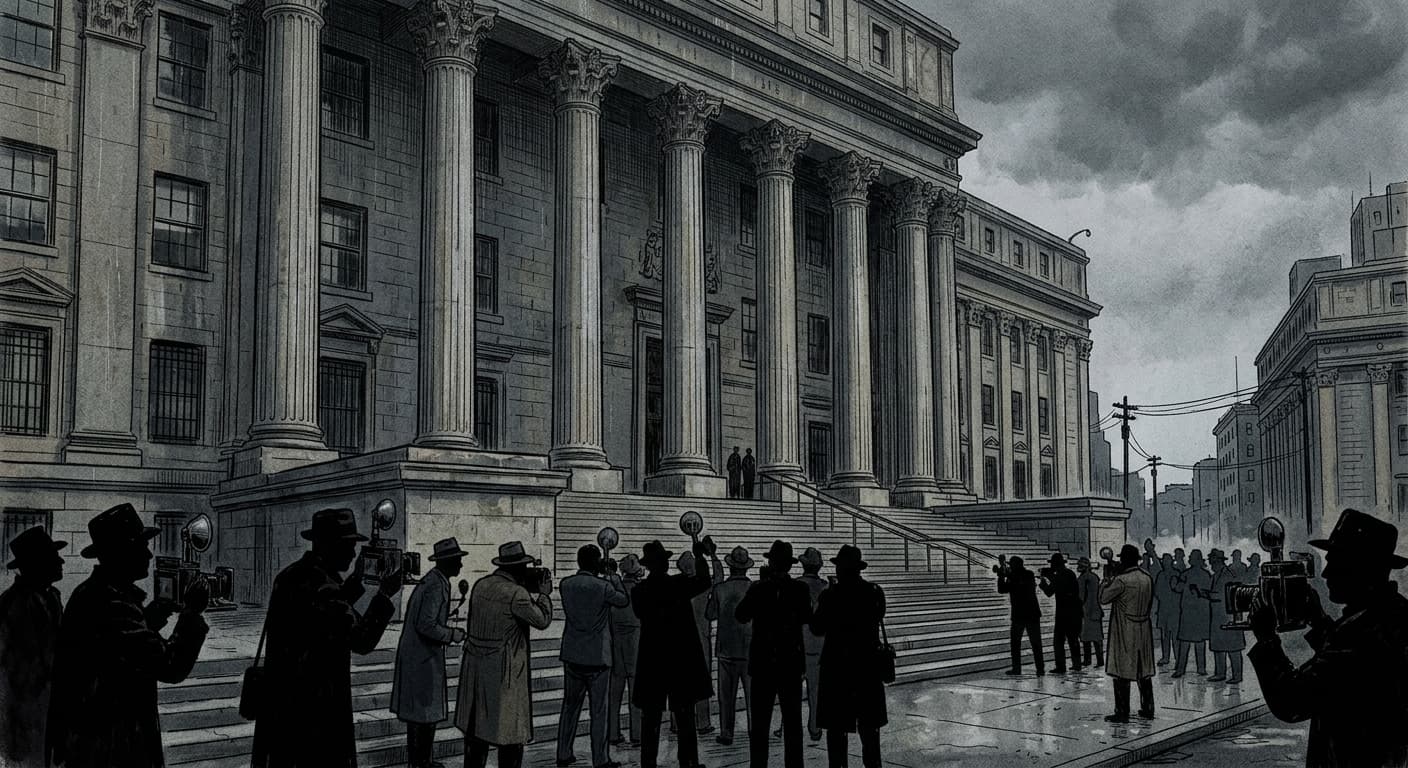
At sundown on June 19, 1953 — a Friday, the execution deliberately scheduled for the onset of the Jewish Sabbath after earlier controversy — Julius and Ethel Rosenberg were strapped into the electric chair at Sing Sing prison and killed by the government of the United States. Julius died relatively quickly. Ethel did not. After the standard sequence of jolts, with smoke rising from the electrodes attached to her body, attendants unstrapped her to remove the chair's restraints and found her heart still beating. She was strapped back in and electrocuted again. It took, by most accounts, five jolts in total to kill Ethel Rosenberg. There is no cleaner summary of the prosecution that put her in that chair: excessive, repeated, and aimed at a target that did not warrant it. For seventy years, history has vindicated the worst suspicions about her case in almost every particular — and its central lessons, about what political fervor does to proportionality and what prosecutors will do with a weak case against a politically convenient defendant, have never been more relevant.
First, Be Honest About Julius
Any rigorous treatment of the Rosenberg case must begin with the fact that the anti-Communist right got partly right: Julius Rosenberg was a spy. When the Soviet Union's Venona decrypts — American codebreakers' partially decoded reads of wartime Soviet intelligence cables — were declassified by the National Security Agency in the 1990s, they identified a Soviet agent codenamed ANTENNA and LIBERAL whose biographical details matched Julius Rosenberg almost exactly. Julius ran an espionage network. He recruited sources, including engineers and machinists with access to defense technology, and he passed classified material to Soviet handlers. Historians like Harvey Klehr, John Earl Haynes, and Allen Weinstein — who began their careers skeptical of the prosecution and ended convinced by the evidence — have established this beyond serious dispute. Julius Rosenberg committed espionage against the United States for the Soviet Union, and if proven at trial under the espionage statute, it was a grave crime.
But two caveats matter legally, and they matter enormously to what follows. First, the espionage Julius committed was industrial and military-technical espionage during a period when the Soviet Union was America's wartime ally — crimes for which no one else was then being executed, and crimes of a categorically different order than the specific act for which the Rosenbergs became infamous: the theft of the secret of the atomic bomb. Second, and decisive for the case at the bar, the Venona intercepts were not used at trial. They were classified, and the government elected not to disclose them even in camera — in part, scholars have long concluded, to protect the ongoing decryption program. The case the jury saw was built almost entirely on the testimony of alleged co-conspirators, and the keystone of that case was a man named David Greenglass — Ethel Rosenberg's brother — whose testimony about Ethel would decades later be revealed as, in crucial respects, a fabrication he offered to protect his wife and to save himself.
The Construction of a Case: Greenglass, the FBI, and the Invention of Ethel
David Greenglass was an Army sergeant and machinist stationed at Los Alamos during the war, where he had access to the machine shops fabricating components for the atomic bomb. He was also a Soviet asset, recruited into Julius's network through his wife, Ruth Greenglass. When the Klaus Fuchs investigation led the FBI to Harry Gold — the courier who had collected material from Fuchs — Gold led them to Greenglass. Greenglass, arrested in June 1950, began talking immediately, and his account had one conspicuous feature: it minimized the roles of David and Ruth Greenglass and maximized the roles of Julius and, over time, Ethel.
Ethel Rosenberg's alleged crime, as the government eventually presented it at trial, was typist's work — literally. David Greenglass testified that on an evening in September 1945, at the Rosenbergs' Knickerbocker Village apartment, Ethel typed up his handwritten notes on the atomic bomb for delivery to the Soviets, with Julius making a jest about her weary fingers. That testimony — the typing — was the direct evidence that Ethel was a participant in the atomic espionage rather than merely the wife of a spy. It was the thread by which the prosecution hung a death sentence on a mother of two small children whose documented activities were, at most, peripheral: recruiting her brother at Julius's direction, being present for conversations, knowing what her husband did.
The thread broke. In 2001, David Greenglass — by then living under an assumed name, having served ten years of a fifteen-year sentence — admitted to journalist Sam Roberts, and then on 60 Minutes II, that the typing testimony was false. He did not know who, if anyone, typed the notes. "I don't remember who typed it, frankly," he said. "And to this day I can't even remember that the typing took place." Why, then, had he sworn it under oath at a capital trial? The answer, he conceded, was that prosecutors suggested it and his own interest demanded it: "I would not sacrifice my wife and my children for my sister." In 2015, after a long legal fight by historians, the grand jury testimony of David Greenglass was released, and it corroborated the fabrication: before the grand jury, Greenglass never mentioned Ethel typing anything. The detail appeared between the grand jury and the trial, exactly when the prosecution needed a case against Ethel to use as leverage against Julius.
That leverage was the point. Internal government documents released in subsequent decades — including Justice Department memoranda — made explicit what the strategy was: prosecuting Ethel, and threatening her life, was a means to compel Julius Rosenberg to confess and name his network. FBI Director J. Edgar Hoover himself expressed discomfort with the execution of Ethel, but the strategy proceeded. The prosecution indicted a woman for capital atomic espionage on evidence its own key witness would later call invented, to squeeze her husband. Julius would not break. Both of them died.
The Courtroom in the Furnace: Cohn, the Press, and the Verdict
The trial lasted barely three weeks. Irving Saypol, the United States Attorney for the Southern District of New York — already famous as the prosecutor of Alger Hiss's circle — led the government's team, but the courtroom's most consequential junior figure was his young assistant, Roy Cohn, who handled David Greenglass. Cohn would spend the rest of a long and morally feral career confirming that the habits on display in the Rosenberg prosecution were not an aberration in his hands: the cultivation of the key witness, the intimate management of the judge, the appetite for the cameras. The defense, led by the capable but overmatched Emanuel Bloch — with Ethel's own brother as the chief witness against her — made a decision born of fatalism: the Rosenbergs, believing the case unwinnable in that atmosphere, declined to testify on espionage specifics and instead invoked the Fifth Amendment selectively in ways the jury could not unhear, while offering character evidence that moved no one. The jury of eleven men and one woman deliberated about a day. Guilty, all counts, both defendants. The foreman later said the jury never seriously considered otherwise. In New York, in March 1951, the verdict had been waiting for the trial to finish confirming it.
What the Government Knew and When It Knew It
The Venona decrypts tell the story the government would not say out loud. The decoded cables identify Julius repeatedly as an active agent — recruiting, tasking, collecting. They mention Ethel, by one reading, on a handful of occasions, and in the most important reference, a November 1944 cable describes her in terms the intelligence historian Ronald Radosh and others have parsed carefully: she is noted as knowing of her husband's work and as a devoted person, but the same cable records the KGB's assessment that, for reasons of health, she does not work — i.e., she was not an agent performing operational tasks. The National Security Agency's own Venona analysts, in their published commentary, described her as an accessory — someone who assisted and knew, not a principal operator. Alexander Vassiliev's notebooks — KGB archival material copied in the 1990s — go further: they document Ethel's awareness and her participation in recruitment conversations (including the recruitment of Ruth and David Greenglass), but they contain nothing assigning her direct responsibility for atomic espionage. On the record as it now exists, Ethel Rosenberg was a knowing accessory to her husband's espionage. Knowing accessories, under the law of 1951 and under the law now, are not principals in capital cases — and many far more culpable figures in atomic espionage, including at least one participant in the same ring, received sentences measured in years or were never tried at all.
The comparison cases are instructive and damning. Klaus Fuchs — the physicist who passed vastly more consequential atomic secrets to the Soviets than anything in Greenglass's sketches, material that likely accelerated the Soviet bomb program years — was tried in Britain, convicted, and sentenced to fourteen years. He served nine. Harry Gold, the courier whose testimony helped send the Rosenbergs to the chair, received thirty years and was paroled after fifteen. Morton Sobell, tried with the Rosenbergs as a co-defendant, received thirty years and was released in 1969. David Greenglass, who confessed to passing atomic secrets with his own hand, received fifteen years and served ten, then lived under protection and a new name. Ruth Greenglass, whose own Venona mention as a recruit was unambiguous, was never indicted at all. Only two people were executed: the man who ran the ring, and the wife who typed — except, it turns out, she didn't.
Venona's Double Edge
The secrecy of Venona cut in two directions, and both deserve statement. The government protected the program even at the cost of letting a deficient record stand in court — a decision that, whatever its intelligence rationale, had the practical effect of concealing from the defense that the government's own decrypted cables corroborated Julius's espionage while portraying Ethel as marginal. Had Venona been disclosed, Julius's conviction might have been sturdier on the evidence and Ethel's prosecution nearly impossible to sustain as a capital matter. The state, in other words, withheld the file that would have clarified both defendants' culpability, and instead tried the case on a co-conspirator's staged testimony. In the classified world, the truth about Julius and Ethel Rosenberg was written in 1940s cables; in the courtroom of 1951, it was written by David Greenglass and a prosecutor who needed Ethel's life as leverage. The American people did not learn what their own government had known at the time until nearly half a century after the executions.
And it must be said plainly, because rigor requires it, that Venona's vindication of the Julius prosecution does not vindicate the proceeding. A conviction obtained on the right conclusion by the wrong evidence is still a failure of process — the process exists precisely so that conclusions are earned in open court, and a state that can convict the guilty on perjured testimony can convict anyone on perjured testimony, as in fact it did to Ethel.
Judge Irving Kaufman and the Anatomy of a Sentence
The trial was held in March 1951 in the federal courthouse in Manhattan, before Judge Irving R. Kaufman and a jury. The atmosphere of that courtroom is difficult to overstate, and impossible to reproduce honestly without acknowledging the genuine fear of the era: the Soviet Union had detonated its own atomic device in August 1949, years ahead of American expectations; Communist China had been proclaimed; the Korean War was underway; Alger Hiss had been convicted of perjury; and Senator Joseph McCarthy was at the height of his powers. The Rosenbergs were tried not in a courtroom but in a furnace.
Judge Kaufman's conduct has been the subject of decades of scholarly and judicial scrutiny, and the record developed since 1951 has made his role darker with each disclosure. Ex parte contacts between Kaufman and the prosecution — conversations about the case and, in particular, about the sentence, held outside the presence of defense counsel — were documented in FBI records released under the Freedom of Information Act. Roy Cohn, then a young assistant in the U.S. Attorney's office and later infamous as McCarthy's counsel and Donald Trump's mentor, claimed in interviews years later that he had discussed the death sentences with Kaufman before they were imposed, and that Kaufman's mind was made up in advance. Kaufman denied improper conduct to the end of his life; the documentary record of judge-prosecutor contact about an ongoing capital case is nonetheless a matter of public record, and under any modern understanding of judicial ethics it was disqualifying.
The sentencing itself, on April 5, 1951, was a performance. Judge Kaufman did not sentence the Rosenbergs for espionage as defined by the indictment — he sentenced them for the Cold War. His remarks are part of the permanent record and must be quoted to be believed. He told the defendants that their crime was worse than murder, that by their betrayal they had undoubtedly altered the course of history to the disadvantage of our country, that their conduct had already caused, in my opinion, the Communist aggression in Korea, with the resultant casualties exceeding 50,000, and that millions more of innocent people may pay the price of your treason. A United States district judge, imposing sentence in a court of law, attributed the Korean War — fifty thousand American dead, he said — to one couple's espionage, and on that attribution hung two death sentences. He did not stop there: he framed the sentence as God's work, telling the defendants he believed their conduct put into the hands of the Russians the A-bomb years before our best scientists predicted — a claim the government had never proven and the weight of scholarship now rejects — and that for this he was sending both of them to the electric chair.
Consider what proportionality requires, and what Kaufman discarded. The Eighth Amendment, inheriting a tradition the Founders drew from the English Bill of Rights, forbids excessive punishment; the entire concept of proportionality — that the severity of the state's violence must bear some rational relation to the severity of the offense — is load-bearing in American constitutionalism. The Espionage Act of 1917, under which the Rosenbergs were tried, authorized death for espionage committed in wartime; the government stretched the wartime provision to cover conduct during the Soviet alliance. But even granting every stretch, the sentence imposed was unique in American history: never before or since has an American civilian been executed by the federal government for espionage. Not Fuchs. Not the Walker family, whose Navy spy ring did indisputable damage to deployed American cryptographic security during actual hostilities. Not Aldrich Ames, whose espionage got Soviet-based American assets executed by firing squad. Julius and Ethel Rosenberg alone — one genuine spy, one accessory on perjured typing testimony — got the chair.
The Convictions Stand, the Execution Doesn't: What the Appeals Process Did
The Rosenbergs' appeals were denied. The Supreme Court declined to review the case repeatedly; Justice Felix Frankfurter, in chambers opinions, wrote with visible anguish about the Court's refusal to intervene while simultaneously expressing personal doubts about the death sentences; Justice William O. Douglas granted a stay of execution on June 17, 1953, on a novel statutory argument — that the Atomic Energy Act of 1946 had superseded the Espionage Act and required a jury verdict recommending death — which the full Court vacated within twenty-four hours over his dissent, an almost unprecedented institutional rebuke. President Eisenhower, on the eve of the execution, declined clemency, writing that the Rosenbergs may have condemned to death tens of millions of innocent people all over the world — the Kaufman attribution, ratified.
What is striking, reading the record today, is what the legal system was and was not fighting about. The courts fought about jurisdiction and statutory construction. No court ever got to fight about the actual problems — perjured key testimony, judge-prosecutor collusion on sentencing, the systematic disproportion between the Rosenbergs' treatment and every comparable case — because those problems were hidden inside classified files, sealed memos, and a witness's conscience that took fifty years to break. The process worked exactly as designed, on exactly the wrong information. That is the deepest structural lesson of the case: adversary process is only as good as the information in the courtroom, and the government controlled both the prosecution's file and, through classification, the exculpatory file. The Rosenbergs were convicted with one evidentiary universe and history has judged them with another. The difference between the two universes is where the scandal lives.
The Clemency Trap
The final safeguard, clemency, was in the story as corruptly compromised as the rest. President Eisenhower's refusal, issued the day of the second scheduled execution date, leaned on Judge Kaufman's own attribution of the Korean War's toll to the defendants. Behind the scenes, the file tells a more procedural shame: J. Edgar Hoover personally doubted the wisdom of executing Ethel — he worried her death would generate sympathy and yield no intelligence value because she had no secrets to trade — and said so in internal memoranda, but the Bureau's public posture did not waver, and its knowledge of the case's evidentiary weaknesses traveled nowhere near the White House. The system that had used Ethel as a lever against Julius could not now spare her without confessing what the lever had been. Both went to the chair as a matter of institutional face.
Michael and Robert: The Children the State Orphaned
No account of this case is complete without the two boys. Michael and Robert Rosenberg were ten and six when their parents were executed. No relative could safely take them — the families were surveilled, harassed, and in one case, Michael and Robert were expelled from a New Jersey school system by local ordinance. For a time they lived in a kind of internal exile, passed between sympathetic households, visiting their parents on Death Row. They were eventually adopted by Abel and Anne Meeropol — Abel being the songwriter who wrote Strange Fruit, the anti-lynching anthem made immortal by Billie Holiday. The boys took the Meeropol name, built lives, and in 1975 came forward to reclaim their history in a memoir, We Are Your Sons. Robert Meeropol subsequently founded the Rosenberg Fund for Children, which supports the children of targeted activists. Michael became an economist. For decades they argued their parents were innocent; after Venona, they conceded Julius's espionage and pivoted, with the intellectual honesty the case has rarely received elsewhere, to the position the evidence now compels: that the government's case overstated what Julius did, invented what Ethel did, and executed both of them for reasons and in a manner that American law and decency should not have allowed. In 2015 and 2016, the Meeropol brothers petitioned for exoneration of Ethel — not Julius — asking the government to acknowledge what its own files show. Fifty Members of Congress signed on. The government declined. Ethel Rosenberg's execution stands.
The Founders' Warning, Furnished with a Chair
The founding generation built a constitutional order on the premise that the worst depredations of governments come not in calm times but in storms. They wrote the Treason Clause — the only crime defined in the Constitution itself — deliberately narrow, requiring two witnesses to the same overt act, precisely because they had watched the Crown destroy political enemies with elastic treason prosecutions. They wrote the Eighth Amendment against cruel and unusual punishment because they understood that the state's monopoly on violence, once justified by emergency, knows no natural stopping point. They wrote due process into the Fifth Amendment because they knew that a government that can execute on inflamed passion rather than proven fact will always find the passion it needs.
The Rosenberg case is what a storm does. The espionage was real; the storm made it into something it was not, and then punished the storm's version rather than the facts'. A judge consulted privately with prosecutors and then ascribed a world war's casualties to two defendants from the bench. A key witness fabricated the detail that made a mother a principal in atomic espionage, and was rewarded with leniency and anonymity. The government classified the decrypts that would have shown Ethel's marginal role, and prosecuted her to the death as leverage for a confession. The Supreme Court, at the end, moved faster to execute than it had moved to consider. Every guardrail held nominally and failed functionally — which is to say, it failed.
Fervor does not repeal proportionality; it just makes courts stop noticing it. That is as true in our own storms as it was in 1951. The machinery that electrocuted Ethel Rosenberg — a prosecutor who needed a bigger case than the facts gave him, a judge who needed to say something grander than the indictment, a public that needed a sacrifice, and an appellate system that reviewed everything except the truth — is the same machinery that runs today. The Venona files were not declassified until the 1990s. David Greenglass's grand jury testimony was not released until 2015. The truth about who typed what took fifty years, and it arrived too late to matter to the woman in the chair. It is not too late to matter to us: the next time the Republic is frightened, and a prosecutor stands before cameras to announce that the defendants have betrayed America itself, remember the typist's chair. Remember what the government swore was true, and what its own files said. And remember that it took five jolts of electricity to stop the heart of a woman the state had already, by every honest measure, reduced to an accessory.