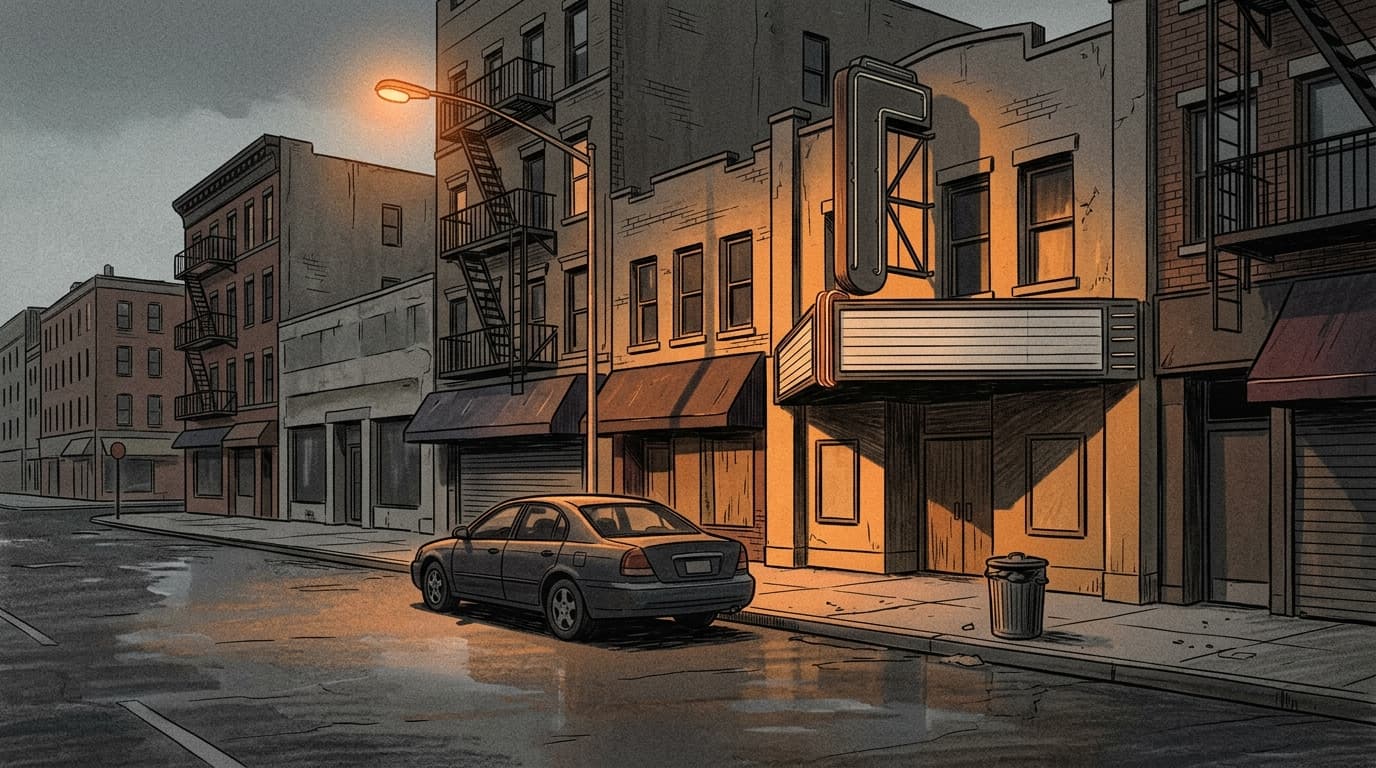
He was supposed to be married at five o'clock that afternoon. Instead, Sean Bell, twenty-three years old, a father of two small daughters, a former high school baseball star from Jamaica, Queens, spent the final hours of his life in the pre-dawn darkness of November 25, 2006, celebrating his bachelor party with friends at the Kalua Cabaret, a strip club near the elevated tracks in the South Jamaica section of the borough. He left the club shortly after 4 a.m. with two friends, Trent Benefield and Joseph Guzman, and got into his Nissan Altima. Within minutes, five New York City Police Department detectives assigned to an undercover operation at the club had poured fifty bullets at and into that car. Four struck Bell. He was killed hours before he was to walk his fiancée, Nicole Paultre, down the aisle. Guzman, hit by at least eleven bullets, and Benefield, hit three times, somehow survived. No gun was ever recovered from Bell's car or its vicinity. No officer was ever convicted of anything. Three detectives — Michael Oliver, Gescard Isnora, and Mark Cooper — stood trial, chose to waive a jury and put their fates in the hands of a single judge, and were acquitted of every charge in April 2008 by that judge, Arthur Cooperman, who found the prosecution's witnesses simply not credible. The United States Department of Justice later declined to bring federal civil rights charges. The City of New York settled the civil suits for seven million dollars and change. The pattern was complete.
If the killing of Amadou Diallo at his own doorstep seven years earlier taught New York anything, the Sean Bell case proved the lesson had not changed the machinery — only refined the public's vocabulary for describing it. Once again: unmarked police, aggressive plainclothes tactics in a Black neighborhood, a perceived gun that did not exist, a storm of bullets extraordinary in number, a defense built on the officers' own narrated fear, and a courtroom outcome that told the city, in the plainest terms, that the criminal law would not reach its police. And once again, the killing was not a freak accident but the predictable output of a system — of an undercover vice operation run on the cheap against a civilian population, of use-of-force doctrine that treats the officer's fear as both question and answer, and of a bench and bar that have, across decades, engineered police shooting trials into a genre with only one reliable ending. This is the story of the Kalua Cabaret, of fifty bullets on Liverpool Street, of the bench trial that absolved the shooters, and of the structural reasons — the pattern-recognition problem at the heart of this series — that American courts keep acquitting police officers who kill unarmed men.
A Bachelor Party and a Vice Squad
The Kalua Cabaret, on 94th Avenue near 143rd Street, was by late 2006 a problem in the NYPD's ledger. The club had accumulated complaints — drugs, prostitution, weapons, fights, underage drinking — and the 103rd Precinct had mounted an undercover operation to build cases against it. On the night of November 24 into the early morning of November 25, Detectives Gescard Isnora and a team of undercover officers were inside the club posing as patrons, with plainclothes backup outside. Their mission, as later described in court and in the press, was not to police the neighborhood's people but to police the club — to observe violations, and, in Isnora's case, to arrange a prostitution transaction that would furnish an arrest. Into this setting came Sean Bell's bachelor party: Bell, Guzman, Benefield, and friends, among them men who, like any group of young men in such a place, drank, talked loudly, and, in the small hours, got into an argument with another patron that spilled onto the street.
What happened outside the Kalua at roughly 4 a.m. would be litigated for two years and is still contested in its details. The prosecution's account, and the account of Bell's companions, was this: an argument between Benefield and another man ended; Bell's party walked to Bell's car on Liverpool Street to leave, the night over, the groom going home. From down the street, by multiple civilian accounts, an unknown man in street clothes approached with a gun drawn — Detective Isnora, who testified that he had overheard members of Bell's group make a threat about getting a gun, specifically a reference he interpreted as a plan to retrieve a firearm from a car. Bell's friends would testify they had no idea the men converging on them were police. The officers' account was that Isnora identified himself, displayed his shield, and ordered the car stopped, and that Bell instead lurched the Altima forward and backward, striking Isnora and an unmarked police van. What is not in serious dispute is what happened next: Isnora fired first, firing a total of eleven rounds; Detective Michael Oliver, who had arrived outside the club, fired thirty-one rounds — emptying his nine-millimeter pistol, reloading during the shooting, and emptying it again. Detective Mark Cooper fired four. Two other detectives fired single shots. In seconds, fifty police rounds flew at and into a car carrying three unarmed men on a residential street.
Bullets struck nearby houses and a lamp in a home down the block. A bullet shattered a window at the AirTrain station at Jamaica — the elevated station serving John F. Kennedy International Airport — where a bullet injured no one but demonstrated, in cold trajectory, the indiscriminate spread of the fusillade. Joseph Guzman, in the front passenger seat, was hit at least eleven times and nearly died; he would carry bullets in his body for the rest of his life and limp into the courtroom to testify. Trent Benefield, in the back, was hit three times in the legs. And Sean Bell, in the driver's seat, was hit four times — in the neck, shoulder, and arm — and died at Jamaica Hospital at about 5 a.m., the groom dead before the sun rose on his wedding day.
No gun was found in the Altima. No gun was found anywhere. The theoretical firearm whose rumored retrieval had justified, in the detectives' telling, the entire use of deadly force, did not exist. The narrative — a threat about a gun, a reach, a ramming, a shootout — had been constructed out of smoke, and the smoke had killed the groom.
The Doctrine Behind the Trigger
As with Diallo, the legal frame must be set out, because the acquittal in the Bell case was not a scandalous departure from the law; it was the law functioning exactly as written. New York's justification statute — Penal Law Article 35 — permits a police officer to use deadly physical force when the officer reasonably believes it to be necessary to defend the officer or another from what the officer reasonably believes to be the use or imminent use of deadly physical force. Layer on the federal reasonableness framework of Graham v. Connor, which instructs courts to judge force from the perspective of a reasonable officer on the scene rather than with 20/20 hindsight, and the result is a test that is, in practice, nearly unwinnable for any prosecution of an on-duty shooting. The officer need only describe a belief — a belief in a gun, a belief in a reach, a belief that the car was being used as a deadly weapon — and the court's task narrows to asking whether a reasonable officer might have shared it. Cars are legally deadly weapons the moment an officer says the wheels moved toward him. Guns are legally present the moment an officer says he heard them mentioned. The doctrine converts rumor into reasonable cause and motion into mortal threat, and then asks, with a straight face, why the officer should be blamed for believing the product of his own unit's own whispered mistakes.
The Bell case added a special wrinkle that would become decisive: the NYPD's own rules appeared to have been violated. Department guidelines discouraged officers from firing at moving vehicles to disable them or to stop their occupants — a policy adopted precisely because bullets cannot stop cars and only multiply the danger — and the operation at the Kalua had, on the evidence, the character of a planless scramble: an undercover inside, a threat misheard or invented, and a chain of plainclothes officers who had not coordinated, converging on a car with guns out. But violating a patrol guide is not a crime, and New York courts had long held that departmental rules do not enlarge criminal liability. The prosecutors could prove recklessness against the manual; the law asked them to prove it against the doctrine. The doctrine won.
The Protests and the Political Reckoning
Before the trial came the streets, and before the streets came the reckoning of numbers. Fifty bullets. Fifty became the headline number the way forty-one had been for Diallo — a digit that told the public something the lawyers could not obscure, that whatever else this was, it was not measured force. The Rev. Al Sharpton, whose National Action Network became the family's institutional voice, led rallies with Nicole Paultre — who took the legal name Nicole Paultre Bell in her late fiancé's honor — and the wounded survivors. Mayor Michael Bloomberg, in a marked departure from his predecessors' reflexive defense of the department, said publicly what the city was thinking: the shooting seemed, he told the press, inexplicable and excessive in its volume, while cautioning that the facts were for the courts. Police Commissioner Ray Kelly promised a full investigation and tightened undercover rules. Governor-Elect Eliot Spitzer announced he would monitor the case. And the Queens District Attorney, Richard Brown, convened a grand jury — a Queens grand jury, empaneled in the borough where the men had been shot, in contrast to the Albany exile of the Diallo prosecution.
In March 2007, the grand jury returned indictments. Detective Michael Oliver and Detective Gescard Isnora were charged with first-degree and second-degree manslaughter — the grave charges, carrying up to fifteen years — as well as assault and reckless endangerment. Detective Mark Cooper was charged with misdemeanor reckless endangerment for the shots that had struck the occupied home down the block and the AirTrain station. But the same grand jury declined to indict two other detectives who had fired, and its manslaughter charges did not extend to Cooper. Even at the charging stage, the system was already filtering: the most lethal single actor, Oliver, whose thirty-one rounds had done the killing, faced manslaughter, not murder, and two shooters walked away uncharged before any trial began.
The Waiver: Why Three Detectives Chose a Judge Over a Jury
Then came a procedural decision that revealed everything about how these cases are actually decided. The three indicted detectives waived their constitutional right to a jury trial and elected to be tried by Judge Arthur Cooperman alone — a bench trial. A bench trial for police officers accused of killing an unarmed Black man is not a neutral procedural choice; it is a calculated strategic maneuver, and understanding why goes to the heart of the pattern this article is about.
Consider the alternatives. A jury drawn from Queens — from the neighborhoods around the Kalua, from communities with lived experience of plainclothes stops, from a borough that had just watched a groom turned away from his own wedding in a body bag — might contain jurors viscerally unwilling to adopt the officers' perspective as the law instructed them to do. Juries are unpredictable, emotional, capable of outrage, and, most dangerously for the defense, capable of viewing the defendant officers as the community's armed agents who had failed it. A judge, by contrast, is a professional consumer of police narrative. New York trial judges hear officers testify daily, rely on them, accommodate them, and — across decades of scholarship on bench trials in police cases — demonstrate measurably higher acquittal rates for police defendants than juries do. The judge-alone trial removes the element of lay outrage from the calculus and replaces it with the collegial equilibrium of the courtroom workgroup — the same equilibrium, this series has documented in courthouse after courthouse, in which judges, prosecutors, and defense attorneys coexist in cycles of deference that defendants in ordinary cases never experience. The detectives' attorneys did the arithmetic, and the arithmetic said: put it before a judge. Judge Cooperman, seventy-six years old, a former prosecutor first appointed to the bench in the 1960s and reappointed by mayors of both parties, would decide. He took it under advisement after a six-week trial, and the prosecution's chances went with it.
The Trial: Credibility as the Trapdoor
The trial that unfolded in Queens Supreme Court in February, March, and April 2008 presented, in miniature, every structural vice of police shooting adjudication. The prosecution, led by Assistant District Attorney Charles Testagrossa, built its case on the surviving victims and civilian witnesses. Joseph Guzman — who had nearly died in that car, who walked with a cane and carried surgical hardware in his leg and bullets in his body — testified that the men who converged on the Altima never identified themselves as police, that he and Bell had no idea they were anything but armed robbers, that Bell tried only to drive away from the guns. Trent Benefield testified that he heard no police identification, that he saw Isnora coming with a gun drawn and panicked. Civilian witnesses from the club and the street offered accounts that contradicted the officers' timeline.
The defense's counter-strategy was savage and, within the rules, effective: impeach the living victims to acquit the killers. Defense attorneys mined the records of Guzman and Benefield — Guzman's prior gun arrest, both men's histories and inconsistencies — and, more importantly, litigated every discrepancy between their trial testimony and their statements in the frantic, morphine-clouded days after the shooting. Grand jury testimony was read back against trial testimony; statements given from hospital beds were parsed and found wanting. The officers, by contrast — Isnora through attorney Philip Karasyk, Oliver through James Culleton — presented polished, internally rehearsed accounts. Isnora testified that he had heard one of Bell's group say words to the effect of get my gun, that he had shown his shield and shouted police, don't move, that Bell's car had hit him and the van, and that he had fired believing deadly force was being used against him and the man he believed to be reaching for a weapon. Oliver did not testify before the grand jury and testified at trial that he had seen what he believed was gunfire coming from Bell's car — a flash, he said — emptying his pistol and reloading. The flash, needless to say, had no source in any evidence. No gun, no shell casings unaccounted for, nothing. But under the doctrine, the flash needed no source. It needed only a witness with a badge to say he saw it.
On April 25, 2008, Judge Cooperman delivered his verdict from the bench in a courtroom packed with family, and within minutes the city knew. Not guilty, on every count, for all three detectives. And the judge did not hedge; he went further than acquittal on reasonable doubt and issued what amounted to an endorsement of the defense's strategy. The witnesses for the prosecution, Cooperman said from the bench, were not believable — their demeanor, their prior inconsistent statements, their records had, in his view, discredited them, and he simply declined to credit their testimony that no police identification had been made. The proof beyond a reasonable doubt, he ruled, had not been made out. By centering the victims' credibility rather than the officers' uncorroborated perceptions, the verdict turned the case inside out: the unarmed men who had been shot at fifty times became the untrustworthy parties, and the detective who had fired thirty-one rounds at a gun that never existed became, in the eyes of the law, a careful public servant caught between inconsistent civilians.
The Pattern-Recognition Problem
Here is where this series must name the phenomenon plainly, because Sean Bell's case is not interesting as an exception. It is interesting as the rule, confirmed again. Police shooting trials in America have a structure, and the structure produces acquittals, and the acquittals are not failures of juries or judges so much as they are the designed outputs of the structure itself.
First, the doctrinal element, already canvassed: justification law asks only whether the officer's stated belief was reasonable, and a police officer's stated belief — rehearsed with union lawyers and testifying experts in use-of-force, a recognized class of professional exonerators — will almost always describe a shooting as fear-driven and reasonable on its face. The officer is the only surviving narrator of the confrontation. The other narrator is dead.
Second, the venue and fact-finder element: police defendants optimize. They move venues when venues are moveable — Diallo went to Albany — and they waive juries when juries are risky — Bell went to a bench trial. The American defendant generally possesses these options, and one would not wish them abolished, but their use concentrates police shooting cases before the fact-finders most institutionally inclined toward the police perspective.
Third, the witness-inversion element: the prosecution's case necessarily rests on the shooting's survivors and bystanders, who are traumatized, often young, often from the policed community rather than the policing one, often with records that can be ransacked, and whose accounts given in the chaotic aftermath will always contain discrepancies that months of defense preparation can magnify. The defendants, by contrast, testify last, polished, with every inconsistency pre-reconciled. The credibility contest is rigged by the circumstances of the shooting itself.
Fourth, the aftermath element: the DOJ reviewed the Bell case for federal civil rights prosecution under 18 U.S.C. § 242 — the same Reconstruction-era statute that required proof of specific willful intent to deprive a person of constitutional rights, the highest intent requirement in the federal code — and in February 2010 announced it would bring no charges, as it had declined in Diallo. The federal backstop failed, again, on the same doctrinal rock. And the civil system then did what it does: in July 2010, New York City agreed to pay $7.15 million to settle the claims — $3.25 million to Bell's estate, roughly $3 million to Guzman, $900,000 to Benefield — a public-fisc indemnification that punished no one, changed no doctrine, and required of the individual officers nothing. Even the NYPD's internal disciplinary process moved at a glacial, negotiated pace: Detective Isnora was eventually forced out and fired in 2012, losing his pension, while Detective Oliver simply resigned with his pension intact and Detective Marc Cooper, the misdemeanor shooter into the residence, and the supervisor on scene received the department's mildest dispositions. Six years after fifty bullets, the department's own accountability yielded one firing, some transfers, and a letter.
Each element is defensible in isolation. Together they constitute a machine for processing police killings into acquittals, declinations, and settlements — a machine whose output was fifty bullets and no crime, forty-one bullets and no crime, and, onward through the American record, the same recurring null. The Founders gave us the jury of the vicinage precisely to subject the Crown's violence to community judgment; the modern machine routes that judgment through doctrines and procedural maneuvers that neutralize it. Take America Back does not argue that every charged officer must be convicted. It argues that a system whose conviction rate in on-duty shooting cases approaches zero across decades and thousands of deaths is not performing adjudication; it is performing absolution, and the appearance of regularity — the indictments, the six-week trial, the reasoned bench verdict — is the absolution's liturgy.
The Groom and the Measure of the Law
What was lost on Liverpool Street is easy to enumerate and impossible to measure: a twenty-three-year-old man two days from his wedding, his fiancée at the altar of a funeral instead, two daughters growing up with settlement money and no father, two friends carrying scars and bullets and the knowledge that the court found their testimony not credible while finding the fifty bullets fired at them legally unremarkable. Nicole Paultre Bell stood with Sharpton after the verdict and said, quietly, what the city already knew — that justice had not been served. Protests followed; hundreds were arrested in coordinated acts of civil disobedience across Manhattan that spring, an echo of One Police Plaza nine years earlier. The Kalua Cabaret itself — the ostensible target of the operation that produced the killing — was later shut down as a nuisance, a bureaucratic footnote that captured the episode's perfect inversion: the city managed to punish the building, but not the bullets.
And what did the law learn? The NYPD revised undercover protocols and re-emphasized its rules against shooting at vehicles. The state considered, and mostly did not pass, reforms. The doctrine stood untouched. The next set of names was already in line — Oscar Grant, shot facedown and handcuffed-then-release in Oakland on New Year's Day 2009 while Bell's case was still awaiting its DOJ declination, and then onward into the decade's terrible litany. Each new killing would be litigated, or not charged, through the same sieve: the justification statute, the belief standard, the forum-optimized fact-finder, the witness inversion, the federal declination, the civil settlement. The Bell case did not create the sieve. It demonstrated, with a groom's blood on a wedding morning, that the sieve was load-bearing.
The Fourth Amendment's guarantee that the people shall be secure in their persons against unreasonable seizure is a guarantee about moments exactly like 4 a.m. on Liverpool Street: about what the government's armed agents may do to a citizen's body when they descend upon it in the dark with drawn weapons. A seizure accomplished with fifty bullets, of a man who had committed no crime, on a street outside a club the police were supposed to be quietly observing, is the paradigm of unreasonableness the amendment was written to forbid. The law's answer — that the bullets were reasonable because the shooters said they were afraid, and that no court could say otherwise — is the amendment turned inside out. Until the doctrine is reconstructed — until justification standards demand corroborated threat rather than narrated fear, until shootings are tried before the communities that bear them, until the federal civil rights backstop has an intent standard that can actually be met, until departments pay for their killings with accountability rather than their insurers' or taxpayers' money — the machine will keep running, and the next Sean Bell is, as a matter of structural certainty, already dancing somewhere, hours before his wedding. The banns are posted. The law, as it stands, will not stop the bullets. That is why the courts must be taken back.