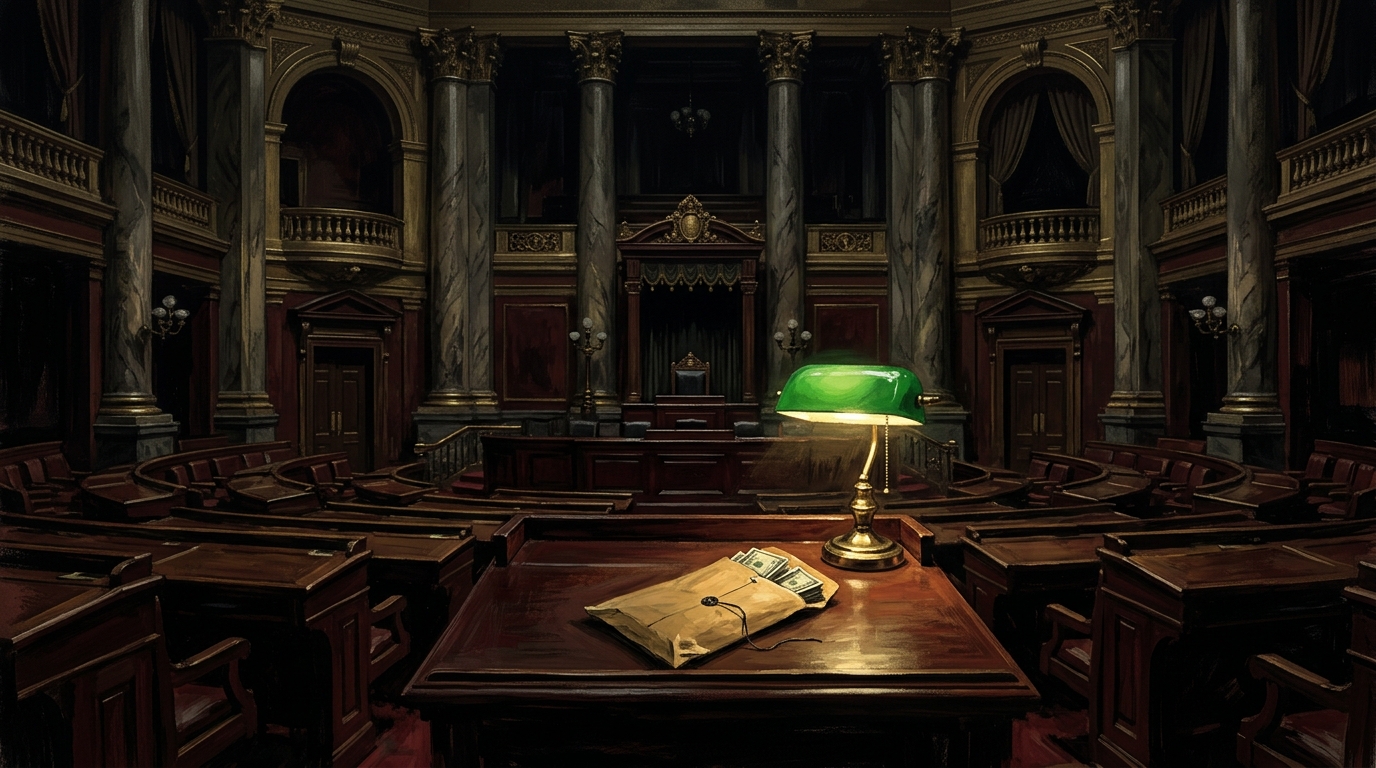
In Albany they used to say that New York was governed by three men in a room: the Governor, the Senate Majority Leader, and the Speaker of the Assembly. The formulation was meant as civics-class shorthand, but it was really a confession — an admission that the fourth-largest state in the union conducted its essential business in private, among men whose power was answerable mainly to one another. For twenty-one years, from 1994 to 2015, the third chair in that room belonged to Sheldon Silver, a Democrat from the Lower East Side of Manhattan: soft-spoken to the point of inaudibility, Orthodox in faith and habit, patient as sediment. Governors came and went — four of them — while Silver remained, controlling which bills reached the Assembly floor, which never would, and, it turned out, a good deal else.
On the morning of January 22, 2015, FBI agents arrested him. The criminal complaint, announced by Preet Bharara, then the United States Attorney for the Southern District of New York, alleged that the Speaker had collected some four million dollars in what he had long described, on his annual disclosure forms, as outside income from the private practice of law — the modest sideline of a citizen-legislator. The government’s account was different: the “law practice” was a laundering mechanism, and the fees were the yield of two schemes in which Silver monetized the one asset he alone possessed — the discretion of the Speaker’s office.
The Referral Machine
The scheme that gave the case its unforgettable shape ran through cancer medicine. Dr. Robert Taub was a Columbia University physician, nationally known for his research and treatment of mesothelioma — the signature cancer of asbestos exposure, almost always fatal, and almost always, in the American system, the seed of a lawsuit worth a great deal of money. Asbestos plaintiffs’ firms compete ferociously for mesothelioma clients; a single case can generate seven-figure fees. Silver was “of counsel” to one of the largest such firms, Weitz & Luxenberg, which paid him referral fees for cases he brought in. Where does a legislator find a stream of mesothelioma patients? The trial answer: from a doctor who needs research funding, in a state where the Speaker controls discretionary money.
Beginning in 2003, at Silver’s direction, five hundred thousand dollars in state grants — drawn from a health-care pool the Speaker controlled with minimal public process — flowed to Taub’s mesothelioma research. Taub, in turn, steered his dying patients’ legal cases to Silver, who forwarded them to Weitz & Luxenberg and collected the referral fees as they matured into settlements: more than three million dollars over the years, for legal work the government proved he never performed. The firm itself was not accused of knowing the source of the referrals’ motive power. When the state money later dried up, the relationship was maintained with smaller courtesies — Silver helped Taub’s family, directed other funds, kept the channel warm. At trial, Taub — testifying under a non-prosecution agreement, visibly anguished — explained that he believed the arrangement served his patients and his research. The jury was left with the image the prosecution built deliberately: the most powerful legislator in New York, collecting a private toll on the deaths of asbestos workers, denominated in state grant money and billed as philanthropy.
The second scheme was drier but larger in Albany terms. New York’s byzantine property-tax system sends major landlords annually to a small specialized bar seeking assessment reductions — tax certiorari work. Silver quietly arranged for two of the state’s most significant developers, Glenwood Management and the Witkoff Group — both deeply dependent on rent regulation and tax legislation the Speaker controlled — to send their certiorari work to a boutique firm, Goldberg & Iryami, which paid Silver a cut of the fees: roughly seven hundred thousand dollars. The developers’ executives testified they learned of Silver’s cut only later and feared the consequences of unwinding it. While the fees flowed, Silver was shaping rent laws and the 421-a tax abatement — the very statutes on which the developers’ business models depended.
Convicted, Reversed, Convicted
The first jury convicted Silver on all counts in November 2015 — honest-services fraud, extortion under color of official right, money laundering — and Judge Valerie Caproni sentenced him to twelve years. Then the ground moved. In 2016, the Supreme Court decided McDonnell v. United States, the case of Virginia’s gifted-Rolex governor, and narrowed the definition of the “official act” that bribery requires: arranging meetings, hosting events, and general advocacy would no longer suffice; the government must prove a decision or action on a formal exercise of governmental power. Appellate courts began unwinding public-corruption verdicts whose jury instructions predated the new grammar, and in July 2017 the Second Circuit vacated Silver’s convictions, holding that his jury had been instructed on the older, broader standard.
The retrial, in the spring of 2018, was therefore a controlled experiment: the same essential evidence, presented to a jury instructed under the Supreme Court’s strictest modern definition of corruption. Silver was convicted again, on every count. Judge Caproni sentenced him to seven years, observing that corruption in New York seemed to survive every judicial attempt to define it out of existence. A further appellate round in 2020 trimmed the verdict once more — the Second Circuit found the evidence of a specific quid pro quo insufficient on certain real-estate counts while sustaining the mesothelioma scheme’s core — and at his final resentencing, in July 2020, Silver, then seventy-six, received seventy-eight months. He reported to the federal prison at Otisville that August. In January 2022, he died in custody, at seventy-seven, his release date still more than two years away. He had been, briefly and controversially, furloughed and returned; reporting later established he had sought a pandemic-era home-confinement release that the Bureau of Prisons rescinded. Disbarment had long since followed the first conviction as a matter of course. The man who had controlled every bill in New York for a generation ended as a federal inmate number in the Bureau of Prisons’ ledgers, a detail his obituaries barely paused on.
The Speaker’s Craft
None of it would have worked — the schemes or the longevity — without the particular kind of power Silver had accumulated, and the particular style in which he held it. He had come up from the Lower East Side’s cooperative housing world, earned his law degree at Brooklyn Law School, and entered the Assembly in 1977; by the time he took the Speaker’s chair in 1994, he had internalized the institution’s deepest rule, which is that patience is power’s compound interest. Governors operated on election cycles; Silver operated on geologic time. He survived a caucus coup attempt in 2000 — crushing it, then methodically unmaking its participants’ careers — and thereafter faced no serious internal challenge for fifteen years. His negotiating style was famous: long silences, an answer of “we’ll see,” the strategic non-decision that let every deadline do his arguing. Editorial boards called him the sphinx of South Pearl Street. His members called him, without irony, the best friend the Assembly ever had — and he was, in the sense that he protected them, funded them, and asked in return only the fealty that made the chamber an instrument.
That same craft governed his private arrangements. The outside-income disclosures that state law required were filed, on time, in categories — “attorney, Weitz & Luxenberg” — vague enough to be true and empty enough to conceal everything that mattered. When good-government groups pressed for detail, Silver’s answer for two decades was a masterpiece of the genre: he was a lawyer in private practice, like citizen-legislators since the founding, and his clients’ affairs were confidential. The claim’s power lay in its plausibility. New York’s part-time-legislature design genuinely contemplates outside careers; the referral fee is a lawful, ordinary instrument; a Speaker is genuinely entitled to counsel. Each fiction was assembled from parts that were individually genuine — which is why it took a federal grand jury, rather than any of the state’s own watchdogs, to put the parts in order.
Three Men in a Room
It is impossible to understand the Silver case — either its longevity or its eventual collapse — without understanding the institutional design that produced him. New York’s legislature was, throughout his tenure, a part-time body whose members were constitutionally permitted nearly unlimited outside income, subject to disclosure rules of studied vagueness. The Speaker controlled member stipends, committee assignments, discretionary grants, and the calendar itself. Ethics oversight belonged to bodies the legislative leaders helped appoint and could quietly strangle; when Governor Andrew Cuomo established the Moreland Commission to investigate Albany corruption in 2013, and its subpoenas began drifting toward legislators’ outside income — including Silver’s — the Governor shut the commission down in a 2014 budget deal with the same leaders it was investigating. Bharara’s office seized the commission’s files. The Silver prosecution grew directly from that seizure, a fact Bharara emphasized with undisguised relish: the investigation Albany euthanized had survived it.
The pattern was not partisan. Within months of Silver’s arrest, Bharara indicted Dean Skelos, the Republican Senate Majority Leader — the second man in the room — on charges of monetizing his own office through his son’s no-show employment. Skelos, too, was convicted, reversed after McDonnell, and convicted again. For a period in the late 2010s, both legislative leaders who had governed New York for a decade were federal felons, and the state’s response was, by any honest measure, cosmetic: a new ethics body with familiar structural dependencies, modest outside-income reforms, and the same three-men-in-a-room architecture, occasionally expanded by a fourth chair for appearances.
The human hinge of the whole case remained Dr. Taub, and the record’s treatment of him is its subtlest moral document. He was never charged; he cooperated under an agreement; his research was real and, by the accounts of the field, valuable; the patients he referred received, at Weitz & Luxenberg, representation no one criticized. At trial he came across as a man who had convinced himself that the arrangement was a partnership for good — state money for science, cases for a capable firm, help from a powerful friend — and who could not locate, even in retrospect, the moment it had become something else. That is precisely what makes the mesothelioma scheme the superior teaching text. Corruption’s cinematic version requires a villain who knows. Its prevailing real-world version requires only participants who prefer not to — a researcher who needs funding, a firm that needs cases, a Speaker who needs income structured as respectability, each transaction locally defensible, the circuit legible only from above. The jury saw it from above, twice.
The Long Goodbye
The endgame had a procedural cruelty appropriate to a man whose power had been procedural. After the 2020 resentencing, Silver — seventy-six, visibly diminished, his lawyers pleading the pandemic and his health — asked to serve his term at home. The Bureau of Prisons briefly seemed to agree: in May 2021 he was released on furlough while a home-confinement decision was processed, and for a night the tabloids ran photographs of the former Speaker returning to the Lower East Side. Then Washington reversed course, and Silver was ordered back to Otisville within days — a man who had once decided the fate of every bill in New York, now shuttled by the discretionary judgment of a corrections bureaucracy, the irony noted in every account. He served roughly a year and a half in all. When he died there in January 2022, the obituaries struggled with proportion, as obituaries of convicted titans do: paragraphs on the tenement-preservation deals and the school money and the 9/11 recovery packages he had shepherded, paragraphs on the schemes, and no arithmetic for weighing them, because there is none. The Assembly he built runs on. The room still holds three men, give or take. The rent, one assumes, is still collected somewhere — in some instrument lawful-looking enough that it will take another decade, another seized file cabinet, and another very patient jury to give it its right name.
After the Fall
The Assembly moved on with unsentimental speed — Silver was stripped of the Speakership within days of his arrest and expelled from office by operation of law upon conviction; his Lower East Side seat passed in time to a new generation with no memory of his favors. Albany’s structural reckoning was thinner. The Legislature capped outside income for its members years later and rebuilt its ethics commission under new names, but the discretionary money, the leadership concentration, and the part-time fiction all survived in recognizable form. Preet Bharara, who had promised after the arrest that observers should “stay tuned,” was himself dismissed from office in 2017 amid a change of administrations, having by then convicted both of the other men who once shared Silver’s room. Dr. Taub, never prosecuted, lost his Columbia position in the fallout — the university parted ways with the researcher whose grant applications had set the machine in motion. Weitz & Luxenberg, which the juries treated as an instrument rather than an author, continued to advertise for mesothelioma clients on daytime television, where its commercials run still — a reminder, several times an hour, of exactly how much a dying man’s case is worth.
The Jurisprudence of Winks
The Silver case’s afterlife belongs as much to law as to politics. His two trials bracket the modern Supreme Court’s campaign — from McDonnell through the later percolation of cases narrowing honest-services fraud — to confine federal bribery law to explicit, provable exchanges, on the theory that anything broader criminalizes politics itself. The Court’s anxiety is not frivolous: a statute that reaches every favor done for every donor would hand prosecutors the whole political class. But the Silver record is the standing rebuttal to the comfortable assumption that real corruption announces itself in explicit terms. No witness ever testified that Silver said “grants for referrals.” He never had to. The doctor understood; the developers understood; the money moved for a decade through lawful-looking channels — referral fees, of-counsel arrangements, discretionary grants — each component defensible in isolation, the whole legible only in aggregate. It took the government two trials, three appellate opinions, and the Supreme Court’s narrowest test to establish that the aggregate was a crime. It cleared the bar. Barely, and twice.
That is the durable lesson of the quiet man of Albany, and it generalizes well beyond New York. The most dangerous corruption in American public life is not the bag of cash — it is the professionalized kind, structured by lawyers, papered as fees, denominated in discretion, and wrapped in the presumption of regularity that attaches to powerful men who speak softly and stay long. Sheldon Silver did not sell his office in any single transaction a camera could capture. He leased it, continuously, for twenty years, and the rent was collected in the most respectable currency his profession had to offer: a referral fee, from a law firm, for clients who were dying of the one disease whose treatment he had arranged for the state to fund.