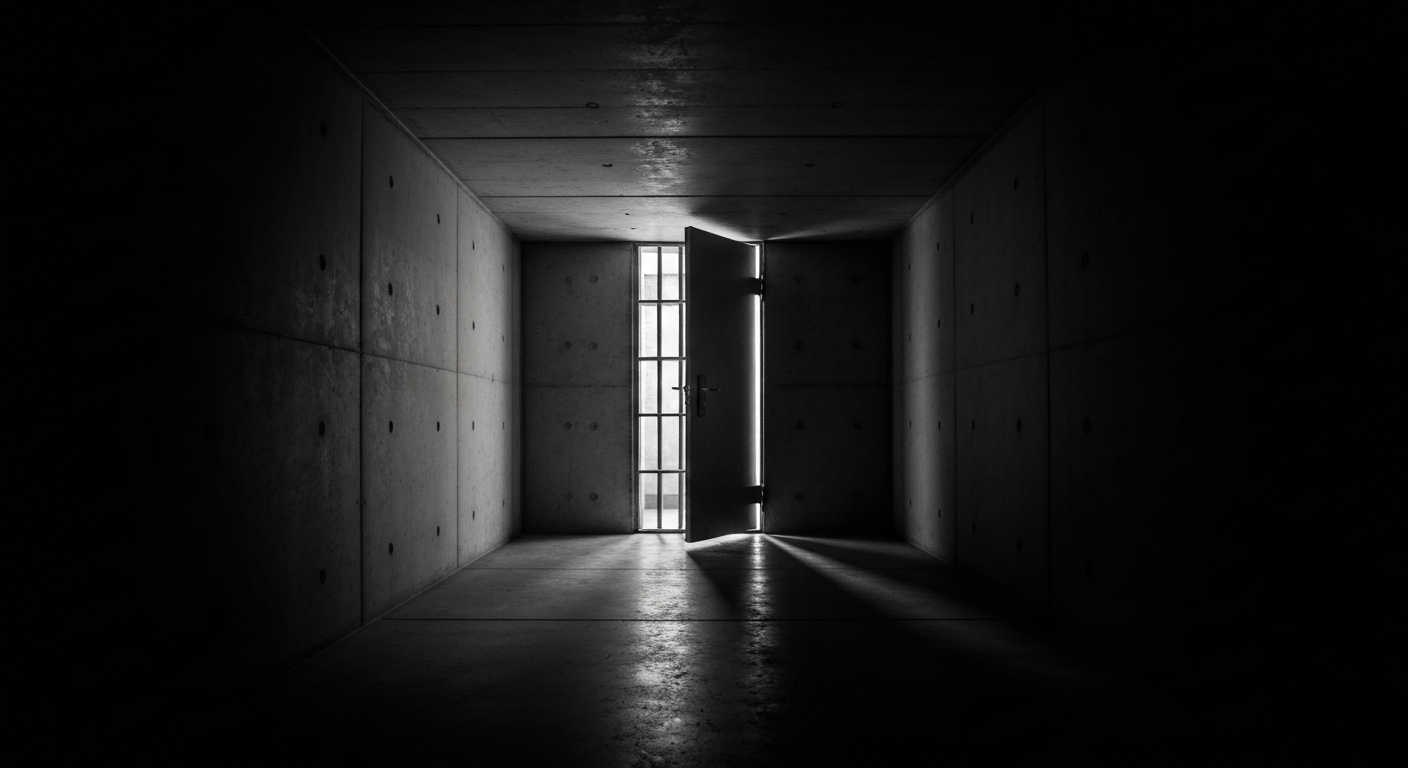
In the summer of 2005, a man named Steven Slevin was pulled over in Doña Ana County, New Mexico. He was driving erratically, possibly intoxicated. He had no criminal history. He was booked into the Doña Ana County Detention Center on a charge of driving while intoxicated and receiving a stolen vehicle — the second charge based on little more than the fact that the car he was driving had been reported stolen by his ex-girlfriend in a domestic dispute. He was 59 years old. He had a history of mental illness and depression. He needed medication. He needed a lawyer. He needed a court date.
What he got instead was a cell.
For 22 months — nearly two years — Steven Slevin sat in solitary confinement in the Doña Ana County Detention Center without ever being brought before a judge. Without a trial. Without a hearing. Without so much as an arraignment. His family didn't know where he was. His requests for medical care were ignored or denied. His requests to see an attorney went unanswered. The DWI charge that put him there — the kind of charge that typically resolves in a few weeks — simply waited. The system forgot about him.
Or, more accurately: the system decided he wasn't worth remembering.
By the time Steven Slevin was finally released in 2007, he was a man destroyed. He had developed severe scabies. He had open, infected bed sores across his body. He had lost more than 50 pounds. He had a broken tooth that no dentist had ever treated — so he had pulled it out himself, without anesthesia, with his bare hands. He had been alone in a concrete box for nearly two years, denied sunlight, denied contact, denied the fundamental constitutional guarantees that are supposed to protect every person accused of a crime in the United States of America.
In 2012, a federal jury awarded him $22 million in damages. The county settled for $15.5 million — at the time, the largest single-plaintiff civil rights settlement in New Mexico history, and one of the largest pretrial detention settlements in the United States.
The sheriff kept his job. The jail administrator kept her job. No criminal charges were filed. No systemic reforms were mandated by the court. And in the years since, despite the settlement, the pretrial detention crisis in America has only deepened.
Steven Slevin's story is not an anomaly. It is a window into a machine.
- Incarcerated: July 2005 — May 2007 (approximately 22 months)
- Original charge: DWI and receiving a stolen vehicle (Doña Ana County, NM)
- Court appearances during detention: Zero
- Medical care received: None documented during confinement
- Conditions: Solitary confinement; scabies; infected bed sores; pulled own broken tooth without anesthesia
- Jury award (2012): $22 million
- Settlement amount: $15.5 million (largest single-plaintiff civil rights settlement in NM history)
- Officials prosecuted: Zero
- Reforms ordered: None by court mandate
- Governing statute violated: Sixth Amendment (right to speedy trial); Fourteenth Amendment (due process); 42 U.S.C. § 1983 (civil rights under color of law)
The Founding Promise They Abandoned
The Sixth Amendment to the United States Constitution is not ambiguous. Ratified in 1791, it reads, in part: "In all criminal prosecutions, the accused shall enjoy the right to a speedy and public trial." The word "speedy" is not a suggestion. It is not a guideline. It is a constitutional guarantee, born from the lived experience of colonists who had watched British authorities jail people indefinitely without charges, without hearings, without recourse. The Founders had seen what happened when governments could hold men in boxes without ever proving they had done anything wrong. They built a wall against it.
That wall crumbled in Doña Ana County, New Mexico, for 22 months, and nobody in a position of authority noticed — or cared.
"The accumulation of all powers, legislative, executive, and judiciary, in the same hands, whether of one, a few, or many, and whether hereditary, self-appointed, or elective, may justly be pronounced the very definition of tyranny."
Madison was describing the institutional failure that the American constitutional order was specifically designed to prevent. And yet, in a county detention center in southern New Mexico, every institutional safeguard failed simultaneously. The jail held a man. The courts did not summon him. The public defender's office did not find him. The sheriff did not flag him. The county administrator did not audit the population for people awaiting charges without hearings. And for nearly two years, Steven Slevin — a human being with a documented mental illness, a prior life, a family — simply ceased to exist in the legal system.
He was not forgotten through abstract bureaucratic negligence. He was forgotten through a specific, systemic failure of every actor who was constitutionally obligated to ensure he appeared before a judge.
The Mechanics of Disappearance
To understand how Steven Slevin disappeared for nearly two years, you have to understand how American pretrial detention actually works — as opposed to how civics textbooks describe it.
When a person is arrested and charged with a crime, the constitutional model envisions a rapid sequence: arrest, booking, arraignment (typically within 48–72 hours), bail hearing, pretrial supervision, and eventually, trial. The Sixth Amendment's speedy trial guarantee, interpreted through the Supreme Court's 1972 ruling in Barker v. Wingo, establishes a balancing test: courts must weigh the length of the delay, the reason for the delay, the defendant's assertion of the right, and prejudice to the defendant. It is not a bright-line rule. It is a weighing test — which, in practice, means it is a standard that courts apply inconsistently, unevenly, and often not at all when the person being detained is poor, mentally ill, and unrepresented.
Steven Slevin was all three.
At the time of his arrest, Doña Ana County's detention facility was overcrowded and chronically understaffed — a condition shared by hundreds of county jails across the United States. The booking process was designed to track charges, not to ensure constitutional compliance with the speedy trial clock. Mental health screenings, to the extent they existed, did not automatically trigger intervention. If a person was booked, held, and simply not brought to court, there was no automated system that would flag the failure and demand resolution.
There was, in theory, a public defender's office. But public defenders in rural New Mexico — and across the rural United States — are typically overwhelmed, underfunded, and operating at caseloads that make meaningful individual representation functionally impossible. According to court records in the Slevin litigation, there is no clear evidence that the public defender's office was ever alerted to his detention or made any effort to locate him during the 22 months he sat in solitary confinement. He fell through every crack simultaneously.
The solitary confinement component compounds the horror. In most detention facilities, inmates in the general population interact with guards, other inmates, and occasionally court transport staff — creating opportunities for someone to notice that a particular person has been there for an unusually long time. In solitary confinement, those interactions are eliminated by design. The cell is the world. And if no one is tracking the constitutional clock, no one is coming.
The Physical Destruction of a Human Being
What Doña Ana County did to Steven Slevin's body is documented in federal court records, medical expert testimony, and photographs entered into evidence during litigation. It is worth describing in specific terms, because sanitized language allows comfortable people to avoid confronting what institutional neglect actually looks like in the flesh.
Scabies is a skin infestation caused by the Sarcoptes scabiei mite. It causes intense, unrelenting itching — particularly at night — and, when untreated, leads to open sores, secondary bacterial infections, and skin damage. In prison and jail environments, scabies spreads easily. When Steven Slevin contracted scabies in the Doña Ana County Detention Center, he received no treatment. He scratched. The sores opened. They became infected.
Pressure sores — commonly called bedsores or pressure ulcers — develop when a person spends extended periods in the same position without adequate movement, nutrition, or skin care. In severe cases, they penetrate through the skin, through the tissue beneath, and down to the bone. They are almost entirely preventable with basic medical attention. Steven Slevin developed them across his body. They went untreated.
Then there was the tooth.
At some point during his detention, one of Steven Slevin's teeth broke or decayed to the point of causing him severe pain. He requested dental care. He received none. So, according to court records and his own testimony, Steven Slevin extracted his own tooth — without anesthesia, without surgical tools, without any medical supervision — because the pain was unbearable and no one in the Doña Ana County system was going to help him.
Read that again slowly. A man in county custody — not convicted of anything, awaiting a trial that never came — pulled his own tooth out with his hands because the people holding him had left him no other choice.
By the time he was released in May 2007, he had lost more than 50 pounds. His body had been systematically destroyed by a government that had a constitutional obligation to either charge him properly and bring him to trial, or release him. It chose neither. It simply held him until he broke.
The Lawsuit, the Jury, and the Settlement
Steven Slevin filed a federal civil rights lawsuit under 42 U.S.C. § 1983, alleging that Doña Ana County officials had violated his Eighth Amendment right to be free from cruel and unusual punishment, his Fourteenth Amendment right to due process, and his Sixth Amendment right to a speedy trial. The named defendants included the Doña Ana County Sheriff's Department and individual county officials responsible for the operation of the detention facility.
The case went to federal court in the District of New Mexico. In 2012, after years of litigation, a federal jury returned a verdict of $22 million in damages — one of the largest civil rights jury verdicts in New Mexico history at that time. The jury found that county officials had been deliberately indifferent to Slevin's constitutional rights and to the serious medical needs that went unaddressed during his detention.
"Deliberate indifference" is the legal standard required under Estelle v. Gamble (1976) for Eighth Amendment medical claims by prisoners. It requires proof that an official knew of and disregarded an excessive risk to an inmate's health or safety. In Slevin's case, the jury found that the county's behavior met that standard — that the men and women running the Doña Ana County Detention Center knew that Slevin was deteriorating, that he needed medical care, and that they chose not to provide it.
The county ultimately settled for $15.5 million — still the largest single-plaintiff civil rights settlement in New Mexico history. The settlement did not require the county to admit wrongdoing. It did not require criminal referrals. It did not mandate specific reforms to the detention facility's policies. It was, in the language of civil settlement agreements, a resolution of the dispute without acknowledgment of liability.
The taxpayers of Doña Ana County paid $15.5 million for what their government did to Steven Slevin. The officials who made the decisions that destroyed him paid nothing. They faced no criminal charges. They faced no civil liability of their own. They were, in the eyes of American law, simply employees who had been named in a lawsuit that their employer resolved on their behalf.
"Equal and exact justice to all men, of whatever state or persuasion, religious or political; peace, commerce, and honest friendship with all nations, entangling alliances with none."
Jefferson's vision of "equal and exact justice to all men" is not reconcilable with a system in which a man can be confined in solitary isolation for 22 months, denied medical care until his body fails, and forced to extract his own tooth — and the people responsible face no personal accountability whatsoever. The settlement money does not represent justice. It represents the price tag of impunity.
The Systemic Context: Pretrial Detention as a National Crisis
Steven Slevin's case is extreme in its duration and in the specific catalog of horrors it produced. But it is not isolated in its underlying dynamics. The pretrial detention system in the United States is, by any serious measure, a constitutional emergency.
According to data from the Bureau of Justice Statistics, approximately 60% of the people held in America's county jails on any given day are pretrial detainees — people who have not been convicted of anything, who are being held because they cannot afford to post bail or because a judge has ordered them detained pending trial. As of the most recent comprehensive census, that represents roughly 400,000 to 500,000 people on any given day. Many of them will wait months for a trial date. Some will wait years. A significant number will ultimately have their charges dropped or will be acquitted — meaning they served months or years in jail for crimes the state ultimately could not prove they committed.
The racial and economic dimensions of this crisis are stark and well-documented. Pretrial detention falls disproportionately on poor people and on Black and Latino communities. The bail system — a commercial enterprise in which private companies profit from pretrial incarceration — has been repeatedly documented as a mechanism that criminalizes poverty rather than managing flight risk or public safety. A wealthy person charged with a serious crime can often post bail and await trial in their home. A poor person charged with a minor offense may sit in a cell for months because they cannot afford the 10% premium on a commercial bail bond.
The mental health dimensions are equally catastrophic. Studies consistently find that between 15% and 20% of people incarcerated in American jails have a serious mental illness. The jail system — designed for short-term detention, not treatment — is catastrophically unprepared to serve this population. The result is that jails have become, by default, the largest mental health providers in the United States. They are providing that "care" through solitary confinement, inadequate medication, and medical neglect.
Steven Slevin had a documented history of mental illness at the time of his arrest. That history was apparently irrelevant to the officials who placed him in solitary confinement and left him there for nearly two years.
The Solitary Confinement Dimension
The use of solitary confinement in American jails and prisons has been the subject of sustained legal challenge, medical condemnation, and growing bipartisan reform pressure for decades. The evidence is unambiguous: prolonged isolation causes severe, lasting psychological harm. Studies published in peer-reviewed medical journals consistently find that solitary confinement produces anxiety, depression, hallucinations, perceptual distortions, paranoia, and — in a significant percentage of cases — irreversible psychological damage. The United Nations Special Rapporteur on Torture has described solitary confinement exceeding 15 days as potentially constituting torture or cruel, inhuman, or degrading treatment under international law.
Steven Slevin was in solitary confinement for approximately 22 months — roughly 660 days. He was not there because he had committed a disciplinary infraction within the facility. According to court records, the reason for the extended solitary placement was his documented mental illness. The county placed him in isolation because he was mentally ill — which is to say, they responded to a condition requiring medical treatment by imposing a condition that medical experts have consistently found to dramatically worsen mental illness.
This is not aberrant. Across the United States, mentally ill pretrial detainees are routinely placed in solitary confinement — sometimes in designated "mental health units" that are, in practice, simply isolation cells with occasional psychiatric check-ins. The theory, to the extent one exists, is that isolation protects either the mentally ill person from harm or the general population from disruption. The reality, documented repeatedly in litigation and inspection reports, is that isolation destroys the mental health of the people subjected to it, generating spiraling crises that cost more to manage and produce more harm than any alternative.
The Americans with Disabilities Act, 42 U.S.C. § 12132, prohibits public entities — including county jails — from discriminating against individuals with disabilities. Placing a person in solitary confinement because they have a mental illness, rather than providing treatment for that illness, is a textbook ADA violation. The Doña Ana County case was not litigated primarily on ADA grounds, but the conduct described would have supported such a claim.
The Accountability Void: Why No One Was Charged
Federal prosecutors have the authority to bring criminal charges against state and local officials who, acting under color of law, willfully deprive individuals of their constitutional rights. The relevant statute is 18 U.S.C. § 242, which imposes criminal penalties — up to life imprisonment, or the death penalty if death results — on anyone who "under color of any law, statute, ordinance, regulation, or custom, willfully subjects any person in any State, Territory, Commonwealth, Possession, or District to the deprivation of any rights, privileges, or immunities secured or protected by the Constitution or laws of the United States."
The standard is "willfulness" — meaning the government official had to know that their conduct was illegal. Deliberate indifference to a pretrial detainee's medical needs, combined with 22 months of solitary confinement without a court appearance, would appear to constitute willful deprivation of rights. The federal jury's finding of deliberate indifference in the civil case established, to a civil preponderance standard, that county officials knew and disregarded the risk.
No federal criminal charges were brought against any Doña Ana County official in connection with Steven Slevin's detention.
This is not surprising. The Justice Department's Civil Rights Division has historically been deeply reluctant to prosecute local law enforcement officials under § 242, reserving the statute for egregious cases — police shootings, beatings, on-camera violence — that generate significant public pressure. The slow bureaucratic destruction of a mentally ill man's body and mind in a county jail cell, however well-documented, rarely generates the kind of political pressure that produces federal prosecution. Institutional neglect is harder to photograph than a beating. It is harder to explain to a jury than a punch. And it is, therefore, easier to quietly settle and forget.
The New Mexico state authorities also declined to take action against any individual county official in connection with the Slevin case. The county's insurance carrier — ultimately the entity writing the $15.5 million check — had every incentive to settle quietly and without findings of individual liability that might expose its client to additional litigation. That is what happened.
The Costs That Never Get Counted
The $15.5 million settlement figure tends to dominate coverage of the Slevin case when it is covered at all. But the true costs of what Doña Ana County did — to Slevin, to the county's own treasury, and to the integrity of the justice system — are far larger and harder to quantify.
Steven Slevin left the detention facility a physically and psychologically destroyed man. The injuries documented during litigation — the scabies damage, the pressure sores, the weight loss, the dental mutilation, the psychological trauma of 22 months in isolation — are not injuries from which a person simply recovers. They are lasting damage. The $15.5 million represents an imperfect attempt to compensate for suffering that cannot actually be compensated. No amount of money gives a man back two years of his life. No settlement undoes the experience of pulling your own tooth out in a county cell.
For Doña Ana County, the costs extend beyond the settlement. The litigation, the legal fees, the insurance premium increases, the reputational damage — none of these appear in the headline figure. And the systemic costs — the ongoing operation of a detention facility whose culture produced this outcome — are never fully counted at all.
For the justice system broadly, the Slevin case represents a data point in a well-documented pattern of constitutional violations that the system resolves through civil settlement rather than through the individual accountability that might actually deter future violations. When the cost of destroying a man falls on taxpayers rather than on the officials who made the decisions, the system generates no corrective signal to those officials. They learn that they can behave this way, and the cost will be absorbed by someone else.
The Broader Pattern: Jails as Constitutional Dead Zones
The conditions that produced Steven Slevin's detention are not unique to Doña Ana County. They represent structural features of the American pretrial detention system that have been documented in jurisdiction after jurisdiction, decade after decade.
In 2011 — the same year the Slevin litigation was working its way through the federal courts — the Supreme Court in Brown v. Plata upheld a lower court order requiring California to reduce its prison population because overcrowding had produced conditions of medical and mental health care so deficient they constituted cruel and unusual punishment. Justice Anthony Kennedy's majority opinion described a suicide watch cage characterized as "smaller than a telephone booth." The case was about California state prisons. But the conditions it described are replicated, in varying degrees, across hundreds of county jails nationwide.
In 2015, Sandra Bland — a 28-year-old Black woman arrested during a routine traffic stop in Waller County, Texas, after a contentious interaction with a state trooper — died in her jail cell three days after being arrested on a misdemeanor charge. She had been held on $5,000 bail she could not post. The medical examiner ruled her death a suicide by hanging. What is not disputed is that Sandra Bland was in a county jail cell, alive and healthy before her arrest, for the fundamental reason that she could not afford to pay $5,000 to a commercial bail bondsman.
In 2019, the Department of Justice issued a report documenting conditions in the Rikers Island jail complex in New York City that included systematic violence, inadequate medical care, and extended pretrial detention for individuals who had been there for years without trial. The report noted that people with serious mental illnesses accounted for a disproportionate share of violent incidents — and that the jail's response to mental health crises was typically punitive isolation rather than treatment.
The pattern is consistent: jails across the United States hold large numbers of people, disproportionately poor and mentally ill, in conditions that frequently violate constitutional minimums. The enforcement mechanism — civil litigation under § 1983 — is slow, expensive, and results in settlements paid by taxpayers rather than accountability imposed on individuals. The constitutional guarantees that were supposed to prevent this are, in practice, largely unenforceable.
Doña Ana County After Slevin: The Persistence of Nothing
The Slevin settlement was entered in 2013. In the years since, Doña Ana County has continued to operate its detention facility. There is no publicly available evidence of court-ordered monitoring of the facility's pretrial procedures. There is no evidence of a federal consent decree requiring specific reforms. The sheriff's office has continued to operate.
Doña Ana County is not unique in this regard. Civil rights settlements in institutional litigation — prison conditions, jail conditions, police misconduct — routinely fail to produce lasting change because they impose financial costs on institutions rather than behavioral costs on individuals, and because they do not include the kind of external, ongoing monitoring that might detect whether the underlying conditions have actually changed.
Research on the effects of civil rights settlements in correctional settings consistently finds that voluntary settlements, in the absence of court-monitored consent decrees, produce short-term improvements that tend to erode over time as institutional cultures reassert themselves, budgets tighten, and attention moves on. The $15.5 million paid to Steven Slevin did not reform the Doña Ana County Detention Center. It compensated one victim of that facility's culture while leaving the culture largely intact.
The Reform Blueprint: What It Would Actually Take
The case of Steven Slevin is not simply a horror story about one man's suffering. It is a diagnostic case study in systemic failure — and like any systemic failure, it points toward systemic solutions. The following are concrete, achievable reforms that could prevent the next Steven Slevin from disappearing into an American jail cell.
- Mandatory Pretrial Appearance Timelines With Automatic Review Triggers. Every person booked into a county jail should be automatically flagged if they have not appeared before a judge within 72 hours of booking. No system should be capable of holding a person for 22 months without generating an automatic alert requiring supervisor review and judicial notification. This is a basic database function — a timer attached to a booking record — that dozens of jurisdictions have already implemented and that every jurisdiction should be required to adopt as a condition of federal justice funding.
- Independent Jail Inspection Boards With Real Authority. Doña Ana County held Steven Slevin for 22 months without any external body identifying or intervening in the violation. County jails should be subject to mandatory, unannounced inspections by independent oversight boards with subpoena authority, public reporting requirements, and the power to refer individual officials for criminal investigation. These boards must be funded independently of the sheriff's office or county executive they are charged with overseeing — otherwise they are ornamental.
- Personal Liability for Deliberate Indifference. The current § 1983 framework allows civil rights settlements to be paid by county governments — meaning taxpayers — without imposing personal financial liability on the individual officials whose decisions produced the violation. Reforming qualified immunity doctrine and creating mechanisms for personal liability — including mandatory professional liability insurance requirements for law enforcement and correctional officers — would introduce financial consequences that actually reach the decision-makers.
- Mandatory Medical Screening and Continuity of Care. Every person booked into a county jail should receive a documented medical and mental health screening within 24 hours of arrival. Any person with a documented serious mental illness, chronic medical condition, or urgent medical need should be flagged for ongoing monitoring and cannot be placed in solitary confinement without specific documented clinical justification reviewed by a licensed medical professional. Solitary confinement as a default mental health management tool should be prohibited by statute.
- Strict Limits on Pretrial Solitary Confinement. Following the recommendations of the United Nations Standard Minimum Rules for the Treatment of Prisoners (the Nelson Mandela Rules), federal legislation should limit the use of solitary confinement for pretrial detainees to no more than 15 consecutive days except in extraordinary circumstances subject to judicial review. Solitary confinement should never be used as a substitute for mental health treatment — and any placement of a mentally ill pretrial detainee in isolation should automatically trigger mandatory judicial review within 48 hours.
- Public Defender Resource Parity. The constitutional right to counsel is meaningless if the public defender's office is too overwhelmed to find its clients. Federal legislation should establish minimum staffing ratios for public defenders in jurisdictions that receive federal criminal justice funding, and should create affirmative obligations for public defenders to verify the location and status of clients who have been booked. A pretrial detainee who has not seen their attorney within seven days of booking should generate an automatic alert to the court.
- Bail Reform and Pretrial Services Expansion. A significant driver of pretrial detention is the commercial bail system, which holds people based on financial inability rather than assessed risk. Evidence-based pretrial services — supervised release programs that use validated risk assessment instruments and provide supervision without incarceration — have been shown in multiple jurisdictions to achieve equivalent or superior court appearance rates at a fraction of the cost of incarceration. States should be incentivized through federal criminal justice grants to transition from commercial bail to evidence-based pretrial services.
- Federal Consent Decree Requirements for Large Settlements. When a civil rights settlement under § 1983 exceeds a specified threshold — suggested: $1 million — federal law should require the settling jurisdiction to enter into a court-monitored consent decree specifying the reforms it will implement and the timeline for achieving them. Settlements should not be allowed to function as simple financial transactions that resolve constitutional violations without producing structural change. The consent decree requirement creates ongoing judicial oversight and a mechanism for enforcing compliance.
- Criminal Accountability for Deliberate Indifference. The Department of Justice should develop and publish clear prosecution guidelines for 18 U.S.C. § 242 cases involving documented deliberate indifference in correctional settings. The current de facto standard — in which deliberate indifference is actionable civilly but rarely prosecuted criminally — creates a perverse incentive structure. Grand jury proceedings should be initiated as a matter of course when civil litigation produces a finding of deliberate indifference resulting in serious physical harm to a pretrial detainee.
- Mandatory Transparency and Data Reporting. Every county jail in the United States should be required to submit monthly reports to a publicly accessible federal database documenting: the total pretrial detainee population, average length of detention by charge category, the number of detainees awaiting initial court appearance for more than 72 hours, the number of detainees in solitary confinement and the duration, and the number of medical complaints filed and resolved. Sunlight is the most effective disinfectant. A jail whose pretrial population is invisible to the public and to oversight bodies will always produce Steven Slevins.
What Steven Slevin's Case Tells Us About America
In 1789, George Mason — one of the principal architects of the Bill of Rights — refused to sign the Constitution because it did not, in his view, adequately protect individual liberty against government power. He was persuaded, ultimately, by the commitment to add a Bill of Rights. He spent the rest of his life insisting that the protections in that Bill of Rights were not decorative — they were load-bearing walls of the republic.
The Sixth Amendment speedy trial guarantee. The Eighth Amendment prohibition on cruel and unusual punishment. The Fourteenth Amendment guarantee of due process. These are Mason's walls. They are the walls that were supposed to make it impossible for a government to do to Steven Slevin what Doña Ana County did to Steven Slevin.
They failed. Not because the words were wrong. Because the institutions charged with enforcing them — the court system, the public defender's office, the sheriff's department, the county government — all failed simultaneously. And because the remedy — a $15.5 million civil settlement — imposed a financial cost but no individual accountability. The people who made the decisions that destroyed Steven Slevin's body and mind continued their careers. They were protected by the same institutional apparatus that had failed their victim.
This is not a story about one bad county in one state. It is a story about what happens when institutions lose their fear of constitutional consequences. When officials know that the worst outcome — for them personally — is that their employer pays a civil settlement, the constitutional floor becomes a negotiating position rather than a minimum. When the cost of cruelty is diffused across the tax base rather than concentrated on the individuals who chose cruelty, those individuals have no personal incentive to choose differently next time.
Steven Slevin pulled his own tooth out in a Doña Ana County cell in 2006. He did it because no one in a position of authority — in the jail, in the courts, in the public defender's office, in the county government — did their job. He did it because the constitutional guarantee of a speedy trial is, in practice, only as strong as the institutions committed to enforcing it. And in Doña Ana County, for 22 months, those institutions simply did not care.
The $15.5 million settlement made him wealthier. It did not make him whole. It did not make the system better. It did not make the officials accountable. It made the problem go away.
Until it happens again.
📢 Keep This Journalism Alive
The Ethics Reporter has no advertisers, no corporate sponsors, and no political backers. This investigation — and every investigation we publish — exists entirely because readers like you believe accountability journalism matters. If this reporting moved you, please consider supporting us.
Donate to The Ethics ReporterEven $1 helps. No amount is too small. Thank you for standing with us.