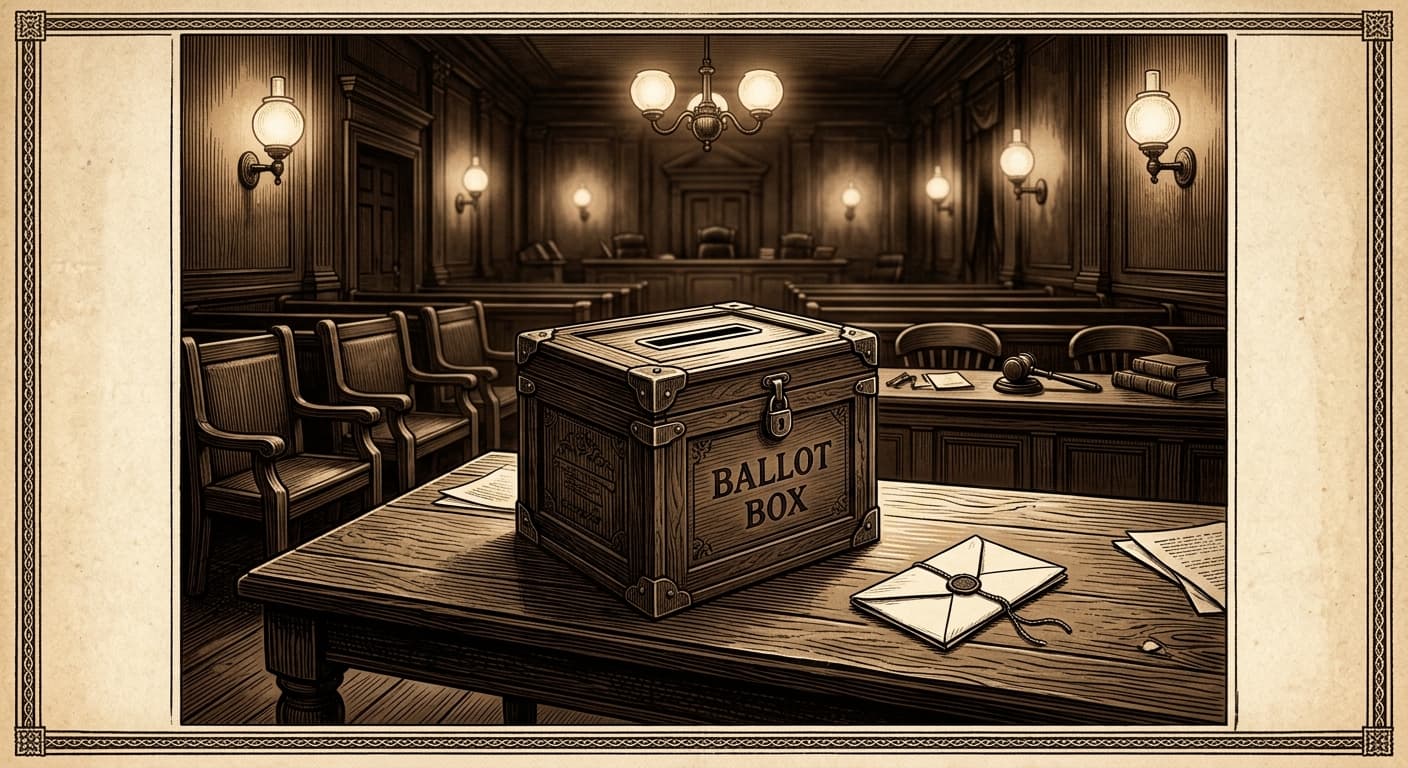
On the morning of June 17, 1873, in the federal courthouse at Canandaigua, New York, the United States government put a fifty-three-year-old woman on trial for a crime that the indictment styled with perfect bureaucratic gravity: knowingly, wrongfully, and unlawfully voting. The defendant was Susan B. Anthony, by then one of the most famous reformers in America, a veteran of thirty years in the movements for abolition, temperance, and the rights of women. The ballot she had cast — in Rochester, on November 5, 1872, alongside some fourteen other women who had persuaded the local inspectors of election to register them — was for members of Congress and for the re-election of President Ulysses S. Grant. For that ballot, a federal grand jury indicted her under the Enforcement Act of 1870, a statute Congress had passed to stop the Ku Klux Klan from terrorizing Black voters in the South. The maximum penalty was three years in prison. Presiding over the trial was Ward Hunt, an Associate Justice of the Supreme Court of the United States, riding circuit. Justice Hunt came to Canandaigua with his mind already made up: he had written his opinion before the trial began. He carried it with him into the courtroom, and near the trial's end, he took the written pages from his pocket and read them from the bench, ordered the jury to return a verdict of guilty, refused to let the defense poll the jurors, and fined the defendant one hundred dollars and costs. Susan B. Anthony rose before sentencing and delivered one of the great courtroom condemnations in the American record. Then she refused to pay. And the court, in a final act of procedural cowardice, declined to jail her — because jailing her would have let her appeal. The government of the United States had convicted a citizen of voting and then locked every door out of the courtroom, including the door to the prison, to make sure no higher court could ever review what it had done.
The trial of Susan B. Anthony is the oldest case in this series, and it is the skeleton key. Every deformity this series has documented in the courts of the twentieth and twenty-first centuries — the predetermined outcome, the captured factfinder, the immunity of the official actor, the substitution of procedure for justice, the conversion of courts from instruments of liberation into mechanisms of control — is present in that Canandaigua courtroom in June 1873, naked and unashamed, performed by a justice of the nation's highest court in front of a packed gallery and the national press. The case also proves the inverse proposition that gives this series its purpose: that when the courts become the mechanism of disenfranchisement, the remedy cannot come from the courts alone, and the Founders' promise must be retaken by the people over the course of generations. It took forty-seven years from Anthony's conviction to the ratification of the Nineteenth Amendment. The constitutional text she invoked in her defense — the Fourteenth Amendment, the founding promise of citizenship and equal protection, the opening words We the People — ultimately won. But it won in spite of the courts, not because of them, and the story of how it won begins with a judge who had already written the ending.
The Ballot and the Theory
To understand what was really on trial at Canandaigua, one has to understand the argument Anthony and the suffrage movement had built, because it was a serious constitutional argument — arguably the strongest reading of the Reconstruction Amendments available in 1872 — and the prosecution's task was not merely to punish her but to ensure the argument never received a fair hearing. The theory went by the name the New Departure, and its premise was the Fourteenth Amendment's first sentence, ratified in 1868: All persons born or naturalized in the United States, and subject to the jurisdiction thereof, are citizens of the United States and of the State wherein they reside. Women were persons. Women were born or naturalized in the United States. Women, therefore, were citizens — and the amendment's next clause forbade any state to make or enforce any law abridging the privileges or immunities of citizens of the United States. If the ballot was a privilege of citizenship, then New York's law restricting the franchise to male citizens was an unconstitutional abridgment, and a woman presenting herself at the polls was not committing a crime; she was exercising a right that the Constitution had already, in text, secured.
Anthony had reached this position through the bitterest of educations. She had spent the Civil War years and the Reconstruction years campaigning for the abolition of slavery and then for the enfranchisement of the freedpeople, expecting — as the abolitionist-suffragist alliance universally expected — that the constitutional settlement following the war would enfranchise women alongside the freedmen. Instead, the Fourteenth Amendment introduced the word male into the Constitution for the first time, in its second section's apportionment penalty, and the Fifteenth Amendment, in 1870, forbade racial disenfranchisement while saying nothing of sex. The movement's congressional allies told the women, in substance: this is the Negro's hour; wait. Anthony and Elizabeth Cady Stanton refused to wait, broke with former allies over the Fifteenth Amendment's omission, and began building the case that the Fourteenth Amendment's citizenship clause had already done what the politicians refused to do. Francis Minor, a St. Louis lawyer and husband of the suffragist Virginia Minor, had published the argument in 1869; the Minors' Missouri suffrage organization had been the first to act on it, when Virginia Minor attempted to register to vote in 1872 and was refused, setting up the lawsuit that would eventually reach the Supreme Court as Minor v. Happersett. Anthony's vote in Rochester was the same constitutional theory, acted upon in New York.
And it was an action undertaken with open eyes and announced intentions. On November 1, 1872, Anthony and a group of women presented themselves at the office of the Rochester registry board and demanded to be registered. The inspectors — three men, Democrats and Republicans of the ward, whose oaths bound them to the Constitution as well as to state law — were persuaded, after Anthony read them the Fourteenth Amendment and after the movement's counsel, Judge Henry R. Selden, a former judge of the New York Court of Appeals and a retired Lieutenant Governor of the state, provided a written opinion that the women were legally entitled to registration. Selden's role matters: it would later become the core of Anthony's defense, since the crime charged required not merely the act of voting but knowing, willful violation of law, and she had voted on the written advice of one of the most distinguished lawyers in the state that her vote was lawful. On election day, November 5, Anthony and fourteen other women voted in the Eighth Ward. The ballots of Susan B. Anthony and her companions were deposited, counted, and reported. The republic survived the shock.
The government's response was measured, deliberate, and revealing. Rather than arrest the women at the polls, the federal marshal waited. On November 18, the deputy United States marshal came to Anthony's home in Rochester with a warrant, and the arrest — Anthony at first demanded to be taken properly, extending her wrists for handcuffs that the embarrassed deputy declined to use — began the prosecution's long choreography. Anthony was examined before a United States commissioner. At that hearing, the government refused to let her testify about her state of mind — the heart of the intent question — and Selden's objection, that the refusal converted the preliminary examination into a trap, was noted for the record and overruled. In January 1873, a federal grand jury indicted her. The case was assigned, as it happened, to the circuit justice, Ward Hunt — an appointee of President Grant placed on the Supreme Court in December of 1872, confirmed in days in a lame-duck Senate, a man who by 1873 was in failing health and whose prior judicial service and political career in New York politics had been marked by no distinction in constitutional law whatever. The government had chosen its forum well.
The Lecture Tour and the Vanishing Venue
Anthony did not sit quietly awaiting trial. In the months between her indictment and the trial date, she did what any sensible defendant with a cause and a voice would do: she took the case to the prospective jury. Traveling through Monroe County, she delivered, twenty-nine times by her own count, a lecture titled Is it a Crime for a Citizen of the United States to Vote? — a point-by-point public argument that her prosecution was itself unconstitutional, that the Fourteenth Amendment secured her ballot, and that the real crime was the government's. The speech drew its power from the founding text she cited constantly, and its refrain deserves quotation because it is the spine of the case: We the people of the United States, she would begin, and then pause, and ask the audience who constituted that people. Not we the white male citizens, she answered; nor yet we the male citizens; but we, the whole people, who formed the Union. The preamble's promise, the blessings of liberty secured to ourselves and our posterity, included, she insisted, the female half of the posterity then living. It was a lay constitutional sermon, and it was effective — so effective that the United States Attorney, Richard Crowley, took the extraordinary step of asking the court to move the trial.
The sequence that follows is a small masterpiece of the forum manipulation this series has documented in cases like Diallo's Albany exile a century and a quarter later, and it should be read with that echo in mind. First the trial was delayed from May to June. Then, on the grounds that Anthony's lectures had prejudiced the entire jury pool of Monroe County, the venue was changed to Ontario County — to Canandaigua — which she had not toured. She promptly went to Ontario County and lectured there, too. The delay had also served the government's deeper purpose: the calendar of the circuit had brought the trial within the sitting of Justice Hunt, rather than the district judge, Nathan Hall, before whom the case had first been expected. Every element of forum, timing, and factfinder had been adjusted. The government understood, as governments always understand, that the trial was dangerous to it only if the forum was free.
Canandaigua: A Trial With the Verdict in the Judge's Pocket
June 17, 1873. The courtroom in Canandaigua was crowded, with the national press present and with women of the movement, including Elizabeth Cady Stanton and Matilda Joslyn Gage, attending through the two days of trial. District Attorney Crowley opened for the United States with a case of studied simplicity: the inspectors testified that Anthony had registered and voted; her own admitted statements established the rest; and the law of New York confined the franchise to male citizens. Simple — if the constitutional question could be kept out of the courtroom. Keeping it out was Justice Hunt's task, and he performed it with a completeness that the later police-acquittal judges of this series could only envy.
First, Hunt refused to permit the defense to open the constitutional question to the jury in any form. Selden — and beside him, the former United States Commissioner Henry R. Selden's co-counsel, the abolitionist-era lawyer John van Voorhis — had planned to argue the Fourteenth Amendment directly, to put to the jury the question whether the constitutional right to citizenship's privileges controlled. Hunt ruled the question of the election law's constitutionality was a matter of law for the court, not of fact for the jury, and that it would be decided by himself. Second — and here the trial crossed from ordinary adverse ruling into the grotesque — when Anthony herself was called by her counsel to testify, Hunt sustained the government's objection that she was incompetent to testify in her own case. The accused was barred from the stand in her own defense, in a trial in which the only real issue was what she had believed when she voted. The entire question of intent — the element the statute made essential, the knowing and willful violation — was to be adjudicated without a word from the only person on earth who knew her intent.
Third, Hunt gutted the good-faith defense by construction. Selden introduced the written opinion of Judge Selden — the advice on which Anthony had registered — to show that she had voted in the honest belief, professionally counseled, that the vote was lawful. The standard criminal-law treatment of advice of counsel is that it negates willfulness. Hunt would hold, as a matter of law, that intent was beside the point: that if she knowingly cast a ballot for candidates while knowing herself to be a woman, the legal element was satisfied regardless of her belief about her right. The distinction is between intent to act and intent to violate, and Hunt collapsed it — a ruling that converted the statute's protection of innocent error into nothing, and that pre-decided, as a matter of law, the very guilt the jury existed to determine.
And then, the fourth act: with the testimony closed and the defense's avenues all sealed, Justice Hunt took from his pocket the opinion he had written before setting foot in Canandaigua, and read it to the jury. The record of the trial, including the account preserved by the movement's own historians and the contemporary press, is clear that the opinion was prepared in advance — written before the trial began. In it, Hunt declared that the right to vote was not a privilege of national citizenship within the meaning of the Fourteenth Amendment, that the states could restrict it as they pleased, that the defendant's belief was no defense, and that there was no question for the jury to determine. He then did what no honest trial permits: he directed the verdict. There is no question upon which the jury has a right to pass, he instructed, in substance; the facts not being in dispute, I direct you to find a verdict of guilty. And — fifth — when Selden asked that the jury at least be polled, that each juror be asked individually whether guilty was his verdict, Hunt refused. The clerk recorded the verdict the judge had ordered. Twelve citizens of Ontario County had sat in a box for two days and been permitted to do nothing — their constitutional office, the office the Founders had designed as the citizenry's direct check on the government's prosecutions, administratively abolished by a justice of the Supreme Court conducting a trial out of circuit.
It is worth pausing on the directed verdict in a criminal case, because its audacity can be lost in the narrative. The Sixth Amendment — the Founders' amendment, the one born of the colonial experience of royal judges overriding colonial juries — guarantees that in all criminal prosecutions the accused shall enjoy the right to trial by an impartial jury. Jury trial in criminal cases means, at its irreducible core, that the question of guilt is the jury's. A judge may direct an acquittal when no evidence supports conviction; to direct a conviction — to command twelve citizens to pronounce the defendant guilty and forbid them even to be asked their own verdicts — is to dispense with the jury while keeping its furniture. Hunt's defenders, then and later, noted that directed verdicts occurred in the era before the doctrine definitively hardened against them; but the Supreme Court itself, within a generation, in decisions including Sparf v. United States two decades later, wrestled with precisely the ruin of the jury's office that Hunt had executed, and the law since has come to treat what happened in Canandaigua as a plain constitutional violation — one the courts of Anthony's day let stand unreviewed because of the final maneuver still to come.
Sentencing: The Defendant Takes the Floor
On the second day, June 18, Hunt pronounced sentence — but first, by ancient right, the convicted was asked whether she had anything to say why sentence should not be pronounced. Customarily a formality. Anthony rose, and the formality failed.
What followed is preserved in the trial record and stands among the most remarkable exchanges in the history of American courtrooms. Yes, your honor, she began, I have many things to say; for in your ordered verdict of guilty, you have trampled underfoot every vital principle of our government. My natural rights, my civil rights, my political rights, my judicial rights, are all alike ignored. Robbed of the fundamental privilege of citizenship, I am degraded from the status of a citizen to that of a subject; and not only myself individually, but all of my sex, are, by your honor's verdict, doomed to political subjection under this, so-called, form of government. Hunt attempted to stop her — the Court cannot listen to a rehearsal of arguments the prisoner's counsel has already consumed three hours in presenting. She continued. May it please your honor, I am not arguing the question, but simply stating the reasons why sentence cannot, in justice, be pronounced against me. Your denial of my citizen's right to vote is the denial of my right of consent as one of the governed, the denial of my right of representation as one of the taxed, the denial of my right to a trial by a jury of my peers as an offender against law — therefore, the denial of my sacred rights to life, liberty, property. The Court ordered her to sit — the prisoner has been tried according to the established forms of law. She answered the sentence the forms deserved: The forms of law all made by men, interpreted by men, administered by men, in favor of men, and against women. Ordered again to sit, she finally sat, and Hunt sentenced her: a fine of one hundred dollars and the costs of prosecution.
Anthony rose one more time, for the declaration that would define the rest of the struggle: May it please your honor, I shall never pay a dollar of your unjust penalty. All the stock in trade I possess is a ten-thousand-dollar debt, incurred by publishing my paper — four years ago — the sole object of which was to educate all women to do precisely as I have done, rebel against your man-made, unjust, unconstitutional forms of law, that tax, fine, imprison and hang women, while they deny them the right of representation in the government. And I shall work on with might and main to pay every dollar of that honest debt, but not a penny shall go to this unjust claim. And I shall earnestly and persistently continue to urge all women to the practical recognition of the old revolutionary maxim, that Resistance to tyranny is obedience to God.
And then Justice Hunt made the decision that revealed the whole proceeding's motive. He announced — the words are in the record — that the court would not order the prisoner committed until the fine was paid. In the ordinary course, a defendant who refused to pay a criminal fine was imprisoned for it. Imprisonment for nonpayment would have produced a judgment Anthony could carry upward — a commitment she could challenge by habeas corpus, a chain of review reaching, by law, to the Supreme Court itself, where the Fourteenth Amendment question — is the ballot a privilege of citizenship? — would at last have been put to the full Court in a case the government could not control. Hunt's decision not to jail her was not mercy. It was the deliberate closure of the appellate road — and Anthony and her counsel understood it at the time and said so in print immediately. The government had convicted her to make the example, and refused to jail her to prevent the appeal. Conviction without consequence, sentence without commitment, judgment without review: the complete, self-immunizing judicial act. Every procedural exit sealed, by a justice of the Supreme Court, in the full knowledge of what he was doing. It is as complete a demonstration as exists in the American record that the courts, when a disfavored claim of constitutional right comes before them, can be operated by their own officers as machines for the right's suppression.
The Law Reviews Itself and Finds for the Machine
What the courts would not do for Anthony, they did for the system she challenged, twice, and both times against the women. The first was already decided by the time of her trial: the Slaughter-House Cases, decided by the Supreme Court in April 1873 — two months before Canandaigua — had eviscerated the Fourteenth Amendment's Privileges or Immunities Clause, holding that it protected only a narrow class of rights of national citizenship and left the great body of civil rights to the states. Hunt's pocket opinion leaned on that gutting. The second came two years later, in 1875, when the full Supreme Court decided Minor v. Happersett — the Missouri case arising from Virginia Minor's refused registration, argued on the identical theory Anthony had voted upon. Chief Justice Morrison Waite's opinion for a unanimous Court held that women were, indeed, citizens — the argument's first premise, granted — but that citizenship carried no right to vote; suffrage, the Court held, was not among the privileges and immunities of citizenship, and the states could withhold it by sex. The New Departure's theory was dead at the Court, unanimously, and the road that Hunt had blocked in Canandaigua was paved over in Washington. The ballot would not come through the courts. The lesson the movement drew — and that this series insists the reader draw — was structural: on the deepest questions of who belongs to We the People, the courts of that era were not a forum for the claim. They were the claim's graveyard, and what vindication came would come from politics, agitation, and amendment over two more generations.
Anthony, characteristically, treated her conviction as a mobilizing document rather than a defeat. The fine was never paid; the government never dared collect it. She published, with Gage and Stanton and Matilda Joslyn Gage's companions, the trial record in the movement's histories, so that the pocket opinion, the directed verdict, the refused poll, and the no-jail maneuver entered the movement's canon as exhibits. She returned to the road for another thirty-three years — until her death in 1906, still unenfranchised, having spent more than half a century pressing the single question the Canandaigua court had refused to hear. The struggle she could not finish was finished by the movement she built, state by state through the suffrage referenda and then federally: the Nineteenth Amendment, forbidding denial of the vote on account of sex, was ratified on August 18, 1920 — forty-seven years after Ward Hunt directed his jury to convict her, fourteen years after her death. The constitutional text she had quoted to the registry board in 1872 was made, by amendment, undeniable in 1920. Every argument she had made at sentencing — consent of the governed, representation of the taxed, trial by a jury of peers — is now orthodoxy. The court was wrong; the criminal was right; and the law took two generations to admit it.
What Canandaigua Teaches
This series began, four articles ago, with forty-one bullets in a Bronx vestibule and a jury that found them reasonable. It ends this batch in a Canandaigua courtroom where a jury was not permitted to find anything at all. The throughline is the jury itself — the Founders' engine of popular sovereignty inside the courtroom, the one institution of the justice system designed to answer the state's prosecution with the community's judgment. In 1873, a justice of the Supreme Court abolished it for an afternoon because it threatened to acquit a woman of voting. In the decades since, the system has learned subtler methods: venue manipulation, factfinder selection, doctrinal standards that pre-decide the critical question as a matter of law, and, above all, the technique Hunt perfected at sentencing — the closure of the appellate road, so that the violation of the defendant's rights never has to be defended before any reviewing court.
The reforms this series demands must therefore include the jury's restoration: an iron rule that no criminal guilt may be pronounced except by twelve citizens voting their own consciences, with directed verdicts of guilt categorically forbidden and the poll guaranteed; a right of the defendant to testify, which in 1873 did not exist and whose later establishment must be treated as untouchable; real appellate access, so that manipulated sentences designed to block review become themselves reversible; and a federal bench whose circuit-riding justices and trial judges are answerable — as Hunt never was — when they pre-write their verdicts. Beyond the courtroom, the lesson is the movement's own: that constitutional belonging, once the courts refuse it, must be rebuilt by amendment, agitation, and the slow machinery of democratic insistence — but that the need to rebuild it at all, for forty-seven years, was the bill the broken courts presented to the American people. They paid it. The least their descendants can do is remember who presented it.
In the summer of 1873, in a courtroom in Canandaigua, a woman stood convicted of putting a piece of paper in a box. The judge who convicted her carried the verdict in his pocket, forbade her jury to speak, and closed the courthouse doors behind her so that no higher bench would ever be asked whether the republic could, constitutionally, make voting a crime. We the People, Susan B. Anthony told that judge, included her. It took forty-seven years and the labor of millions to make the law say so. When it finally did, it was not a gift of the courts. It was a conquest over them — the first and purest proof in this series that taking America back means taking back the courts, and that the people, in the end, are the only reviewing court whose judgment cannot be pocketed, directed, or refused.