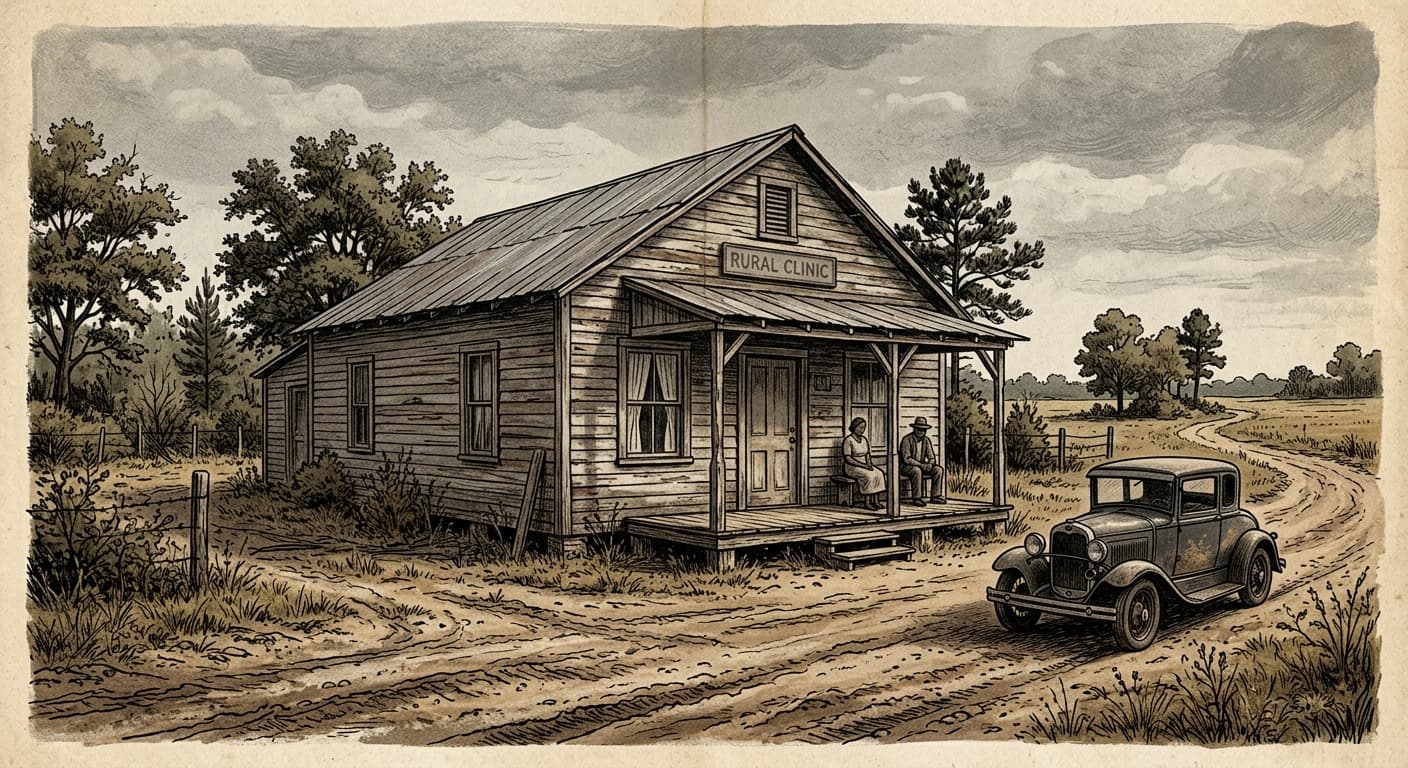
In 1932, in the pine woods and cotton fields of Macon County, Alabama, the United States Public Health Service launched an experiment. It was not conducted in secret laboratories or hidden military installations. It was conducted in the open, in plain sight, in the sharecropping cabins and church halls of a desperately poor Black community, and it continued for forty years. It was called the Tuskegee Study of Untreated Syphilis in the Negro Male. Its purpose was to observe what syphilis does to the human body when it is left to run its course — to watch men go blind, go mad, rot from within — and to do nothing to stop it. The men who ran the study were not rogue scientists operating in defiance of the law. They were federal and state officials, physicians, and nurses, working within the boundaries of accepted public health practice as their institutions defined it. The law, as it existed in 1932 and for most of the study's duration, let them do it.
The Tuskegee Study is not merely a story of medical racism, though it is that too. It is a story about the constitutional order — or rather, the specific places where that order failed to reach. The men of Macon County were American citizens, many of them veterans of the First World War, living under what the Constitution calls the blessings of liberty. Yet for four decades, the federal government treated their bodies as laboratory material, their pain as data, and their deaths as endpoints on a chart. No court intervened. No legislature acted. No grand jury indicted a single official. The study ended not because a judge declared it unconstitutional, not because Congress cut its funding, but because a whistleblower leaked it to an Associated Press reporter named Jean Heller in July 1972, and the resulting public outrage forced the Department of Health, Education, and Welfare to shut it down. Four hundred men were still alive when it ended; twenty-eight had died directly of syphilis, one hundred more of related complications, forty wives had been infected, and nineteen children had been born with congenital syphilis. The surviving participants received a settlement of $10 million in 1974, and in 1997 President Bill Clinton apologized on behalf of the nation. But no one was ever criminally prosecuted. No one ever lost a medical license. The constitutional system that should have protected those men simply did not.
"Bad Blood"
The study originated in a public health paradox. Syphilis was a scourge in the rural South, particularly among Black communities with little access to medical care. In the late 1920s, the Rosenwald Fund, a Chicago-based philanthropic organization, had funded successful treatment programs in several Southern states, demonstrating that syphilis could be controlled with the arsenic-based drugs then available — Salvarsan and later Neosalvarsan, painful and toxic but effective. When the Depression gutted the Rosenwald Fund's resources, the Public Health Service faced a decision: continue expensive treatment programs in Macon County, where prevalence was estimated at nearly 40 percent of the Black male population, or find a cheaper alternative.
What they chose was neither treatment nor honest non-intervention. Led by Dr. Taliaferro Clark, chief of the PHS Venereal Disease Division, they designed a study to observe the "natural history" of untreated syphilis. They recruited approximately 600 Black men, 399 with syphilis and 201 without as controls. They told the men they were being treated for "bad blood," a local colloquialism encompassing everything from anemia to general malaise, and that the "treatment" would be free. The men were given placebos — aspirin, iron tonic, and useless ointments — and subjected to painful, invasive diagnostic procedures that were presented as therapy. Most notoriously, they were subjected to spinal taps, lumbar punctures that carried real risk of serious injury, purely to obtain cerebrospinal fluid for analysis. These were described in recruitment letters as a "special free treatment," a deliberate deception. The men were never told the name of their disease, never told they were part of an experiment, and never asked for consent in any meaningful sense. They were promised free medical care, free meals on examination days, and free burial insurance — the last of which was a particular inducement, as it guaranteed that their families would receive a modest payout if they died, and thus guaranteed autopsies for the study's data.
The study was not a secret. It was published in medical journals. It was reviewed by PHS leadership, including Surgeon Generals Thomas Parran Jr. and Leonard Scheele, both of whom knew its details and approved its continuation. When penicillin became widely available after 1945 — a genuine cure for syphilis, cheap and effective — the study's directors did not merely decline to treat their subjects. They actively prevented treatment. During World War II, when draft boards began requiring syphilis testing and treatment for all men found to be infected, PHS officials intervened directly with the Macon County draft board to ensure that the study's participants were exempted from treatment. The men were not told why. They were simply kept, watched, and left to die.
The Machinery of Deception
The details of the deception are worth tracing because they reveal how ordinary, how bureaucratic, the evil was. The study was run day-to-day by a Public Health Service nurse named Eunice Rivers, an African American woman who became its indispensable administrator. Nurse Rivers knew the men, visited their homes, drove them to examinations, sat with their families, and earned their trust over decades. She was, in the study's internal records, the critical factor in its longevity: she kept participation rates near 100 percent by serving as the human face of the operation. She believed, or persuaded herself to believe, that she was helping these men by providing them with such medical attention as the study allowed. The PHS, for its part, valued her precisely because she could cross the racial divide that made white doctors suspect in the Black community.
The medical literature of the period reveals no sense of ethical crisis. A 1936 paper in the Journal of the American Medical Association by Clark and his colleagues described the study in clinical terms, noting the "unusually favorable opportunity" presented by Macon County's untreated population. A 1964 paper in the Archives of Internal Medicine, by which time the study had been running thirty-two years, discussed it as a standard longitudinal investigation. The men were referred to not as patients or subjects but as "the material." The study's directors worried about losing "material" to outside physicians; they sent letters to local doctors warning them not to treat study subjects, and they compiled lists of participants to ensure that any man who showed up at a clinic with syphilis symptoms could be identified and diverted. The Tuskegee Institute, the legendary Black educational institution founded by Booker T. Washington, lent its facilities to the study, lending its prestige to the enterprise. Its role has been debated ever since — whether it was a coerced participant, a naive dupe, or an active collaborator — but the record shows at minimum that the institute's hospital and staff were made available to PHS researchers.
The constitutional dimension becomes clear when one asks: under what theory of law could this be done? The answer, in 1932 and for decades afterward, was essentially: under no theory that the Constitution recognized as enforceable. The men were not wards of the state under any formal guardianship. They were not prisoners or mental patients subject to special state control. They were free citizens, but free citizens whose poverty, race, and illiteracy — the study's internal records noted that most could not read the consent forms they were made to sign — rendered them effectively without the rights that freedom supposedly entailed. The Supreme Court had not yet recognized a constitutional right to bodily integrity outside the criminal procedure context. The doctrine of informed consent in medicine was embryonic; the landmark case Salgo v. Leland Stanford Jr. University Board of Trustees, which established the term in California law, would not come until 1957. The Nuremberg Code, drafted in 1947 in response to Nazi medical experiments, articulated principles — voluntary consent, avoidance of unnecessary suffering, termination when harm becomes evident — that the Tuskegee Study violated on every point, but the Code had no force of American law. The men of Macon County lived in a zone where the Constitution's promises had not yet been mapped onto medical practice, and the government exploited that zone systematically.
The Whistle and the Investigation
The man who stopped it was Peter Buxtun, a PHS venereal disease investigator who had joined the service in 1965. Buxtun learned of the study almost by accident, from colleagues, and was appalled. He raised objections within the agency and was told, in essence, to mind his own business. He persisted. In 1968, he wrote to the PHS's Director of Venereal Disease Control, formally requesting that the study be re-evaluated. The response was a bland assurance that the study was being "reviewed." In 1971, Buxtun left the PHS and, still unable to get action, went to the press. He contacted the Washington Star, which assigned the story to reporter Jean Heller. Heller's investigation, published on July 25, 1972, under the headline "Syphilis Patients Died Untreated," was the detonation. The story ran on the Washington Star's front page and was picked up by the Associated Press. Within days, the study was national news, and the Department of Health, Education, and Welfare announced an ad hoc advisory panel to investigate. The panel, chaired by Dr. Broadus Butler of Dillard University, conducted hearings and reviewed records; its final report, issued in October 1972, concluded that the study was "ethically unjustified" from its inception and recommended its termination. HEW Secretary Elliott Richardson ordered it shut down in November.
It is worth pausing on the agency's internal history, because it shows that the study was not perpetuated by ignorance but by review. In 1969, the Centers for Disease Control convened a blue-ribbon panel — including physicians and ethicists — to review the study in light of growing criticism from Buxtun and a few colleagues. The panel recommended continuation. Its reasoning, preserved in the record, was that the men were now old, that treatment at their advanced stage of disease might do them more harm than good, and that the scientific value of completing the observation outweighed the residual benefit of therapy. Critics within the agency, including Dr. William J. Brown, who directed the CDC's venereal disease training unit, dissented. Brown warned that continuing without treatment was ethically indefensible and proposed treating the survivors if the study must continue. He was overruled. The study continued for three more years. The episode matters because it demonstrates that Tuskegee was not a fossil of the 1930s coasting on inertia: it was actively re-authorized, decade after decade, by credentialed men making reasoned decisions within a framework that simply did not count the subjects as full persons. There had been earlier warnings too. As far back as the 1950s, a physician named Count Gibson, working in Virginia, had learned of the study and written of his concerns; J. W. Williams, serving an internship at the Tuskegee Institute's hospital in the early 1960s, objected to what he saw and was ignored. The institution absorbed every objection and continued.
The aftermath reveals the limits of legal accountability. The survivors, represented by civil rights attorney Fred Gray, filed a class-action lawsuit in 1972, United States ex rel. Smith v. United States. It was settled in 1974 for $10 million — $37,500 for each living survivor, $15,000 for each deceased participant's heirs, and lifetime medical benefits for survivors and their families. The settlement was administered by the U.S. District Court for the Middle District of Alabama. No individual PHS official was sued. No physician lost a license. No criminal charges were filed. The statute of limitations for any conceivable criminal offense had long expired, and in any case, the study's directors had operated within the broad discretion of public health authority. The settlement was, in legal terms, a government decision to pay for a policy choice, not a judicial finding of constitutional violation.
The regulatory response was more substantial. Congress passed the National Research Act of 1974, creating the National Commission for the Protection of Human Subjects of Biomedical and Behavioral Research. The Commission's 1978 report, the Belmont Report, established the three principles that now govern American research ethics: respect for persons (informed consent), beneficence (do no harm), and justice (equitable selection of subjects). Federal regulations — 45 CFR 46 — institutionalized Institutional Review Boards, mandatory consent procedures, and special protections for vulnerable populations. These were real reforms. But they were regulatory, not constitutional. They applied to federally funded research. They did not create a private right of action strong enough to prevent a future Tuskegee, and they did not retroactively constitutionalize the bodily autonomy of the Macon County men.
The legacy in Black communities has been documented by researchers: a deepened distrust of public health institutions and of medical research generally, a distrust that scholars have traced forward into measurably lower participation in clinical research and, during the COVID-19 pandemic, into vaccine hesitancy that commentators repeatedly linked back to Tuskegee's memory. The study became, in the words of the Reverend Gray and others who litigated it, a standing lesson in what happens when the law forgets that the poor are citizens. Its name is shorthand now — invoked in congressional hearings, in bioethics classrooms, in consent-form debates — for the proposition that good intentions and scientific value cannot launder the use of human beings without their knowledge. Every Institutional Review Board consent form signed in America today is, in a sense, a small monument to the men who were never given one.
The Apology and the Unaddressed Question
On May 16, 1997, President Clinton stood in the East Room of the White House and apologized. The ceremony was attended by five surviving participants (or their representatives; the youngest survivor was 87), by the Reverend Franklyn Richardson, and by family members of the deceased. Clinton's words were carefully chosen: "The United States government did something that was wrong — deeply, profoundly, morally wrong. It was an outrage to our commitment to integrity and equality for all our citizens." He acknowledged that the study was "clearly racist" and that the men were "denied the fundamental right to control their own bodies." He announced the creation of a bioethics center at Tuskegee University and a memorial. The apology was important. It was also, in constitutional terms, an admission that the system had failed. A president does not apologize for acts that were lawful and proper; he apologizes for betrayals of the constitutional order, even when no court has yet defined the specific right that was violated.
The question that Tuskegee leaves hanging is whether the betrayal was, in a just legal order, actionable. The Fifth Amendment declares that no person shall be "deprived of life, liberty, or property, without due process of law." The concept of "liberty" has expanded through judicial interpretation to encompass bodily integrity, parental rights, contraceptive choice, and end-of-life decisions. If the government knowingly withholds medical treatment from citizens it has deliberately deceived, while actively preventing others from treating them, is that not a deprivation of liberty — of the right to one's own body — without any process at all, let alone due process? The Tuskegee Study suggests that the answer, in 1932 through 1972, was effectively no, or at least not one that any court was prepared to enforce. The men were poor, Black, rural, and voiceless. They were, in the phrase the study's own doctors used, "material." The Constitution, as applied by the institutions that were supposed to apply it, did not see them as rights-bearers.
The Founders would have recognized the pattern. They wrote the Bill of Rights in reaction to exactly this kind of power: the power of the state to use the bodies of subjects for state purposes, to invade homes and persons without consent, to treat certain classes of people as means rather than ends. The Fourth Amendment's protection against unreasonable searches of "persons, houses, papers, and effects" grew directly from colonial anger at general warrants and writs of assistance. The Fifth Amendment's due process clause was a direct descendant of the Magna Carta's guarantee that no free man would be "taken or imprisoned or disseised or outlawed or exiled or in any way ruined" except by lawful judgment. The Eighth Amendment's ban on cruel and unusual punishments was, in part, a reaction to medical and penal experiments on prisoners and the poor. What the Tuskegee Study demonstrates is that these protections, however noble in theory, were not self-executing. They required institutions — courts, legislatures, medical boards, professional associations — willing to enforce them. For forty years, in Macon County, Alabama, those institutions were not willing. They were the violators.
The Founding Frame: Your Body as Your First Property
The constitutional language for what was done at Tuskegee comes from the founding generation's deepest premise: that the body is the first and most fundamental property, preceding and grounding every other right. John Locke, whose formulations Madison and Jefferson absorbed directly, wrote in the Second Treatise that “every Man has a Property in his own Person. This no Body has any Right to but himself.” The American founders translated property-in-person into the specific protections of the Bill of Rights. The Third Amendment’s ban on quartering soldiers in peacetime homes — an amendment now rarely litigated but central to the founding generation's experience — was a declaration that the state may not use the citizen's living space as an instrument of policy. The Fourth Amendment's protection of “persons” against unreasonable searches was, as the Court eventually recognized in Union Pacific Railway Co. v. Botsford (1891), a recognition that the body itself stands behind the barricade: “No right is held more sacred, or is more carefully guarded by the common law, than the right of every individual to the possession and control of his own person, free from all restraint or interference of others, unless by clear and unquestionable authority of law.”
The phrase “clear and unquestionable authority of law” is the hinge. The Tuskegee doctors had no authority of law for what they did — they had budget lines and administrative approvals, which is not the same thing. No statute authorized the withholding of treatment from deceptive research subjects. No court ordered it. No legislature debated it. The study existed in the zone of unreviewed administrative discretion — the same zone the Founders fought a revolution to eliminate. The writs of assistance that James Otis denounced in Paxton's Case in 1761 — general warrants allowing customs officers to search where they pleased — were objectionable, Otis argued, precisely because they placed the citizen at the mercy of official discretion without judicial supervision. “An act against the constitution,” Otis declared, “is void.” John Adams, who heard that speech, later wrote that “then and there the child Independence was born.” The Tuskegee Study was a writ of assistance written on human bodies: official discretion, unbounded by law, treating persons as means. On the founding account, it should have been void from its first day.
To Take America Back Is to Close the Zones
The Tuskegee Study is often described as a medical ethics scandal. It is better understood as a constitutional scandal: a demonstration that the Bill of Rights, as a practical matter, did not extend to certain bodies. The reforms that followed — the Belmont Report, IRBs, informed consent — were necessary but insufficient, because they addressed procedure rather than the underlying question of whose body the government may treat as a resource. The deeper principle, the one the Founders asserted and the Tuskegee men were denied, is that bodily autonomy is not a privilege granted by the state to those it deems worthy. It is a right inhering in persons, protected by the Constitution against all deprivations, whether accomplished by a soldier quartering in a home, a constable searching without warrant, or a physician withholding a cure while pretending to administer one.
To take America back — to reconstruct a legal system worthy of the Founders' design — we must close the zones where the Constitution's light does not reach. We must make bodily integrity a judicially enforceable right, not merely a regulatory standard. We must ensure that no citizen, however poor or powerless, can be made into "material" by the stroke of a bureaucrat's pen. The men of Macon County waited forty years for the law to notice them. It never did. A reporter did. That is not a constitutional system working. It is a constitutional system that failed, and whose failure was covered over with settlement money and presidential words. The debt remains unpaid, not in dollars, but in the harder currency of a legal order that has not yet fully internalized what those men's suffering proved: that the Constitution's promises are only as real as the willingness of courts and officials to enforce them, especially — especially — for those who have no power but their rights.