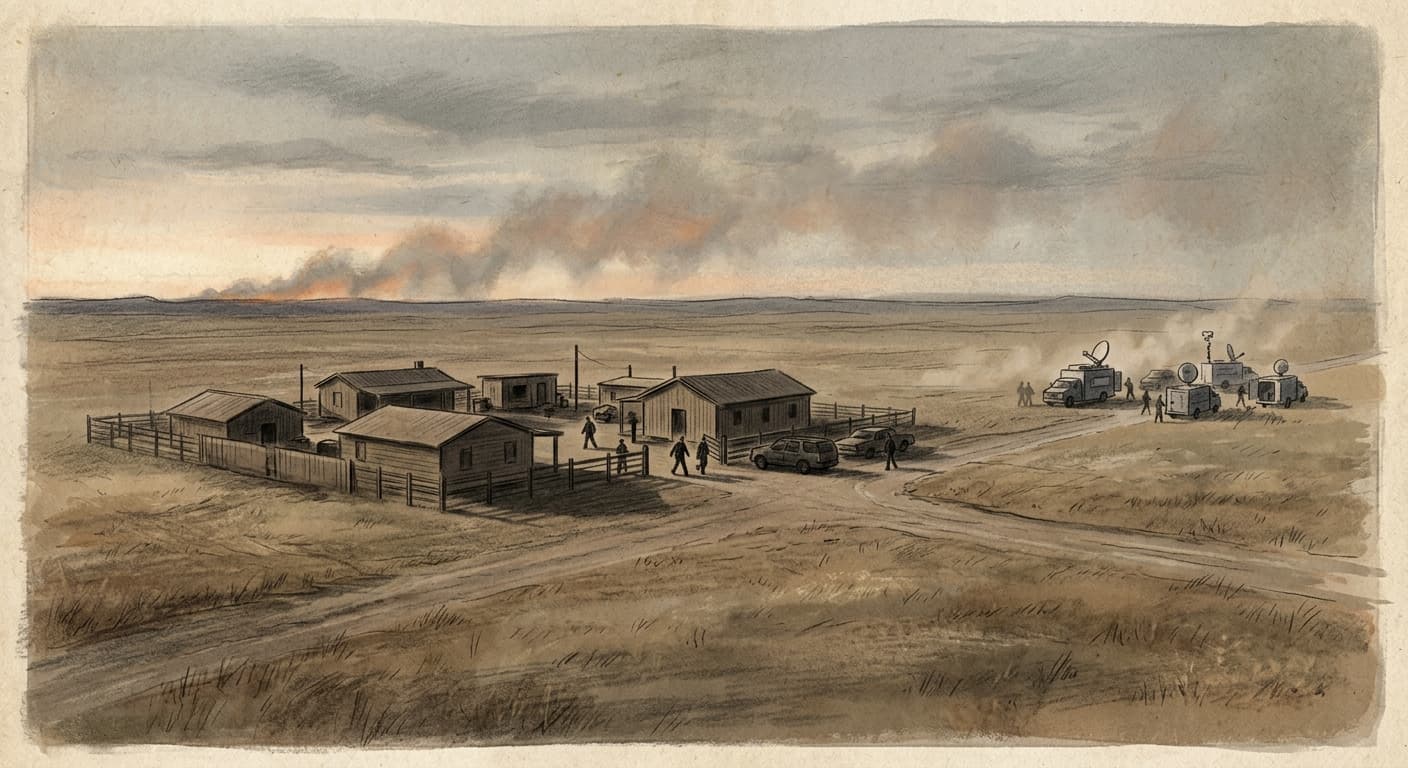
On the morning of February 28, 1993, seventy-six agents of the Bureau of Alcohol, Tobacco and Firearms assembled before dawn in a staging area outside Waco, Texas, for a raid they had named Operation Trojan Horse. Their target was a rambling, poorly constructed wooden building on seventy-seven acres of prairie nine miles northeast of the city — a religious community called Mount Carmel Center, home to roughly 130 men, women, and children who called themselves Branch Davidians and who followed a thirty-three-year-old self-described messiah named Vernon Wayne Howell, known to the world as David Koresh. The ATF’s operational plan called for a “dynamic entry”: cattle trailers pulling up to the compound’s front, agents pouring out, National Guard helicopters overhead for distraction, teams swarming the building’s arms-storage areas and arresting Koresh before the community could react. The plan assumed surprise. Surprise was already gone. An undercover ATF agent named Robert Rodriguez had been posing as a Branch Davidian neighbor for months; that very morning, inside the compound, Rodriguez heard Koresh telling his followers that a raid was coming. Rodriguez called his superiors from inside the compound and told them, in the plainest language available, that the element of surprise had been lost and the raid should be called off. His superiors authorized it anyway.
What followed was a gun battle whose origins remain disputed three decades later — the ATF and the Davidians each claiming the other fired first — and whose result is not disputed: four ATF agents dead, twenty wounded; six Davidians dead, including two killed, by the government’s own later concession, by friendly ATF fire; Koresh wounded; the raid a failure; the surviving Davidians barricaded inside Mount Carmel. The FBI took over. What followed then was a fifty-one-day siege — the longest standoff between American law enforcement and a domestic group in the nation’s history — that ended on April 19, 1993, when FBI armored vehicles drove gas into the building for six hours, fires broke out in three separate locations inside the compound, and the entire wooden structure burned to the ground with the people still inside it. Seventy-six people died on April 19, 1993, in and around the burning compound. The dead included Koresh. They included his children and the children of his followers — twenty-five of the dead were seventeen years old or younger, some as young as infants. They included pregnant women. They died of smoke inhalation, of fire, of falling debris, of gunshot wounds the government attributed to the Davidians themselves. The bodies of children were found in a concrete room — called “the bunker” in the aftermath — where mothers had apparently taken them to shield them from the fire.
The official narrative, established within days and maintained through decades of investigation, was that the Branch Davidians had started the fires themselves — a mass suicide by fire, ordered by Koresh, with the government merely an onlooker. The official narrative, however, has never been able to fully explain why the FBI launched a tank-and-gas assault on a building it knew to be filled with children on the morning after the fifty-first day of a siege the Davidians had shown no sign of breaking; why the bureau declined to wait longer after a fifty-one-day investment in waiting; why the FBI’s own Forward Looking Infrared camera footage showed flashes consistent with gunfire from federal positions directed at the compound’s rear exit during the fire; why the bureau denied, then admitted under pressure that it had in fact fired pyrotechnic — meaning incendiary-capable — tear-gas rounds at a concrete outbuilding adjacent to the main structure hours before the fire started; or why the Davidians’ surviving adults and the physical evidence have never supported a coordinated mass-suicide-by-fire plan. The 1993 civil trial brought by surviving Davidians and the families of the dead produced a verdict that the ATF had not used excessive force and the FBI had not caused the fire — a verdict delivered against a factual backdrop that included the government’s withheld evidence, its changed stories, and the systematic destruction of physical evidence in the compound’s bulldozing and burial within weeks of the fire. The Danforth investigation, commissioned by Attorney General Janet Reno in 1999 after the pyrotechnic-round admission made continued denial untenable, concluded in 2000 that the government bore no responsibility for the fires — a conclusion the special counsel’s own investigators reached only by crediting the FBI’s account of its own conduct over physical evidence and witness testimony that contradicted it. No federal official was ever criminally charged for Waco. The dead included twenty-five children.
Koresh, the Community, and the Case That Brought the ATF
The Branch Davidians were an offshoot of the Davidian Seventh-day Adventist movement, which itself traced to the 1930s schism within the Seventh-day Adventist Church. They had lived at Mount Carmel since the 1950s in various configurations — a separatist religious community whose members worked in Waco, sent their children to local schools for periods, and lived under a communal structure centered on biblical prophecy and the teaching of their leader. David Koresh had assumed leadership of the community in the late 1980s after an internal power struggle that had included a gunfight with the previous leadership. Koresh’s theology combined end-times prophecy, the belief that he was the Lamb of God destined to open the Seven Seals, and a practice he called the “House of David”: his claimed spiritual authority to take the women and girls of the community as his “wives,” including — by the account of former members and later-established evidence — girls as young as twelve or thirteen. This allegation — child sexual abuse — would become central to the government’s public justification for the raid and the siege, and central to the defenders’ argument that the entire operation was justified by the imperative of rescuing children. What it did not become was the basis for the ATF raid itself. The ATF’s legal jurisdiction is firearms and explosives. The warrant authorizing the February 28 raid was for firearms offenses: the alleged illegal manufacture and possession of machine guns and destructive devices in the Mount Carmel arsenal.
This distinction matters more than any other single fact about Waco. The ATF did not raid Mount Carmel to rescue children. It raided Mount Carmel to search for illegal weapons. The child-abuse allegations were known to Texas child-protective services, which had investigated them in 1992 and declined to remove children from the community, and to the ATF through former members. They do not appear in the arrest warrant or the operational plan as the legal basis for the entry. They appear in the public relations aftermath — in the FBI’s daily press conferences during the siege, in the internal memos justifying escalation, and ultimately in the government’s defense of its decision to end the siege with a tank-and-gas assault — as the moral rationale for everything. The conversion of a failed firearms raid into a child-rescue operation was a narrative reconstruction performed after the fact, and it has largely succeeded: “Waco” exists in American memory primarily as the story of a dangerous cult abusing children, not as the story of a firearms raid that killed four federal agents and fifty-one days later produced the incineration of twenty-five children inside a building the United States government spent six hours gassing before it burned.
The ATF’s acquisition of the arrest warrant itself was documented later in ways that undermine the operation’s necessity. The bureau’s case rested substantially on the testimony of former members, on undercover purchases of weapons parts by Agent Rodriguez, and on the technical determination that certain semi-automatic rifles in the compound had been converted to fully automatic fire. The weapons themselves were, for the most part, lawfully purchased semi-automatic firearms; the conversion allegations involved parts kits and modifications whose legality was contested and whose manufacture the raid was supposed to document. The raid itself was conducted in a manner guaranteed to produce confrontation: a dynamic entry against a community that had armed itself in anticipation of apocalyptic violence, against a leader who had told his followers a government assault was the prophesied end, on a plan that assumed surprise the lead agent had already been told was lost. The internal ATF review conducted by the Treasury Department after the raid acknowledged all of this — the lost surprise, the flawed plan, the decision to proceed anyway — and recommended discipline that was mostly administrative. Nobody was fired. Nobody was charged. The four dead agents were memorialized. The six dead Davidians from the raid were folded into the narrative of a violent cult that had ambushed federal officers.
The Fifty-One Days: The Siege as Psychological Warfare
The FBI’s Hostage Rescue Team assumed control on March 1, 1993. What it did for the next fifty-one days was, by the standards of any constitutional republic, bizarre to the point of parody — except that the parody ended in seventy-six deaths. The bureau established a perimeter of armored vehicles, helicopters, floodlights, and loudspeakers. It cut electricity and water to the compound. It negotiated with Koresh daily by telephone through a series of FBI negotiators who achieved real results — thirty-five people, including twenty-one children, were released from the compound during the first weeks of the siege — while a parallel tactical command pursued a strategy of escalating pressure explicitly designed to make the community’s continued residence in the building intolerable.
The pressure campaign’s contents were documented in congressional hearings. The FBI played recordings at massive volume around the clock: screams of dying rabbits being slaughtered, Buddhist chanting, Nancy Sinatra’s “These Boots Are Made for Walkin’,” the sound of telephone busy signals, Tibetan monk chants, jet-engine noise, dental-drill sounds. The recordings were broadcast at the building where children slept. Floodlights were trained on the windows all night. Armored vehicles drove the perimeter, crushing the community’s outbuildings, cars, and on one documented occasion a motorcycle belonging to a Davidian. The negotiations alternated with the pressure tactics in what the tactical commanders apparently believed was a coherent strategy, but which negotiators testified later worked at cross-purposes: each time negotiators built rapport sufficient to produce a release, the tactical side’s escalation undermined it. The FBI’s own behavioral-science consultants, in memos that emerged in subsequent congressional investigation, warned the tactical commanders that the pressure campaign was more likely to provoke mass suicide or violent outbreak than to induce surrender. The warnings were documented. The campaign continued.
Koresh, for his part, was simultaneously negotiating and delaying, promising releases contingent on radio broadcasts of his sermons and the writing of his manuscript on the Seven Seals — a document he claimed would end the standoff once complete, and which surviving Davidians maintain he was actively writing in the final days. On April 14, Koresh’s attorney presented the FBI with a written commitment from Koresh that he and all remaining occupants would exit the compound once Koresh had finished his manuscript, which he claimed to be near completion. The FBI’s behavioral experts assessed the commitment as a delaying tactic. Attorney General Janet Reno, who had been in office for a month, was briefed that a tactical plan to end the siege with tear gas delivered by armored vehicle was ready, and that the alternative — waiting — presented growing risks to the children inside from the deteriorating sanitary conditions, the possibility of renewed abuse by Koresh, and the uncertain durability of the perimeter. Reno approved the plan. She would later say it was the hardest decision of her life. She approved it on April 17. The assault began on the morning of April 19.
April 19: Six Hours of Gas, Three Fires, and the End of Mount Carmel
The FBI assault began at approximately 6 a.m. on April 19, 1993, with Combat Engineering Vehicles — modified M-60 tanks — approaching the compound and beginning to punch holes in its walls to deliver CS gas, a chemical agent that in high concentration can cause respiratory distress and, in enclosed spaces with heating sources or open flames, presents a documented fire hazard. The delivery continued for six hours. The bureau’s stated plan was incremental: gas was supposed to force the occupants out, and if the occupants came out unarmed, the FBI would take them into custody. The occupants did not come out. At approximately noon, fires broke out in three separate locations inside the compound — fires the FBI’s own aerial Forward Looking Infrared (FLIR) footage documented beginning nearly simultaneously in different parts of the building. Within minutes, the entire structure was engulfed. Fire trucks — held back from the perimeter by the FBI, on the stated ground that armed Davidians might fire on firefighters — arrived after the building was already consumed. Nine people escaped. Seventy-six did not.
The question of how the fires started has never been resolved to the satisfaction of independent investigators. The government’s position — maintained through the Treasury review, the House hearings, the criminal trial of surviving Davidians in 1994, the civil trial in 1994 and 2000, and the Danforth investigation in 1999-2000 — is that the Davidians set the fires themselves, deliberately, in a coordinated act of mass suicide ordered by Koresh. The evidence for this position includes: audio surveillance from listening devices inside the compound the morning of April 19, in which individual Davidians are heard discussing spreading fuel and lighting fires; accelerant residues found on the clothing of some survivors; and the testimony of some survivors that they smelled fuel inside the building. The evidence that complicates this position includes: the FLIR footage showing what independent experts identified as flashes from automatic gunfire directed at the compound’s rear exit during the first minutes of the fire — flashes the government initially said were sunlight reflections, then said were thermal anomalies, then declined to explain; the discovery of pyrotechnic CS-gas rounds — military projectiles capable of igniting fires — in the debris near a concrete outbuilding, after the government had denied for six years using any incendiary-capable devices; the testimony of surviving Davidians denying a suicide plan; and the physical implausibility of a coordinated mass-suicide-by-fire decision being executed by a hundred people including infants, toddlers, and children during an active military assault.
The Danforth investigation, after reviewing the evidence for ten months, concluded that the government did not start the fire and did not shoot at the Davidians during the fire, but acknowledged the use — previously denied — of the pyrotechnic rounds. The investigation’s conclusion was, as the special counsel himself stated, not a finding that the fires could not have been started by the government; it was a finding that the government’s account was, on the available evidence, more credible than the alternatives. That finding has not been universally accepted. The FLIR flashes were analyzed by independent experts retained by the documentary filmmaker Michael McNulty — whose 1999 film Waco: The Rules of Engagement won an Emmy and brought the FLIR evidence to public attention — and identified as consistent with automatic weapons fire from positions behind the compound. The government’s experts identified them as reflections. Congress re-flew the FLIR mission under controlled conditions and was unable to reproduce the flashes as reflections. The issue was, in the official record, closed. It has never been, in the considered judgment of people who examine the evidence outside the federal accountability system, resolved.
The children’s bodies were found primarily in the concrete storage room the compound’s residents called the pantry or the vault. Autopsies documented children who died of smoke inhalation, of blunt-force trauma from falling concrete, of gunshot wounds the medical examiner attributed to mercy killings by parents, and of fire. The youngest was an infant, a girl named Dayland Gent, born during the siege on March 29, killed three weeks later on April 19. She was twenty-one days old. The official narrative of Waco has never adequately explained how a government that justified its entire siege escalation by reference to the children’s rescue came to authorize the gassing of a building it knew to contain at least twenty-five of them, then watched the building burn with the children inside, then prevented fire trucks from reaching the building during the half hour in which rescue might have been possible.
The Accountability Phase: Civil Trial, Danforth, and the Foreclosed Record
Surviving Davidians were criminally tried in San Antonio in early 1994 on charges including conspiracy to murder federal agents and weapons violations. The jury acquitted all defendants of the most serious murder-conspiracy charges and convicted some on lesser counts — voluntary manslaughter and weapons offenses — with the trial judge sentencing most to terms of seven to fifteen years. The verdict was, in effect, a jury’s recognition that the original raid had been a disaster for which both sides bore responsibility, and that the Davidians had not ambushed federal agents in the manner the government’s initial narrative required. The surviving Davidian families’ civil wrongful-death suit against the federal government, tried in 1994 and again in 2000, produced defense verdicts: the juries found the ATF had not used excessive force in the original raid and the FBI had not negligently caused the fire. These verdicts must be read against the evidentiary record available to the civil juries, which was shaped by the government’s control of the physical evidence — the compound had been bulldozed and the debris bulldozed and buried within weeks of the fire; the ATF’s initial after-action reports were later shown to contain false statements; the pyrotechnic rounds were not disclosed until 1999, six years after the fire; and the FLIR footage was litigated with the government’s experts characterizing flashes as reflections while independent experts characterized the same flashes as gunfire.
The legal record of Waco is, in the constitutional sense, a record that has been managed. Congress held hearings in 1995 that documented the siege’s planning failures, the internal warnings ignored, and the decision-making chain that authorized the final assault. Attorney General Reno accepted responsibility for authorizing the plan while maintaining the fires were the Davidians’ doing. The Treasury Department’s review recommended the dismissal of senior ATF officials; two of the three were allowed to resign with benefits, and one eventually returned to the agency. Not a single federal official was criminally charged. The Danforth special counsel’s final report in November 2000 closed the federal record. The physical evidence remains, where it was buried by the government in 1993, in a landfill outside Waco — a disposal that the government has characterized as standard hazardous-material handling and critics have characterized as destruction of the crime scene. The distinction is not pedantic. The disposal foreclosed the independent forensic examination that the civil jury trials and the Danforth investigation were, by the time they occurred, no longer in a position to conduct.
Posse Comitatus, the Militarization of Policing, and the Language of the Compound
The Founders wrote into American law a set of structural restraints on the use of military force against citizens that are, in their historical depth, the direct inheritance of the English experience with standing armies. The Declaration of Independence charged George III with keeping “among us, in times of peace, Standing Armies without the Consent of our legislatures” and with rendering “the Military independent of and superior to the Civil Power.” The Constitution responded with the Second Amendment’s militia structure, the Third Amendment’s quartering prohibition, the Fifth Amendment’s grand-jury requirement for capital military cases, and the placement of military appropriations under a two-year congressional limit. The Posse Comitatus Act of 1878 extended the structure by statute: federal military forces may not, absent specific congressional authorization, be used to execute the law against citizens. The act was passed in the aftermath of Reconstruction precisely because its generation had watched federal bayonets used to police elections in the South, and understood the pattern as the template of tyranny.
At Waco, the Posse Comitatus structure was circumvented through mechanisms that have since become standardized. The ATF raid was supported by Texas National Guard helicopters — technically under state authority and therefore not subject to Posse Comitatus, though the Guard’s participation was requested by federal agencies under the pretext of a “drug nexus,” specifically an allegation that the compound contained a methamphetamine lab, an allegation that was never substantiated and appears to have been included in operational planning to obtain military support legally. The FBI’s Hostage Rescue Team, while nominally a civilian law-enforcement unit, was trained, equipped, and organized on military special-operations lines and employed military weaponry, armored vehicles, and tactics against American citizens on American soil. The Combat Engineering Vehicles that punched holes in Mount Carmel’s walls were U.S. Army M-60 tanks operated under FBI authority. The CS gas delivered by those vehicles was the same agent the Chemical Weapons Convention would, four years later, ban as a method of warfare between nations — while American law continued to permit its use against American citizens in their homes. The Founders’ structural prohibition on military force against citizens was, by 1993, honored formally and evaded functionally. The evasion has since become the standard: the 1033 program, the proliferation of SWAT teams, the routine deployment of military equipment against American communities, all operate within the same legal architecture that Waco documented.
It is worth dwelling on the word “compound,” because the word is doing work the Founders would have recognized. The Branch Davidians’ home was a building on private land owned by a religious community. In the language the ATF, the FBI, and the press used about it from the first hour, it was a “compound” — a word that in American usage connotes a military target, a fortified encampment, a place whose inhabitants have forfeited the presumptions of home. The word was not accidental. It performed the constitutional work of converting the residents of Mount Carmel from citizens in their home into occupants of a target. The same conversion is performed, with the same vocabulary, against every American community the state has decided to treat as a military problem: the “compound” at Ruby Ridge, the “compound” at Waco, the “enemy combatant” in the global war on terror, the “no-go zone” in the urban war on crime. The Founders wrote the Fourth and Fifth Amendments against the possibility that the state could re-designate a home as a battlefield by changing the word used to describe it. Waco is the paradigm case of that re-designation succeeding.
What Waco Produced: Militias, Oklahoma City, and the Security State
The immediate political effect of Waco was the radicalization it produced across the American anti-government right. Timothy McVeigh, who had observed Ruby Ridge from the perimeter and had traveled to Waco during the siege to distribute anti-government literature at the roadblocks, planned and executed the bombing of the Alfred P. Murrah Federal Building in Oklahoma City on April 19, 1995 — the second anniversary of the Mount Carmel fire, a date he selected deliberately. The Oklahoma City bombing killed 168 people, nineteen of them children in a day-care center, and remains the deadliest act of domestic terrorism in American history. McVeigh’s stated rationale, in letters and interviews from death row, was that Waco had demonstrated the federal government had declared war on its citizens, and that only equivalent violence could answer it. The moral logic is insane. The causal chain is direct: Ruby Ridge radicalized McVeigh; Waco confirmed the radicalization; the second anniversary of Waco was chosen as the date of the bombing.
The federal response to Oklahoma City — the Antiterrorism and Effective Death Penalty Act of 1996, the expansion of federal death-penalty jurisdiction, the expansion of FBI domestic-terrorism authorities, the militarization of police that the 1033 program would accelerate after 9/11 — extended the security state that had produced Ruby Ridge and Waco into the twenty-first century. The cycle is documented and undeniable: federal overreach produces domestic radicalization; domestic radicalization produces terrorism; terrorism produces expanded federal power; expanded federal power produces further overreach. The Founders would have recognized the cycle, because they had watched the British Empire run the same cycle through the colonies in the decade before the Revolution — each act of imperial enforcement producing resistance, each instance of resistance producing greater imperial enforcement, the cycle terminating in Lexington and Concord. They wrote the Bill of Rights to break that cycle at its trigger point: by denying the federal government the discretionary coercive capacities that, used against citizens, produce the resistance that justifies their expansion.
The Children of Mount Carmel, and the Founders’ Question
Twenty-five children died at Mount Carmel on April 19, 1993. They had names. Channel Jones was one. She was one year old. So was Dayland Gent, twenty-one days, born during the siege. Star Howell was six. Cyrus Howell was eight. Lisa Martin was thirteen. The children’s names and ages are in the medical examiner’s record and in the memorial that stands outside Waco today. They were inside a wooden building that the United States government spent six hours gassing and then permitted to burn. The official record holds that the government bears no responsibility for their deaths — that the children’s parents, the community’s leader, and the fires those people set themselves killed the children while the government was, at worst, a bystander to its own assault.
Set aside the contested questions — who fired first on February 28; whether the FLIR flashes were gunfire; whether the pyrotechnic rounds contributed to the fire; whether a different waiting strategy would have produced a different outcome. Concede, what the government has never conceded and the evidence has never established, that every disputed point resolves in the government’s favor. The remaining undisputed facts are sufficient. The ATF planned a dynamic raid against a building full of children on the basis of a firearms warrant, proceeded after being told the element of surprise was lost, and lost four agents and killed six residents in the exchange. The FBI then besieged the building for fifty-one days, employed psychological-warfare tactics against sleeping children, received a written commitment from Koresh to surrender on completion of his manuscript, and rejected waiting in favor of a tank-and-gas assault approved by a month-old attorney general on a briefing that presented waiting as the riskier option. The assault used a chemical agent banned shortly thereafter in international warfare, delivered by military tanks, against a building whose layout, the FBI knew, contained a concrete room the residents might use as shelter — and where the mothers did, in the event, take the children to die. The fire trucks were held back. The building burned. Seventy-six people, twenty-five of them children, did not come out alive.
The Founders’ question, posed across the Bill of Rights, is this: what structural restraints must a free people place upon its government so that the government may never find itself in this position? The Fourth Amendment’s answer is that the search of a home must be particularized, reasonable, and executed in a manner consistent with the residents’ safety. The Fifth Amendment’s answer is that the state may not deprive persons of life without due process of law — that the decision to gas a building full of children is not a tactical decision but an execution, and must be made, if at all, through the machinery of law. The Second Amendment’s structural answer is that a free state must not possess a standing military apparatus capable of routine deployment against its citizens. Posse Comitatus encoded the same answer into statute. Every one of those restraints was, formally, in force in 1993. Every one of them failed. The ATF raided the home; the FBI besieged it; the tanks gassed it; the fire burned it; the courts acquitted the government; the special counsel cleared the government; and the buried debris of Mount Carmel lies today under a Texas landfill — the physical record of what happens when a free republic permits its government, on the strength of re-designating a home as a compound, to treat the citizens inside as a military target.
The Founders feared this. They wrote against it at length and specifically. Their warnings are not antiquarian curiosities. They are documents describing, with terrible precision, the mechanism by which a republic becomes a siege state: the concentration of armed federal force, the conversion of policing into military action, the re-description of citizens as enemies, and the insulation of the entire apparatus from the criminal accountability that attaches to any private person who commits the same act. Waco is the demonstration. The twenty-five children of Mount Carmel are the demonstration’s cost. The American republic has never answered for them, and until the structural restraints are rebuilt — until the military is removed from policing, until compounds are homes again, until officials who gas buildings full of children face the same criminal law as anyone else — the demonstration stands, and the republic’s claim to be the Founders’ republic stands on the same landfill as the dead children of Mount Carmel.
Even $1 helps. No amount is too small. Thank you for standing with us.