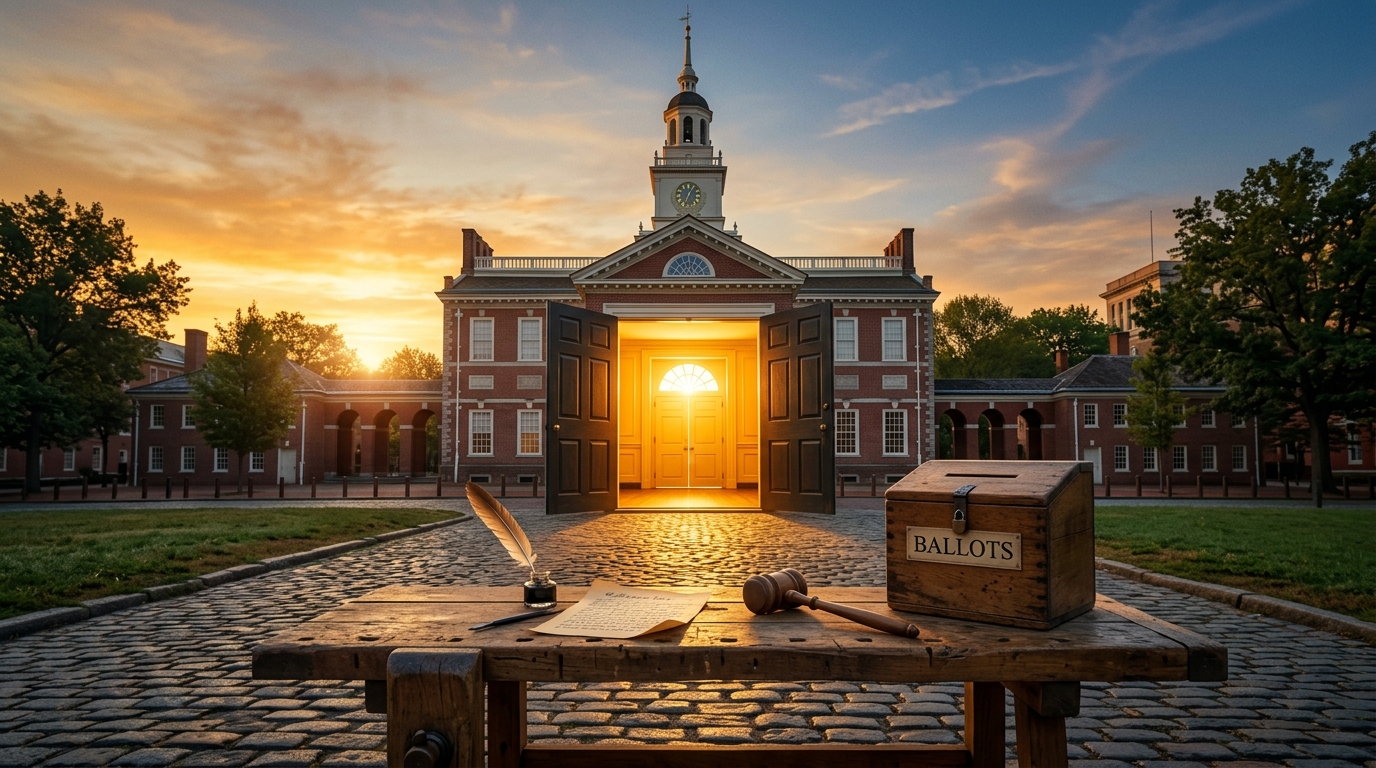
The most quoted sentence Thomas Paine ever wrote after his famous opening line comes from the appendix of Common Sense: "We have it in our power to begin the world over again." What is almost never quoted is the sentence's context. Paine was not rhapsodizing. He was answering the most paralyzing objection of his day — the argument, made by sensible and moderate men, that however bad things were, nothing could really be done. His answer was practical: a situation like ours, he wrote, "hath not happened since the days of Noah until now," and the remedy was not to wish but to build — call the conventions, draft the charter, constitute the government. Within eleven years, that is precisely what his readers did, twice.
The three preceding essays in this sequence made the indictment. First, that America has reconstituted the entrenched, unremovable governing class the Revolution was fought to abolish. Second, that our courts have rebuilt the two-tiered justice system — the protected official and the processed citizen — that fills the Declaration's bill of grievances. Third, that the generational right of renewal, which Jefferson and Paine held to be the very definition of freedom, has sat unexercised for over half a century while the government amended itself by rule, doctrine, and decree. If those essays are right, the conclusion is the one Paine drew in 1776: the defects are structural, and structural defects are not cured by better personnel. They are cured by revolution — in the exact, literal, American sense of that word: the wheel turned back round, power returned to its source, the living reasserting ownership of their government.
The moderate and sensible reader now raises Paine's old objection in modern dress: be serious — nothing can really be done. This essay is the answer, and it is the same answer: build. What follows is the inventory of the toolshed — every major instrument of lawful revolution the Founders left behind, in roughly the order they expected us to reach for them.
The First Tool: The Ballot, Used as a Weapon Rather Than a Habit
Begin with the obvious one, because it is not as dead as the cynics say — it is merely used wrong. The vote the Founders imagined was not an expression of identity or a quadrennial entertainment. It was an instrument of removal. The re-election rates documented earlier in this series are not proof that the ballot is broken; they are proof that it is never aimed. The machinery of entrenchment — the safe district, the donor wall, the party gate — depends entirely on low-information, high-habit voting, and it is genuinely vulnerable to organized, single-issue, anti-incumbent discipline. The primary, not the general, is where the governing class is actually hired; primaries are routinely decided by a few thousand votes, and a bare fraction of a district's citizens, voting together on the single question has this incumbent earned another term?, outweighs every dollar in the war chest. The Founders gave the House a two-year leash precisely so the people could yank it hard and often. A leash never pulled trains the animal to ignore it. Pull it — systematically, across parties, for as many cycles as it takes — and the entire incentive structure of the capital changes without a single law being passed.
The Second Tool: The Jury Box — the Citizen's Veto
The jury was designed as far more than a fact-finder. It is the only place in the constitutional architecture where ordinary citizens hold direct, unappealable power over the state — where twelve of the governed can look at the government's case and simply say no. The founding generation understood this perfectly: the acquittal of John Peter Zenger in 1735, against the judge's explicit instruction, established American press freedom a half-century before the First Amendment existed. Jurors refusing to convict under the Fugitive Slave Act made that law unenforceable across whole states. The first Chief Justice of the United States, John Jay, told a jury to its face that it had "a right to take upon yourselves to judge" both fact and law. This is the tool the modern system most fears, which is why, as the previous Crisis essay showed, it has been starved — pleas coerced, trials made ruinous, jurors instructed they must apply the law as given. But the power itself is structurally untouchable: a general verdict of acquittal cannot be reviewed, reversed, or punished. Every citizen who does not evade jury service but seeks it, and who walks in knowing what Jay knew, restores a piece of the veto. A public that re-learned the jury's true function would end coercive plea practice within a decade — no legislation required, no permission asked.
The Third Tool: The States — the Founders' Counterweight
The Constitution's authors did not expect the federal government to check itself; they expected the states to check it. Madison and Hamilton wrote openly in the Federalist Papers that state governments would sound the alarm and organize resistance if the central power overreached. Everything in the modern reflex runs the other way — every problem routed to the capital, every remedy imagined as federal — and that reflex is itself part of the drift this series has described. But the counterweight still exists and still moves when pushed. States have, in living memory, forced national course-changes on issues from surveillance to criminal justice simply by refusing cooperation and legislating differently — laboratories, as Brandeis said, but also brakes. Term limits on state officials, independent redistricting, immunity reform for state officers, plea-bargaining limits: every one of these can be enacted state by state, tomorrow, by citizens who will never win a national argument but can absolutely win in Lansing, Nashville, or Harrisburg. The revolution of 1776 was not run from a capital. There wasn't one. It was run from the colonies inward — and the toolshed still has that layout.
The Fourth Tool: Article V — the Scheduled Revolution Itself
Then there is the master tool, the one the previous essay described: the amendment power, including the convention of the states that two-thirds of the legislatures can force and Congress cannot refuse. This is the founding generation's formal answer to the question what do a free people do when the federal government will never reform itself? — asked and answered in the document's own text. Congress will never propose term limits on Congress, never restrain its own delegation of lawmaking to agencies, never dismantle immunities the federal bench invented for federal officers. The Founders knew institutions never amputate their own advantages, so they built the bypass. It has never been used, and the fear-mongering against it — the "runaway convention" — deserves one honest paragraph: any convention's proposals must still be ratified by three-quarters of the states, thirty-eight of fifty, the highest consensus threshold in American law. Nothing "runs away" through a gate that narrow. The runaway convention is a ghost story told by the class the convention would restrain. Meanwhile the mere approach of the threshold has historically been enough: the Seventeenth Amendment exists because the Senate, watching state applications pile up one shy of the mark, chose to jump before it was pushed. The lesson is mechanical: credible movement toward a convention is itself a lever on Congress, and the states control it entirely.
The Fifth Tool: The Press, the Petition, and the Assembly — the Tools That Aim the Others
Paine's own tool was none of the above. It was forty-seven pages of plain argument, and it did more than any statute of its century. The First Amendment's cluster — speech, press, assembly, petition — are not decorative freedoms; they are the targeting system for every other instrument, the means by which a scattered public becomes a deliberate one. The committees of correspondence that organized the Revolution were, in modern terms, a citizen media network routing around official channels. The modern equivalent is in your pocket, and for all its poisons it has already shown it can break stories the institutional press buried, end careers the establishment protected, and move millions of citizens onto a single question in a week. This series — a daily chronicle of judicial corruption published to anyone who will read it — is itself an exercise of this tool, in the exact tradition of the pamphleteers: name the abuse, document it, repeat it until the custom that protects it cracks. "A long habit of not thinking a thing wrong gives it a superficial appearance of being right." The cure for a long habit is a longer argument, made in public, every single day.
What Paine Would Say About the Order of Operations
Note what is absent from this inventory, and why. The founding generation reached for arms only when — in the Declaration's own sequence — repeated petitions had been "answered only by repeated injury," assemblies dissolved, charters revoked, juries abolished, and armies quartered among them. Every peaceful door was closed, bolted, and guarded before they touched the last resort; that is precisely why their revolution earned the legitimacy that has carried it two hundred and fifty years. Ours is the opposite case, and the honest radical must say so plainly: every one of our doors still opens. The ballot functions. The jury's veto stands. The states retain their powers. Article V waits, fully operational, three generations overdue. The press is freer in raw capacity than at any moment in human history. A people whose lawful instruments all still work, and who reach past them, forfeit the very legitimacy that made 1776 different from every mere revolt in history. But the corollary cuts the other way, and it cuts deeper: a people whose lawful instruments all still work and who use none of them have not been conquered. They have abdicated. Tyranny that could be voted, ratified, and argued out of existence, and isn't, is not imposed. It is licensed — renewed annually by every citizen who mutters that nothing can be done while the toolshed stands unlocked twenty feet away.
Beginning the World Over Again
So end where Paine ended, with the practical sentence rather than the famous one. After "we have it in our power to begin the world over again," after the birthday-of-a-new-world flourish, the appendix of Common Sense closes with instructions: hold the conventions, draft the charter, and above all stop waiting — "the present time is the true time," because legitimacy belongs to those who act while acting is still cheap. The window in which revolution costs only effort — signatures, primary votes, jury summonses answered, state bills drafted, arguments made daily in public — is exactly the window in which it is least glamorous and most available. Later, history teaches, the price goes up.
This series will return tomorrow to its daily work: the chronicle, case by case, of what the American legal system does when it believes no one is watching. These four essays are the frame around that chronicle. The stories are not entertainment, and they are not despair. They are the bill of particulars — drawn up in the same spirit, and for the same purpose, as the twenty-seven grievances of July 1776: not to prove that the situation is hopeless, but to prove that it is intolerable, which is a different thing entirely. Intolerable situations end. The only question a free people ever gets to answer is whether they end by the people's design or by their default.
The Founders answered with a design and left us the drawings. We have it in our power. We have had it all along. The revolution is not coming; it is waiting — filed, notarized, and addressed to the living, in a toolshed with the door unlocked.