On the morning of November 10, 1898, roughly five hundred armed white men assembled at the armory of the Wilmington Light Infantry in Wilmington, North Carolina, the largest city in the state. By the time they finished marching, the crowd had swelled to as many as two thousand. They carried rifles, pistols, and a rapid-fire Colt machine gun mounted on a horse-drawn wagon. Before the sun set, they had burned the offices of the only Black daily newspaper in the state, shot Black residents in the streets of the Brooklyn neighborhood — the number killed has never been officially established, with credible estimates running from the teens to sixty or more — and forced the city's lawfully elected mayor, police chief, and board of aldermen to resign at gunpoint, one by one, replacing them the same afternoon with the leaders of the mob. The man who led the march, a former Confederate officer and failed politician named Alfred Moore Waddell, was installed as mayor of Wilmington before the bodies were buried.
What happened in Wilmington was not a riot, though for a century that is what the textbooks called it. A riot is a breakdown of order. This was the imposition of a new order — planned in advance, announced in public, executed on schedule, and ratified afterward by every institution that existed to stop it. It remains the only successful violent overthrow of an elected government in the history of the United States. And no one — not one man, out of a mob of two thousand acting in daylight before witnesses and newspaper correspondents from around the country — was ever prosecuted for it. Not by the county. Not by the state. Not by the federal government of the United States, whose own Constitution had been shredded in the streets.
The City That Had to Be Destroyed
To understand why Wilmington was targeted, you have to understand what Wilmington was. In 1898 it was a thriving port city of about 20,000 people, and a majority of them — roughly 56 percent — were Black. More remarkable than the numbers was the texture of the place. Wilmington had a substantial Black professional and merchant class: physicians, lawyers, restaurateurs, tailors, barbers, and builders. Black men served as aldermen, magistrates, and police officers. The federal collector of customs, one of the most important patronage posts in the state, was a Black man. And the city had something almost no other city in America had — a Black-owned daily newspaper, the Daily Record, edited by Alexander Manly.
Politically, Wilmington sat at the center of the most interesting experiment in the post-Reconstruction South. In 1894 and 1896, North Carolina's Republicans — the party of most Black voters — had joined with white Populist farmers in a "Fusion" coalition that won the legislature and the governorship. Fusion government was not radical, but it was genuinely biracial, and it had loosened the machinery that Democrats had used to control elections. In Wilmington, the mayor, Silas P. Wright, governed with a board of aldermen that included Black members. Crucially, the city government was not even on the ballot in November 1898 — municipal terms ran into 1899. Whatever happened at the polls that fall, Wilmington's elected government would lawfully remain in office. That fact matters, because it means what followed cannot be dressed up as an election result. The election could not remove the city government. Only force could.
The Campaign: Manufacturing a Race War
The 1898 campaign run by the North Carolina Democratic Party was, by the open admission of the men who ran it, a white supremacy campaign — that was the phrase they used themselves, printed on their own literature. The state party chairman, Furnifold Simmons, organized it. Josephus Daniels, publisher of the Raleigh News and Observer, supplied the propaganda: months of inflammatory front pages and cartoons depicting "Negro domination" as a sexual and political menace. Speakers like Charles Aycock carried the message across the state. And a paramilitary arm — the Red Shirts, mounted, armed, and undisguised — rode through Black neighborhoods and Fusionist counties breaking up meetings and warning voters away from the polls. None of this was hidden. It was the campaign.
In August 1898, the campaign found its pretext. Responding to a Georgia speech defending lynching as protection of white womanhood, Alexander Manly published an editorial in the Daily Record observing, among other things, that some relationships between white women and Black men were consensual — and that the "protection of white womanhood" rhetoric was a cover for mob murder. It was a statement of fact. It was also, in the South of 1898, the most dangerous sentence a Black editor could print. Democratic newspapers reprinted the editorial for months, stripped of context, as proof that Black political power meant an assault on white women. By November, the editorial had done its work: the campaign had transformed a municipal patronage dispute into a promised race war. Waddell told a Wilmington audience in October that white men would do their duty even if they had to "choke the current of the Cape Fear with carcasses."
On November 8, amid ballot-box stuffing and armed Red Shirt patrols at the polls, the Democrats swept the state. In Wilmington the vote totals in some precincts exceeded the number of registered voters. But the city government — not on the ballot — remained. So the second, unprecedented phase began.
The White Declaration of Independence
On November 9, the day after the election, a mass meeting of roughly a thousand white men convened at the New Hanover County courthouse. Waddell read aloud a document its authors called the "White Declaration of Independence." It declared that the signers would "no longer be ruled, and will never again be ruled, by men of African origin." It demanded that Alexander Manly leave the city forever and that his press be shipped out or destroyed. It demanded the resignation of Mayor Wright and the chief of police. Approximately 450 of the city's leading white citizens signed it — not a mob of drifters, but bankers, merchants, lawyers, and clergymen. The Wilmington coup was organized by the city's establishment, which is precisely why it succeeded and precisely why it was never punished.
That evening, a "Committee of Colored Citizens" — thirty-two of Black Wilmington's most prominent men — was summoned and handed an ultimatum: comply by 7:30 the next morning. The committee met, agreed that Manly (who had already fled the city) would go, and drafted a conciliatory reply. By the accounts assembled decades later by state investigators, the reply was sent by mail rather than delivered by hand, and Waddell's committee treated the deadline as missed. It is worth pausing on that detail. The men who planned the coup had assembled the machine gun, the armory, and the marching order before the deadline expired. The ultimatum was not an offer. It was a countdown.
November 10: The Fire and the Machine Gun
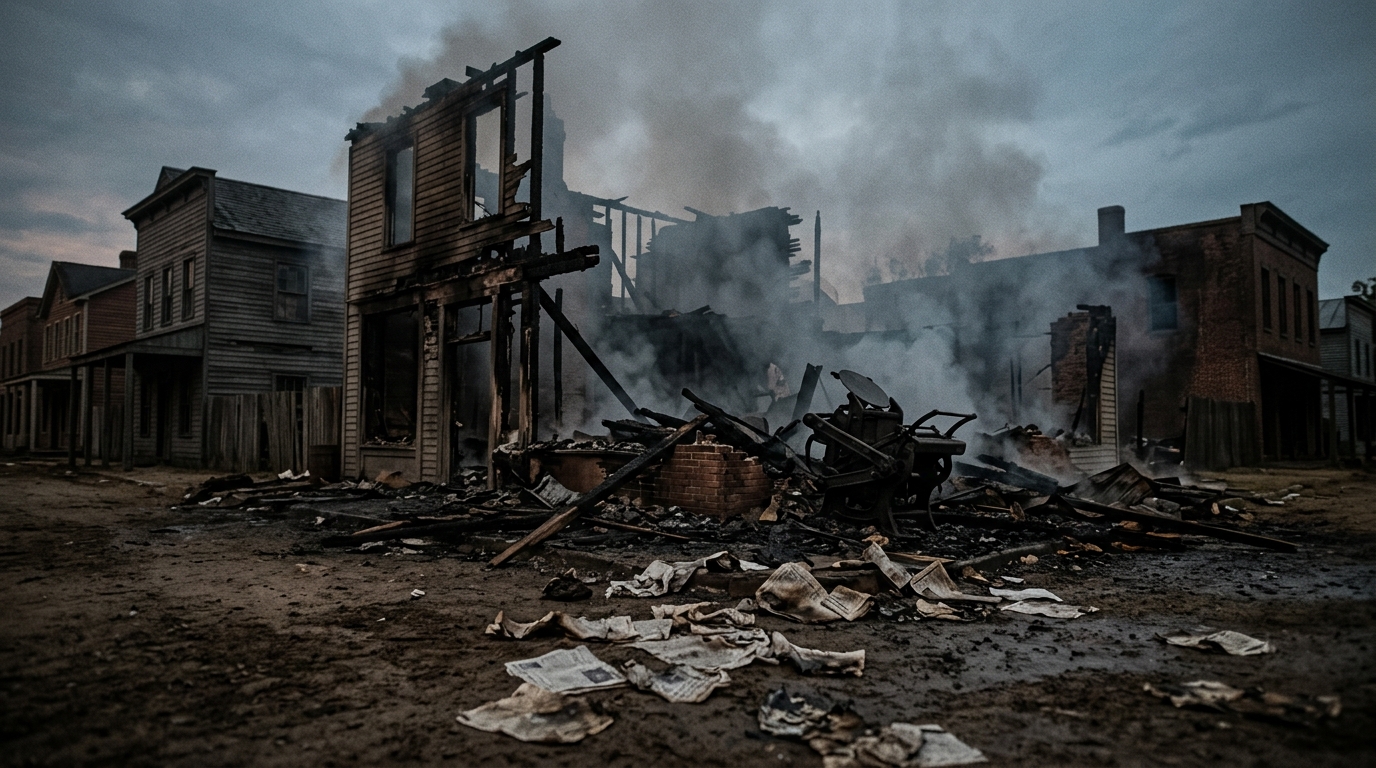
At about eight o'clock the next morning, Waddell led the column from the armory to the Daily Record's offices in Love and Charity Hall on South Seventh Street. The men smashed the press, wrecked the interior, and set the building on fire. They posed for a photograph in front of the burning building — rifles in hand, faces uncovered. That photograph survives. It is one of the most remarkable documents in American history: the perpetrators of a coup d'état, recording themselves in the act, secure in the knowledge that no court would ever ask them to answer for it. They were right.
By midday the violence had spread into Brooklyn, the city's principal Black neighborhood. White squads — including members of the Wilmington Light Infantry, a state militia unit, operating alongside the mob — moved through the streets with the wagon-mounted rapid-fire gun. Shots were fired into homes and at fleeing residents. Contemporary accounts counted somewhere between fourteen and twenty-five Black men killed; the state's official 2006 investigation concluded the toll may have reached sixty; oral tradition in Wilmington has always held it was higher. No white deaths were ever confirmed. Hundreds of Black families fled into the swamps and cemeteries outside town and hid for days in the November cold. There was no official count of the dead because no official ever wanted one. No inquest identified the shooters. No grand jury indicted anyone for any of the killings — though Black men were afterward prosecuted on charges arising from the day's events.
The Coup: Resignations at Gunpoint
While the shooting was still going on, the political operation proceeded with bureaucratic precision. That afternoon, armed committees escorted the members of the board of aldermen to city hall and forced them to resign, one at a time. As each seat was vacated, the remaining members — under the guns of the men filling the chamber — "elected" a replacement named by the coup's leadership, a procedure with the outward form of the city charter and the inward reality of an armed robbery. Mayor Wright and Police Chief John Melton resigned the same way. By late afternoon the reconstituted board had elected Alfred Moore Waddell mayor of Wilmington. The paperwork was in order. The minutes were recorded. American government had been overthrown by force of arms, and the coup had taken care to generate a paper trail certifying itself as lawful.
Then came the banishments. Over the following days, prominent Black leaders and white Fusionist officials were marched under armed guard to the railroad station, put on trains, and told they would be killed if they returned. Among them were men who had committed no offense except holding office or influence: attorneys, ministers, a deputy sheriff who was nearly lynched from a lamppost on the way. In the months that followed, more than two thousand Black residents abandoned the city. Wilmington, a Black-majority city on the morning of November 10, 1898, became a white-majority city and stayed one. Property, businesses, and professional practices built over a generation were sold at ruinous prices or simply left behind.
The Letters McKinley Never Answered
The survivors did what Americans are taught to do: they petitioned their government. In the days after the massacre, Black citizens of Wilmington wrote to President William McKinley — many anonymously, because signed letters meant death — describing the killings and begging for federal protection. One letter, from a woman who signed herself only as an American citizen, asked why the government that had just gone to war for the people of Cuba could not protect its own citizens in North Carolina. The letters survive in the National Archives. They were filed. The president, who had a Republican Justice Department and an army at his disposal, did nothing. Attorney General John Griggs opened a file; federal prosecutors in North Carolina looked at the matter; by 1900 the effort had been quietly abandoned without a single charge. The governor of North Carolina, Daniel Russell — a Republican, himself from Wilmington, whose own government had effectively been decapitated — could do nothing either: the militia that might have restored order had marched with the mob.
The federal paralysis was not merely cowardice, though it was that too. It had a constitutional architecture. In United States v. Cruikshank (1876), arising from the Colfax massacre in Louisiana, the Supreme Court had held that the Fourteenth Amendment restrained only state action, not private violence, and gutted the federal Enforcement Acts as tools against armed mobs. The Civil Rights Cases (1883) finished the job. By 1898, the settled legal position of the United States was that if a private army overthrew a city government and murdered its citizens — so long as the paperwork of the state was afterward in order — the Constitution had nothing to say about it. The Fourteenth and Fifteenth Amendments guaranteed rights but the courts had dismantled every remedy. Wilmington was the proof of concept: rights without remedies are press releases.
The Reward and the Erasure
Consider what accountability would have looked like, and then consider what actually happened. Waddell served as mayor of Wilmington until 1905 and died an honored citizen. Furnifold Simmons, the campaign's architect, was elevated to the United States Senate in 1900 and held the seat for thirty years, becoming one of the most powerful men in Washington. Charles Aycock, the campaign's great orator, was elected governor of North Carolina in 1900. Josephus Daniels, whose newspaper had manufactured the hysteria, became Secretary of the Navy under Woodrow Wilson, where his assistant secretary — and lifelong admirer — was a young Franklin Delano Roosevelt. Every principal author of the only coup d'état in American history was rewarded with higher office. The lesson was not lost on anyone in the South.
The legislative consolidation came immediately. In 1899 the new Democratic legislature began writing Jim Crow into North Carolina law, and in 1900 the state adopted a suffrage amendment combining a literacy test with a grandfather clause — disenfranchisement engineered to be race-neutral on its face and absolute in its operation. Black voter registration in North Carolina collapsed from roughly 125,000 in the mid-1890s to a few thousand by 1902. It did not recover for more than half a century, until the Voting Rights Act of 1965. Alexander Manly, whose printing press was the first target of the guns, settled in Philadelphia and never lived in North Carolina again. For a hundred years the event he fled was taught, when it was taught at all, as the "Wilmington race riot" — a phrasing that managed to blame the victims and conceal the coup in two words.
The truth was finally made official in 2006, when a state commission created by the North Carolina legislature published an exhaustive report concluding what the survivors had always known: that November 10, 1898 was a premeditated coup d'état, carried out by the leadership of the state Democratic Party and the city's white establishment, with a death toll that will never be fully known. The commission recommended reparative measures. Most were never adopted. In 2019, the state finally replaced a historical marker's euphemisms with the word "coup." That — a word on a sign, 121 years late — is the sum total of the official accounting for the armed overthrow of an American city.
The constitutional lesson of Wilmington is the same one this series keeps finding, in Colfax and Tulsa and Marion, Alabama, in courtrooms and statehouses: the Constitution does not enforce itself. In 1898, every institution charged with defending the rule of law — the county grand jury, the state courts, the governor, the Justice Department, the President of the United States, and a Supreme Court that had spent two decades disarming the Fourteenth Amendment — looked at a machine gun in the streets of an American city and found that it had no jurisdiction. The men with the gun understood the system perfectly. They photographed themselves in front of the fire, because they knew that in America, the crime that is never prosecuted eventually becomes the history that was never taught. It took 108 years for the state to even call what they did by its name. No one was ever punished. The government they installed simply became the government — and its heirs wrote the laws the South lived under for the next sixty years.