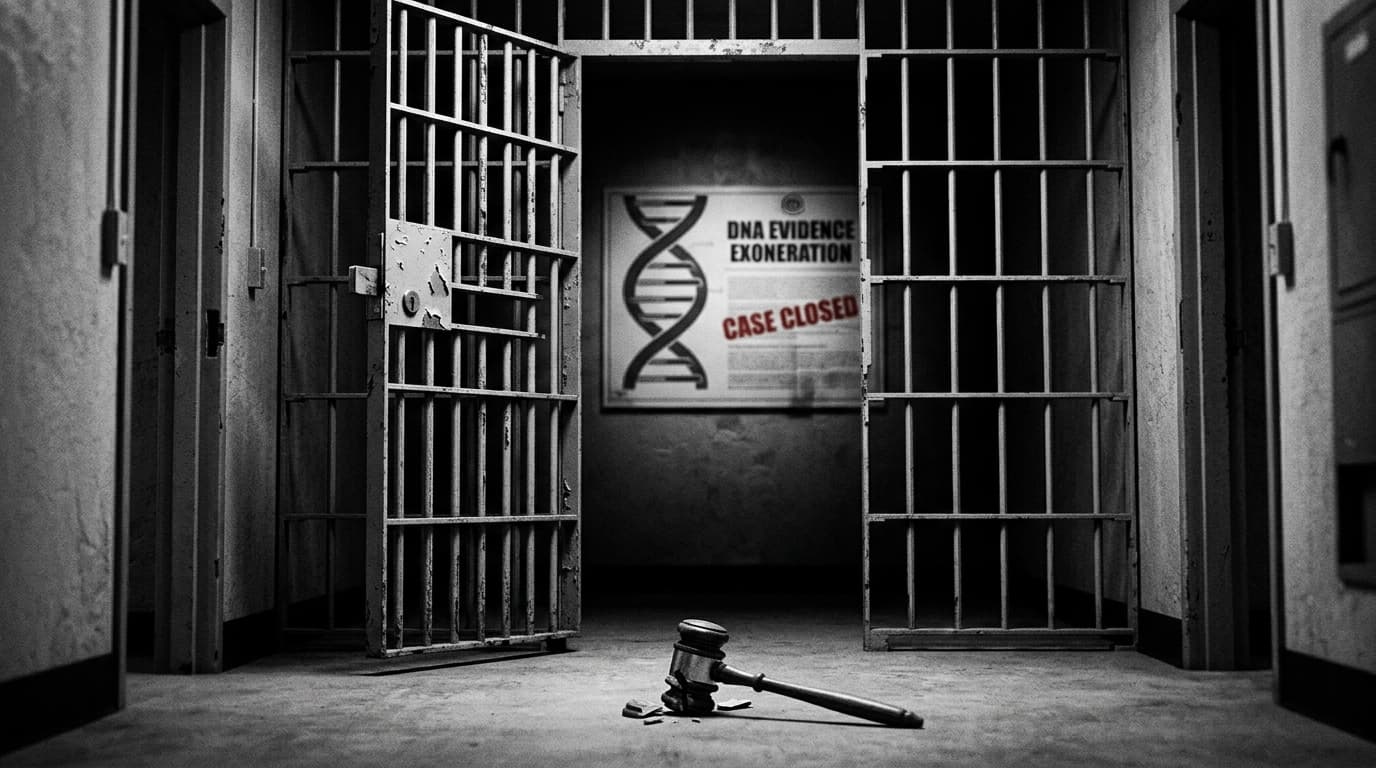
In 1984, a North Carolina man named Ronald Cotton was convicted of rape and sentenced to life in prison plus fifty-four years. The victim, Jennifer Thompson-Cannino, had identified him with absolute certainty. She had studied her attacker's face during the assault, she later said, so that she could identify him if she survived. She was a credible, courageous, and compelling witness. She was also completely wrong. Eleven years after Cotton's conviction, DNA testing proved that the rape had been committed by Bobby Poole, another man who had actually bragged about the crime to fellow inmates. Cotton spent eleven years in prison for a crime he did not commit, identified with certainty by an eyewitness who was utterly convinced she was right.
The Innocence Project, founded by attorneys Barry Scheck and Peter Neufeld at Cardozo School of Law in 1992, has now secured the exoneration of more than 375 wrongfully convicted people through post-conviction DNA testing. The average time served before exoneration: fourteen years. These are not marginal cases, not technicalities, not convicted criminals who found a loophole. These are people who were convicted — often beyond reasonable doubt, in the minds of juries — of crimes they did not commit, and who spent a combined total of more than 5,000 years in prison for those non-crimes before science caught the legal system in its error.
What the Innocence Project's work reveals is not a series of isolated mistakes. It is a map of the American criminal justice system's most catastrophic structural failures: the unreliability of eyewitness testimony, the coercive production of false confessions, the corruption of incentivized informant testimony, the junk science embedded in forensic disciplines that courts have treated as reliable for decades. Each exoneration is an indictment — not just of the individuals who made the original mistake, but of a system that designed itself to be nearly impossible to correct.
• DNA exonerations since 1992: 375+ (Innocence Project)
• Average time served before exoneration: 14 years
• Combined years of wrongful imprisonment: 5,000+ years
• Leading cause of wrongful conviction: Eyewitness misidentification (69% of DNA exonerations)
• False confessions: Present in 29% of DNA exonerations — in many cases, people confessed to crimes they did not commit
• Incentivized informant testimony: Present in approximately 15-18% of DNA exonerations
• Junk forensic science involved: Present in approximately 45% of exonerations overall (National Registry)
• National Registry of Exonerations total: 3,300+ exonerations documented since 1989
• Wrongful conviction rate estimate: Conservative studies suggest 1-5% of all convictions may be wrongful
The Eyewitness Catastrophe
Eyewitness testimony is the most trusted evidence in the American courtroom. Jurors believe it. Prosecutors rely on it. Judges treat it as powerful. And it is, in a critical mass of cases, wrong. The psychology of eyewitness memory is by now well-documented in decades of peer-reviewed research: memory is not a recording. It is a reconstruction. It is vulnerable to suggestion, to stress, to the passage of time, to the race of the person being identified, to the way the lineup is administered, and to the confidence of the witness herself — which, research consistently shows, has almost no predictive value for accuracy.
The specific problems with American lineup procedures are well-known and largely unreformed. Sequential lineups — where a witness views one photo at a time, reducing relative judgment errors — are significantly more reliable than simultaneous lineups, where witnesses compare photos against each other rather than against memory. Double-blind administration — where the officer running the lineup does not know who the suspect is — eliminates unconscious suggestion. Instructions that tell witnesses it's okay not to make an identification ("the person may or may not be in this lineup") reduce the conformity pressure that leads to false identifications. Studies show these reforms reduce false identifications by 40 to 50 percent without meaningfully reducing accurate identifications.
And yet, as of 2024, less than half of American jurisdictions have implemented comprehensive eyewitness identification reform policies. The reforms that have been implemented are often partial, inconsistently applied, or subject to exceptions that swallow the rule. Why? Because law enforcement agencies have resisted reforms that might reduce conviction rates — even reforms that research conclusively shows would reduce false conviction rates without affecting the prosecution of the actually guilty. The institutional interest in conviction rates has been more powerful than the evidence about accuracy.
Ronald Cotton's story has a complicated postscript that illustrates exactly how wrong the system's incentives are. After his exoneration, Jennifer Thompson-Cannino and he became advocates for eyewitness reform together — a remarkable act of joint redemption. They wrote a book, "Picking Cotton." They testified before legislatures. They helped pass reforms in North Carolina and other states. And they have spent decades doing the advocacy work that the criminal justice system itself should have done decades earlier, to fix a problem that the system has known about for generations and refused to fix.
False Confessions: The System That Breaks the Innocent
It seems impossible that an innocent person would confess to a crime they did not commit. It happens in 29 percent of DNA exonerations. Understanding why requires understanding how American police interrogation works — and what decades of psychological research have documented about its capacity to produce false confessions.
The Reid Technique, developed in the 1950s and still widely taught in American law enforcement, is a nine-step interrogation method premised on the assumption that the interrogator has already determined that the suspect is guilty. The technique involves confrontation (telling the suspect they are guilty), minimization (suggesting moral justifications that make confession seem less serious), and persistent pressure applied over hours or days. It is designed to overcome resistance. And it is extraordinarily effective at overcoming resistance — including the resistance of innocent people who did not commit the crime being investigated.
The Central Park Five — Yusef Salaam, Raymond Santana, Kevin Richardson, Antron McCray, and Korey Wise — were teenagers between 14 and 16 years old when they were interrogated without counsel for twelve to thirty hours each about the brutal assault and rape of a jogger in Central Park in 1989. All five confessed on videotape. Their confessions were detailed. They were compelling. They were utterly false. The crime had been committed by Matias Reyes, a serial rapist and murderer who confessed in 2002 — and whose DNA matched the biological evidence that had been recovered in 1989 but never matched to any of the five. The five had spent between six and thirteen years in prison by the time Reyes came forward.
The Central Park Five confessions demonstrate every documented risk factor for false confession: youth (teenagers are dramatically more susceptible), extended interrogation without sleep or food, interrogators who were completely certain of guilt, pressure to implicate each other, and the psychological coercion of isolation from family and counsel. They also demonstrate the institutional barrier to correction: even after Reyes's DNA match, even after his detailed confession, law enforcement officials initially resisted acknowledging the exonerations, suggesting the five might have participated in some way. The system's commitment to its original verdict outlasted its commitment to the truth.
Adams's Republic and the False Witness
"It is more important that innocence be protected than it is that guilt be punished, for guilt and crimes are so frequent in this world that they cannot all be punished. But if innocence itself is brought to the bar and condemned, perhaps to die, then the citizen will say, 'whether I do good or whether I do evil is immaterial, for innocence itself is no protection,' and if such an idea as that were to take hold in the mind of the citizen that would be the end of security whatsoever." — John Adams
John Adams, defending the British soldiers charged in the Boston Massacre — a case in which his political sympathies ran completely counter to his legal duty — articulated the foundational principle that innocence must be protected above all else. His argument was not sentimental. It was systemic: if people believe that innocence is no protection, they will stop trusting the system entirely. The social contract that makes law possible depends on citizens believing that the system distinguishes the guilty from the innocent.
The wrongful conviction crisis is an existential threat to that social contract. When the National Registry of Exonerations documents more than 3,300 cases of wrongful conviction since 1989 — cases where courts got it definitively wrong, where innocent people went to prison, in many cases for decades — and when those exonerations represent only the tip of an iceberg (most wrongful convictions involve cases where DNA evidence either was not collected or has been lost or destroyed), the message sent to every American is the one Adams feared: innocence is no protection. The system will convict you anyway.
The Jailhouse Informant Crisis
Among the most corrosive elements of the wrongful conviction machinery is the systematic use of jailhouse informants — fellow prisoners who claim that a defendant confessed to them while in pretrial custody. These witnesses are, by any objective measure, the least reliable in the American criminal justice system. They are almost always facing their own charges, and their testimony is almost always preceded by negotiations with prosecutors about how their cooperation will be rewarded. They have everything to gain from testifying and nothing to lose if their testimony is false, because the perjury prosecution that should follow false testimony almost never materializes.
The documented history of jailhouse informant corruption is long and bipartisan. In Los Angeles, a 1989 grand jury investigation — prompted by the case of Leslie White, a career informant who demonstrated to prosecutors and the media exactly how easy it was to fabricate detailed "confessions" using nothing but publicly available court documents — found that the county had been systematically using unreliable informants whose testimony was almost certainly false in dozens of cases. The district attorney's office had maintained a "snitch tank" where informants were deliberately placed with high-profile defendants to solicit confessions. The grand jury's report led to some reforms but no criminal prosecutions of any official who had used fabricated informant testimony.
The most dangerous jailhouse informants are not the obvious liars. They are the plausible ones — witnesses whose testimony includes accurate details that any observer of the case might have noticed, who present credibly on the stand, and whose motivation for lying is obscured by the non-disclosure of their cooperation agreements. Giglio v. United States (1972) requires prosecutors to disclose all agreements made with witnesses, including informal understandings about leniency. But studies of wrongful conviction cases involving informants consistently find that prosecutors did not disclose — or actively concealed — the full scope of benefits promised. No prosecutor has ever been criminally prosecuted for that concealment in a wrongful conviction case. The impunity is absolute.
The Junk Science Catastrophe: Bite Marks, Hair Analysis, and Other Forensic Frauds
Perhaps the most intellectually scandalous dimension of the wrongful conviction crisis is the role of forensic science disciplines that courts have admitted as reliable for decades — and that have no reliable scientific foundation whatsoever. The National Academy of Sciences issued a landmark 2009 report, "Strengthening Forensic Science in America," that concluded with devastating clarity: most forensic disciplines other than DNA analysis had never been subjected to rigorous scientific validation, had unknown error rates, and could not support the certainty with which forensic examiners routinely testified in court.
Bite mark evidence is the paradigm case. For decades, forensic odontologists testified in court that they could match a bite mark on a crime victim's body to a specific suspect's teeth with a high degree of certainty. Courts admitted this testimony. Juries convicted on it. People went to prison for decades on the basis of bite mark evidence. And the underlying science was, according to a 2016 President's Council of Advisors on Science and Technology (PCAST) report, not science at all. There is no validated method for determining that a bite mark on human skin was made by a specific individual. The error rate is unknown. The discipline has produced documented wrongful convictions. Courts continue to admit it in most jurisdictions.
Microscopic hair analysis — the examination of hair fibers under a microscope to determine if they "match" a suspect — was used by FBI examiners in more than 2,500 cases over decades. In 2015, the FBI acknowledged that its hair examiners had overstated the certainty of hair analysis evidence in at least 90 percent of the cases reviewed in a joint audit conducted with the Innocence Project and the National Association of Criminal Defense Lawyers. Examiners had testified that hair evidence was capable of identifying a specific individual — testimony that had no scientific basis — in case after case. Fourteen of the people convicted on this evidence had been sentenced to death. By the time the FBI released its findings, six of those fourteen were already dead.
The systemic response to these revelations has been inadequate to the point of obscenity. The forensic science reforms recommended by the NAS in 2009 and PCAST in 2016 have been partially implemented in some jurisdictions and ignored in most. Courts continue to admit forensic evidence that fails scientific reliability standards because the precedents that admitted it are old and the doctrine of stare decisis creates enormous inertia against overturning them. Prosecutors resist scrutiny of forensic evidence because forensic evidence wins cases. Defense lawyers lack the resources to mount effective Daubert challenges in most cases. The junk science keeps going to juries.
The Financial Interests That Keep the Machine Running
Wrongful convictions are not just systemic failures. They are, in a specific institutional sense, products of financial incentives that reward conviction regardless of accuracy. District attorneys run for election, and their electoral prospects depend in part on their reputation for being tough and winning. A DA with a high conviction rate looks effective. A DA whose convictions are frequently overturned on appeal looks ineffective. This creates an institutional bias toward conviction over accuracy — toward winning cases rather than pursuing truth.
The private prison industry adds another layer. The two largest private prison operators in America, CoreCivic and GEO Group, have a direct financial interest in high incarceration rates — they are paid per prisoner per day. These companies have lobbied against criminal justice reform, mandatory minimum sentencing reform, and early release programs. They do not advocate for wrongful conviction reform because a wrongfully convicted person is still a paying customer in their revenue model. Their lobbying spending in the tens of millions annually has helped maintain the legal and political environment in which wrongful convictions flourish.
The police unions that protect law enforcement officers who commit misconduct — including the misconduct that produces wrongful convictions through fabricated evidence, coerced confessions, and suppressed exculpatory information — are among the most politically powerful unions in America. The Detectives' Endowment Association in New York, the Fraternal Order of Police nationally, and hundreds of local unions have systematically defended officers accused of misconduct, blocked civilian oversight, and opposed any reform that might subject officers to professional accountability for producing wrongful convictions. Officers who suppress Brady material — exculpatory evidence that must be disclosed to the defense — almost never face professional discipline and essentially never face criminal prosecution.
Blueprint for Reform: Rebuilding the Truth-Finding System
1. Mandatory Eyewitness Identification Reform. All jurisdictions must adopt double-blind, sequential lineup procedures with standard instructions informing witnesses that the perpetrator may not be present. Confidence assessments should be recorded immediately following identification, before any feedback is given to the witness. Failure to follow these procedures should result in automatic suppression of identification evidence.
2. Mandatory Recording of All Custodial Interrogations. Every interrogation of a suspect in custody must be recorded in its entirety, from the moment the person is brought to the interrogation room until they leave. Incomplete recordings should create a rebuttable presumption that the unrecorded portion contained constitutionally problematic conduct. More than forty states have adopted some version of this requirement; it must be universal and unwaivable.
3. Jailhouse Informant Corroboration Requirement. No conviction should rest primarily on uncorroborated jailhouse informant testimony. Courts should adopt a corroboration requirement — similar to the rule that exists in most jurisdictions for accomplice testimony — that requires independent evidence supporting an informant's account. All cooperation agreements must be disclosed to the defense in full, including informal understandings about case treatment, and any prosecutor who conceals a cooperation agreement should face mandatory professional discipline.
4. Forensic Science Courts. Federal and state courts should establish specialized forensic science review panels — consisting of scientists, not just lawyers — with authority to review the admissibility of forensic disciplines under genuinely scientific reliability standards. Disciplines that fail scientific validation (bite marks, blood spatter pattern analysis as applied to guilt determination, hair analysis) should be excluded until validated. Existing convictions resting substantially on these disciplines should be subject to mandatory review.
5. Innocence Review Commissions. Every state should establish a permanent conviction review unit — independent of the district attorney's office — with power to investigate claims of wrongful conviction, subpoena records, and refer cases for judicial review. North Carolina's Innocence Inquiry Commission is the national model; it has reviewed hundreds of claims and secured several exonerations. Independence from the prosecutor's office that won the original conviction is essential — asking that office to investigate its own error is asking for the minimum possible scrutiny.
6. Prosecutorial Accountability for Brady Violations. Brady violations — the suppression of exculpatory evidence — contribute to a significant percentage of documented wrongful convictions. Yet prosecutors who commit Brady violations face essentially no professional consequences. State bars must establish automatic referral procedures for prosecutors identified as committing Brady violations in exoneration cases. Criminal referrals for deliberate suppression should be the standard response, not the rarity.
7. Wrongful Conviction Compensation. The federal standard for wrongful conviction compensation — established by the Justice for All Act — provides $50,000 per year of imprisonment, up to $1 million for death row exonerees. Many states have no compensation statute at all. A federal floor of $100,000 per year of wrongful imprisonment, with no cap, should be established, and states should be required to meet or exceed that standard as a condition of receiving federal justice system grants.
Conclusion: The System That Punishes Truth
The wrongful conviction crisis reveals a criminal justice system that has, at every level, prioritized the appearance of effectiveness over actual accuracy. Police interrogation techniques designed to produce confessions at any cost. Forensic disciplines admitted to courts without scientific validation. Jailhouse informants incentivized to lie and protected when they do. Prosecutors who can suppress evidence without professional consequence. Courts that resist revisiting old convictions even in the face of new evidence because finality is more comfortable than truth.
John Adams's warning echoes down two centuries with uncomfortable precision: when innocence itself is no protection, when citizens know that the system convicts regardless of guilt, the social contract that makes justice possible dissolves. The 375 people exonerated by the Innocence Project are not just individual stories of vindication. They are 375 indictments of a system that chose conviction over truth — and 375 reasons to rebuild a system that actually finds it.