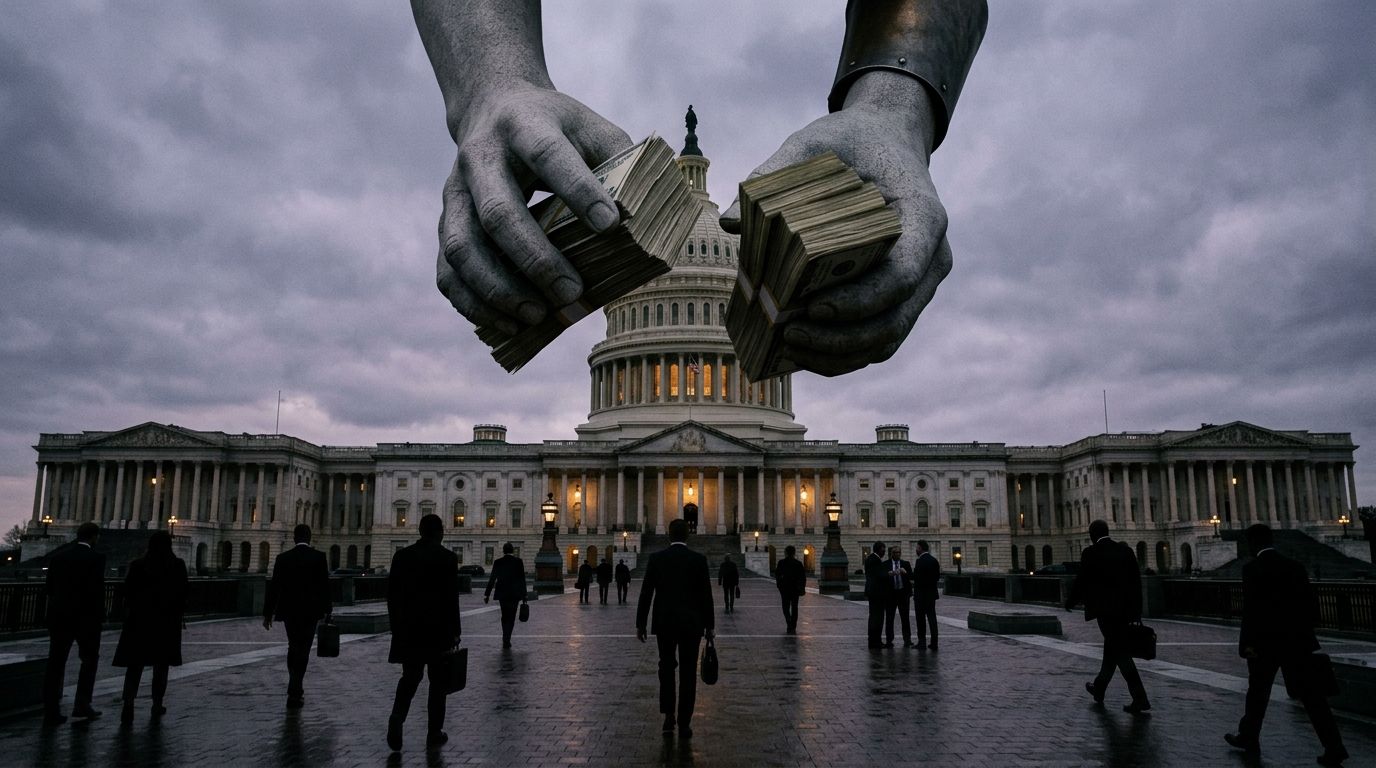
- Total AIPAC spending, 2024 cycle: $126.9 million combined between AIPAC PAC and its super PAC, the United Democracy Project — the largest single-PAC spending operation in the history of congressional elections.
- Jamaal Bowman (D-NY): $14.5 million spent to defeat him in a House Democratic primary — the most ever spent by a single outside group on a House race in U.S. history.
- Cori Bush (D-MO): $8.6–$9 million spent to defeat her in a Democratic primary. Bush had called for a ceasefire in Gaza.
- Reach: AIPAC spent in more than 80% of all congressional races — 389 of 469 seats up for election in 2024.
- The core ethical question: When a single foreign-policy lobby can spend $126.9 million to elect or defeat members of Congress, does the American voter still choose their representative — or does AIPAC?
In 2024, the United States held what was advertised as a democratic election for Congress. Voters went to the polls. Ballots were cast. Winners were certified. But before a single American entered a voting booth, a different election had already largely been decided — one run not by voters but by a single lobbying organization and its billionaire donors, spending money at a scale that rewrote the rules of American political influence.
The American Israel Public Affairs Committee, better known as AIPAC, and its electoral arm, the United Democracy Project, spent a combined $126.9 million on the 2023-2024 congressional election cycle. That figure, documented by the Federal Election Commission, makes AIPAC the largest PAC contributor to federal candidates in the cycle — by a dramatic margin. And the implications of that fact for American democracy, for the independence of the legislative branch, and for the ethics of elected representation deserve far more attention than they are receiving.
How It Works: The Machine
AIPAC's electoral operation functions on two tracks. The first is AIPAC PAC — a traditional political action committee that gives direct "hard money" contributions to candidates' campaigns. In 2024, this vehicle delivered more than $55.2 million in direct contributions to federal candidates, at least $45.2 million of which went to members of the new 119th Congress. The second is the United Democracy Project (UDP), a super PAC that raised $87.2 million in the cycle and spent approximately $61 million in independent expenditures — the unlimited "soft money" unleashed by Citizens United, which can run television ads, digital campaigns, and mailers without coordinating with candidates.
Together, these vehicles gave AIPAC something no other single-issue lobbying group has ever possessed in American politics: the ability to credibly threaten any member of Congress with a seven-figure primary challenge funded by one organization if that member crosses its policy line. You don't need to win every race to reshape every vote. You just need members to believe you can and will spend what it takes to end their careers.
The Executions: Bowman and Bush
The 2024 cycle's most dramatic demonstrations of AIPAC's electoral power came in two Democratic House primaries that became national stories — and cautionary tales for every member of Congress watching.
Rep. Jamaal Bowman of New York's 16th Congressional District — a former middle school principal and member of the progressive "Squad" — was a vocal critic of unconditional U.S. military aid to Israel during the Gaza war. He voted against military aid packages. He called for a ceasefire. He was one of the most outspoken progressive voices on the issue in Congress.
AIPAC's United Democracy Project spent $14.5 million to defeat him in his Democratic primary against Westchester County Executive George Latimer. That $14.5 million figure is not a typo: it is the largest amount any single outside group has ever spent to influence a single U.S. House race in the entire history of American elections. Bowman lost by 17 points.
Weeks later, Rep. Cori Bush of Missouri's 1st Congressional District — the first Black woman elected to Congress from Missouri and another vocal ceasefire advocate — faced a primary challenge backed by $8.6 to $9 million in AIPAC/UDP spending. The money went to Wesley Bell, a county prosecuting attorney with far less name recognition. Bush lost. After her defeat, she told supporters: "AIPAC, I'm coming to tear your kingdom down." She is no longer in Congress.
AIPAC celebrated both victories publicly on X (Twitter), posting its standard victory message: "Being pro-Israel is good policy and good politics!"
The Bipartisan Cover
AIPAC's most effective defensive argument against criticism is its bipartisanship. The organization gave to 233 Republicans totaling more than $17 million and 152 Democrats totaling more than $28 million in the 2024 cycle, along with three independents. It spent in every state except Ohio and touched more than 80% of all congressional seats. When an organization funds members of both parties at that scale, it becomes very difficult for either party to legislate against it — because every member has skin in the game.
But bipartisanship in funding is not the same as neutrality in impact. AIPAC's most aggressive and most publicized spending was overwhelmingly concentrated on removing Democratic progressives who criticized Israel's military conduct in Gaza. The Republicans AIPAC funded were, by and large, already aligned with its positions. The Democrats AIPAC targeted in primaries were specifically those who had exercised their independent legislative judgment on a question of U.S. foreign policy and military spending.
That is not bipartisan influence. That is a systematic campaign to purge one political party of dissenting voices on a single foreign-policy issue.
The Ethical Core: Who Do Elected Representatives Represent?
The foundational ethical question raised by AIPAC's 2024 spending is one that goes to the heart of what representation means. Members of the U.S. House of Representatives are elected to represent the people of their congressional districts. They take an oath to the Constitution. Their votes are supposed to reflect the judgment and interests of their constituents.
When a single outside organization can spend $14.5 million in a House primary — more than the candidate himself can raise — the question of who the winner actually represents becomes genuinely complicated. George Latimer defeated Jamaal Bowman with more outside money than has ever been spent on a House primary in history. He did not raise that money from his constituents. It came overwhelmingly from AIPAC's billionaire donor network — people whose financial interests and foreign-policy preferences do not necessarily align with the residents of Westchester County and the Bronx.
The Supreme Court, in Citizens United v. FEC (2010), held that unlimited independent expenditures cannot legally corrupt a political candidate. The theory is that money spent "independently" — without coordination — does not create the kind of quid pro quo corruption that the Constitution permits Congress to regulate. But the real-world effect of a $14.5 million campaign spending blitz on a House candidate is not theoretical. It sends a message to every member of Congress: vote a certain way on a certain issue, and this will happen to you. The corruption is systemic rather than transactional. And systemic corruption is the kind the First Amendment was not designed to protect.
The STOCK Act Parallel
Congress passed the STOCK Act in 2012 to address concerns about members trading stocks based on non-public information obtained through their legislative work. It imposed disclosure requirements and nominal penalties. It was almost immediately recognized as inadequate — members routinely violated it and paid trivial fines. The Campaign Legal Center has filed 15 complaints representing between $14.3 million and $52.1 million in undisclosed or untimely disclosed stock trades.
The parallel to AIPAC is instructive. In both cases, the fundamental problem is the same: members of Congress are being financially influenced — either through their own trading or through campaign funding — in ways that create structural conflicts between their duty to their constituents and their financial interests or political survival. In both cases, the existing legal framework is insufficient to address the conflict. And in both cases, the members who would need to pass reform legislation are the same members who benefit from the status quo.
The difference is that AIPAC's influence is legal, disclosed, and celebrated by its practitioners. At least stock traders have to hide what they're doing.
The question is not whether AIPAC has the legal right to spend $126.9 million influencing congressional elections. Under current law, it does. The question is whether a democracy in which a single foreign-policy lobby can spend that money — most of it from a small number of billionaire donors — and reshape the composition of Congress in its preferred direction, is functioning as a democracy at all. That is an ethics question. And it is one that elected representatives — the ones who took an oath to the voters, not to AIPAC — need to answer.