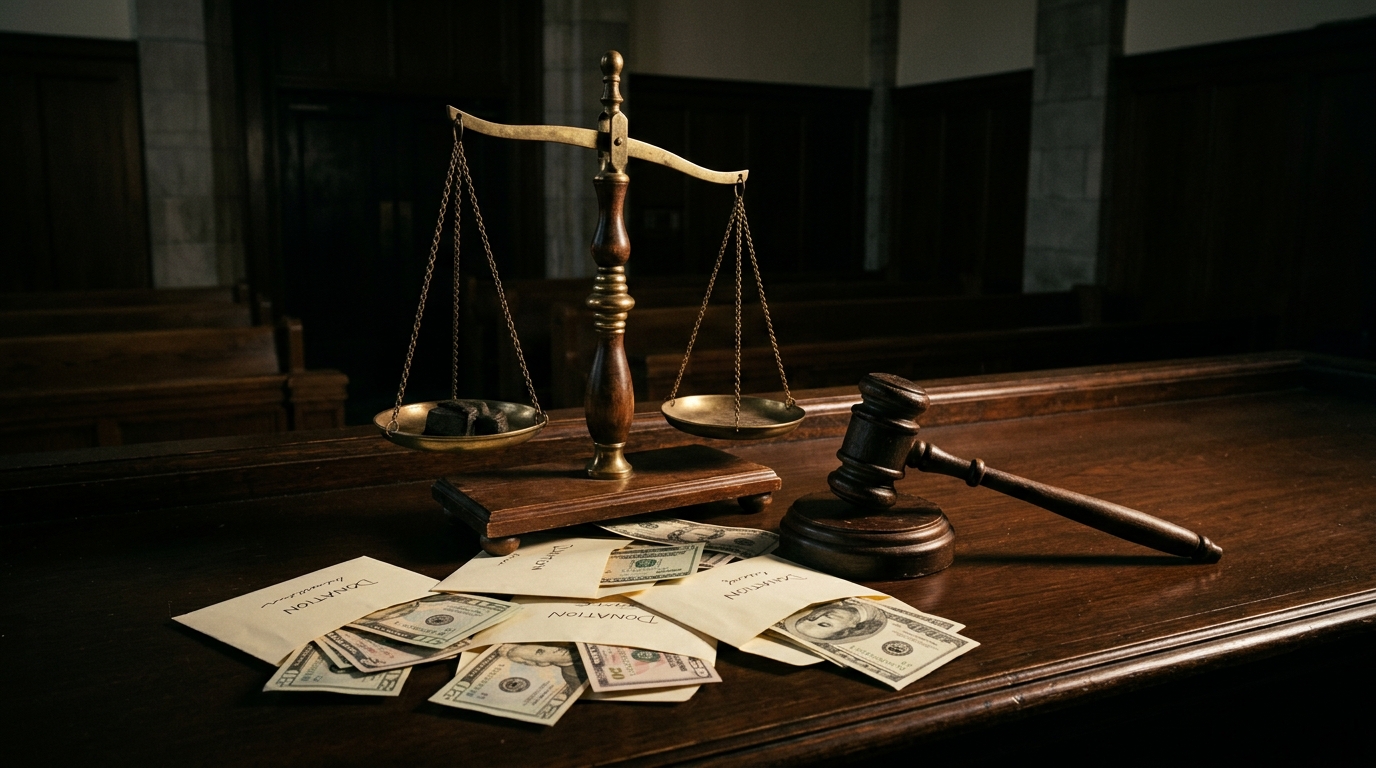
- The scale: 39 U.S. states elect their judges — either through partisan elections, nonpartisan elections, or retention elections. State supreme court spending has reached record levels, with total outside spending in state supreme court races now reaching hundreds of millions of dollars over the past decade.
- The conflict: The lawyers and corporations that donate to judicial campaigns regularly appear before those same judges as litigants. In most states, a judge is not required to recuse from a case involving a donor unless the contribution exceeds a specific dollar threshold — often $2,500 or more.
- The research: Studies find that judges rule in favor of their campaign contributors at statistically significant rates that exceed what chance would predict — particularly in civil cases where large corporate donors have direct financial stakes in the outcome.
- The precedent: In Caperton v. A.T. Massey Coal Co. (2009), the Supreme Court held 5-4 that extreme campaign contributions can create a due process violation requiring recusal. But the standard is narrow and rarely applied.
Imagine you are a litigant in a lawsuit. You are suing a corporation for damages — a personal injury case, a contract dispute, a consumer fraud claim. The case works its way through the court system and eventually reaches the state supreme court for a final ruling. You learn, in the course of your research, that the corporation you are suing contributed $150,000 to the campaign of the justice who will be writing the majority opinion in your case. That justice has declined to recuse. The court rules against you.
In 39 states across the United States, this is not a hypothetical. It is how the judicial system works.
The American experiment in elected judges is one of the most widely criticized institutions in the democratic world. No other advanced democracy holds competitive elections for positions on its highest courts. The practice, which dates to Jacksonian-era reforms designed to make courts more accountable to ordinary citizens, has instead produced a system in which courts are accountable primarily to the organized interests capable of funding the multi-million-dollar campaigns required to win — and keep — a seat on a state supreme court.
The Campaign Finance Reality of State Judicial Elections
The Brennan Center for Justice, which has tracked spending in state supreme court elections since 2000, has documented the steady escalation of campaign spending in judicial races. In 2000, total spending in state supreme court elections was approximately $45 million. By the 2013-2014 cycle, it had exceeded $33 million for that two-year period alone. Recent cycles have continued that upward trajectory, with individual state races regularly reaching into the millions of dollars in outside spending.
The composition of judicial campaign funding is what makes the conflict of interest acute. The largest donors to judicial campaigns are, predictably, the entities with the most at stake in those courts' decisions: plaintiffs' trial lawyers, corporate defense firms, business associations, insurance companies, and the political action committees of industries facing ongoing litigation. In Texas, the civil defense bar and business interests have historically dominated judicial campaign funding, contributing to a state supreme court widely perceived as favorable to corporate defendants. In other states, plaintiffs' trial lawyers dominate, with opposite effects on the court's jurisprudence.
The problem is not that judges are consciously corrupt — taking money in exchange for explicit promises of favorable rulings. The problem is structural. When the people who fund a judge's campaign are the same people who regularly appear before that judge, even an entirely well-intentioned and honest judge faces an impossible situation. Human psychology does not permit clean separation between gratitude toward those who helped you achieve your position and the professional judgments you make in that position. The conflict is not hypothetical — it is inherent.
Caperton v. Massey: The Case That Exposed Everything
The most dramatic illustration of how judicial campaign money corrupts the appearance of justice is the case that ultimately reached the U.S. Supreme Court: Caperton v. A.T. Massey Coal Co. (2009).
The facts are extraordinary. Don Blankenship, the CEO of Massey Coal, had just lost a $50 million verdict against his company in the West Virginia circuit courts. The case was headed to the West Virginia Supreme Court of Appeals. While the case was pending appeal, Blankenship spent approximately $3 million supporting the candidacy of Brent Benjamin, a Republican candidate for the West Virginia Supreme Court — a figure that exceeded the total spent by all other supporters of Benjamin's campaign combined.
Benjamin won. He refused to recuse himself from the Massey Coal case. He then cast the deciding vote in a 3-2 decision that reversed the $50 million verdict against Massey Coal. The company Blankenship controlled saved $50 million. The judge Blankenship funded cast the deciding vote. Benjamin maintained he could be impartial.
The U.S. Supreme Court held, 5-4, that Benjamin's participation in the case violated the plaintiffs' due process rights. Justice Kennedy's majority opinion acknowledged that the probability of actual bias, given the scale and circumstances of Blankenship's contribution, was too high to permit the appearance of impartiality. But the majority was careful to limit the holding to extreme circumstances — the ruling created a constitutional floor for recusal, not a comprehensive solution to the structural problem of judicial campaign finance.
The structural problem remains.
The Recusal Standard That Protects No One
Following Caperton, states have adopted varying recusal standards — but most remain inadequate. Many states require recusal only when a campaign contribution exceeds a specified dollar threshold, typically ranging from $2,500 to $10,000. Below that threshold, a judge may preside over a case involving a donor regardless of how frequently that donor appears before the court, how significant the case is to the donor's financial interests, or how recently the donation was made.
The thresholds are set by the same judicial systems that administer them. The judges who would be required to recuse under stricter standards are the judges (or their colleagues) who interpret and apply those standards. The conflict of interest in setting recusal standards is the same as the conflict of interest in the underlying campaign finance — just one layer more abstract.
States with partisan judicial elections — Texas, Alabama, Louisiana, and others — are particularly vulnerable to the structural problem because the political identity of the judge becomes part of the campaign, which means partisan donors have an explicit ideological stake in the election's outcome. A corporate donor who contributes to a Republican judicial candidate in Texas is not making a neutral civic contribution. They are making a strategic investment in the composition of the court that will hear their cases.
The Reform Blocked by Those Who Benefit
Meaningful reform of judicial campaign finance faces the same structural obstacle as every other electoral ethics reform: the people who would need to enact it are the people who benefit from the current system. State legislatures — themselves funded by many of the same donor networks — have consistently failed to adopt public financing systems for judicial elections, comprehensive recusal requirements, or the most obvious solution: moving to merit-selection systems that remove judges from contested elections entirely.
The American Bar Association, the Brennan Center, and numerous bar associations have for decades recommended merit selection — the system used by the federal courts and by 11 states, in which judges are appointed through a process designed to evaluate legal qualifications rather than campaign fundraising ability. The resistance to merit selection comes from two directions: partisan politicians who want to maintain influence over judicial composition through elections, and the very donor interests that benefit from the current campaign finance system. When the people with the most at stake in a court's decisions are also the people funding judges' campaigns, they have little incentive to support a system that removes their financial influence from the process.
The ethics of elected judgeships are not complicated. A judge who accepts money from lawyers and companies that appear before her is in an inherent conflict of interest. A judge who refuses to recuse from cases involving major donors is compounding that conflict. A system that structurally creates these conflicts — and then provides inadequate mechanisms to address them — is a system that has prioritized the appearance of judicial independence over its substance. And when justice is for sale, it is the people who cannot afford to buy it who pay the highest price.